Key takeaways
- Product pages overtook listicles as the most-cited content format in Google AI Overviews on July 28, 2026, ending the month at 17.9% of daily citations versus 16.2% for listicles, according to Promptwatch's AI Overviews citation data.
- The shift is bigger on ChatGPT: product pages hit 32.8% of July citations there, more than three times listicles' 9.7%.
- This isn't a blip. Product pages were around 9% of AI Overviews citations in January 2026 and have nearly doubled. Listicles fell from roughly 26% in Q1 to 18%.
- Intent still decides what gets cited: listicles win commercial "which should I pick" queries, articles win informational ones, and product pages win transactional and navigational ones.
- The practical move is to treat product pages as citation assets, with structured specs, transparent pricing, and fresh availability data, while keeping listicles in the mix.
What happened in July 2026
For as long as anyone has been tracking AI search citations, one format sat comfortably at the top: the listicle. "Best X for Y" pages, top-N roundups, comparison lists. In Q1 2026, listicles averaged about 26% of all Google AI Overviews citations. Nothing else came close.
In July, that run ended.
Listicles still led the monthly average at 18.0% of daily citations, with product pages at 16.3% and how-tos at 15.1%. But the daily data tells the real story: from July 28 onward, product pages were the most-cited format every single day, and they finished the month at 17.9% against 16.2% for listicles.
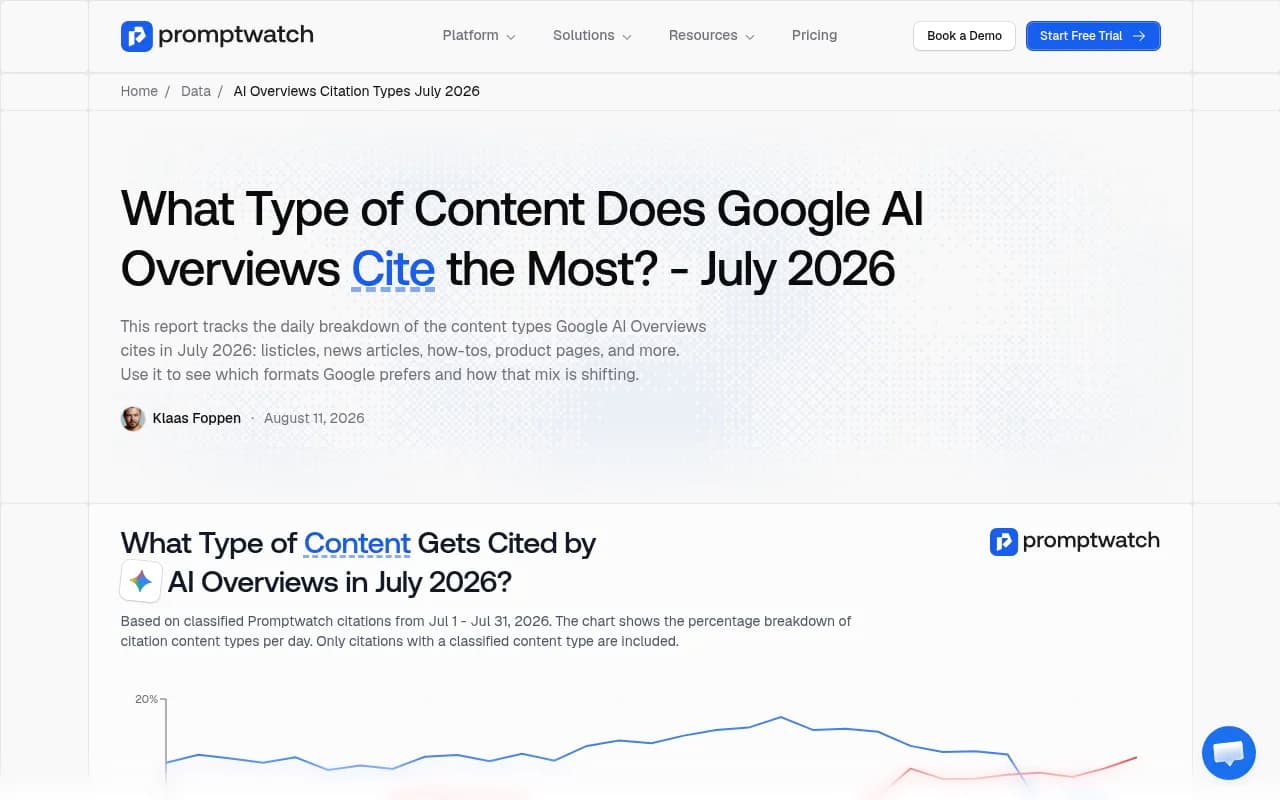
Here's the full July breakdown for AI Overviews:
| Content format | Share of AI Overviews citations (July 2026) |
|---|---|
| Listicle | 18.0% |
| Product page | 16.3% |
| How-to | 15.1% |
| News article | 13.5% |
| Video | 5.9% |
| Social post | 5.1% |
| Landing page | 4.7% |
| Comparison | 3.6% |
A few things strike me about this table. The gap between the top four formats is small, which means AI Overviews is citing a genuinely mixed diet. And video at nearly 6% is quietly becoming a real player, up from around 2.7% in January. More on that later.
The trend started months ago
If you only looked at July, you'd call this a photo finish. Zoom out and it looks like a trajectory.
Product pages sat around 9% of AI Overviews citations in January 2026. By late July they were pushing 18%. That's a near-doubling in seven months, and the curve has been steady rather than spiky, which suggests a systematic change in how Google's AI retrieves and ranks commercial content rather than a one-off algorithm event.
Listicles went the other direction. Roughly 26% in Q1, 18% by July. Still the highest monthly average, still a format worth having, but the lead is shrinking for the first time since Promptwatch started tracking citation types.
ChatGPT got there first, and harder
The AI Overviews crossover is headline-worthy because listicles dominated there for so long. But ChatGPT made the same move earlier and far more dramatically.
In July 2026, product pages took 32.8% of ChatGPT Search citations. Not close to any other format. Listicles managed 9.7%, news articles 5.2%, how-tos 4.1%. Back in March, product pages averaged about 18% on ChatGPT, so the share nearly doubled in four months.
| Format | Google AI Overviews (July 2026) | ChatGPT Search (July 2026) |
|---|---|---|
| Product page | 16.3% | 32.8% |
| Listicle | 18.0% | 9.7% |
| News article | 13.5% | 5.2% |
| How-to | 15.1% | 4.1% |
| Video | 5.9% | 0.1% |
Two engines, same direction, different magnitudes. That pattern matters because it points to something bigger than a Google quirk: AI search as a whole is warming to brand-owned commercial pages. When someone asks an assistant "how much does X cost" or "is X available in Europe," the assistant increasingly goes straight to the source rather than routing through a third-party roundup.
There's a wrinkle, though. Within July itself, listicles were the fastest-growing format on ChatGPT, climbing from about 8% on July 1 to over 10% by month-end. So the story isn't "product pages up, everything else dead." It's "product pages way up, listicles compressed but still climbing from a smaller base."
Why this is happening
Intent decides what gets cited
The best explanation for the format shift comes from a Wix Studio AI Search Lab study of 75,000 AI answers and over a million citations across ChatGPT, Google AI Mode, and Perplexity. Their finding: query intent predicts which content type gets cited more strongly than industry or which model is answering.
The intent breakdown from that study:
- Informational queries: articles dominate at 45.5%, listicles at 21.7%, product pages just 3.5%
- Commercial queries: listicles lead at 40.9%, nearly double any other format's top performer
- Transactional queries: product pages at 24.9%, listicles at 16.9%
- Navigational and local queries: product pages at 22.0%, category pages at 18.3%
So the formats haven't swapped jobs. Listicles still win the "which should I pick" searches, and articles still win deep informational questions. What changed is the mix of queries hitting AI search. As people shift from researching in Google and buying on websites to asking assistants transactional questions directly, transactional and navigational queries have grown, and product pages rose with them.
Ranking alone stopped being enough
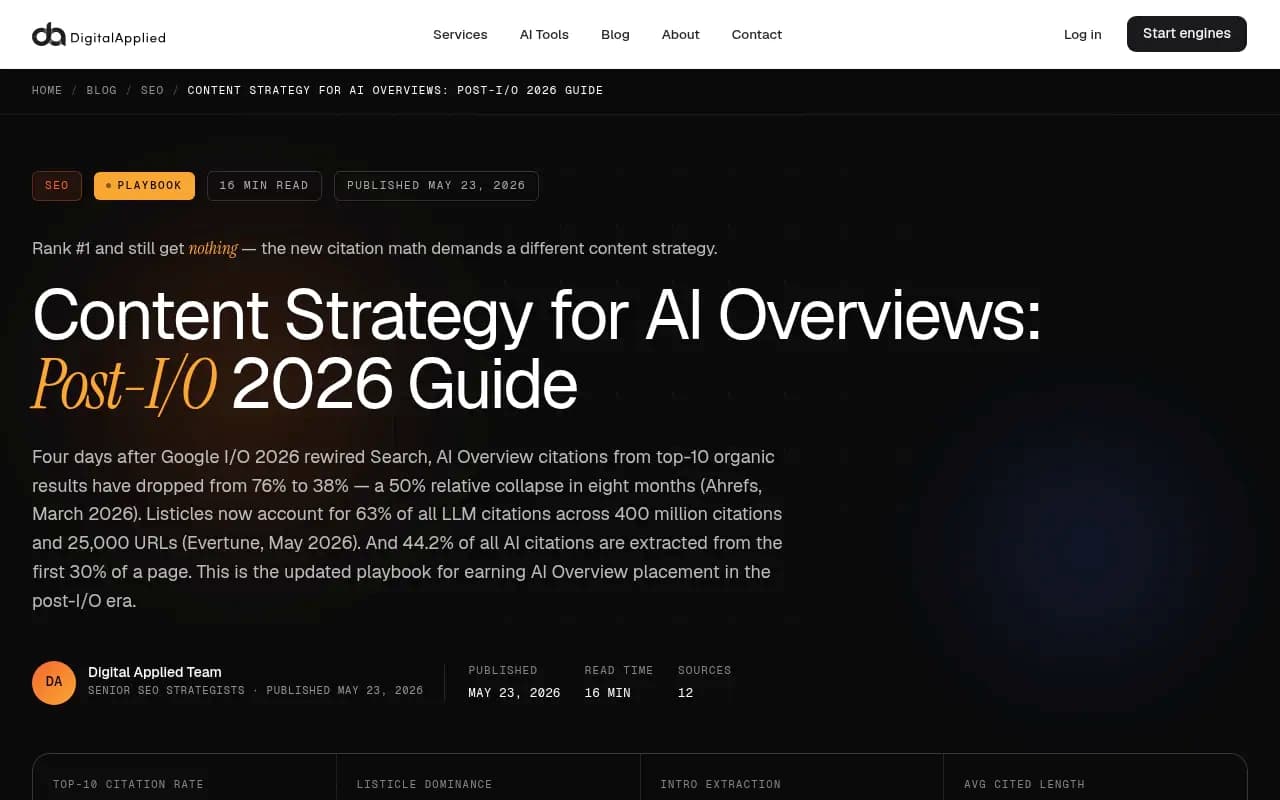
There's a second force at work. Ahrefs found that AI Overview citations coming from top-10 organic results dropped from 76% in July 2025 to 38% by March 2026. Half the citation supply moved off the first page of traditional rankings.
That decoupling means Google's AI is selecting sources on relevance and extractability, not just position. A well-structured product page with clean specs, clear pricing, and current availability is exactly the kind of page an extraction pipeline loves: short factual claims, unambiguous numbers, easy to verify.
AI Overviews has more slots to fill
One more mechanical detail worth knowing: AI Overviews cites roughly 10 sources per answer, about double ChatGPT's 5, and it's been remarkably stable at that level. More slots means more chances for mid-authority domains to break in, and it means the citation mix can diversify faster than on a stingier engine. Product pages filling those extra slots fits that picture.
How to optimize product pages for citations
If product pages are now the most-cited format, they deserve the same optimization attention you'd give editorial content. Most product pages are built for conversion, not extraction. Here's what the evidence says to fix.
Get your data parity right
This is the hard gate. If your JSON-LD schema says one price and the visible page shows another, or your structured data says "in stock" while the page says "backordered," citation probability drops. ChatGPT and Claude both penalize inconsistency between markup and page content. Audit this regularly, because pricing and stock drift fast.
For Product schema, cover the fields that matter: name, price with currency, availability, GTIN or MPN, AggregateRating (only if reviews are actually displayed on the page), and hasMerchantReturnPolicy with the country field, which Google currently requires.
Put specs where extraction can find them
Keep two or three category-defining specs, like waterproof rating or battery life, repeated both above the fold and in a proper spec table. Clean nouns and numbers get extracted far more reliably than narrative copy. "Battery life: 18 hours" beats a paragraph about staying powered through your day.
Structure for extraction
A SE Ranking study found pages with 120 to 180 word sections between headings average 4.6 ChatGPT citations, versus 2.7 for sections under 50 words. Longer content (2,900+ words) averaged 5.1 citations versus 3.2 for sub-800-word pages. And page speed correlates too: fastest-loading pages averaged 6.7 citations versus 2.1 for the slowest. Chunky, well-organized, fast pages win.
One counterintuitive finding from a July 2026 audit of 60 pages ranking for AI search queries: HowTo schema appeared on 0% of top-3 pages, and FAQPage on just 10%. The commonly repeated advice to slap FAQ schema everywhere doesn't match what top performers actually do. What they do carry is a median of 5 distinct schema types, with Article, BreadcrumbList, and Organization leading.
Add media with quotable text
Lead with a "what it is" product photo, and if you have a demo video, put its transcript on the page. Transcripts give assistants quotable text, and video citation share keeps climbing, reaching almost 6.3% of AI Overviews citations by late July. YouTube alone accounts for about 4.1% of all AI Overviews citations, ahead of Reddit at 2.7%. Most brands have zero video assets competing for those slots, which makes this one of the least contested lanes in AI search right now.
If you run an ecommerce store and want help systematizing this kind of product page optimization, tools like ConvertMate focus specifically on SEO for product catalogs.
Don't abandon listicles
The worst possible reaction to this data is deleting your listicle strategy. Listicles still hold the highest monthly average share in AI Overviews, they're the fastest-growing format on ChatGPT within July, and they own commercial-intent queries outright at 40.9% of citations in the Wix study.
One nuance from that study worth internalizing: in professional services, 80.9% of listicle citations went to third-party, neutral lists, while only 19.1% went to self-promotional ones where a brand ranks itself first. AI systems prefer editorial comparisons over brand-led rankings. So your listicle play is partly a PR and placement game: getting featured in other people's roundups matters as much as publishing your own.
The balanced portfolio looks like this:
| Query intent | Format to invest in | July 2026 status |
|---|---|---|
| Informational ("what is X") | Articles | Stable, 45.5% of informational citations |
| Commercial ("best X for Y") | Listicles | Compressed but still leading monthly average |
| Transactional ("buy X", "X price") | Product pages | Fastest-growing, now #1 daily |
| Navigational/local | Product and category pages | Strong and rising |
| Demonstrations and reviews | Video | Small share, fast growth, low competition |
How to know if it's working
Format strategy only pays off if you can see which of your pages actually get cited, and most analytics setups are blind to this. A platform like Promptwatch tracks citation share by page type across AI Overviews, AI Mode, ChatGPT, Perplexity, and the other major engines, so you can watch whether your product pages are actually picking up citations as you optimize them, and compare your format mix against competitors.

If you're evaluating options in this category more broadly, the GEO software directory at bestgeosoftware.com covers the full landscape of AI visibility platforms.
What to do this month
- Audit your top product pages for schema parity: does markup match visible price and stock?
- Add or clean up spec tables on your highest-traffic product pages, with the key specs repeated above the fold.
- Check page speed on product templates; the citation gap between fast and slow pages is larger than most content improvements can deliver.
- Keep publishing listicles for commercial queries, and pitch third-party roundups in your category, since neutral lists get cited four times more than self-promotional ones.
- Stand up at least one video asset with an on-page transcript while the competition for video citations is still thin.
The July crossover might reverse next month, or it might accelerate. Either way, the direction of travel is clear enough to act on: brand-owned commercial pages are now first-class citizens in AI search citations, and most companies are still treating them as conversion-only assets. That gap between how product pages are built and how they're now being cited is the opportunity.