Key Takeaways
- AI search adoption is accelerating: 50% of consumers already use AI-powered search in 2026, and research suggests AI could overtake traditional search traffic entirely by mid-2028
- Compute scaling drives everything: Leading AI models in 2030 will be trained with 1,000x the compute of today's models, enabling superhuman capabilities across coding, research, and content generation
- Work transformation is inevitable: By 2030, 75% of IT work will be done by humans augmented with AI, 25% by AI alone, and 0% by humans without AI assistance
- Revenue impact is massive: McKinsey estimates AI search could impact $750 billion in revenue by 2028, forcing brands to rethink their entire digital presence strategy
- The window to adapt is narrow: Organizations that don't optimize for AI visibility now risk becoming invisible to the next generation of search users
Introduction: The Search Revolution Nobody Saw Coming
When OpenAI launched ChatGPT in November 2022, most marketers dismissed it as a novelty. Three years later, the landscape has shifted so dramatically that CEOs at OpenAI, Google DeepMind, and Anthropic are all predicting AGI (Artificial General Intelligence) will arrive by 2027-2030.
This isn't science fiction. It's happening right now, backed by concrete data trends and massive investment. According to McKinsey, half of all consumers are already using AI-powered search today, and the technology could impact $750 billion in revenue by 2028.
The question isn't whether AI search will dominate—it's whether your brand will be visible when it does.
What Industry Leaders Are Predicting
The AI 2027 Scenario: Superhuman AI Within 24 Months
The AI 2027 project, backed by forecasting research and expert feedback from OpenAI veterans, paints a concrete picture of what's coming. Their central prediction: by early 2027, AI will achieve superhuman coding abilities. By mid-2027, it will become a superhuman AI researcher.
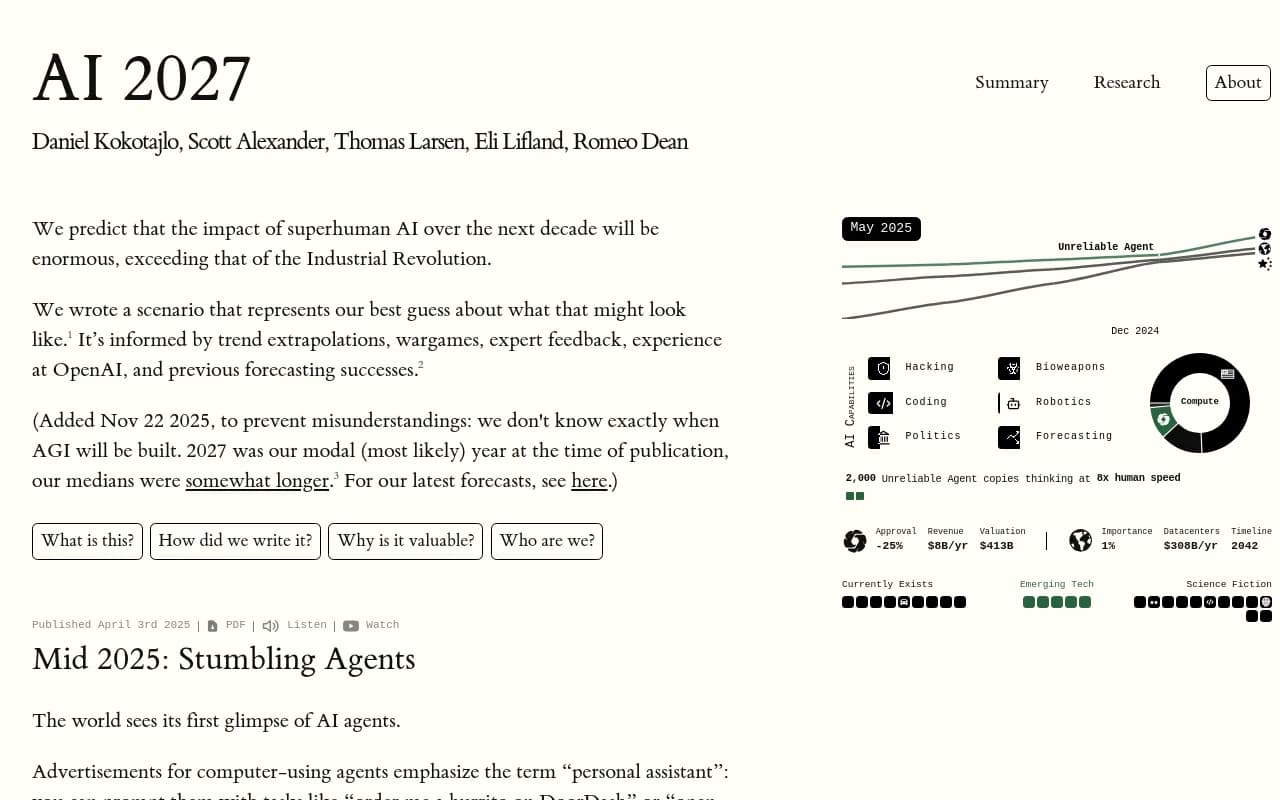
The authors deliberately wrote two endings—a "slowdown" scenario and a "race" scenario—to explore different paths forward. But both scenarios agree on the fundamental trajectory: the impact of superhuman AI over the next decade will exceed that of the Industrial Revolution.
This isn't hyperbole. When AI systems can outperform human experts in coding, research, and content creation, the entire knowledge economy gets restructured. Search—the gateway to that knowledge—transforms first.
Gartner: Zero Human Work Without AI by 2030
Gartner's November 2025 survey of over 700 CIOs revealed a stunning consensus about the future of work. By 2030, CIOs expect:
- 0% of IT work will be done by humans without AI
- 75% of IT work will be done by humans augmented with AI
- 25% of IT work will be done by AI alone
This has direct implications for search. If AI touches 100% of IT work, it will certainly touch 100% of how people find information. The traditional Google search box—type query, scan ten blue links—becomes a relic of the pre-AI era.
Gartner's research also highlights a critical gap: while AI readiness is improving, human readiness lags far behind. Organizations know AI can help them find value, but they lack the workforce transformation needed to capture and sustain that value. The same dynamic applies to search visibility: brands know AI search matters, but most haven't restructured their content strategy to win in this new environment.
Epoch AI: 1,000x Compute Scaling by 2030
Epoch AI's commissioned report for Google DeepMind provides the most detailed technical forecast available. Their core prediction: leading AI models in 2030 will be trained with 1,000x the compute of today's leading models.
This exponential scaling has cascading effects across:
- Training compute: Growing from today's ~10^25 FLOPs to ~10^28 FLOPs by 2030
- Inference compute: Enabling real-time, multi-step reasoning at massive scale
- Investment: Requiring hundreds of billions in capital expenditure
- Data: Consuming essentially all high-quality text data available on the internet
- Energy: Demanding new power infrastructure and potentially nuclear energy solutions
For search, this means AI models will have near-perfect recall of human knowledge, sophisticated reasoning capabilities, and the ability to synthesize answers from millions of sources in milliseconds. Traditional keyword matching becomes obsolete. Brands that rank in AI search will be those that provide authoritative, well-structured, citation-worthy content—not those that game algorithms.
McKinsey: $750 Billion Revenue Impact by 2028
McKinsey's research on AI search provides the clearest picture of the business stakes. Their analysis shows:
- 50% of consumers are already using AI-powered search in 2026
- AI search could impact $750 billion in revenue by 2028
- The shift represents a "new front door to the internet"
This isn't about incremental changes to SEO strategy. It's about a fundamental restructuring of how consumers discover brands, evaluate options, and make purchase decisions. When ChatGPT recommends three CRM platforms, the brands it doesn't mention effectively don't exist.
McKinsey's framework emphasizes that winning in AI search requires a "gen AI engine optimization" strategy—not just monitoring where you appear, but actively optimizing content, citations, and authority signals to influence AI recommendations.
Semrush Forecast: AI Overtakes Traditional Search by Mid-2028
Research from Semrush predicts that AI-powered search could overtake traditional search traffic entirely by the first half of 2028. This timeline aligns with broader adoption curves and the exponential improvement in AI model capabilities.
The implications are stark: if AI search becomes the dominant mode of information discovery within 18-24 months, brands have a narrow window to establish visibility. Early movers who optimize for AI citations, build authoritative content, and structure data for AI consumption will capture disproportionate market share.
The Technical Foundation: Why This Is Inevitable
Compute Scaling Drives Capability Improvements
The Epoch AI report makes clear that compute scaling is the primary driver of AI progress. Every 10x increase in compute has historically produced measurable improvements in:
- Language understanding and generation
- Reasoning and problem-solving
- Multi-step task completion
- Factual accuracy and citation quality
This relationship has held remarkably stable across multiple generations of models. Extrapolating forward, the 1,000x compute increase predicted by 2030 will enable AI systems that are genuinely superhuman in many domains.
For search, this means AI models will:
- Understand user intent with near-perfect accuracy
- Synthesize information from millions of sources in real-time
- Provide personalized, context-aware answers
- Cite authoritative sources and explain reasoning
- Handle complex, multi-part queries that would stump traditional search
Data Constraints and the Race for Quality Content
One critical constraint identified by Epoch AI: by 2030, AI training will have consumed essentially all high-quality text data available on the internet. This creates a "data wall" that could slow progress—or accelerate the race for proprietary, high-quality content.
For brands, this presents an opportunity. Content that is:
- Authoritative and well-researched
- Structured for machine readability
- Regularly updated with fresh insights
- Cited by other authoritative sources
...will become increasingly valuable as AI models compete for training data. The brands that invest in creating this content now will be the ones AI models cite in 2027-2030.
Energy and Infrastructure Challenges
The Epoch AI report also highlights energy as a potential bottleneck. Training models with 1,000x more compute requires massive power infrastructure—potentially including new nuclear plants or renewable energy installations.
This has implications for which companies can compete in the AI search space. Only organizations with access to enormous capital and energy resources will be able to train frontier models. This suggests consolidation around a small number of dominant AI search engines (OpenAI/ChatGPT, Google/Gemini, Anthropic/Claude, Perplexity, Meta/Llama) rather than fragmentation.
For brands, this means optimizing for 5-10 major AI search engines, not hundreds. The playbook is different from traditional SEO, but it's manageable.
What This Means for Brands and Marketers
The Visibility Crisis: Ranking in AI Search
Traditional SEO focused on ranking in the top 10 results for target keywords. AI search collapses this to a single synthesized answer, often citing 3-5 sources. If your brand isn't one of those sources, you're invisible.
This creates a winner-take-most dynamic. The brands that AI models cite will capture the majority of traffic and conversions. Everyone else gets nothing.
Tools like Promptwatch help brands understand where they're visible in AI search and where they're missing. But visibility tracking is just the first step. The real challenge is optimization.
Content Strategy for AI Search
Winning in AI search requires a fundamentally different content approach:
-
Authority over volume: AI models prioritize authoritative, well-researched content over keyword-stuffed articles. One comprehensive guide beats ten thin blog posts.
-
Structure for machine readability: Use clear headings, lists, tables, and schema markup. AI models parse structured content more effectively than walls of text.
-
Citations and references: Link to authoritative sources. AI models evaluate content based on citation networks, not just keyword density.
-
Freshness and updates: Regularly update content with new data, insights, and examples. AI models favor recent, accurate information.
-
Answer real questions: Use tools like AlsoAsked or AnswerThePublic to identify the actual questions your audience asks, then answer them comprehensively.
The Action Loop: Find Gaps, Create Content, Track Results
The most effective AI search optimization follows a continuous improvement cycle:
-
Find the gaps: Identify prompts where competitors are visible but you're not. Understand what content is missing from your site.
-
Create content that ranks: Generate articles, guides, and comparisons grounded in real citation data and prompt analysis. This isn't generic SEO filler—it's content engineered to get cited by AI models.
-
Track the results: Monitor visibility scores across AI engines. See which pages are being cited, how often, and by which models. Connect visibility to actual traffic and revenue.
This cycle—find gaps, generate content, track results—is what separates optimization platforms from monitoring-only tools. Most competitors stop at step one. The winners close the loop.
Multi-Engine Optimization
Unlike traditional SEO where Google dominates with 90%+ market share, AI search is fragmented across multiple engines:
- OpenAI/ChatGPT
- Google AI Overviews and Gemini
- Anthropic/Claude
- Perplexity
- Meta/Llama
- Microsoft/Copilot
- Grok
- DeepSeek
- Mistral
Each engine has different citation preferences, data sources, and ranking signals. Effective optimization requires tracking visibility across all major engines and tailoring content accordingly.
Industry-Specific Predictions
E-Commerce and Product Discovery
ChatGPT Shopping and similar features are already changing how consumers discover products. By 2028-2030, AI search will likely become the dominant product discovery channel, replacing both traditional search and social media.
Brands that optimize product descriptions, reviews, and comparison content for AI citations will capture disproportionate market share. Those that don't will become invisible.
B2B and Professional Services
B2B buyers are already using AI search to research vendors, compare solutions, and evaluate options. By 2030, AI-powered research will be the norm for enterprise purchasing decisions.
B2B brands need to ensure their thought leadership content, case studies, and technical documentation are structured for AI consumption. The brands that AI models cite as authorities will win the majority of inbound leads.
Healthcare and Medical Information
AI search has particular implications for healthcare. Patients already use AI to research symptoms, treatments, and providers. By 2030, AI-powered medical information will be ubiquitous.
Healthcare organizations must ensure their content meets the highest standards of accuracy, authority, and citation quality. The stakes—both for patient outcomes and organizational reputation—are enormous.
Education and Research
Academic research is being transformed by AI. By 2030, AI systems will be superhuman researchers, capable of synthesizing insights across millions of papers and identifying novel research directions.
Educational institutions and research organizations need to optimize their publications, datasets, and documentation for AI consumption. The institutions that AI models cite will shape the next generation of research.
Risks and Challenges
The Hallucination Problem
AI models sometimes generate plausible-sounding but factually incorrect information. As AI search becomes more dominant, the risk of widespread misinformation increases.
Brands need to monitor not just where they're cited, but what AI models say about them. Tools that track hallucinations and incorrect citations will become essential.
Bias and Fairness
AI models reflect the biases present in their training data. If certain brands, perspectives, or communities are underrepresented in training data, they'll be underrepresented in AI search results.
Addressing this requires both technical solutions (better training data, bias detection) and policy solutions (transparency requirements, fairness audits).
Concentration of Power
The energy and compute requirements for frontier AI models mean only a handful of organizations can compete. This concentration of power raises concerns about monopolistic behavior, censorship, and lack of accountability.
Regulatory frameworks will likely emerge by 2028-2030 to address these concerns, but the shape of that regulation remains uncertain.
The Data Wall
As noted earlier, AI training is consuming all available high-quality text data. By 2030, models may hit a "data wall" that limits further progress.
This could slow the pace of AI search improvement—or accelerate the race for proprietary, high-quality content. Either way, brands that create authoritative content will be better positioned.
Preparing for 2027-2030: Action Steps
1. Audit Your Current AI Visibility
Start by understanding where you're visible (or invisible) in AI search today. Track your brand mentions across ChatGPT, Perplexity, Claude, Gemini, and other major engines.
Identify the prompts where competitors are cited but you're not. These gaps represent your biggest opportunities.
2. Restructure Content for AI Consumption
Review your existing content and optimize it for AI citations:
- Add clear headings and structure
- Include data, statistics, and concrete examples
- Link to authoritative sources
- Update outdated information
- Add schema markup and structured data
3. Create New Content Based on Citation Data
Use prompt analysis and citation data to identify high-value content opportunities. Focus on:
- Comprehensive guides that answer multiple related questions
- Comparison articles that help users evaluate options
- Data-driven research that provides unique insights
- Case studies and examples that demonstrate expertise
4. Monitor AI Crawler Behavior
Track which AI crawlers are visiting your site, which pages they're reading, and how often they return. Fix any crawling errors or indexing issues that prevent AI models from discovering your content.
5. Build a Citation Network
AI models evaluate authority based on citation networks. Build relationships with other authoritative sites in your industry. Guest post, collaborate on research, and earn citations from trusted sources.
6. Track and Iterate
Monitor your visibility scores over time. See which content improvements drive the biggest gains. Double down on what works and cut what doesn't.
This is a continuous process, not a one-time project. The brands that win in AI search will be those that treat optimization as an ongoing discipline.
Conclusion: The Window Is Closing
The predictions from industry leaders are remarkably consistent: AI search will dominate by 2028-2030, driven by exponential compute scaling and rapid capability improvements. The revenue impact will be measured in hundreds of billions of dollars. The workforce transformation will touch every industry.
For brands, the window to establish AI visibility is narrow—perhaps 18-24 months. Early movers who optimize now will capture disproportionate market share. Late movers will struggle to catch up.
The good news: the playbook for AI search optimization is becoming clear. It's not about gaming algorithms or keyword stuffing. It's about creating authoritative, well-structured, citation-worthy content that AI models want to reference.
The brands that invest in this approach today will be the ones AI models cite in 2027-2030. The brands that wait will be invisible.
The future of search is here. The question is whether you'll be visible in it.