Key Takeaways
- The spam wave peaked in Q2-Q3 2025: Google's March 2025 core update and subsequent AI content crackdown decimated thousands of sites relying on low-quality, AI-generated content
- Traditional SEO traffic collapsed by 34.5%: AI Overviews and answer engines fundamentally changed how users consume search results, reducing organic clicks to traditional blue links
- The casualties were predictable: Affiliate sites, thin content farms, and brands that prioritized volume over value saw 60-90% traffic drops
- Winners adapted to AI search: Brands that pivoted to Generative Engine Optimization (GEO) and focused on authoritative, cited content maintained or grew their visibility
- 2026 is about recovery and reinvention: The lessons from 2025's spam purge are reshaping how marketers approach content, with AI visibility platforms becoming essential infrastructure
The Perfect Storm: How 2025 Became SEO's Reckoning
2025 didn't start with a bang—it started with a whisper. By January, the signs were already there: Google's AI Overviews were appearing on 40% of searches, ChatGPT had crossed 200 million weekly active users, and Perplexity was processing over 500 million queries per month. Traditional search was being quietly displaced by AI-powered answer engines.
But the real catalyst came in March 2025, when Google launched what many SEOs now call "The Great Purge"—a core algorithm update specifically targeting AI-generated spam. The update was ruthless. Sites that had been churning out hundreds of thin, keyword-stuffed articles using tools like Jasper, Copy.ai, and ChatGPT saw their traffic evaporate overnight.
The Timeline: Month by Month
January 2025: Early warning signs emerge. Google begins testing more aggressive AI Overview placements. Studies show that 80% of consumers now rely on AI-generated results for at least 40% of their searches.
March 2025: The March Core Update drops. Google explicitly states it's targeting "scaled content abuse"—a thinly-veiled reference to AI spam. Sites lose 50-80% of their rankings within 72 hours.
May 2025: The second wave hits. Google introduces real-time content quality scoring using its Gemini models. Sites with high AI-detection scores start getting filtered from results entirely.
July 2025: ChatGPT launches its shopping features and product recommendations. Brands that aren't being cited by AI models realize they're invisible to a growing segment of buyers.
September 2025: Google AI Overviews expand to 70% of queries. Organic click-through rates on the top result drop by an average of 34.5%. The era of "10 blue links" is effectively over.
November 2025: The dust settles. Marketers begin calling 2025 "the year SEO died"—though what really died was the old playbook of keyword stuffing and content farms.
The Casualties: Who Got Hit Hardest
The spam wave didn't discriminate, but it did have clear patterns. Here's who suffered the most:
1. Affiliate Content Farms
Sites built entirely on "best X for Y" listicles—especially those using AI to generate dozens of variations—were decimated. These sites had been gaming Google's algorithm for years by targeting low-competition, high-volume keywords. The March update specifically targeted this pattern.
Example: A network of 50+ affiliate sites generating $2M/month in revenue saw traffic drop 87% within two weeks. The sites were producing 200+ articles per day using AI, with minimal human oversight.
2. Thin Content Publishers
News aggregators, content scrapers, and sites that republished press releases with minimal original commentary got hammered. Google's update prioritized "unique value"—something these sites couldn't provide.
3. Over-Optimized Niche Sites
Small niche sites that had been following the "SEO playbook" to the letter—keyword density, internal linking, meta descriptions—found that the playbook was now a liability. Google's AI could detect over-optimization patterns that human reviewers missed.
4. Brands That Ignored AI Search
Perhaps most surprisingly, established brands that had strong traditional SEO but zero presence in AI search engines suffered too. As users shifted to ChatGPT and Perplexity for research, these brands became invisible. They were still ranking #1 on Google—but fewer people were searching on Google.
The Survivors: What They Did Differently
Not everyone lost. Some brands and publishers actually grew their traffic in 2025. Here's what separated winners from losers:
1. They Invested in Original Research and Data
Sites that published original studies, surveys, and proprietary data became citation magnets for AI models. ChatGPT, Claude, and Perplexity all prioritize authoritative sources with unique information.
Example: A B2B SaaS company that published quarterly industry benchmark reports saw their AI visibility increase 340% while their Google traffic only dropped 15%. They became the go-to source for AI models answering questions in their niche.
2. They Optimized for Citations, Not Just Rankings
The smartest marketers realized early that AI search is fundamentally different from traditional search. Instead of optimizing for "rank #1 on Google," they optimized for "get cited by ChatGPT."
This meant:
- Creating content that directly answers questions AI models are trained to respond to
- Structuring information in ways that LLMs can easily parse and cite
- Building authority signals (backlinks, brand mentions, Reddit discussions) that AI models use to evaluate source credibility
Platforms like Promptwatch became essential for tracking which content was being cited by AI models and identifying gaps in visibility.

3. They Embraced Generative Engine Optimization (GEO)
As Forbes reported in August 2025, "Move over Search Engine Optimization (SEO), the new must-have marketing strategy is Generative Engine Optimization (GEO)."
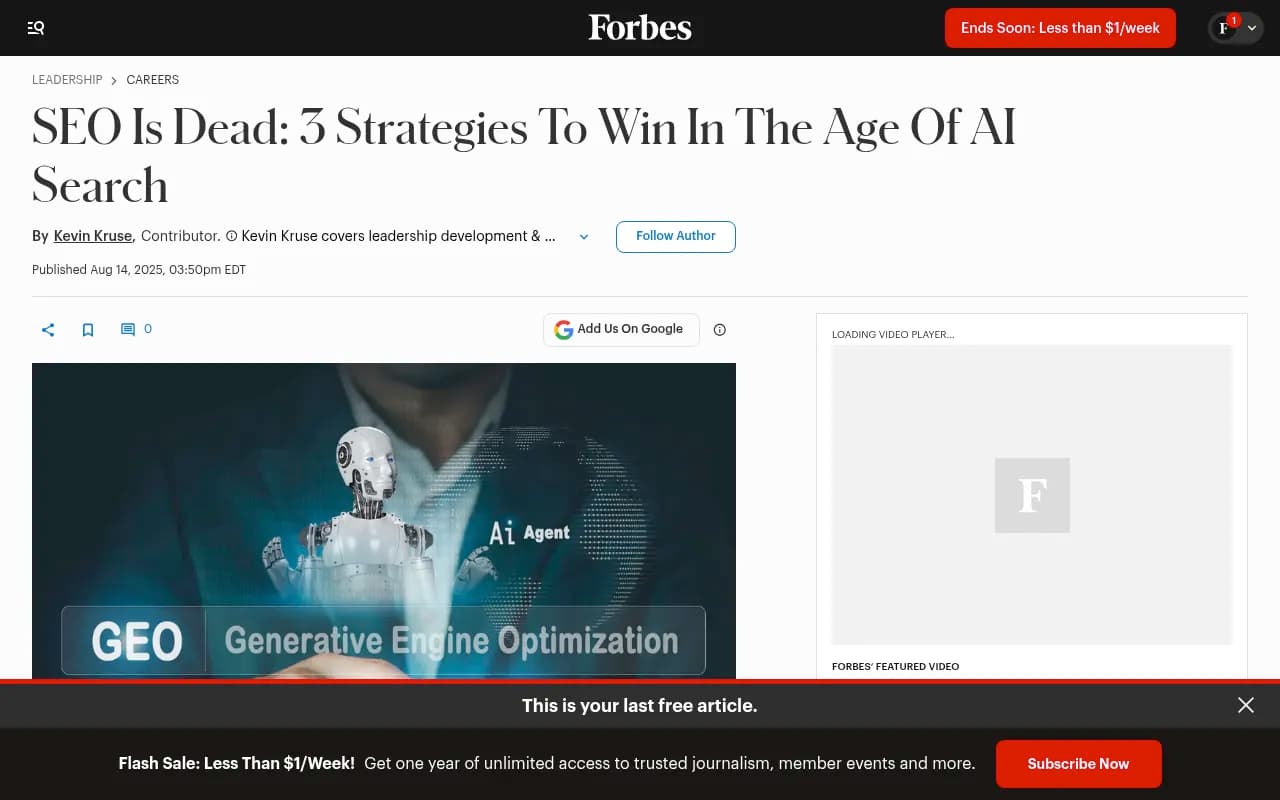
GEO isn't just SEO with a new name—it's a fundamentally different approach:
- Traditional SEO: Optimize for keywords, backlinks, and Google's algorithm
- GEO: Optimize for how AI models discover, evaluate, and cite your content
The brands that pivoted to GEO in early 2025 were the ones still standing by year-end.
4. They Focused on E-E-A-T at Scale
Google's emphasis on Experience, Expertise, Authoritativeness, and Trustworthiness (E-E-A-T) became non-negotiable in 2025. But the winners didn't just add author bios and credentials—they built entire content operations around demonstrating expertise.
This meant:
- Publishing fewer, higher-quality articles
- Featuring real subject matter experts, not just staff writers
- Building topical authority through comprehensive coverage of specific niches
- Earning citations from other authoritative sources
The Shift to AI Search: What Changed in 2025
The spam wave was just one part of a larger transformation. Here's what fundamentally changed about how people search:
1. Agentic Commerce Emerged
AI stopped being just an "answer engine" and became an "executive assistant." By late 2025, ChatGPT and other AI models weren't just telling users which running shoes were best—they were finding sizes, applying coupons, and executing checkouts.
For marketers, this meant optimizing for machine readability and API compatibility, not just human clicks.
2. Personalization Became the Default
AI search results are inherently personalized. ChatGPT remembers your preferences, Perplexity learns from your search history, and Google's AI Mode adapts to your context. This made traditional "one-size-fits-all" SEO strategies obsolete.
3. The Death of the Click
With AI Overviews reducing clicks to the top organic result by 34.5%, the entire economics of content marketing shifted. Brands that relied on ad revenue from organic traffic had to find new business models.
But here's the twist: the traffic that did come from AI search converted 7x higher than traditional Google traffic. Why? Because AI models pre-qualified users by answering their basic questions first. The people who clicked through were ready to buy.
4. Reddit and YouTube Became Citation Goldmines
AI models increasingly cited Reddit discussions and YouTube videos as sources. Brands that had ignored these platforms suddenly realized they were missing massive visibility opportunities.
Smart marketers started:
- Participating authentically in Reddit communities
- Creating educational YouTube content that AI models could reference
- Monitoring which discussions were being cited by AI engines
Lessons for 2026: How to Win in AI Search
If 2025 was the warning shot, 2026 is the year to act. Here's what you need to do:
1. Audit Your AI Visibility
You can't optimize what you don't measure. Start tracking:
- Which prompts trigger mentions of your brand across ChatGPT, Claude, Perplexity, and Google AI Overviews
- Which competitors are being cited instead of you
- Which content gaps are preventing you from being cited
Tools like Promptwatch provide answer gap analysis that shows exactly which prompts competitors are visible for but you're not—and what content you need to create to close those gaps.
2. Create Content That AI Models Want to Cite
Not all content is created equal in the eyes of AI. To get cited, your content needs:
- Authoritative sources: Original research, expert quotes, proprietary data
- Clear structure: Headings, lists, and formatting that LLMs can easily parse
- Comprehensive coverage: In-depth answers that address the full question, not just surface-level information
- Recency: AI models prioritize recent information for time-sensitive queries
3. Monitor AI Crawler Activity
AI models don't discover your content through backlinks—they discover it through crawlers. GPTBot (OpenAI), ClaudeBot (Anthropic), and PerplexityBot are constantly scanning the web.
You need to:
- Track which pages these crawlers are visiting
- Identify and fix crawl errors that prevent AI models from accessing your content
- Optimize your robots.txt and crawl budget for AI bots
Most traditional SEO tools don't track AI crawler activity. Platforms built for AI search visibility—like Promptwatch—provide real-time crawler logs showing exactly which AI engines are reading your site and what they're finding.
4. Build a Multi-Platform Presence
AI search isn't just about your website. It's about your entire digital footprint:
- Reddit: Where are people discussing your brand or industry? Are you part of those conversations?
- YouTube: Are you creating educational content that AI models can reference?
- Podcasts: Audio content is increasingly being transcribed and indexed by AI models
- Social media: Brand mentions and discussions influence how AI models perceive your authority
5. Invest in Prompt Intelligence
Not all prompts are created equal. Some have high volume but low conversion. Others have low volume but represent high-intent buyers.
Prompt intelligence means:
- Understanding which prompts your target audience is actually using
- Prioritizing high-value, winnable prompts over vanity metrics
- Tracking how prompts evolve over time as AI models change
This is fundamentally different from keyword research. Keywords are what people type into search boxes. Prompts are how people converse with AI—and they're often longer, more conversational, and more context-dependent.
6. Focus on the Action Loop
The brands winning in AI search aren't just monitoring—they're taking action. The cycle looks like this:
- Find the gaps: Identify which prompts competitors are visible for but you're not
- Create content that ranks: Generate articles, guides, and resources specifically designed to get cited by AI models
- Track the results: Monitor your visibility scores and see which content is actually getting cited
- Close the loop: Connect AI visibility to actual traffic and revenue
This is where platforms like Promptwatch differentiate themselves from basic monitoring tools. They don't just show you data—they help you act on it with built-in content generation, gap analysis, and optimization tools.
The Road Ahead: What to Expect in 2026
The spam wave of 2025 was painful, but it was necessary. It cleared out the noise and forced marketers to focus on what actually matters: creating valuable, authoritative content that serves users—whether those users are human or AI.
Here's what we expect to see in 2026:
1. AI Search Will Continue to Grow
ChatGPT, Perplexity, Claude, and other AI search engines will capture an even larger share of search traffic. Google will continue expanding AI Overviews to more queries. Traditional organic search traffic will decline further.
2. The Best SEOs Will Ship Tools, Not Tasks
As one industry leader put it: "The best SEOs in 2026 will ship tools, not tasks." This means building automation, creating systems, and leveraging AI to scale what works—not just executing manual tasks.
3. Proprietary Data Will Become Your Moat
In a world where AI can generate content instantly, the only sustainable competitive advantage is information that AI models can't replicate. Original research, proprietary data, and unique insights will be the currency of AI search visibility.
4. AI Literacy Will Become a Hiring Filter
Marketing teams that don't understand how AI search works will be left behind. AI literacy—knowing how to optimize for LLMs, track AI visibility, and create content that AI models cite—will become a baseline requirement for SEO and content roles.
5. SEO Will Become More Holistic
Successful search optimization in 2026 requires integration of editorial, IT, UX, PR, and product management. It's no longer just about keywords and backlinks—it's about your entire digital presence and how AI models perceive your brand.
Conclusion: Adapt or Disappear
The great SEO spam wave of 2025 wasn't just an algorithm update—it was a market correction. It punished brands that prioritized volume over value, shortcuts over substance, and gaming the system over serving users.
The brands that survived—and thrived—were the ones that saw the shift coming and adapted early. They invested in AI search visibility, built authoritative content, and focused on getting cited by AI models, not just ranking on Google.
If you're still approaching search marketing with a 2024 mindset, you're already behind. The question isn't whether AI search will replace traditional search—it's whether you'll be visible when it does.
The tools exist. The playbook is emerging. The only question is: will you adapt, or will you become another casualty of the next wave?
Start by understanding where you stand today. Track your AI visibility. Identify your gaps. Create content that AI models want to cite. And most importantly, close the loop between visibility and revenue.
The future of search isn't coming—it's already here. The only question is whether you're ready for it.