Key Takeaways
- AI search engines apply stricter credibility standards to healthcare content than any other industry — fewer than 20% of healthcare organizations appear in AI-generated answers due to rigorous source verification requirements
- Trust signals are now mandatory, not optional — clinician credentials, peer-reviewed citations, transparent authorship, and institutional affiliations directly determine whether AI models will cite your content
- Healthcare AI funding surged to 55% of all health tech investment in 2025 (up from 29% in 2022), signaling that AI-powered patient discovery is the new competitive battleground
- Compliance and visibility are not mutually exclusive — healthcare brands can optimize for AI search while maintaining HIPAA compliance, FDA regulations, and medical accuracy standards
- Traditional SEO metrics no longer predict AI visibility — ranking #1 on Google does not guarantee citation in ChatGPT, Claude, or Perplexity responses
Why Healthcare AI Search Is Different in 2026
Healthcare is the most conservative category in AI search. When a patient asks ChatGPT about symptoms, treatment options, or provider recommendations, the model applies verification layers that don't exist for other industries. AI systems prioritize organizations with verified clinical credentials, institutional affiliations, peer-reviewed research citations, and transparent authorship over generic health content — even if that generic content ranks well on Google.
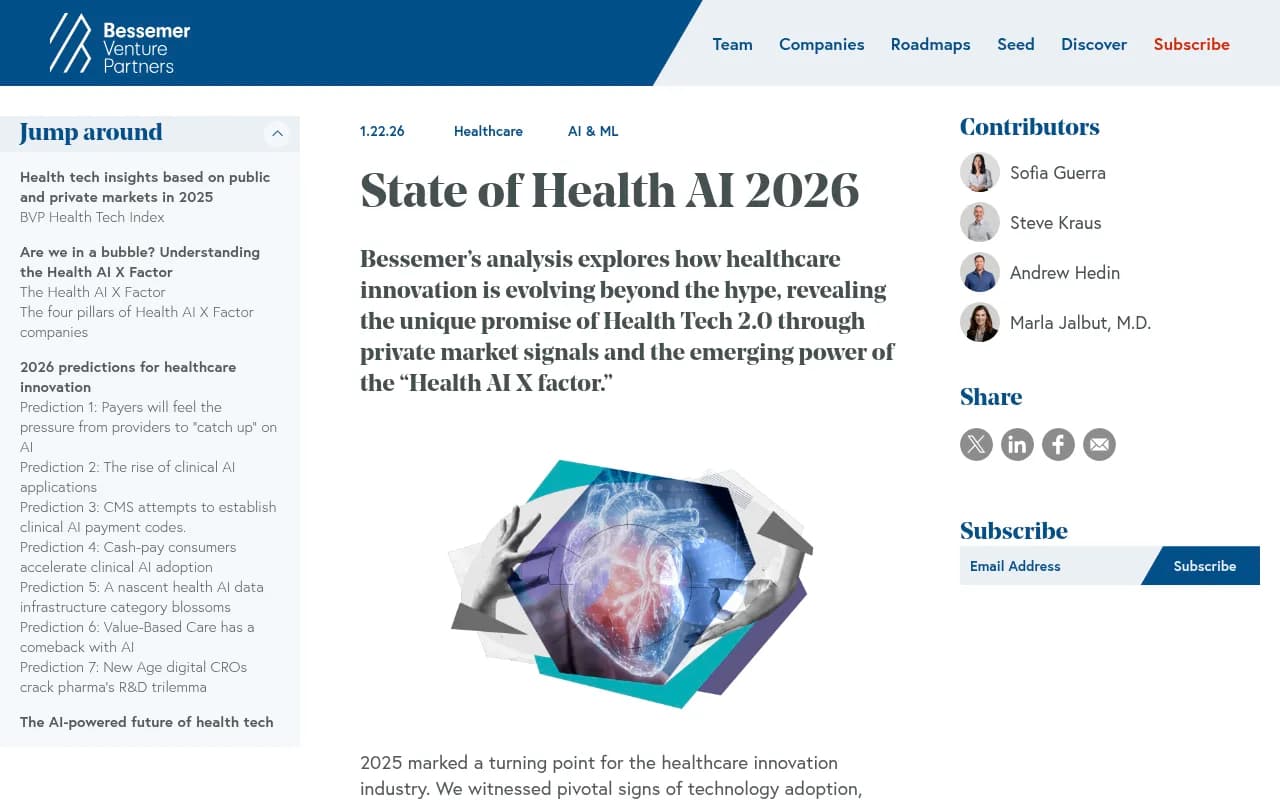
This shift reflects a fundamental change in how patients discover healthcare information. According to Bessemer Venture Partners' State of Health AI 2026 report, AI companies captured 55% of all health tech funding in 2025, up from just 29% in 2022. This investment surge signals that AI-powered patient acquisition is no longer experimental — it's the primary growth channel for healthcare brands.
Yet most healthcare organizations remain invisible in AI-generated answers. RankOS™ data reveals that fewer than 20% of healthcare brands evaluated appeared in AI search results, despite many ranking well in traditional Google search. The gap between SEO performance and AI visibility has never been wider.
The Trust Signal Framework for Healthcare Brands
AI models evaluate healthcare content through a trust signal framework that goes far beyond traditional E-A-T (Expertise, Authoritativeness, Trustworthiness). In 2026, healthcare brands must demonstrate:
Clinical Credentials and Author Verification
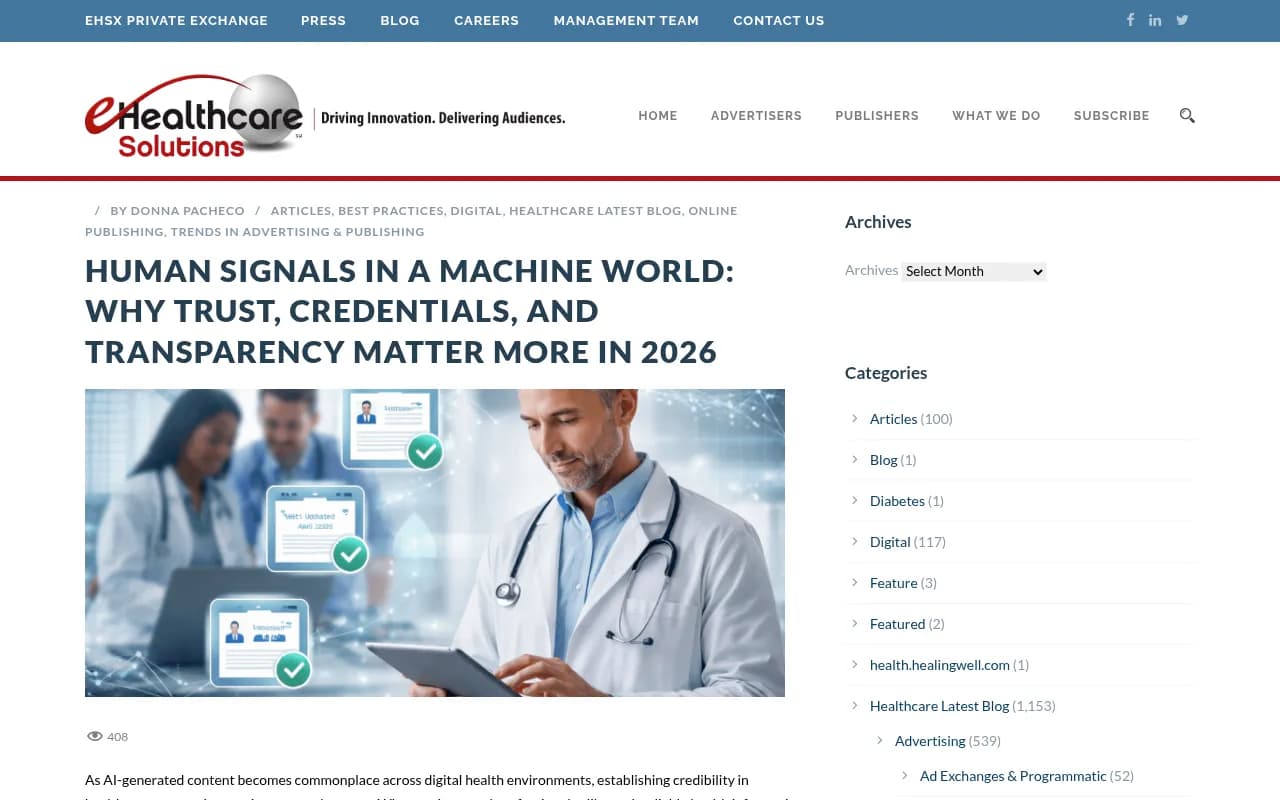
Every piece of medical content must display verified clinician authorship with credentials, specialties, and institutional affiliations. AI models parse structured data to confirm that Dr. Sarah Chen, MD, FACP is a board-certified internal medicine physician at Massachusetts General Hospital before citing her content on diabetes management.
This means:
- Author bylines must include full credentials (MD, DO, RN, PharmD, etc.)
- Institutional affiliations must be current and verifiable
- Specialty certifications should be explicitly stated
- Author bio pages must link to professional profiles (LinkedIn, hospital directories, medical society memberships)
Peer-Reviewed Citations and Source Transparency
AI models strongly favor content that cites peer-reviewed research from PubMed, JAMA, NEJM, The Lancet, and other authoritative medical journals. Generic health content without citations rarely gets cited by AI engines, regardless of how well it ranks on Google.
Best practices:
- Link directly to PubMed abstracts or full-text journal articles
- Use DOI (Digital Object Identifier) links for permanent citation access
- Include publication dates to demonstrate currency
- Cite multiple sources for controversial or evolving medical guidance
- Avoid citing press releases, marketing materials, or unverified health blogs
Medical Review and Update Transparency
AI models look for explicit medical review statements and content update histories. A diabetes guide last updated in 2019 will not be cited, even if it ranks #1 on Google. Healthcare content must display:
- Medical review dates and reviewer credentials
- Content update timestamps
- Version history for significant revisions
- Editorial policies and conflict of interest disclosures
Institutional Authority and Third-Party Validation
AI systems prioritize content from recognized healthcare institutions, academic medical centers, professional medical societies, and government health agencies. Independent healthcare brands must build institutional authority through:
- Partnerships with academic medical centers
- Membership in professional medical societies (AMA, AHA, ADA, etc.)
- Accreditation from recognized bodies (Joint Commission, NCQA, URAC)
- Media mentions in trusted health publications
- Speaking engagements at medical conferences
- Published research in peer-reviewed journals
How AI Models Evaluate Healthcare Content
ChatGPT, Claude, Perplexity, and Google AI Overviews use different evaluation criteria than traditional search engines. Understanding these differences is critical for healthcare brands optimizing for AI visibility.
Source Verification and Credibility Scoring
AI models assign credibility scores to domains based on:
- Domain authority and backlink profiles from medical institutions
- HTTPS security and technical trust signals
- Presence in medical knowledge graphs and structured data
- Historical accuracy and absence of medical misinformation
- Regulatory compliance (HIPAA, FDA, FTC)
A healthcare startup's blog post will score lower than content from Mayo Clinic, Cleveland Clinic, or Johns Hopkins — even if the startup content is more comprehensive. This is why building institutional partnerships and third-party validation is essential.
Content Freshness and Medical Currency
AI models heavily weight publication and update dates for healthcare content. Medical guidance evolves rapidly, and AI systems know this. Content about COVID-19 treatments from 2020 will not be cited in 2026, regardless of ranking position.
Healthcare brands must:
- Update cornerstone content quarterly
- Add update timestamps to every medical article
- Archive or redirect outdated clinical guidance
- Monitor FDA approvals, clinical trial results, and guideline changes
- Publish timely content on emerging health topics
Structured Data and Medical Schema
AI models parse structured data more effectively than unstructured text. Healthcare brands should implement:
- MedicalWebPage schema for health content
- MedicalCondition schema for disease and symptom pages
- Physician schema for provider profiles
- MedicalOrganization schema for hospitals and clinics
- FAQPage schema for common patient questions
Structured data helps AI models understand content context, extract key facts, and determine citation-worthiness.
Compliance Considerations for Healthcare AI Optimization
Healthcare brands must balance AI visibility with regulatory compliance. The good news: compliance and optimization are not mutually exclusive.
HIPAA Compliance in AI Search
AI models do not access protected health information (PHI) when crawling public websites. However, healthcare brands must ensure:
- Patient testimonials and case studies are properly de-identified
- Marketing content does not inadvertently disclose PHI
- AI chatbots on healthcare websites comply with HIPAA requirements
- Analytics tracking does not capture identifiable patient data
FDA Regulations and Medical Device Marketing
Medical device manufacturers and pharmaceutical companies face additional constraints. AI-optimized content must:
- Avoid off-label use promotion
- Include required risk disclosures and warnings
- Balance efficacy claims with safety information
- Comply with FDA advertising and promotion guidelines
- Maintain documentation of all marketing claims
FTC Truth in Advertising Standards
Healthcare marketing content must be truthful, not misleading, and substantiated by scientific evidence. AI optimization cannot involve:
- Exaggerated efficacy claims
- Cherry-picked research citations
- Misleading before/after comparisons
- Unsubstantiated testimonials
- Deceptive pricing or availability claims
Building an AI-First Healthcare Content Strategy
Healthcare brands must shift from traditional SEO to AI-first content strategies. This requires new workflows, quality standards, and measurement frameworks.
Content Gap Analysis for Healthcare
Identify the specific medical questions and conditions where your brand should be visible but isn't. Tools like Promptwatch help healthcare brands discover which prompts competitors are visible for but they're not — revealing the exact content gaps to fill.
For example, a cardiology practice might discover they're invisible for prompts like:
- "What are the warning signs of heart disease in women?"
- "Should I take statins if my cholesterol is borderline high?"
- "How do I prepare for a cardiac stress test?"
These gaps represent opportunities to create AI-optimized content that gets cited by ChatGPT, Claude, and Perplexity.
Medical Content Creation Workflows
Healthcare content creation must involve clinical experts at every stage:
- Topic research and prompt analysis — Identify high-value medical questions patients are asking AI models
- Clinical expert involvement — Engage physicians, nurses, or pharmacists to outline content and provide medical accuracy review
- Evidence-based writing — Cite peer-reviewed research, clinical guidelines, and authoritative medical sources
- Medical review and approval — Formal review by credentialed clinicians before publication
- Compliance review — Legal and regulatory review for HIPAA, FDA, and FTC compliance
- Structured data implementation — Add medical schema markup to help AI models parse content
- Publication and promotion — Distribute through owned channels and earn citations from authoritative health sites
AI Crawler Optimization for Healthcare Sites
AI models crawl healthcare websites differently than traditional search engines. Understanding crawler behavior helps optimize for AI visibility:
- Monitor which pages AI crawlers (ChatGPT, Claude, Perplexity) are accessing
- Identify crawl errors and indexing issues specific to AI bots
- Optimize robots.txt and crawl budgets for AI crawler access
- Ensure AI crawlers can access gated content appropriately
- Track crawler frequency to understand content freshness signals
Platforms like Promptwatch provide real-time AI crawler logs showing exactly which pages ChatGPT, Claude, and Perplexity are reading, how often they return, and any errors they encounter.
Measuring Healthcare AI Visibility
Traditional SEO metrics (rankings, traffic, backlinks) don't predict AI visibility. Healthcare brands need new measurement frameworks.
AI Citation Tracking
Track how often your brand, physicians, and content are cited in AI-generated answers across:
- ChatGPT (including ChatGPT Search and Shopping)
- Claude
- Perplexity
- Google AI Overviews
- Gemini
- Meta AI
- Grok
- DeepSeek
Monitor citation frequency, context, and sentiment. Are you cited as a trusted source or merely mentioned in passing? Are citations positive, neutral, or negative?
Prompt-Level Performance
Analyze visibility at the prompt level, not just overall brand mentions. For a dermatology practice, track citations for specific prompts like:
- "Best dermatologist in [city]"
- "How to treat acne scars"
- "Is Accutane safe for teenagers?"
- "Difference between eczema and psoriasis"
Understand which medical topics you own in AI search and which represent opportunities.
Competitor Benchmarking
Compare your AI visibility against competitors:
- Which healthcare brands are cited most frequently?
- What trust signals do they display that you lack?
- Which medical topics do they dominate?
- How do their citation contexts differ from yours?
Competitive intelligence reveals the specific gaps preventing your brand from achieving AI visibility.
Traffic Attribution
Connect AI visibility to actual patient acquisition:
- Track referral traffic from AI search engines
- Monitor appointment bookings from AI-referred visitors
- Measure conversion rates for AI traffic vs. traditional search
- Calculate patient lifetime value by acquisition channel
AI visibility means nothing if it doesn't drive patient growth and revenue.
The Future of Healthcare AI Search
AI search for healthcare is evolving rapidly. Healthcare brands must prepare for:
Multimodal AI Search
AI models are incorporating images, videos, and voice into search experiences. Healthcare brands should:
- Create video content explaining medical procedures and conditions
- Optimize medical images with descriptive alt text and captions
- Develop voice-optimized content for smart speakers and AI assistants
Personalized Health Recommendations
AI models will increasingly personalize health recommendations based on user context, demographics, and health history. Healthcare brands must:
- Create content for specific patient personas and demographics
- Address diverse health needs and cultural considerations
- Optimize for location-based healthcare queries
AI-Powered Patient Triage
AI assistants will help patients self-triage and determine when to seek care. Healthcare brands should:
- Provide clear guidance on when to see a doctor vs. self-care
- Create symptom checker content that AI models can reference
- Establish authority for urgent vs. non-urgent conditions
Regulatory Evolution
Government agencies are developing AI-specific regulations for healthcare. Healthcare brands must:
- Monitor FDA, FTC, and state-level AI healthcare regulations
- Implement AI transparency and explainability standards
- Document AI-related marketing and patient engagement practices
Conclusion
Healthcare AI search in 2026 is fundamentally different from traditional SEO. AI models apply stricter credibility standards, prioritize verified clinical expertise, and demand transparent sourcing and medical review. Healthcare brands that invest in trust signals, clinical authority, and AI-first content strategies will dominate patient acquisition in the AI era.
The opportunity is massive: fewer than 20% of healthcare organizations are visible in AI search today. Early movers who build institutional authority, optimize for AI crawlers, and create evidence-based content will capture disproportionate patient growth as AI search adoption accelerates.
The question is not whether to optimize for AI search, but how quickly you can build the trust signals and content infrastructure that AI models demand. Healthcare brands that wait will find themselves invisible in the primary channel patients use to discover care.