Key Takeaways
- SaaS stocks lost over $1 trillion in 2026 as AI agents and native-AI competitors threaten traditional per-seat pricing models and workflow dominance
- Horizontal point solutions are most vulnerable -- tools with low switching costs and weak enterprise integration face existential risk from AI-native alternatives
- Platform consolidation is accelerating -- enterprises are cutting SaaS sprawl by 30-40% and moving toward integrated platforms with embedded AI capabilities
- AI search visibility is now a survival skill -- being cited in ChatGPT, Perplexity, Claude, and Google AI Overviews directly impacts pipeline, brand authority, and competitive positioning
- Usage-based and outcome-based pricing models are replacing per-seat licenses as AI consumption economics force vendors to align pricing with actual value delivered
The SaaSpocalypse: Why Traditional SaaS Is Under Siege
February 2026 marked a turning point for the software industry. In a single week, software stocks shed over $1 trillion in market value while the S&P 500 held steady. Salesforce dropped 26%. The iShares Expanded Tech-Software Sector ETF fell 21%. Traders called it the "SaaSpocalypse."
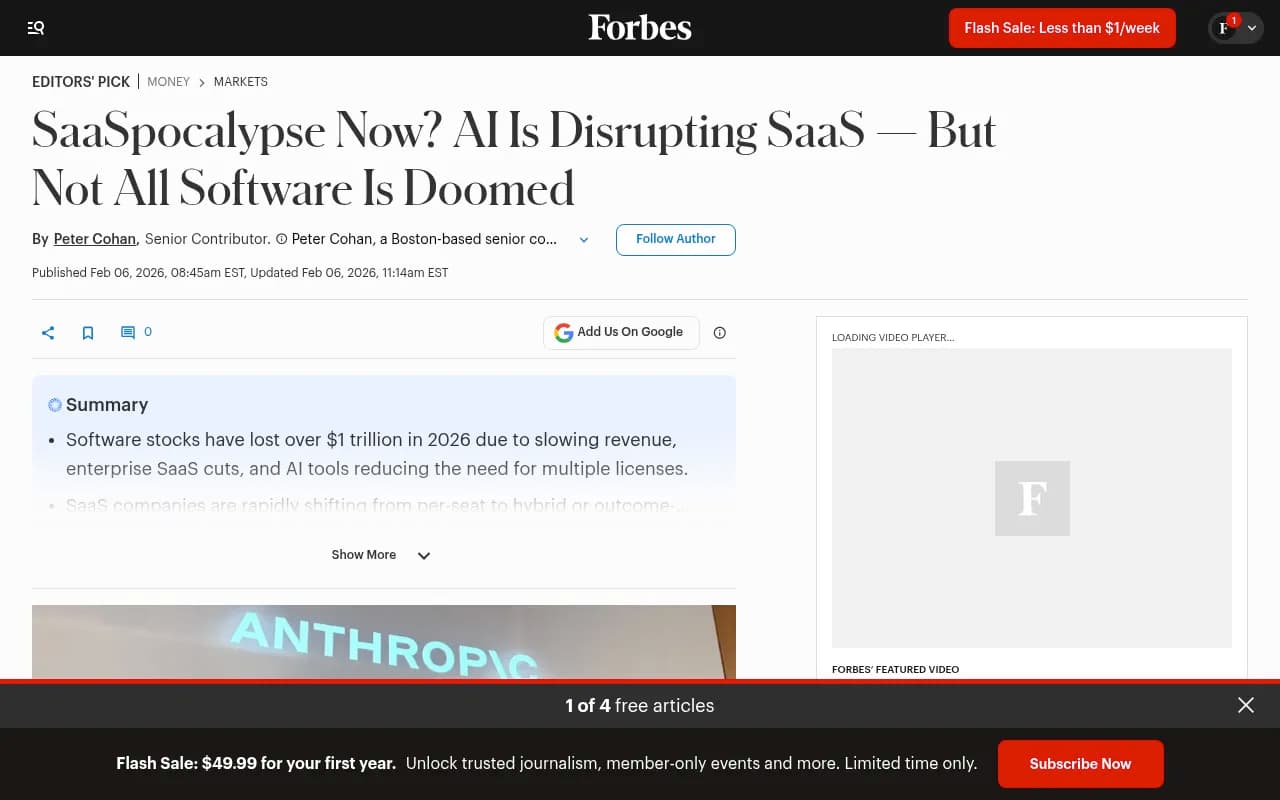
The sell-off wasn't driven by a single earnings miss or macro shock. It was driven by a fundamental shift in how work gets done. AI agents from OpenAI, Anthropic, Google, and dozens of startups are now performing tasks that previously required human users clicking through SaaS interfaces. The traditional per-seat model -- charge $50/month per user -- breaks when AI agents can execute workflows autonomously at a fraction of the cost.
Investors are betting that:
- SaaS vendors won't control AI agent distribution -- users will interact with ChatGPT or Claude directly, not through legacy SaaS UIs
- Per-seat pricing is obsolete -- if one AI agent does the work of 10 humans, revenue collapses
- Vibe coding erodes moats -- startups can now replicate complex SaaS features in weeks using AI-assisted development
- SaaS sprawl is unsustainable -- enterprises managing 400+ disconnected tools are consolidating aggressively
The global SaaS market is still growing -- projected to reach $315 billion in 2026 and $1.13 trillion by 2032 -- but the composition is changing fast. Traditional vendors are losing share to AI-native competitors and integrated platforms.
What's Not Working: The SaaS Models Under Threat
Horizontal Point Solutions Are Dying
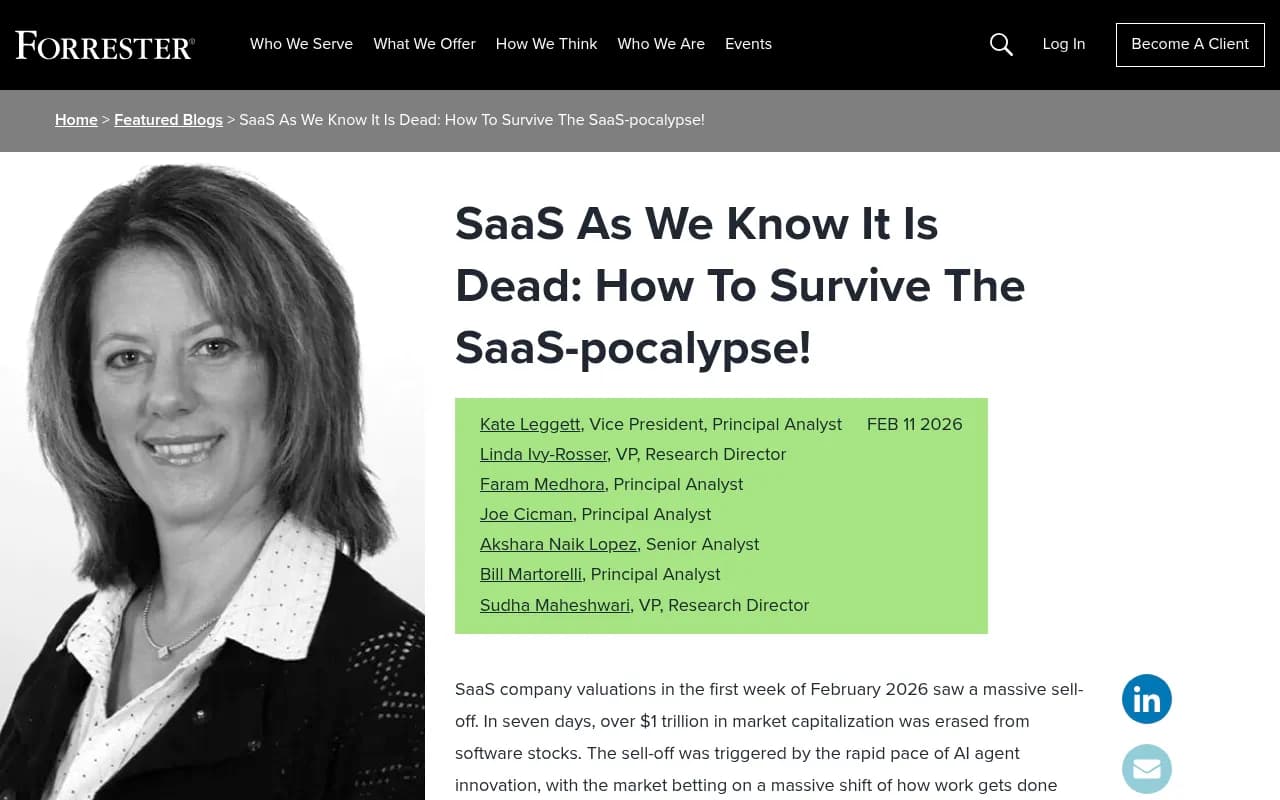
Forrester's analysis is blunt: horizontal point-solution vendors with low switching costs and weak enterprise integration won't scale beyond their current customer base. These are tools that solve a narrow problem (scheduling, note-taking, basic analytics) without embedding deeply into mission-critical workflows.
Why are they vulnerable?
- AI agents can replicate their functionality -- ChatGPT with a few plugins can schedule meetings, summarize notes, and generate basic reports
- No switching costs -- customers can move to a competitor or build their own solution in days
- No network effects -- the tool doesn't get better as more users join
- Commoditized value -- the core feature set is table stakes, not differentiated
Examples: standalone scheduling tools, basic CRM add-ons, simple form builders, generic project management apps. These categories are seeing 30-50% churn as enterprises consolidate onto platforms.
Per-Seat Pricing Is Breaking
The traditional SaaS model charges per user per month. If you have 100 employees using a tool, you pay for 100 seats. This worked when humans were doing the work.
AI breaks this model in two ways:
- AI agents don't need seats -- one agent can perform tasks for dozens of users, collapsing seat count
- Usage becomes wildly variable -- AI consumption spikes unpredictably based on workload, making fixed pricing untenable
Vendors are scrambling to adapt. BetterCloud reports that SaaS pricing is shifting toward:
- Hybrid models combining base fees with usage-based add-ons
- Outcome-based pricing tied to results delivered (leads generated, tickets resolved, revenue influenced)
- Consumption tiers that scale with AI inference volume, not user count
But the transition is messy. Vendors that can't pivot fast enough are seeing revenue decline even as usage grows.
SaaS Sprawl Is Collapsing
The average enterprise now manages 400+ SaaS applications. IT teams are drowning in integration complexity, security risks, and redundant spend. AI is accelerating consolidation.
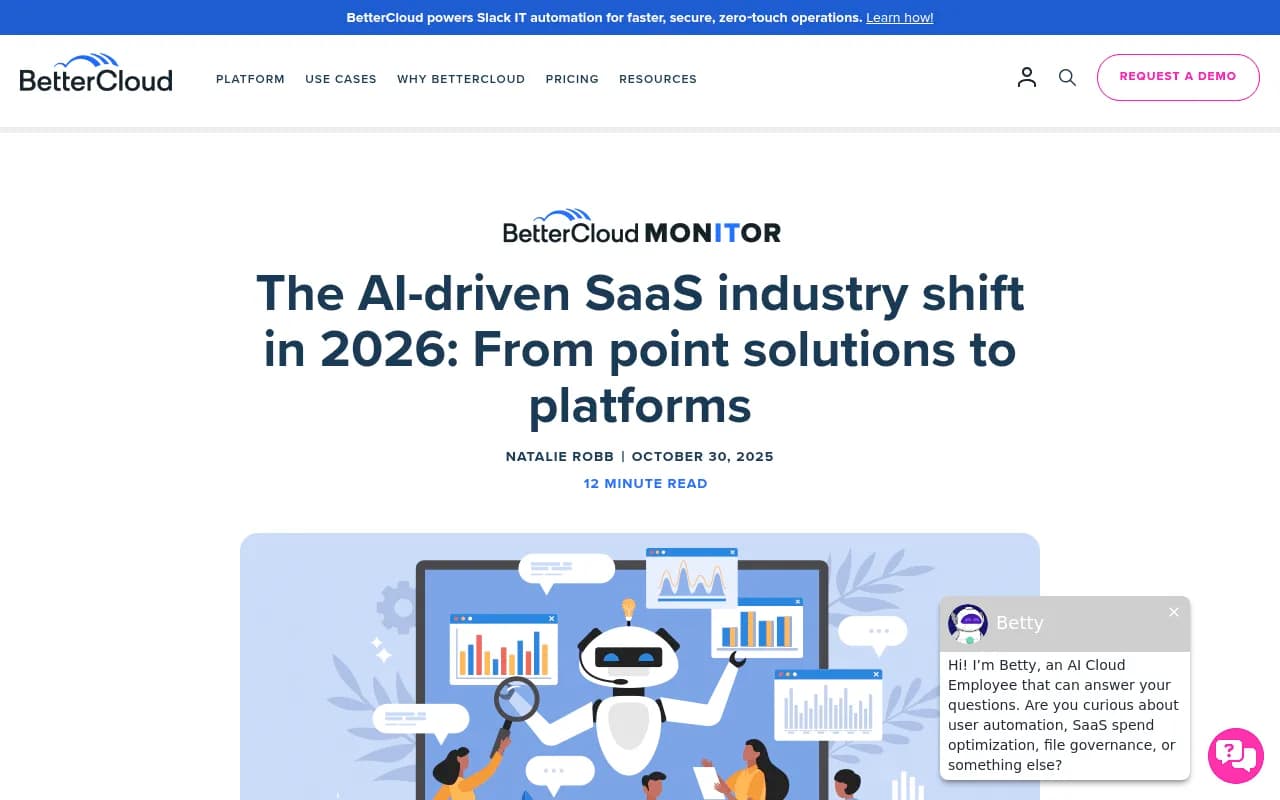
Enterprises are cutting SaaS portfolios by 30-40% by:
- Moving to integrated platforms that bundle multiple capabilities (HubSpot, Salesforce, Microsoft)
- Replacing point solutions with AI agents that orchestrate across systems
- Demanding interoperability -- tools that don't integrate via API are getting cut
This trend is brutal for niche vendors. If your tool doesn't integrate seamlessly or deliver 10x value, you're on the chopping block.
Invisible in AI Search = Invisible to Buyers
Here's the part most SaaS companies are missing: if you're not visible in AI search engines, you're losing deals before the conversation even starts.
Buyers are starting their research in ChatGPT, Perplexity, Claude, and Google AI Overviews. They're asking:
- "What's the best CRM for mid-market B2B companies?"
- "Compare Salesforce alternatives for startups"
- "Which marketing automation platform integrates with HubSpot?"
If your brand isn't cited in those responses, you don't exist. Competitors who are visible capture the consideration set. You're left fighting for scraps in traditional search or cold outreach.
The data is stark: brands with strong AI search visibility see 40-60% higher inbound pipeline velocity. Brands that are invisible see declining organic traffic and longer sales cycles.
What's Working: The SaaS Strategies That Win in 2026
Deep AI Integration That Delivers Measurable Outcomes
SaaS companies that survive the shakeout are those embedding AI so deeply that the product becomes fundamentally more valuable. Not AI as a feature bolt-on, but AI as the core engine.
Examples:
- Salesforce Einstein analyzing pipeline health and recommending next actions autonomously
- HubSpot's AI agents writing personalized email sequences based on contact behavior
- Zendesk AI resolving 40% of support tickets without human intervention
These aren't cosmetic improvements. They're 10x productivity gains that justify price increases and reduce churn.
The key: quantifiable ROI. Vendors that can prove "our AI saved you 200 hours this month" or "our AI generated $500K in pipeline" win budget. Vague claims about "AI-powered insights" lose.
Platform Consolidation and Ecosystem Lock-In
Integrated platforms are eating point solutions. Microsoft, Salesforce, HubSpot, and Adobe are bundling more capabilities and making it painful to leave.
Why platforms win:
- Data gravity -- all your customer data, workflow history, and integrations live in one place
- Switching costs -- migrating off a platform requires re-training teams, rebuilding integrations, and risking data loss
- Network effects -- the platform gets better as more apps and users join the ecosystem
- AI leverage -- platforms can train AI models on unified data across sales, marketing, and support
For smaller vendors, the survival strategy is becoming an essential platform extension rather than competing head-on. Build on Salesforce AppExchange, HubSpot Marketplace, or Shopify App Store. Become so embedded that removing you breaks critical workflows.
Dominating AI Search Visibility
The SaaS companies winning in 2026 are those that treat AI search visibility as a core growth channel, not an afterthought.
What this looks like in practice:
- Tracking brand mentions across ChatGPT, Perplexity, Claude, Gemini, and Google AI Overviews -- knowing exactly which prompts trigger citations and which competitors are winning
- Optimizing content for AI citation -- creating comparison guides, use case breakdowns, and integration documentation that AI models want to cite
- Monitoring AI crawler behavior -- understanding which pages ChatGPT, Claude, and Perplexity are reading, how often they return, and what errors they encounter
- Closing the loop with attribution -- connecting AI visibility to actual pipeline and revenue
Tools like Promptwatch help SaaS companies execute this strategy by showing exactly where content gaps exist, generating AI-optimized content, and tracking results across 10+ AI models.

The competitive advantage is massive. If your brand appears in the top 3 citations for high-intent prompts like "best [category] for [use case]", you capture 60-80% of consideration. If you're invisible, you're fighting uphill.
Outcome-Based and Hybrid Pricing Models
Vendors that have successfully transitioned from per-seat to outcome-based or hybrid pricing are seeing revenue growth despite seat count declines.
Examples:
- Gong charging based on deals influenced, not seats
- Drift pricing on conversations handled by AI, not user count
- Intercom offering consumption tiers tied to support ticket volume
The shift requires:
- Instrumentation to measure outcomes accurately
- Transparency so customers understand what they're paying for
- Flexibility to adjust pricing as usage patterns change
Customers prefer this model because they only pay for value delivered. Vendors benefit because high-performing customers pay more, and pricing scales with AI consumption.
Vertical SaaS and Niche Domination
While horizontal tools struggle, vertical SaaS companies serving specific industries (healthcare, construction, legal, real estate) are thriving. Why?
- Deep domain expertise that AI can't replicate overnight
- Regulatory compliance baked into workflows
- Industry-specific integrations that are hard to build
- High switching costs due to specialized training and data models
Examples: Veeva (pharma), Procore (construction), Toast (restaurants). These companies aren't worried about ChatGPT replacing them because their value is in solving complex, regulated, industry-specific problems.
The lesson: go narrow and deep. Own a niche so completely that competitors can't displace you.
The AI Search Visibility Playbook for SaaS Companies
If you're a SaaS company trying to survive and grow in 2026, AI search visibility is no longer optional. Here's the playbook:
Step 1: Audit Your Current Visibility
Track how often your brand appears in responses from:
- ChatGPT (OpenAI)
- Perplexity
- Claude (Anthropic)
- Google AI Overviews
- Gemini
- Copilot
- Meta AI
For each model, identify:
- Which prompts trigger citations (e.g., "best CRM for startups")
- Where you rank vs competitors
- What sources AI models cite (your website, third-party reviews, Reddit threads)
- Which pages are being read by AI crawlers
This baseline tells you where you're winning and where you're invisible.
Step 2: Find Content Gaps
Run a competitive gap analysis:
- Which prompts do competitors get cited for that you don't?
- What content exists on their sites that's missing from yours?
- Which topics, use cases, and integrations are AI models looking for?
This reveals exactly what content you need to create to close the visibility gap.
Step 3: Create AI-Optimized Content
Generate content specifically designed to get cited by AI models:
- Comparison guides ("[Your Product] vs [Competitor]")
- Use case breakdowns ("How [Industry] Uses [Your Product]")
- Integration documentation ("[Your Product] + [Popular Platform]")
- Pricing transparency (clear, up-to-date pricing pages)
- Customer stories with quantifiable outcomes
The content should be:
- Factual and specific -- AI models prefer concrete data over marketing fluff
- Structured with clear headings -- makes it easy for AI to extract information
- Comprehensive -- covers the topic in depth, not surface-level
- Up-to-date -- AI models prioritize recent content
Step 4: Monitor AI Crawler Behavior
Track which pages ChatGPT, Claude, Perplexity, and other AI crawlers are visiting:
- Crawl frequency -- how often they return
- Pages accessed -- which content they're reading
- Errors encountered -- 404s, timeouts, access issues
- Indexing status -- whether your content is being stored for future queries
This tells you if your content is being discovered and indexed properly. If AI crawlers aren't reading your pages, you won't get cited.
Step 5: Track Results and Iterate
Measure the impact:
- Visibility scores across AI models
- Citation frequency for target prompts
- Traffic attribution from AI search (via UTM tags, referrer logs, or direct measurement)
- Pipeline influence -- deals that started with AI search discovery
Iterate based on what's working. Double down on content that drives citations. Kill content that doesn't move the needle.
The Role of Platforms Like Promptwatch
Executing this playbook manually is nearly impossible. You'd need to:
- Query 10+ AI models daily with hundreds of prompts
- Manually track citations and rankings
- Analyze competitor content gaps
- Monitor AI crawler logs
- Attribute traffic back to AI search
Platforms like Promptwatch automate the entire workflow. They show you where you're invisible, help you create content that ranks, and track the results. Unlike monitoring-only tools (Otterly.AI, Peec.ai, AthenaHQ), Promptwatch is built around taking action -- not just showing you data.
For SaaS companies fighting for survival in 2026, this capability is the difference between being discovered by buyers or being invisible.
What SaaS CEOs Need to Do Right Now
- Audit your AI search visibility -- know where you stand vs competitors across ChatGPT, Perplexity, Claude, and Google AI Overviews
- Prioritize AI integration that delivers quantifiable ROI -- not cosmetic features
- Shift pricing models toward outcomes or hybrid consumption-based structures
- Consolidate or partner -- if you're a point solution, become an essential platform extension
- Invest in AI search optimization -- treat it as a core growth channel, not an experiment
- Cut SaaS sprawl internally -- model the behavior you want customers to adopt
The SaaS companies that survive the 2026 shakeout will be those that adapt fastest. AI search visibility, deep product integration, and outcome-based pricing aren't nice-to-haves. They're survival requirements.
The SaaSpocalypse is real. But it's not the end of SaaS -- it's the end of SaaS as we knew it. The winners will be those who embrace the shift, optimize for AI discovery, and deliver measurable value in an AI-first world.