Key Takeaways
- AI platforms are expected to account for $20.9 billion in retail spending in 2026, nearly quadrupling 2025's $5.3 billion (eMarketer, December 2025)
- AI-referred traffic on Black Friday 2025 grew 805% year-over-year, signaling explosive adoption of AI-assisted shopping (Adobe via MetaRouter)
- The shift to "zero-click" discovery means consumers research products inside AI interfaces like ChatGPT and Perplexity, then navigate directly to retailers—bypassing measurable ads and links entirely
- Traditional attribution models are breaking: when AI tools influence purchases without generating clicks, analytics credit the wrong channels (search, direct traffic, marketplaces) instead of the actual discovery source
- E-commerce brands must optimize product feeds, structured data, and content for AI agent discovery—not just traditional SEO—to remain visible in this new shopping paradigm
The AI Shopping Revolution Is Here
For over a decade, e-commerce marketers optimized around a familiar playbook: capture attention through ads or content, drive a click to your site, measure the conversion. That model is quietly breaking—not because consumers have stopped buying, but because they've stopped clicking.
Generative AI tools like ChatGPT, Perplexity, and Google's AI Overviews are rapidly becoming the primary way people research products, compare options, and decide what to buy. Increasingly, that discovery happens inside an AI interface, not on a search results page or social feed. The result is a growing "zero-click" reality: consumers learn about a brand, form intent, and then navigate directly to a retailer or marketplace without ever touching a measurable ad or link.
This shift isn't theoretical. According to eMarketer's December 2025 report, AI platforms are expected to account for $20.9 billion in retail spending in 2026—representing 1.5% of total retail e-commerce and nearly quadrupling 2025's figures. McKinsey estimates the global agentic commerce opportunity could reach $3-5 trillion by 2030.
How AI Search Is Changing Product Discovery
Traditional search engines present a list of links. AI search engines present answers—complete with product recommendations, comparisons, and purchase guidance—all without requiring the user to leave the interface.
When someone asks ChatGPT "What's the best running shoe for flat feet?" or Perplexity "Which mattress is good for back pain?", the AI doesn't just point them to websites. It synthesizes information from across the web, evaluates products based on reviews and specifications, and delivers a curated recommendation. The user gets their answer immediately. The click becomes optional.
The Three Major AI Shopping Platforms
ChatGPT Shopping (OpenAI)
In November 2024, OpenAI launched ChatGPT Shopping, allowing users to search for products, compare prices, and complete purchases without leaving the chat interface. By late 2025, ChatGPT Shopping had integrated with major retailers and payment processors, enabling end-to-end transactions. The platform uses natural language understanding to interpret complex product queries and deliver personalized recommendations based on user preferences and conversation history.
Perplexity Shopping Assistant
Perplexity launched its shopping assistant in November 2025, offering AI-powered product suggestions tailored to individual users. Unlike traditional search, Perplexity's assistant asks clarifying questions, narrows down options based on specific needs, and provides detailed comparisons with citations to source material. The platform emphasizes transparency—showing users exactly where product information and reviews come from.
Google AI Overviews & Gemini Shopping
Google has integrated AI-powered shopping features across its ecosystem. AI Overviews now appear for product-related queries, synthesizing information from merchant feeds, reviews, and web content. Google's Gemini assistant can help users research products, compare options across retailers, and track prices. Because Google already owns the shopping graph through Google Merchant Center, it has a structural advantage in connecting AI recommendations to actual inventory and pricing.
The Zero-Click Problem: When Discovery Becomes Invisible
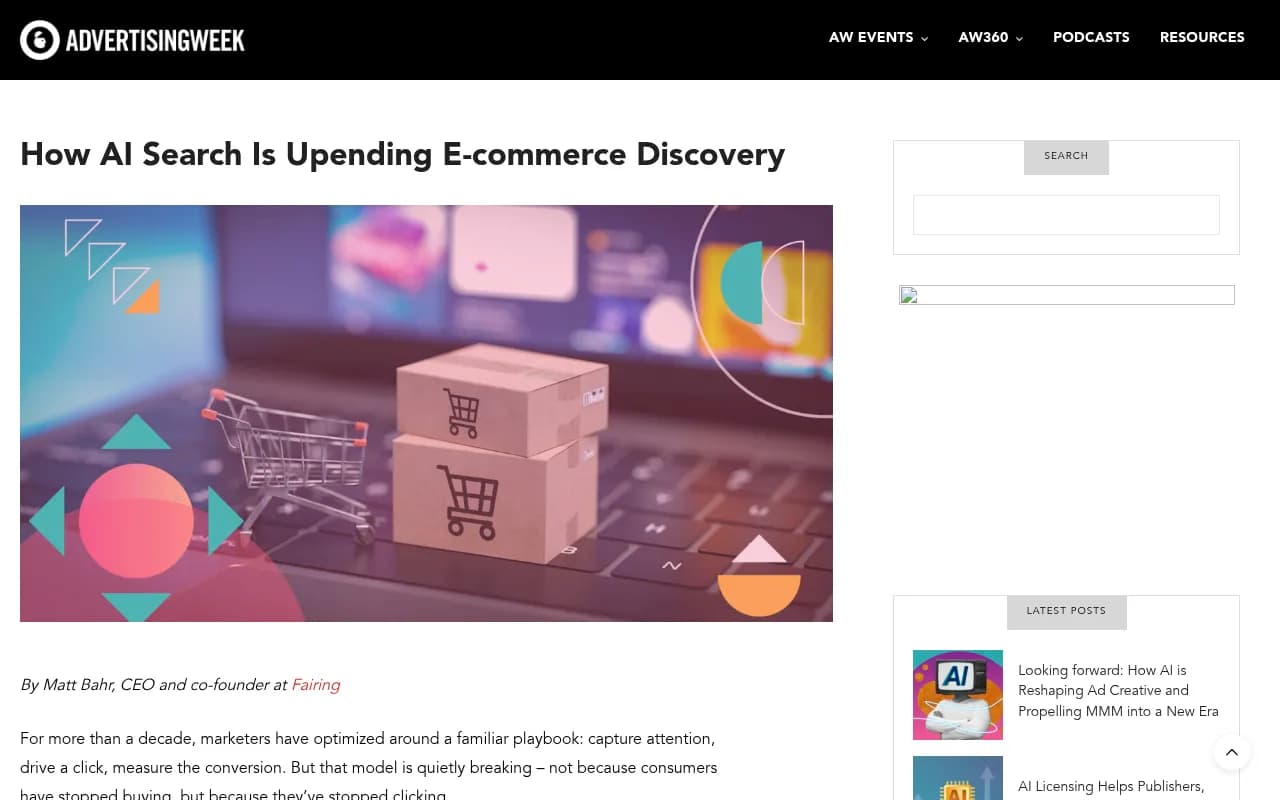
The most profound impact of AI search shopping isn't what happens inside the AI interface—it's what happens to attribution when users leave it.
Traditional metrics like impressions, clicks, and engagement were never designed to capture influence without interaction. They reward the moment of transaction, not the moments that created intent. When someone learns about a product from ChatGPT, then later types the brand name into Google or buys on Amazon, traditional attribution models credit search or marketplace performance—even though neither created the original demand.
At Fairing, a post-purchase survey platform analyzing millions of customer responses, the latest LLM Product Discovery benchmarks show that brand mentions in AI-driven search are rising sharply—particularly in categories like lifestyle and consumer electronics. Awareness is starting in new places, even though the final transaction still shows up somewhere familiar.
This creates a growing disconnect between where marketers think discovery happens and where it actually happens. Budgets are still being justified as if nothing has changed, while a growing share of discovery is happening in places analytics can't see.
Real-World Impact: Black Friday 2025 Data
The tipping point came during Black Friday 2025. According to Adobe Analytics data reported by MetaRouter, AI-referred traffic grew 805% year-over-year. This wasn't a gradual shift—it was an inflection point.
Retailers who had optimized their product feeds for AI discovery saw measurable lifts in branded search and direct traffic. Those who hadn't found themselves invisible in AI recommendations, even when they ranked well in traditional search results.
The data revealed a clear pattern: AI search doesn't just redistribute existing traffic—it creates new discovery moments that wouldn't have happened otherwise. Users who might never have clicked through ten pages of Google results will ask an AI assistant for recommendations and act on them immediately.
How AI Agents Discover and Recommend Products
Understanding how AI shopping agents work is critical to optimizing for them. Unlike traditional search engines that rely primarily on keyword matching and backlinks, AI agents evaluate products through a multi-layered process:
1. Product Feed Ingestion
AI platforms consume structured product data from merchant feeds (Google Merchant Center, Facebook Catalog, custom feeds). This includes product titles, descriptions, specifications, pricing, availability, images, and category information. The quality and completeness of your product feed directly impacts whether AI agents can discover and recommend your products.
2. Content Synthesis
AI agents crawl and analyze content across the web—product pages, review sites, Reddit discussions, YouTube videos, blog posts, and forum threads. They synthesize this information to understand product quality, use cases, common complaints, and user sentiment. Brands mentioned frequently in high-quality contexts gain authority.
3. Query Understanding & Matching
When a user asks a product question, AI agents parse intent, extract key requirements (price range, features, use case), and match against their knowledge base. They prioritize products that align with the user's specific needs rather than generic "best" lists.
4. Recommendation Generation
AI agents generate recommendations by weighing multiple factors: product specifications, reviews, price competitiveness, availability, brand reputation, and contextual fit. They explain their reasoning, cite sources, and often present multiple options with trade-offs.
The Infrastructure Behind AI Shopping: Open Protocols
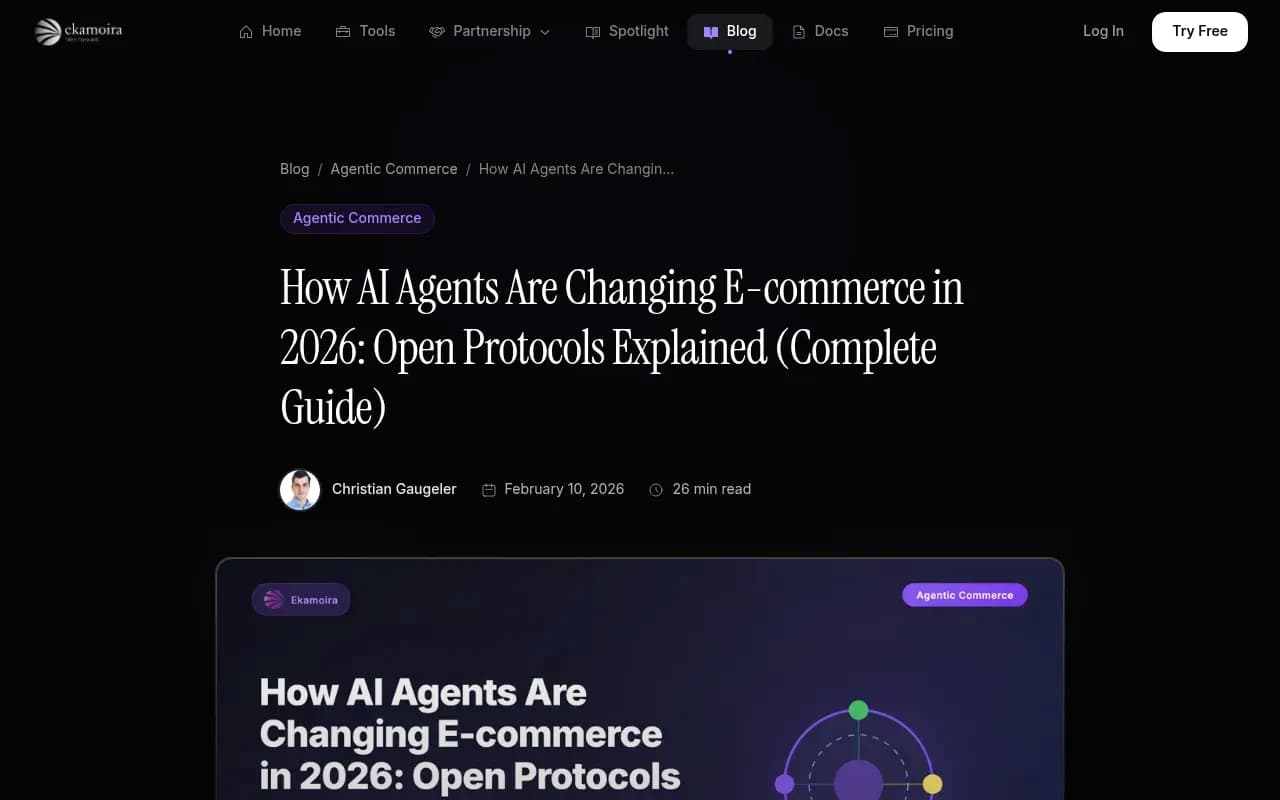
Behind the scenes, AI shopping agents rely on open protocols that enable them to discover products, negotiate transactions, and complete checkouts across platforms. Three key protocols are shaping the infrastructure:
Universal Commerce Protocol (UCP)
UCP standardizes how AI agents access product catalogs, pricing, and inventory across different e-commerce platforms. It creates a common language for product discovery, allowing agents to query multiple retailers simultaneously without custom integrations for each one.
Model Context Protocol (MCP)
Developed by Anthropic and donated to the Agentic AI Foundation in January 2026, MCP enables AI agents to securely connect to external data sources and tools. With over 97 million monthly SDK downloads and 10,000+ active public servers, MCP has become the de facto standard for AI agent interoperability. For e-commerce, MCP allows agents to access real-time inventory, pricing, and product specifications from merchant systems.
Agent-to-Agent (A2A) Protocol
Google's A2A protocol enables different AI agents to communicate and collaborate. In shopping scenarios, this means a user's personal AI assistant can negotiate with a merchant's AI agent to find the best price, check availability, or arrange delivery—all without human intervention. Google has partnered with over 50 technology companies to build A2A-compatible systems.
These protocols prevent vendor lock-in and democratize access to e-commerce infrastructure. A small brand with a well-structured product feed can be discovered by ChatGPT, Perplexity, and Google AI on equal footing with larger competitors—if they optimize correctly.
What This Means for E-Commerce Brands
The shift from traditional search to AI-assisted shopping requires fundamental changes to how e-commerce brands approach discoverability and attribution.
From Keyword SEO to Product Feed Optimization
Traditional SEO focused on ranking web pages for keywords. AI search shopping focuses on ranking products for intent-based queries. This means:
- Structured data is mandatory: Schema.org Product markup, complete with offers, reviews, and specifications, helps AI agents understand your products
- Product feed quality matters more than ever: Incomplete, inconsistent, or poorly categorized feeds make you invisible to AI agents
- Descriptions must be comprehensive: AI agents need detailed information to match products to user needs—short, keyword-stuffed descriptions don't work
- Reviews and UGC are signals of authority: AI agents heavily weight user-generated content when evaluating product quality
From Click-Based Attribution to Influence Tracking
Traditional analytics track clicks and conversions. AI search shopping requires tracking influence:
- Monitor brand mentions in AI responses: Tools like Promptwatch can track when and how your brand appears in ChatGPT, Perplexity, and other AI platforms

- Implement post-purchase surveys: Ask customers "How did you first hear about us?" to capture AI-assisted discovery that doesn't show up in analytics
- Track branded search lift: Increases in branded search and direct traffic often indicate AI-driven discovery upstream
- Analyze AI crawler logs: Understanding which AI agents are crawling your site and how frequently helps you optimize for their discovery patterns
From Reactive Monitoring to Proactive Optimization
Most brands are still in reactive mode—checking if they appear in AI results but not actively optimizing for it. The winners in 2026 are taking a proactive approach:
- Answer Gap Analysis: Identify which product queries competitors appear in but you don't, then create content to fill those gaps
- Content Generation for AI Discovery: Publish detailed buying guides, comparison articles, and use-case content that AI agents can cite when making recommendations
- Prompt Intelligence: Understand which product queries have high volume and low competition, then optimize specifically for those prompts
- Citation Analysis: See which pages, Reddit threads, and YouTube videos AI agents cite most frequently, then build similar content or get featured in those channels
Preparing Your Brand for AI Shopping in 2026
Here's a practical checklist for e-commerce brands looking to optimize for AI search shopping:
Technical Foundation
- ✅ Implement complete Schema.org Product markup on all product pages
- ✅ Submit and maintain product feeds to Google Merchant Center, Facebook Catalog, and other major platforms
- ✅ Ensure product feeds include all fields: title, description, GTIN, brand, price, availability, image URLs, category, specifications
- ✅ Add structured FAQ and review markup to product pages
- ✅ Monitor AI crawler activity (ChatGPT-User, Claude-Web, PerplexityBot) in server logs
- ✅ Ensure your robots.txt allows AI crawlers to access product pages and content
Content Strategy
- ✅ Create comprehensive buying guides for your product categories
- ✅ Publish detailed comparison articles ("X vs Y") for competitive products
- ✅ Write use-case content ("Best [product] for [specific need]")
- ✅ Encourage and respond to customer reviews—AI agents heavily weight review sentiment
- ✅ Participate in relevant Reddit discussions and forums where your products are mentioned
- ✅ Create YouTube content demonstrating products and answering common questions
Monitoring & Optimization
- ✅ Set up tracking for brand mentions in ChatGPT, Perplexity, Google AI Overviews, and other AI platforms
- ✅ Implement post-purchase surveys to capture AI-assisted discovery
- ✅ Monitor branded search trends for lift that indicates AI-driven awareness
- ✅ Conduct regular Answer Gap Analysis to find opportunities where competitors appear but you don't
- ✅ Track which products AI agents recommend and why—analyze the reasoning they provide
- ✅ Test different product descriptions and structured data to see what improves AI visibility
The Competitive Landscape: Who's Winning
Early data from 2026 shows clear winners and losers in AI search shopping:
Winners:
- Brands with complete, well-structured product feeds across multiple platforms
- Companies that actively participate in review sites, Reddit, and YouTube
- Retailers who publish comprehensive buying guides and comparison content
- Brands that monitor and optimize for AI visibility proactively
Losers:
- Brands relying solely on paid ads without organic AI visibility
- Companies with incomplete or inconsistent product data
- Retailers who ignore AI crawler activity and don't optimize for AI discovery
- Brands that can't track or attribute AI-assisted purchases
The Future: What's Coming in 2026 and Beyond
The AI shopping landscape is evolving rapidly. Here's what to expect:
Agentic Commerce Goes Mainstream
By late 2026, expect AI agents to handle not just product discovery but the entire purchase journey—comparing prices across retailers, applying coupons, scheduling delivery, and even negotiating on your behalf. Brands will need to decide whether to embrace these agents or try to block them.
Multi-Modal Shopping
AI shopping assistants are adding visual search, voice shopping, and video-based product discovery. Users will be able to take a photo of a product and ask "Find me something similar but cheaper" or describe what they need verbally while driving.
Personalization at Scale
AI agents will remember your preferences, purchase history, and constraints (budget, dietary restrictions, style preferences) across all shopping interactions. Recommendations will become hyper-personalized, making generic product pages less effective.
The Attribution Crisis Deepens
As more discovery happens inside AI interfaces, the gap between actual influence and measured attribution will widen. Brands that figure out how to track AI-assisted purchases will have a massive advantage in budget allocation and strategy.
Conclusion: Adapt or Become Invisible
The shift to AI search shopping isn't coming—it's here. With $20.9 billion in retail spending projected for 2026 and 805% year-over-year growth in AI-referred traffic, brands that don't optimize for AI discovery risk becoming invisible to a rapidly growing segment of shoppers.
The good news: the infrastructure is open, the tools exist, and the playbook is emerging. Brands that invest now in product feed optimization, content creation for AI discovery, and proper attribution tracking will capture disproportionate share in this new channel.
The bad news: your competitors are already doing this. The window to gain first-mover advantage is closing.
Start by auditing your product feeds, implementing structured data, and monitoring your brand's visibility in ChatGPT, Perplexity, and Google AI. Then build the content and optimization processes to improve it systematically. The brands that win in AI search shopping won't be the ones with the biggest ad budgets—they'll be the ones that understand how AI agents discover and recommend products, and optimize accordingly.