Key Takeaways
- Google Business Profile clicks are declining 15-25% year-over-year despite stable rankings, as AI-powered search engines redirect traffic away from traditional local pack results
- AI search engines now handle 17% of local discovery queries, with Gartner predicting traditional search volume will drop 25% by 2026 as ChatGPT, Perplexity, and Google AI Overviews reshape how customers find businesses
- Entity-based optimization has replaced keyword stuffing — local businesses must now focus on structured data, consistent NAP citations, and content that answers specific questions AI models want to cite
- Multi-platform visibility is mandatory — 67% of 18-24 year olds use Instagram for local business information, 62% use TikTok, and only 61% still rely on Google
- The businesses winning in 2026 are those tracking AI visibility and optimizing content specifically for citation in ChatGPT, Claude, Perplexity, and Google AI Overviews
The Fundamental Shift: What Actually Changed in 2025-2026
Local SEO isn't dead. But if you're still optimizing the same way you did in 2023, you're losing ground every single day.
Here's what happened: AI search engines went mainstream. Not as a novelty or early adopter toy, but as a genuine alternative to Google that millions of people now use daily. ChatGPT, Perplexity, Claude, Google AI Overviews — these aren't experimental features anymore. They're how a significant and growing percentage of your potential customers discover local businesses.
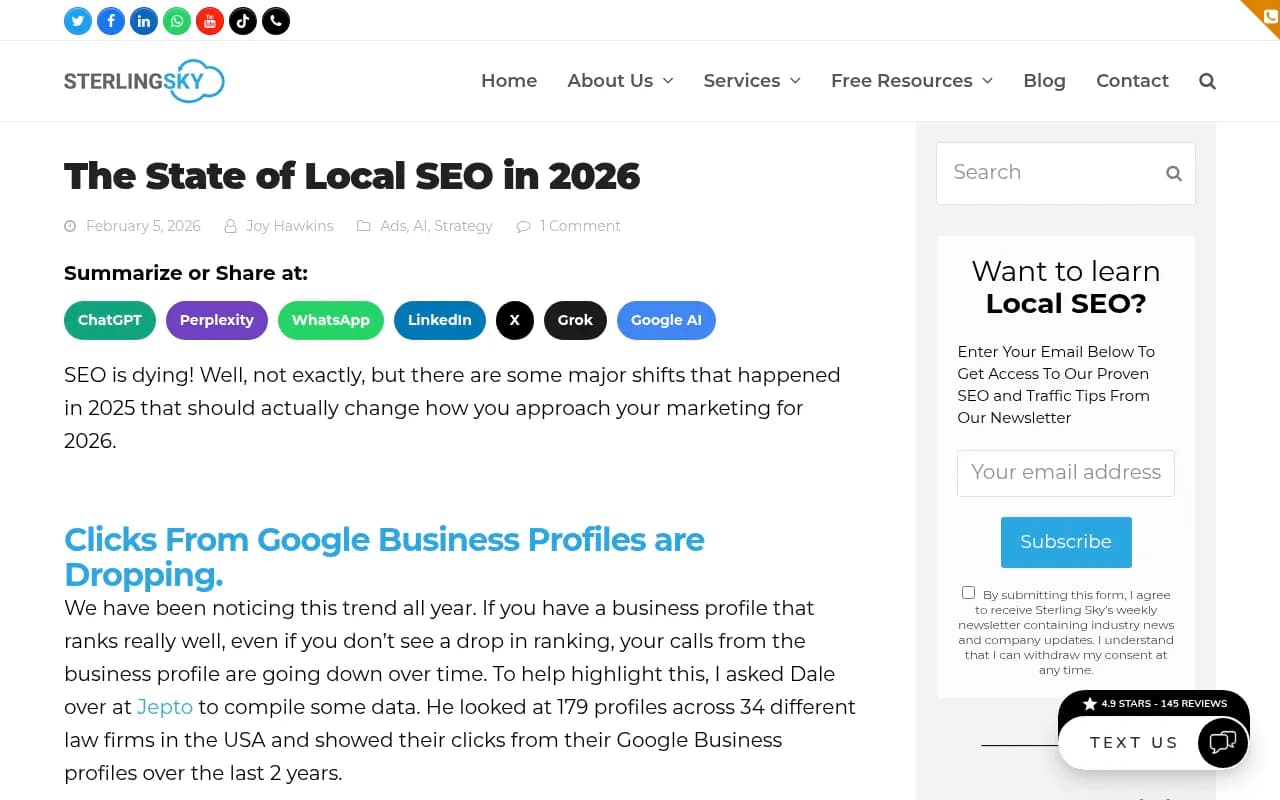
The data tells the story. Sterling Sky analyzed 179 Google Business Profiles across 34 law firms and found a clear pattern: clicks-to-call from Google Business Profiles have been declining steadily over the past two years. Not because rankings dropped. Not because the businesses got worse. But because the traffic is going somewhere else.
Meanwhile, 17% of U.S. consumers are already using AI chatbots like ChatGPT for search queries. Among 18-24 year olds, only 61% still use Google for local business information, while 67% use Instagram and 62% use TikTok. The fragmentation is real, and it's accelerating.
Why Google Business Profile Clicks Are Dropping (And What It Means)
Let's be clear about what's happening. Your Google Business Profile still matters. Local pack rankings still matter. But the conversion path has fundamentally changed.
When someone searches "best plumber near me" in 2026, they have multiple options:
- Click through to your Google Business Profile and call you directly
- Ask ChatGPT or Perplexity to recommend local plumbers and get a curated list with explanations
- Check Instagram or TikTok for local recommendations and reviews
- Read Google AI Overviews that synthesize information from multiple sources without requiring clicks
Option 1 is declining. Options 2-4 are growing rapidly.
This doesn't mean Google Business Profile optimization is dead. It means the stakes have changed. Your GBP needs to be optimized not just for Google's local algorithm, but as a data source that AI models can cite and reference when answering questions about local services.
The Rise of Entity-Based Search and What It Actually Means
Keyword stuffing is officially over. AI search engines don't work like traditional search algorithms. They understand entities, relationships, and context.
An entity is a distinct, well-defined thing: your business, your location, your services, your team members, your specializations. AI models build knowledge graphs connecting these entities based on structured data, citations, and consistent information across the web.
What this means practically:
Your business needs to be a clearly defined entity across the web. Consistent NAP (Name, Address, Phone) citations aren't just an SEO best practice anymore — they're how AI models verify your business actually exists and understand what you do.
Structured data markup is mandatory, not optional. Schema.org markup for LocalBusiness, Service, Review, and FAQ schemas tells AI models exactly what your business offers, where you operate, and what customers think of you.
Content must answer specific questions AI models want to cite. Generic service pages don't cut it. You need content that directly addresses the questions potential customers ask: "How much does X cost in [city]?" "What's the difference between X and Y?" "How long does X take?"
How AI Search Engines Actually Discover and Cite Local Businesses
AI search engines don't crawl the web the same way Google does. They have their own discovery mechanisms, and understanding these is critical for visibility.
AI Crawler Activity: ChatGPT, Claude, Perplexity, and other AI models send their own crawlers to websites. These crawlers read your content, extract structured data, and build their understanding of your business. Most local businesses have no idea these crawlers are hitting their site or what they're finding.
Citation Sources: AI models pull information from multiple sources when answering local queries:
- Your website (if properly structured and crawlable)
- Your Google Business Profile
- Review platforms (Google Reviews, Yelp, industry-specific sites)
- Reddit discussions and forum threads
- YouTube videos and local content
- News articles and local publications
- Social media profiles and posts
Verification and Trust Signals: AI models prioritize sources they trust. Consistent information across multiple verified sources carries more weight than a single mention. This is why NAP consistency and citation building remain critical — but now for AI visibility, not just Google rankings.
The Multi-Platform Reality: Where Your Customers Actually Are
Google is no longer the only game in town. Not even close.
The data is stark: while 72% of consumers still use Google for local business information, that number drops to 61% for 18-24 year olds. This younger demographic is already living in a multi-platform world:
- 67% use Instagram for local business discovery
- 62% use TikTok
- 31% use Instagram for reviews
- 20% use TikTok for reviews
- 17% use AI chatbots for search
If your local SEO strategy only focuses on Google, you're invisible to a growing segment of potential customers.
What Actually Works in 2026: The Action Framework
Enough about what changed. Here's what you need to do.
1. Audit Your AI Visibility
You can't optimize what you don't measure. Start by understanding how AI search engines currently see your business.
Search for your business name in ChatGPT, Claude, Perplexity, and Google AI Overviews. What do they say about you? Do they cite your website? Are the details accurate? Do they recommend you for relevant local queries?
Then search for broader category queries: "best [your service] in [your city]" or "[your service] near me" or "how to choose a [your service] in [your area]." Do you appear in the AI-generated responses? Do your competitors?
Tools like Promptwatch can automate this tracking across multiple AI models, showing you exactly which prompts you're visible for, which competitors are beating you, and what content gaps exist on your website.

2. Fix Your Entity Foundation
Structured Data Implementation: Add comprehensive Schema.org markup to every page:
- LocalBusiness schema on your homepage
- Service schema for each service page
- Review schema for testimonials
- FAQ schema for common questions
- BreadcrumbList for site navigation
NAP Consistency Audit: Your Name, Address, and Phone number must be identical across:
- Your website footer and contact page
- Google Business Profile
- Bing Places
- Apple Maps
- Yelp and industry directories
- Social media profiles
- Citation sources
Even minor variations ("St" vs "Street", "Suite 100" vs "Ste 100") confuse AI models and dilute your entity strength.
Google Business Profile Optimization: Complete every section:
- Primary and secondary categories
- Service areas (if applicable)
- Business hours (including special hours)
- Attributes specific to your industry
- High-quality photos (exterior, interior, team, work samples)
- Regular posts and updates
- Q&A section with common questions answered
3. Create Content AI Models Want to Cite
Generic service pages don't get cited by AI models. Specific, detailed, locally-relevant content does.
Answer Real Questions: Use tools like AnswerThePublic, Google's "People Also Ask" boxes, and Reddit to find the actual questions people ask about your services in your area. Then create dedicated content answering each question thoroughly.
Examples:
- "How much does [service] cost in [city]?" (with local pricing ranges and factors)
- "What's the difference between [option A] and [option B] for [city] residents?"
- "How long does [service] take in [city]?"
- "Do I need a permit for [service] in [city]?"
- "Best time of year for [service] in [city]?"
Local Context Matters: AI models prioritize locally-relevant information. Generic national content gets outranked by content that addresses local regulations, climate considerations, common local issues, and area-specific factors.
Structured Format: Use clear headings, bulleted lists, tables, and FAQ sections. AI models extract information more easily from well-structured content.
4. Build Multi-Platform Presence
Reddit and Forum Participation: AI models frequently cite Reddit discussions when answering local questions. Participate authentically in local subreddits and industry forums. Answer questions, share expertise, mention your business naturally when relevant.
YouTube Local Content: Create videos addressing common local questions about your services. "How to choose a [service provider] in [city]" or "What to expect from [service] in [city]" or "[City] [service] cost breakdown." AI models cite YouTube videos frequently.
Instagram and TikTok: Post regular content showing your work, explaining your services, and addressing common questions. Use local hashtags and geotags. Encourage customers to tag you in their posts.
Review Generation: Reviews on Google, Yelp, and industry-specific platforms serve as trust signals for AI models. Implement a systematic review request process for satisfied customers.
5. Monitor AI Crawler Activity
Most local businesses have no idea that ChatGPT, Claude, Perplexity, and other AI crawlers are hitting their website daily. These crawlers read your content, extract information, and build their understanding of your business.
Check your server logs for AI crawler activity. Look for user agents like:
- ChatGPT-User
- Claude-Web
- PerplexityBot
- Google-Extended
Are they successfully crawling your key pages? Are they encountering errors? How often do they return?
Platforms like Promptwatch provide real-time AI crawler logs showing exactly which pages AI models are reading, what errors they encounter, and how often they return to your site.
6. Track Results and Close the Loop
Visibility without traffic attribution is just vanity metrics. You need to connect AI visibility to actual business results.
Page-Level Tracking: Which specific pages are being cited by AI models? Which content is driving visibility?
Traffic Attribution: Implement tracking to identify visitors coming from AI search engines. This could be:
- Code snippet tracking (like Promptwatch's visitor analytics)
- Google Search Console integration
- Server log analysis
- UTM parameters in citations
Conversion Tracking: Are AI-sourced visitors converting at different rates than traditional Google traffic? What's the actual ROI of AI visibility?
The Content Gap Analysis Approach
The most effective strategy in 2026 is finding and filling content gaps — the specific topics, questions, and angles your competitors are visible for but you're not.
Here's how it works:
-
Identify high-value prompts: What questions do potential customers ask AI models when looking for your services? Tools like Promptwatch provide prompt volume estimates and difficulty scores.
-
Analyze competitor visibility: Which competitors appear in AI responses for these prompts? What content are they being cited for?
-
Find your gaps: Which prompts are competitors visible for but you're not? What specific content is missing from your website?
-
Create targeted content: Write articles, guides, and pages that directly address these gaps. Focus on questions AI models want to cite but can't find good answers to on your site.
-
Track improvement: Monitor your visibility scores as AI models start citing your new content. Measure the traffic and conversion impact.
This cycle — find gaps, create content, track results — is what separates businesses that adapt from those that fall behind.
Common Mistakes Local Businesses Make in 2026
Ignoring AI search entirely: Assuming Google is still the only platform that matters. By the time you notice the traffic decline, competitors have already captured market share.
Treating AI visibility as an afterthought: Optimizing for Google first, then hoping AI models pick up the content. AI search requires specific optimization strategies.
Focusing only on monitoring: Tracking your AI visibility without actually fixing the content gaps. Monitoring-only tools show you the problem but leave you stuck.
Neglecting structured data: Assuming AI models will figure out what your business does from unstructured content. They won't.
Creating generic content: Writing broad service pages instead of specific, locally-relevant answers to real questions.
Inconsistent NAP citations: Letting small variations persist across platforms, confusing AI models about your business identity.
Skipping multi-platform presence: Focusing exclusively on your website and Google Business Profile while ignoring Reddit, YouTube, Instagram, and TikTok.
What the Next 12 Months Look Like
AI search adoption will accelerate. Gartner's prediction of a 25% drop in traditional search volume by 2026 is already playing out. The businesses that adapt now will capture market share from those that wait.
Google will continue integrating AI Overviews into more queries, further reducing clicks to traditional results. Perplexity, ChatGPT, and Claude will expand their local search capabilities. New AI search engines will emerge.
The local businesses that win will be those that:
- Understand how AI models discover and cite local businesses
- Create content specifically designed for AI citation
- Track their visibility across multiple AI platforms
- Maintain consistent entity signals across the web
- Build presence on the platforms where their customers actually are
Local SEO in 2026 isn't about gaming algorithms or finding shortcuts. It's about being genuinely helpful, consistently visible, and strategically positioned across the platforms that matter.
The tools exist to track AI visibility, identify content gaps, and optimize for citation. The strategies are proven. The only question is whether you'll adapt before your competitors do.
Taking Action: Your Next Steps
Start with visibility. Search for your business and your key service terms in ChatGPT, Perplexity, Claude, and Google AI Overviews. Document what you find. That's your baseline.
Then audit your entity foundation. Is your NAP consistent everywhere? Do you have comprehensive structured data? Is your Google Business Profile fully optimized?
Next, identify your content gaps. What questions do potential customers ask that you haven't answered thoroughly? What local context are you missing? What specific topics are competitors visible for but you're not?
Create content that fills those gaps. Not generic service pages, but specific, detailed, locally-relevant answers to real questions.
Track the results. Monitor your AI visibility over time. Measure the traffic impact. Connect visibility to revenue.
The businesses that execute this framework consistently will dominate local search in 2026 — across Google, AI search engines, and every platform where customers discover local services.
The question isn't whether AI search will reshape local SEO. It already has. The question is whether you'll adapt in time to capture the opportunity.