Key takeaways
- Tibly ($49/mo), Dageno AI ($79/mo), and Nimt.ai ($89/mo) are all challenger tools in AI visibility tracking. None of them appear yet in the mainstream 2026 roundups from Zapier or KIME, which still favor Profound, Otterly.AI, Peec AI, and Semrush.
- Engine coverage is where they diverge hardest: Nimt includes all 8 tracked models from its first paid tier. Tibly gates Claude behind Enterprise, and Dageno caps you at 3 platforms on every tier below Enterprise.
- The three solve different problems. Tibly is a website builder with AEO baked in. Dageno is a monitoring layer with content agents. Nimt is a credit-metered tracker with an agent that produces finished deliverables.
- Watch for stale pricing in third-party reviews. Dageno's homepage still advertises "$67/mo" while checkout says $79, and older Nimt reviews cite a pricing model the company has since replaced.
Why compare these three
Most AI visibility comparisons cover the same five or six names. Profound, Otterly.AI, Peec AI, Scrunch, Semrush AI Toolkit. That's useful if you have an enterprise budget and a procurement process. It's less useful if you're a solo operator, a small agency, or a SaaS team that just wants to know whether ChatGPT recommends you, and wants something to fix it when it doesn't.
That's the gap these three are aiming at. Tibly, Dageno AI, and Nimt.ai all launched recently enough that the big roundup sites haven't caught up with them. They also share a pitch that would have sounded absurd two years ago: they don't just measure your AI visibility, they claim to improve it, some of them autonomously.
I spent time with each platform's documentation, pricing pages, and third-party reviews. Here's what I found, including a few pricing discrepancies the marketing pages would rather you not notice.
Quick comparison
| Tibly | Dageno AI | Nimt.ai | |
|---|---|---|---|
| Entry price | $49/mo | $79/mo | $89/mo |
| Models at entry tier | 3 (ChatGPT, Gemini, AI Mode) | 3 (you choose) | All 8 |
| Full engine coverage | Enterprise only (custom pricing) | Enterprise only (custom pricing) | Included at $89/mo |
| Free trial | None, billed immediately | 7 days | $45 in free credits |
| Execution model | Edits your website directly | Six content/marketing agents | Agent produces deliverables pending approval |
| What it actually is | Website builder + AEO tracker | GEO monitoring + agent platform | Credit-metered tracker + agent |
| Best for | Local businesses and solo operators without a site | Teams that want monitoring plus content production | Budget-conscious teams wanting full engine coverage |
Tibly: the website builder that tracks its own recommendations
Tibly takes the strangest, and possibly smartest, approach of the three. Instead of bolting a tracker onto your existing site, Tibly wants to be your site. It's a website builder with payments, booking, and store features built in, plus an AI visibility tracker that measures how often engines recommend the business and then, in its own words, "fixes what's missing right on your website."
The target audience is unambiguous: contractors, restaurants, photographers, food trucks, rental property owners. Small businesses that will never hire a developer and don't know what schema markup is.
The pricing structure reflects that. Four tiers: Starter at $49/mo, Plus at $149/mo, Growth at $299/mo, and custom Enterprise. Tracked prompts scale from 15 at Starter to 150 at Enterprise. Transaction fees on payments and bookings drop from 5% at Starter to 1% at Growth and above.
Here's the catch, and it's a big one for a tool whose whole pitch is AI visibility: the Starter plan only tracks ChatGPT, Gemini, and Google AI Mode. Copilot arrives at Plus. AI Overviews and Perplexity arrive at Growth, which costs $299/mo. Claude requires Enterprise. If you want the full picture of how AI recommends your business, you're paying custom pricing.
Also worth knowing: there's no free trial. Tibly's terms state plainly that paid plans are billed immediately at checkout. For a small business owner experimenting with a new category of tool, that's a real friction point.
The homepage case studies are eye-catching, things like "+62% more AI-driven visits" and "3x more booking requests," but these are self-reported customer quotes with no independent verification. Treat them as anecdotes, not evidence.
Dageno AI: monitoring plus a small army of agents
Dageno AI positions itself as a "data-driven GEO and marketing agent platform" with an explicit loop: insight, understanding, action. The company claims 3,700+ marketing teams as customers across B2B SaaS, ecommerce, and agencies, and it tracks 252 regions across 7+ AI models.

The feature set is the deepest of the three on paper. Citation and source-domain ranking, citation path depth, competitor content share, content gap analysis, and six named agents: Opportunity Analyst, Content Writer, Pitch Builder, SEO/GEO Auditor, Backlinks, and Social Media. There's a native API and an MCP server for connecting to Claude, Cursor, or n8n, plus white-label dashboards for agencies and a 2-hour human support SLA.
Pricing: Starter at $79/mo (50 prompts, 1 project, 5 seats), Growth at $199/mo (150 prompts, 2 projects, 8 seats), Scale at $499/mo (500 prompts, 5 projects, 10 seats), and custom Enterprise. Annual billing takes 15% off, and there's a 7-day free trial on all plans.
Now the fine print. Every tier below Enterprise caps you at 3 platforms, and you choose which three. Even the $499/mo Scale plan. Full 7-platform coverage, including Claude and Grok, is Enterprise-only. Dageno's homepage advertises "from $67/mo," but the live pricing page shows Starter at $79. Third-party review sites cite other numbers entirely, from ~$49/mo to $149/mo, none of which match the current checkout. The pricing has clearly churned multiple times, and the internet is full of stale copies of it.
There's also an independent critique worth weighing. A comparison by Ranked AI notes that Dageno's content is "AI-generated without an editorial layer," and that it doesn't implement technical fixes on your site directly. It recommends; it doesn't always execute. That's a meaningful distinction for a tool whose marketing leans heavily on "agent-driven execution."
Nimt.ai: credits, all eight engines, and an agent that does the work
Nimt.ai's tagline is "Track your AI search. Let the AI agent fix it." It tracks 8 models and surfaces: ChatGPT, ChatGPT Search, Copilot, Google AI Mode, AI Overviews, Perplexity, Gemini, and Claude. The dashboard shows visibility percentage, share of voice, brand strength, sentiment, per-model breakdowns, query fan-outs, and visibility split by intent (informational, consideration, transactional).
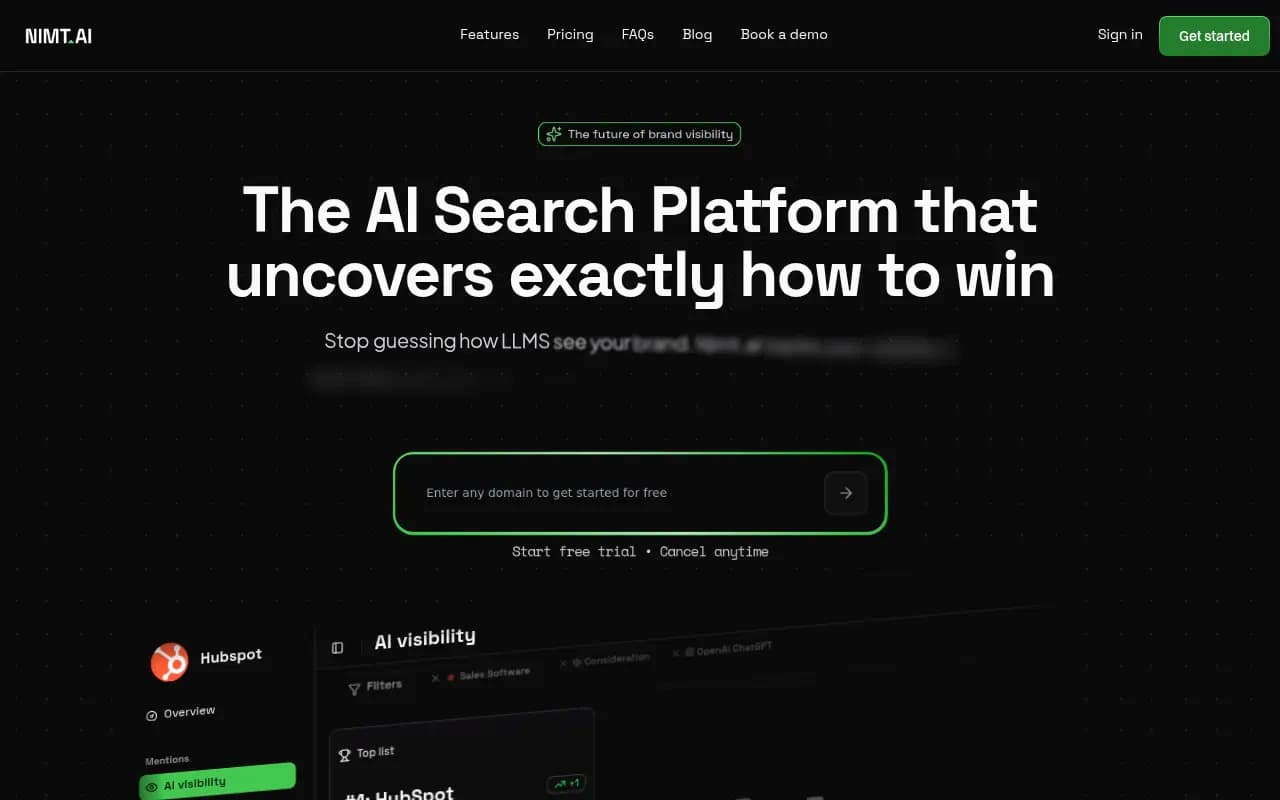
The pricing model is credit-based, which is either refreshing or annoying depending on your tolerance for metering. Flex costs $89/mo and includes 10,000 credits, up to 72 tracked prompts per day, daily tracking, unlimited team members, unlimited projects and domains, 230 countries, and unlimited languages. Enterprise is custom.
Here's what makes Nimt interesting: all 8 models are included from the first paid tier. No engine gating, no "Claude available at Enterprise." If your priority is full coverage without paying custom prices, Nimt is the only one of the three that delivers it under $100/mo.
The integrations list is genuinely broad: 3,000+ apps including HubSpot, WordPress, Shopify, GA, Search Console, Reddit, and YouTube, plus a Slack app and an MCP server. The agent produces finished deliverables, content, citation work, PR outreach, technical and schema fixes, pending your approval before anything publishes.
Two cautions. First, the credit-to-prompt ratio has already been revised at least once. An older LinkedIn post from the Nimt team describes a prior model at €79/mo for 10,000 credits and 218 prompts, and aggregator sites still quote it. Treat any review citing those numbers as stale. Second, the review aggregator RankSpot gives Nimt a 3.1 rating. The methodology isn't detailed, and young tools often accumulate early reviews from users who hit rough edges, but it's a data point worth knowing before you commit.
The $45 in free credits to start, with no card apparently required, makes it the lowest-risk trial of the three.
The pricing fine print nobody advertises
If you take one thing from this comparison, take this: the entry price of an AI visibility tool tells you almost nothing. What matters is the price of full engine coverage, because partial coverage produces misleading conclusions.
The reason is mathematical. According to Promptwatch's research on average sources per response, ChatGPT cites roughly 5 sources per web-search answer, while Google AI Overviews and Perplexity cite around 10, and Microsoft Copilot swings wildly between under 2 and nearly 17. A brand can be invisible in ChatGPT and prominent in AI Overviews, or the reverse. A tool that only tracks three engines isn't giving you a smaller sample of the truth. It's giving you a distorted one, because the engines differ in how many brands they recommend, how they phrase questions, and which sources they trust.
So the real price comparison looks like this:
| What you're buying | Tibly | Dageno AI | Nimt.ai |
|---|---|---|---|
| Entry price | $49/mo | $79/mo | $89/mo |
| Price for all 7-8 engines | Enterprise (custom) | Enterprise (custom) | $89/mo |
| Trial risk | None offered | 7 days | $45 free credits |
| Prompts at entry tier | 15 | 50 | ~72/day |
Tibly and Dageno look cheaper until you ask for Claude. Then the answer is "call sales." Nimt just includes it.
What actually gets you cited
All three tools sell some version of "we'll fix your visibility." It's worth checking that against what the engines actually reward.
Promptwatch's citation data for July 2026 shows product pages are now the single most-cited content type in ChatGPT Search, at 32.8% of citations, nearly double their share in March 2026. Listicles (9.7%), news (5.2%), how-tos (4.1%), and social posts (4.1%) trail well behind. Listicles were the fastest-growing format within the month.
This matters differently for each tool. Tibly's whole architecture is built around commercial pages, store, booking, invoices, that AI can quote directly. That happens to align with the highest-leverage content type in ChatGPT right now, which is either lucky or shrewd. Dageno's listicle-friendly outreach and PR agents align with the second-highest path. Nimt's intent-based visibility reporting at least lets you see whether you're showing up for transactional prompts, where product-page citations dominate, versus informational ones.
The honest caveat: none of these three appear in Promptwatch's tracked-domain citation-share reports yet. They're too new and too small. That doesn't make them bad, but it means their claims rest on their own case studies rather than independent citation data.
How they stack up against the established players
Context matters here. These three are challengers, and the incumbents are further along. Promptwatch, for instance, has analyzed more than 4.5 billion citations, clicks, and prompts, serves 1,840+ brands and agencies, and holds a 4.7/5 rating on G2. More to the point, it goes where none of these three fully go: AI crawler logs showing when ChatGPTBot or ClaudeBot actually visits your pages and what errors they hit, visitor analytics tying AI traffic to conversions, Reddit and YouTube citation tracking, and ChatGPT Shopping and Ads Radar. Its Content Agents plan, write, and publish to Webflow, Framer, or WordPress.

That's the benchmark the challengers are chasing. Dageno's agent roster is the closest analog to Promptwatch's execution layer, but without crawler logs it can tell you what AI says about you while staying silent on whether AI can even read your site. Nimt's 8-model coverage at $89/mo undercuts most incumbents on price per engine, but a 3.1 aggregator rating suggests polish is still in progress. Tibly plays a different game entirely, and for its audience, a local business that needs a website and AI visibility in one purchase, it may be the only game in town.
If you want to survey the broader field before committing, the directories at ai-rank-tools.com and bestgeosoftware.com catalog dozens of options in this category, including the established names.
Who should pick which
Pick Tibly if you're a local business or solo operator who needs a website anyway. The tracker-plus-builder combination only makes sense if Tibly is also running your site, payments, and bookings. Don't pick it purely for tracking; the engine gating and lack of a trial make it a weak standalone tracker.
Pick Dageno AI if you have an existing site, a small team, and a desire to move from monitoring into content production without hiring writers. The 7-day trial lets you verify the agent output quality before paying, which matters given the "no editorial layer" critique. Go in knowing that full engine coverage means an Enterprise conversation.
Pick Nimt.ai if full engine coverage at a fixed price is your priority. It's the only one of the three tracking all 8 models under $100/mo, and the $45 free credits make it cheap to test. Budget some attention for credit management, and weigh the 3.1 review rating against how young the product is.
Pick none of them yet if you need crawler logs, AI traffic attribution, or verified citation data at scale. Those capabilities currently live with the established platforms, and the price gap isn't big enough to give them up for most mid-size teams.
Verdict
After sitting with all three, my read is that they're solving three different problems and the "vs" framing is mostly artificial. Tibly is a website builder that happens to track AI visibility, and for its niche that's genuinely useful. Dageno has the most ambitious architecture and the most agents, but the 3-platform cap below Enterprise undercuts its data-driven pitch. Nimt wins the coverage-per-dollar argument outright, and its approval-gated agent is the most sensible execution model of the three, but it needs to shake its early reputation.
If I had to pick one today: Nimt for a small team that wants everything tracked cheaply, Dageno for a content-hungry team that will use the agents daily, Tibly only if the website builder is the actual draw. And for anyone whose budget stretches to it, the established platforms still offer data depth none of these three can match yet. The challengers are worth watching. In a category this young, that's not a dismissal, it's a timeline.