Key takeaways
- AI models like ChatGPT, Perplexity, and Google AI Overviews now answer learner research queries directly -- if your e-learning brand isn't cited, you're invisible at the most critical discovery moment.
- Most AI visibility tools only monitor where you appear; the best ones help you fix the gaps by identifying missing content and generating material that gets cited.
- E-learning brands face a specific challenge: learners ask highly specific, comparison-heavy questions ("best platform to learn Python for free") that require deep prompt coverage across many topics.
- Platforms with content gap analysis and built-in content generation give e-learning marketers a real edge over monitoring-only dashboards.
- The tools below range from enterprise-grade GEO platforms to lightweight trackers -- pick based on how many prompts you need to cover and whether you need to act on the data or just watch it.
Why AI visibility matters more for e-learning than almost any other sector
Think about how someone decides where to learn something new. A few years ago, they'd Google "best online courses for UX design," scan the top results, and click through to a few platforms. Today, they're just as likely to open ChatGPT or Perplexity and ask the same question -- and get a direct answer with three or four platform recommendations, no clicking required.
That's the problem. If ChatGPT recommends Coursera, LinkedIn Learning, and Udemy in response to a learner's question, and your platform isn't mentioned, you've lost that prospect before they ever visited your site. You didn't rank poorly. You simply didn't exist in that conversation.
E-learning is particularly exposed to this shift for a few reasons. Learners ask research-heavy, comparison-heavy questions. "What's the best platform to learn Python for beginners?" "Which online MBA programs are worth the money?" "Is [your platform] better than Coursera for data science?" These are exactly the kinds of queries where AI models synthesize multiple sources and give a direct recommendation -- and where being absent is genuinely costly.
The good news: this is a solvable problem. AI visibility tools can show you which prompts your competitors are winning, what content is getting cited, and what you need to publish to get into those answers. The bad news: not all tools are built equally, and many stop at "here's your visibility score" without telling you what to do next.
This guide breaks down the 10 most useful AI visibility tools for e-learning and online education brands in 2026, with honest assessments of what each one actually does well.
What to look for in an AI visibility tool (especially for education)
Before the list, a quick framework. E-learning brands need tools that can handle:
- Broad prompt coverage: Learners search across dozens of topic areas, skill levels, and formats. You need to track visibility across hundreds of prompts, not just a handful.
- Competitor comparison: The e-learning market is crowded. Knowing that Coursera appears in 78% of relevant AI responses while you appear in 12% is actionable. A raw visibility score isn't.
- Content gap identification: Which specific topics are AI models recommending competitors for, but not you? That's your content roadmap.
- Multi-model tracking: ChatGPT, Perplexity, Google AI Overviews, and Gemini all behave differently. A learner using Perplexity might get different recommendations than one using Claude.
- Traffic attribution: Can you connect AI citations to actual signups or course enrollments? Without this, you're optimizing in the dark.
With that in mind, here are the tools worth knowing about.
The top 10 AI visibility tools for e-learning brands in 2026
1. Promptwatch
Promptwatch is the most complete option for e-learning brands that want to move beyond tracking and actually improve their AI visibility. The core workflow -- find gaps, create content, track results -- maps directly onto what education marketers need to do.
The Answer Gap Analysis is particularly useful for e-learning. You can see exactly which prompts your competitors are appearing in that you're not. For a platform teaching data science, that might mean discovering that ChatGPT recommends three competitors when someone asks "best platform to learn machine learning for career changers" -- and that you're not mentioned because you don't have a dedicated page addressing that specific audience.
The built-in AI writing agent then generates content grounded in real citation data. This isn't generic blog filler -- it's material engineered to get cited by AI models, based on analysis of 880M+ citations. For e-learning brands trying to cover dozens of topic areas and learner personas, that's a significant time advantage.
Crawler logs show which pages AI models are actually reading on your site, so you can fix indexing issues before they cost you citations. And the traffic attribution layer (via code snippet, GSC integration, or server logs) connects AI visibility to actual enrollment data -- which is what your leadership actually cares about.
Pricing starts at $99/month for the Essential plan (1 site, 50 prompts, 5 articles), with the Professional plan at $249/month covering 150 prompts and 15 articles per month. For a mid-sized e-learning platform tracking visibility across multiple course categories, the Professional tier is probably the right starting point.

2. Profound
Profound is a strong enterprise option, particularly for larger education platforms with dedicated analytics teams. It covers 9+ AI search engines and goes deeper on data than most tools in the market.
Where Profound shines is in its breadth of AI model coverage and the quality of its reporting. It's built for teams that want to understand the full picture of their AI presence. The trade-off is price -- it sits at a higher price point than Promptwatch -- and it doesn't have the same content generation capabilities, so you'll still need a separate workflow for acting on the data you find.
For a large university or enterprise e-learning platform with a big marketing team, Profound is worth evaluating. For a growing mid-market platform, the cost-to-value ratio may be harder to justify.
Profound

3. Otterly.AI
Otterly.AI is one of the more accessible entry points into AI visibility monitoring. It tracks brand mentions across ChatGPT, Perplexity, and Google AI Overviews, and the interface is clean and easy to navigate.
For e-learning brands just starting to think about AI visibility, Otterly is a reasonable first step. It'll show you whether you're appearing in AI responses and give you a baseline to work from. The limitation is that it stops there -- there's no content gap analysis, no content generation, and no crawler logs. You'll know you have a problem, but you won't have much help figuring out how to fix it.
Otterly.AI

4. Peec AI
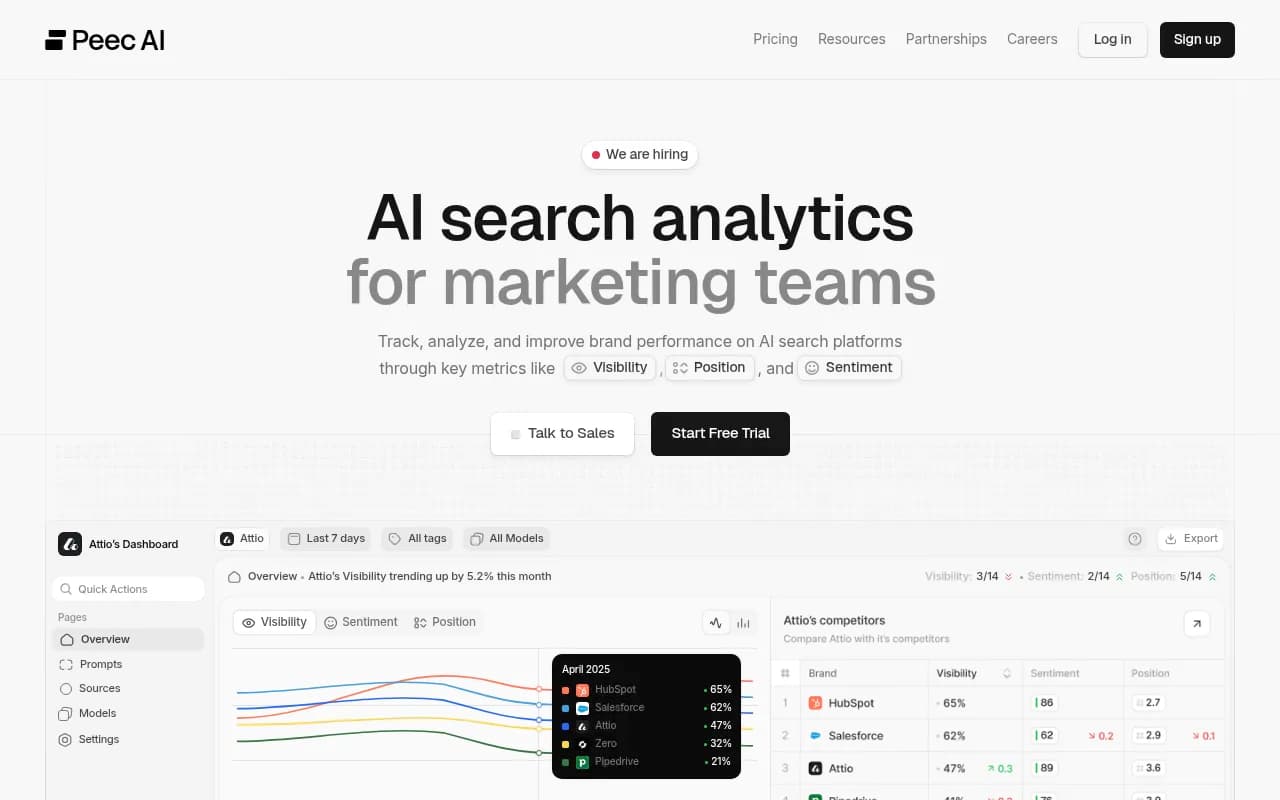
Peec AI takes a slightly different approach: it tries to turn raw AI search data into a prioritized action list. For e-learning marketers who are overwhelmed by data and want clearer direction, that framing is appealing.
In practice, Peec AI is solid for monitoring and gives decent suggestions on where to focus. It's a step above pure monitoring tools because it at least tries to point you toward action. But the content generation and optimization capabilities aren't as developed as Promptwatch's, so you're still doing most of the content work yourself.
5. Semrush (AI Toolkit)
Semrush has been adding AI search tracking capabilities to its existing platform, and for teams already paying for Semrush, it's worth exploring. The advantage is consolidation -- you can track traditional SEO and AI visibility in one place, which simplifies reporting.
The limitation is that Semrush's AI tracking uses fixed prompts, which means you're monitoring a preset list of queries rather than the specific questions your learners are actually asking. For e-learning brands with niche course offerings, that's a real constraint. It also lacks AI traffic attribution, so connecting AI citations to enrollment data requires additional tooling.
6. Evertune
Evertune is positioned as an enterprise GEO platform, and it's built for Fortune 500 brands that need deep GEO insights and sophisticated reporting. For large education institutions or publicly traded e-learning companies, it's worth a look.
For most e-learning brands, though, it's likely overkill in terms of complexity and cost. The platform is strong on analytics but lighter on the content optimization and generation side, which is where most education marketers need the most help.
7. Rankshift
Rankshift focuses on tracking brand visibility across ChatGPT, Perplexity, and AI search more broadly. It's a cleaner, more focused tool than some of the larger platforms, which makes it easier to get up and running quickly.
For e-learning brands that want a lightweight tracker without a lot of setup overhead, Rankshift is a reasonable option. It won't help you fix your visibility gaps, but it'll give you a clear picture of where you stand relative to competitors.

8. LLM Pulse
LLM Pulse tracks brand visibility across ChatGPT, Perplexity, and other AI search engines. It's designed to be straightforward -- you set up your brand and competitors, and it shows you how you compare across models.
For e-learning teams that want a simple, no-frills monitoring tool, LLM Pulse does the job. It's not going to generate content or tell you exactly which pages to write, but it gives you the data you need to have informed conversations about AI visibility strategy.
9. Ahrefs (Brand Radar)
Ahrefs has added AI visibility tracking through its Brand Radar feature, and for teams already deep in the Ahrefs ecosystem, it's a natural extension. The backlink and keyword data that Ahrefs is known for can complement AI visibility tracking -- understanding which pages have strong link authority can inform which pages are most likely to get cited by AI models.
The constraints are similar to Semrush: fixed prompts limit how granular you can get, and there's no AI traffic attribution. For e-learning brands with diverse course catalogs, the fixed prompt approach means you're probably missing a lot of the queries that actually matter to your audience.
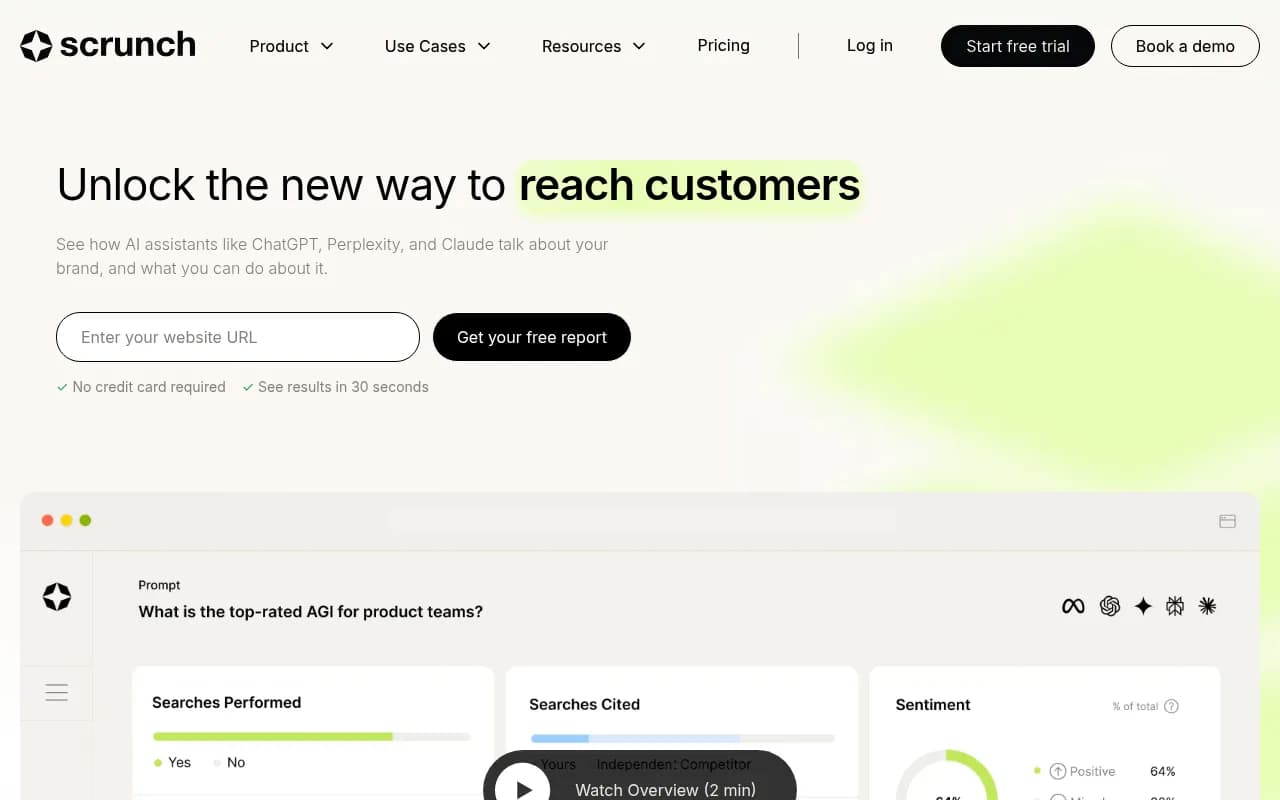
10. Scrunch AI
Scrunch AI is an AI search visibility platform that tracks brand mentions across LLMs. It's a solid mid-tier option that covers the core monitoring use case without a lot of extra complexity.
For e-learning brands that have already done some AI visibility work and want a dedicated tracking tool to complement their existing content workflow, Scrunch AI is worth considering. It's not a full optimization platform, but it's a reliable monitoring layer.
How these tools compare
Here's a quick comparison across the dimensions that matter most for e-learning brands:
| Tool | Prompt coverage | Content gap analysis | Content generation | Traffic attribution | Crawler logs | Multi-model tracking | Starting price |
|---|---|---|---|---|---|---|---|
| Promptwatch | Flexible (custom prompts) | Yes | Yes (AI writing agent) | Yes | Yes | 10+ models | $99/mo |
| Profound | Flexible | Partial | No | No | No | 9+ models | Higher (custom) |
| Otterly.AI | Limited | No | No | No | No | 3 models | Lower |
| Peec AI | Moderate | Basic | No | No | No | Multiple | Mid-range |
| Semrush AI Toolkit | Fixed prompts | No | No | No | No | Limited | Add-on to Semrush |
| Evertune | Flexible | Partial | No | No | No | Multiple | Enterprise |
| Rankshift | Moderate | No | No | No | No | Multiple | Lower |
| LLM Pulse | Moderate | No | No | No | No | Multiple | Lower |
| Ahrefs Brand Radar | Fixed prompts | No | No | No | No | Limited | Add-on to Ahrefs |
| Scrunch AI | Moderate | No | No | No | No | Multiple | Mid-range |
The pattern is clear: most tools stop at monitoring. Promptwatch is the only one in this list that covers the full loop from gap identification through content creation to traffic attribution.
A practical approach for e-learning brands
Here's how I'd think about using these tools if I were running marketing for an e-learning platform:
Start by mapping out the learner research queries that matter to your business. Think about the questions your target learners ask before they sign up: "best platform to learn [skill]," "is [your platform] worth it," "[your platform] vs [competitor]," "how to get a job in [field] without a degree." These are the prompts you need to be winning.
Then use a tool like Promptwatch to see which of those prompts you're currently appearing in, and which your competitors are winning. The gap between those two lists is your content roadmap.
For each gap, you need content that directly answers the prompt -- not generic marketing copy, but specific, useful information that AI models can cite when generating responses. This is where the built-in content generation in Promptwatch saves a lot of time, because it's generating content based on what's actually getting cited, not just what sounds good.
Finally, track whether your new content is getting cited, and whether those citations are driving actual traffic and enrollments. Without that attribution layer, you can't prove the value of the work to your organization.
The e-learning prompts you should be tracking
To make this concrete, here are the types of prompts that e-learning brands should be monitoring across AI models:
- "[Skill] courses for beginners" (e.g., "Python courses for beginners")
- "Best platform to learn [skill] online"
- "Is [your platform] worth it?"
- "[Your platform] vs [competitor]"
- "How to get a job in [field] without a degree"
- "Best online [degree/certification] programs"
- "Free courses for [skill]"
- "Best [language] learning apps" (for language learning platforms)
- "Corporate training platforms for [skill]"
- "Best LMS for [company size/industry]"
The specific prompts will vary by your niche, but the pattern is consistent: learners ask research questions before they commit, and AI models are increasingly answering those questions directly. Your job is to be in those answers.
Final thought
The e-learning market is competitive enough that you can't afford to be invisible in AI search. When a learner asks ChatGPT which platform to use for their next course, that's a high-intent moment -- and it's happening millions of times a day. The brands that show up consistently in those answers will have a structural advantage in learner acquisition that compounds over time.
Most of the tools in this list will help you understand where you stand. The ones worth investing in are the ones that also help you do something about it.