KeywordTool.io Review 2026
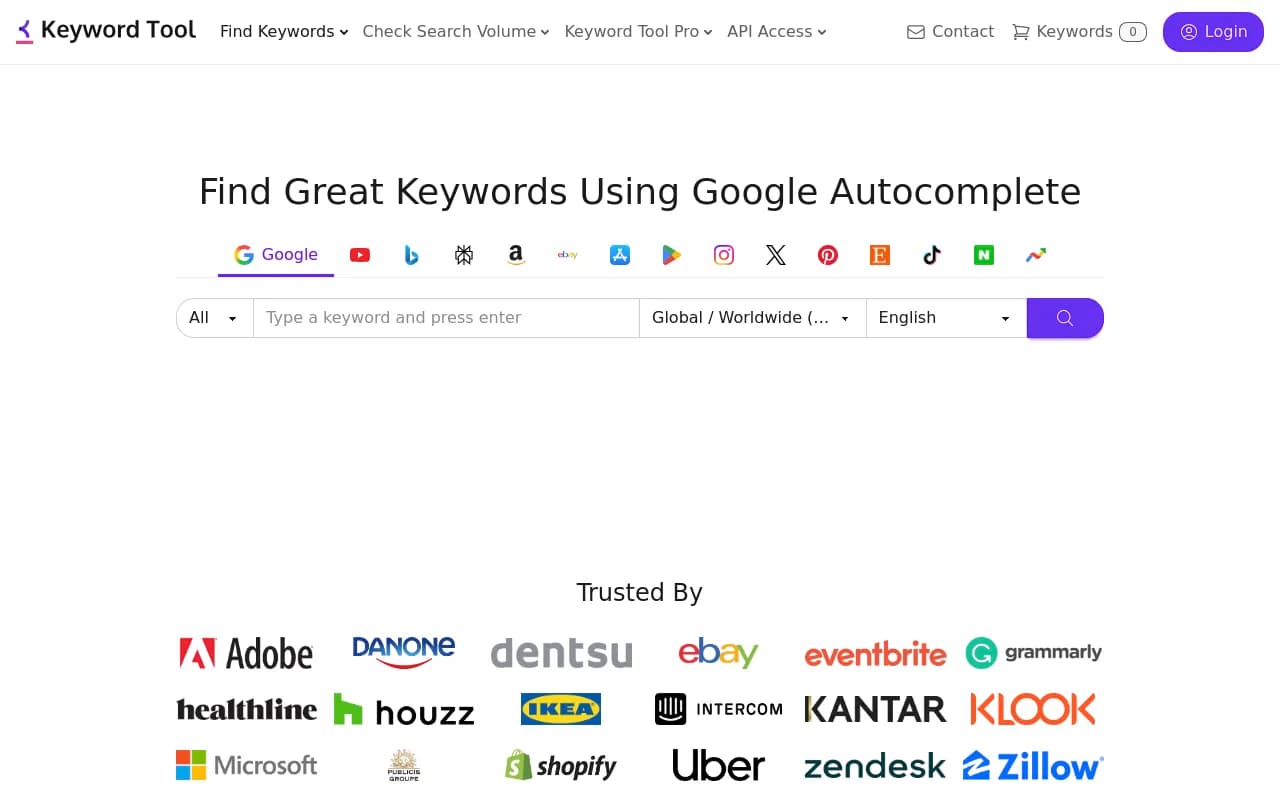
KeywordTool.io is a keyword research platform that extracts search suggestions from Google Autocomplete and 14 other platforms to generate hundreds of long-tail keywords. Used by Adobe, Microsoft, eBay, and Shopify, it provides keyword ideas for SEO, content creation, and PPC campaigns across 192 co
Summary
• Best for: Content marketers, SEO professionals, and PPC advertisers who need long-tail keyword ideas without Google Ads account requirements • Standout strength: Generates up to 750+ autocomplete-based keywords for free across 15 platforms (Google, YouTube, Amazon, Perplexity, TikTok, etc.) • Key limitation: Free version lacks search volume data and CPC metrics -- you'll need Pro ($89/mo+) for actionable metrics • Pricing reality: Free tier is genuinely useful for brainstorming, but serious keyword research requires paid plans starting at $89/month • Bottom line: Excellent autocomplete scraper with broad platform coverage, but you're paying primarily for search volume data that competitors like Ahrefs and Semrush bundle with deeper SEO toolsets
KeywordTool.io has been a staple in the SEO toolkit since its launch as a free alternative to Google Keyword Planner. The platform was built around a simple insight: Google Autocomplete suggestions reveal what real people are actually searching for, often surfacing long-tail queries that traditional keyword tools miss or hide. Today it's used by major brands including Adobe, Microsoft, eBay, Shopify, and IKEA, processing millions of keyword queries across 192 countries and 83 languages.
The tool's core value proposition is accessibility. Unlike Google Keyword Planner, which requires an active Google Ads account and often shows vague search volume ranges, KeywordTool.io lets anyone generate keyword suggestions instantly without signing up. For content creators and SEO beginners, this removes a significant barrier to entry.
How KeywordTool.io Actually Works
The mechanics are straightforward but effective. When you enter a seed keyword, KeywordTool.io programmatically appends and prepends letters, numbers, and common modifiers (who, what, where, when, why, how, can, with, for, etc.) to your term, then scrapes the autocomplete suggestions that Google (or YouTube, Amazon, etc.) returns. This happens in seconds and surfaces hundreds of variations you wouldn't think to search manually.
For example, searching "running shoes" might generate suggestions like "running shoes for flat feet women," "running shoes near me open now," "running shoes vs walking shoes," and "running shoes that look like dress shoes." These are real queries people type -- not synthetic combinations a keyword tool invented.
The free version shows you these suggestions organized alphabetically or by platform. You can filter by questions, prepositions, or comparisons. You can export results (though the free export is limited). What you don't get for free: search volume, cost-per-click, competition data, or trend charts. Those require Keyword Tool Pro.
Platform Coverage: 15 Search Engines and Social Networks
KeywordTool.io's breadth is a major differentiator. Beyond Google, it pulls autocomplete data from:
• YouTube -- critical for video content creators and YouTube SEO • Amazon -- essential for e-commerce sellers optimizing product listings • eBay -- another e-commerce angle, particularly for resellers • Bing -- often overlooked but still 3%+ of search traffic in the US • Perplexity -- newly added in 2026, reflecting the rise of AI search engines • App Store and Google Play Store -- for app developers doing ASO (App Store Optimization) • Instagram, TikTok, Pinterest -- hashtag and content discovery for social media marketers • X (formerly Twitter) -- trending topics and hashtag research • Etsy -- niche e-commerce for handmade and vintage sellers • Naver -- dominant search engine in South Korea • Google Trends -- integrated trend analysis
This multi-platform approach is rare. Most keyword tools focus exclusively on Google. If you're a YouTube creator, Amazon seller, or social media manager, KeywordTool.io gives you platform-specific suggestions that tools like Ahrefs or Semrush don't provide (or charge extra for via separate products).
Free vs. Pro: What You Actually Get
The free version generates up to 750+ keyword suggestions per search. You can run unlimited searches. You can see the keywords. That's it. No volume data, no CPC, no competition scores, no trend graphs. For brainstorming blog topics or discovering question-based queries, this is genuinely useful. For prioritizing which keywords to target, it's insufficient.
Keyword Tool Pro unlocks:
• Search volume data -- monthly search estimates for each keyword • Cost-per-click (CPC) -- average bid prices for Google Ads • Competition metrics -- how difficult it is to rank organically or bid on the term • Trend data -- 12-month search volume trends • 2x more keywords -- up to 1,500+ suggestions per search instead of 750 • Bulk keyword analysis -- upload lists of keywords to get metrics at scale • API access (on higher tiers) -- integrate keyword data into your own tools or workflows
Pro Basic is $89/month (or €89/month), limited to 1 user and 100 keyword searches per day. Pro Plus is $99/month, adds 2 users and 200 searches/day. Pro Business is $199/month, supports 5 users and 500 searches/day. Annual billing discounts are available. There's no free trial, but the free version serves as a functional demo.
Who Should Use KeywordTool.io
Ideal users: • Bloggers and content creators who need topic ideas and question-based queries for articles, especially if they're just starting out and don't have budget for Ahrefs or Semrush • YouTube creators doing video keyword research -- KeywordTool.io's YouTube autocomplete scraping is more comprehensive than YouTube Studio's built-in suggestions • Amazon and e-commerce sellers optimizing product titles and descriptions with actual customer search terms • PPC advertisers looking for long-tail, low-competition keywords to reduce CPC in Google Ads campaigns • International SEO teams targeting non-English markets -- the 83-language, 192-country support is extensive • Social media managers researching hashtags on Instagram, TikTok, and Pinterest
Not ideal for: • SEO agencies managing client sites -- you'll outgrow it quickly. Tools like Ahrefs, Semrush, or Moz offer keyword research plus backlink analysis, rank tracking, site audits, and competitor research in one platform. KeywordTool.io is keyword-only. • Enterprise SEO teams -- lacks collaboration features, advanced filtering, SERP analysis, and integrations with analytics platforms • Users who need SERP feature data -- KeywordTool.io doesn't show which keywords trigger featured snippets, People Also Ask boxes, or local packs
Integrations and Workflow
KeywordTool.io is a standalone web app. There's no browser extension, no mobile app, no native integrations with Google Search Console, Google Analytics, or SEO platforms. You export keyword lists as CSV or Excel files and manually import them into other tools.
Keyword Tool API (available on Pro Business and custom Enterprise plans) lets developers pull keyword data programmatically, but this is overkill unless you're building a SaaS product or automating large-scale keyword research.
Strengths
• Autocomplete scraping is fast and comprehensive -- you get hundreds of real user queries in seconds, often surfacing question-based and conversational long-tail keywords that traditional tools miss • Multi-platform coverage -- YouTube, Amazon, TikTok, Perplexity, and 10+ other platforms in one tool. Competitors typically charge separately for platform-specific keyword tools. • No Google Ads account required -- unlike Google Keyword Planner, which gates data behind ad spend, KeywordTool.io is accessible to anyone • International support -- 192 countries and 83 languages with localized autocomplete data. Crucial for global SEO. • Free tier is actually useful -- 750 keywords per search with no signup is generous compared to competitors that limit free users to 10-20 results
Limitations
• Search volume data requires paid plan -- the free version is a keyword idea generator, not a research tool. Without volume/CPC data, you're guessing which keywords matter. • No SERP analysis -- tools like Ahrefs and Semrush show you the top-ranking pages, their domain authority, backlink counts, and content structure. KeywordTool.io just gives you the keywords. • Limited filtering and organization -- you can filter by questions or prepositions, but there's no way to group keywords by topic clusters, search intent, or funnel stage. Export to Excel and organize manually. • No rank tracking -- if you want to monitor how your pages rank for the keywords you find, you'll need a separate tool • Pricing is high for keyword-only functionality -- $89/month gets you keyword metrics. Semrush's $139/month plan includes keyword research, rank tracking, site audits, backlink analysis, and more. You're paying a premium for multi-platform autocomplete scraping.
How It Compares
vs. Google Keyword Planner: KeywordTool.io surfaces more long-tail keywords and doesn't require a Google Ads account. Keyword Planner shows search volume for free (if you have an account) but hides many profitable keywords to push advertisers toward high-competition terms.
vs. Ahrefs/Semrush: Those are full-suite SEO platforms. They cost more ($139-$229/month) but include rank tracking, backlink analysis, site audits, and SERP analysis. KeywordTool.io is cheaper ($89/month) but only does keyword research. If you need one tool for everything, choose Ahrefs or Semrush. If you only need keywords across multiple platforms, KeywordTool.io is more focused.
vs. Ubersuggest: Ubersuggest (Neil Patel's tool) is similar in scope and price ($29-$99/month). It also scrapes autocomplete and provides search volume. Ubersuggest adds basic rank tracking and site audits. KeywordTool.io has better multi-platform support (YouTube, Amazon, TikTok, etc.).
vs. AnswerThePublic: AnswerThePublic visualizes question-based keywords beautifully but limits free users to 3 searches per day. KeywordTool.io's free version is unlimited and shows more keyword variations. AnswerThePublic is better for content ideation presentations; KeywordTool.io is better for bulk keyword lists.
Pricing and Value
At $89/month for Pro Basic, KeywordTool.io is competitively priced for a keyword-only tool. The free version is generous enough for casual users. The paid tiers are worth it if you're heavily focused on YouTube, Amazon, or international SEO -- areas where Ahrefs and Semrush are weaker or more expensive.
However, if you're doing traditional Google SEO and need rank tracking, backlink analysis, and site audits, you'll end up paying for KeywordTool.io plus another tool. In that case, consolidating to Ahrefs or Semrush makes more financial sense.
Bottom Line
KeywordTool.io excels at one thing: generating long-tail keyword ideas from autocomplete data across 15 platforms. It's fast, easy to use, and genuinely helpful for content brainstorming, YouTube SEO, Amazon listing optimization, and international keyword research. The free version is one of the best no-signup keyword tools available.
But it's a keyword idea generator, not a complete SEO platform. If you need search volume, CPC, and competition data, you'll pay $89+/month. If you need rank tracking, backlink analysis, or SERP insights, you'll need additional tools. For bloggers, YouTubers, and e-commerce sellers focused on keyword discovery, it's a solid choice. For SEO agencies and in-house teams managing comprehensive campaigns, it's a supplementary tool at best.
Best use case in one sentence: Content creators and e-commerce sellers who need platform-specific long-tail keywords (YouTube, Amazon, TikTok) without the overhead of a full SEO suite.
Tags:
Similar and alternative tools to KeywordTool.io