Key Takeaways
- For AI visibility + content optimization: Promptwatch is the only platform that goes beyond monitoring to help you create content that ranks in ChatGPT, Claude, and Perplexity—not just track it
- For budget-conscious teams: DataJelly ($19/mo) and LovableHTML ($19/mo) offer DNS-only setup with no middleware required—ideal for Lovable, Bolt, and React apps
- For technical SEO audits: Screaming Frog (free up to 500 URLs) is the desktop standard for crawling and finding on-site issues quickly
- For enterprise scale: Botify delivers end-to-end AI search optimization with agentic workflows, crawler log analysis, and ROI tracking—but expect $10k-$50k+/month pricing
- For self-hosted control: Rendertron is open-source and free, but deprecated by Google and requires significant DevOps resources to maintain
Prerender.io has been the go-to JavaScript rendering solution for years, helping 100,000+ domains make their React, Vue, and Angular apps crawlable by search engines and AI bots. But at $90-$990+/month and requiring middleware integration, it's not the only option—and depending on your needs, it might not be the best one.
The core problem Prerender.io solves: search engines and AI crawlers struggle with JavaScript-heavy single-page applications (SPAs). They see an empty shell instead of your actual content. Prerender.io sits between your site and bots, serving fully-rendered HTML snapshots so Google, ChatGPT, Perplexity, and other crawlers can index your pages properly.
But in 2026, the landscape has shifted. AI search engines like ChatGPT, Claude, Gemini, and Perplexity now drive significant traffic—and they need more than just rendered HTML. They need clean, structured content they can cite and recommend. Meanwhile, new tools have emerged that solve rendering problems faster, cheaper, or with better AI optimization built in.
Here's how the top alternatives compare, what they do differently, and who should pick each one.
Promptwatch

Promptwatch isn't a direct rendering replacement—it's an AI Search Visibility platform that solves the next problem after rendering: getting your brand cited and recommended by ChatGPT, Claude, Perplexity, Gemini, and other AI models.
While Prerender.io ensures AI crawlers can read your pages, Promptwatch shows you what's missing and helps you fix it. It monitors 10 AI models, tracks real user prompts, analyzes 880M+ citations, and surfaces exactly which content gaps are keeping you invisible. Then it generates AI-optimized articles, comparisons, and listicles grounded in citation data—content engineered to rank in AI search results.
The action loop: find gaps (Answer Gap Analysis shows prompts competitors rank for but you don't), create content (built-in AI writing agent generates articles that get cited), track results (page-level visibility scores and traffic attribution). Most competitors stop at monitoring. Promptwatch closes the loop.
Additional capabilities that set it apart: AI crawler logs (see which pages ChatGPT, Claude, Perplexity are reading and when), prompt intelligence (volume estimates and difficulty scores), citation analysis (know which pages and domains AI models cite), Reddit and YouTube insights (surface discussions that influence AI recommendations), ChatGPT Shopping tracking, competitor heatmaps, multi-language and multi-region monitoring, Looker Studio integration, and a full API.
Prerender.io makes your site crawlable. Promptwatch makes it visible and cited. If you're investing in rendering, you need visibility tracking to know if it's working—and content optimization to maximize the ROI.
Pricing: Essential $99/mo (1 site, 50 prompts, 5 articles), Professional $249/mo (2 sites, 150 prompts, 15 articles, crawler logs), Business $579/mo (5 sites, 350 prompts, 30 articles). Free trial available.
Best for: Marketing and SEO teams that want to rank in AI search engines, not just be crawlable. Agencies managing multiple clients. Brands competing for visibility in ChatGPT, Perplexity, and Google AI Overviews.
Trade-offs: Not a rendering solution—you still need Prerender.io, DataJelly, or another tool to handle JavaScript rendering. Promptwatch focuses on what happens after crawlers can read your site.
DataJelly
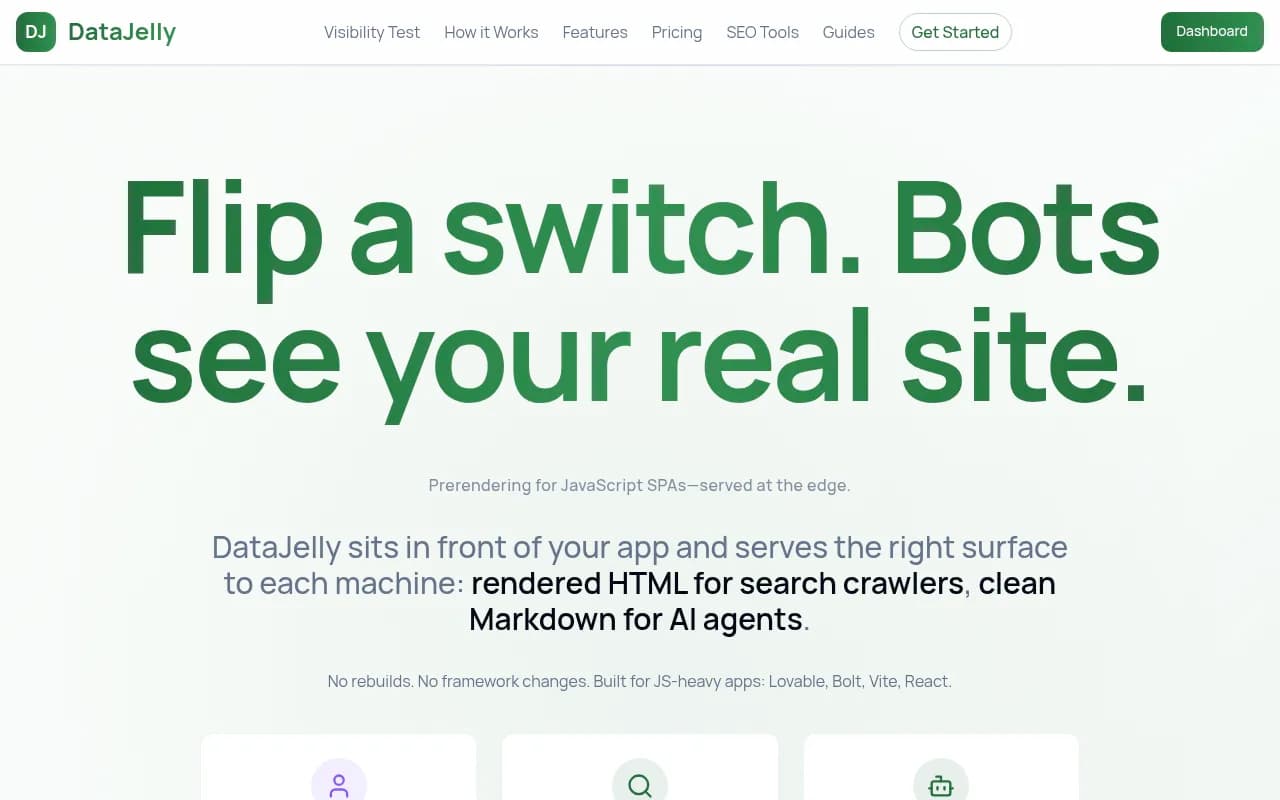
DataJelly is the easiest Prerender.io alternative—no middleware, no code changes, just a DNS update. It sits at the edge and serves the right format to each visitor: your live app for humans, rendered HTML for search crawlers, clean Markdown for AI bots.
Built specifically for JavaScript-heavy apps (React, Lovable, Bolt, v0, Vite), DataJelly solves the rendering problem in minutes. Point your DNS to DataJelly, and it automatically generates snapshots of your routes. Search engines get fully-rendered HTML. AI models like ChatGPT and Claude get structured Markdown extracts—cleaner input that reduces token overhead and improves citation accuracy.
The free visibility test is genuinely useful: paste your URL and see exactly what Google, Bing, ChatGPT, and Perplexity receive compared to what humans see. Shareable report links make it easy to diagnose indexing issues.
DataJelly's edge: it's purpose-built for modern AI builders. If you're shipping apps with Lovable, Bolt, or Cursor, DataJelly handles rendering without touching your workflow. No server-side rendering refactor. No middleware layer. Just DNS and done.
Pricing: Free tier (10 pages, weekly snapshots), Starter $19/mo (100 pages, daily snapshots), Pro $79/mo (1,000 pages). Significantly cheaper than Prerender.io for small to mid-sized sites.
Best for: Developers building with Lovable, Bolt, v0, or any JavaScript framework who want the fastest setup. Teams that need AI-optimized Markdown output, not just HTML. Budget-conscious projects that can't justify $90+/month.
Trade-offs: Newer platform with a smaller customer base than Prerender.io. Snapshot frequency is lower on free and starter tiers (weekly/daily vs. real-time rendering). Less enterprise-focused—no dedicated account management or SLAs.
Screaming Frog
Screaming Frog isn't a rendering service—it's a desktop SEO spider that crawls your site and surfaces technical issues. But it's essential for diagnosing why your JavaScript site isn't indexing properly, even with rendering in place.
The tool crawls like Googlebot, executing JavaScript and rendering pages to show you what search engines actually see. It flags broken links, missing meta tags, redirect chains, duplicate content, slow-loading resources, and indexing blockers. The JavaScript rendering mode uses Chromium to mimic how Google processes SPAs.
Where Screaming Frog excels: speed and depth. It can crawl thousands of URLs in minutes, export detailed reports, and integrate with Google Analytics, Search Console, and PageSpeed Insights. The free version (up to 500 URLs) is enough for most small sites. The paid license ($259/year) unlocks unlimited crawling, scheduling, and advanced features.
Screaming Frog complements rendering tools—it doesn't replace them. Use it to audit your site before and after implementing Prerender.io, DataJelly, or another solution. It shows you exactly what's broken and whether your rendering fix is working.
Pricing: Free up to 500 URLs, $259/year for unlimited crawling. One-time payment, no monthly fees.
Best for: SEO teams and agencies that need deep technical audits. Developers debugging indexing issues. Anyone who wants to see their site through Googlebot's eyes before investing in a rendering solution.
Trade-offs: Desktop-only (Windows, Mac, Linux)—no cloud-based crawling. Requires technical knowledge to interpret results. Doesn't solve rendering problems—it just identifies them.
Botify
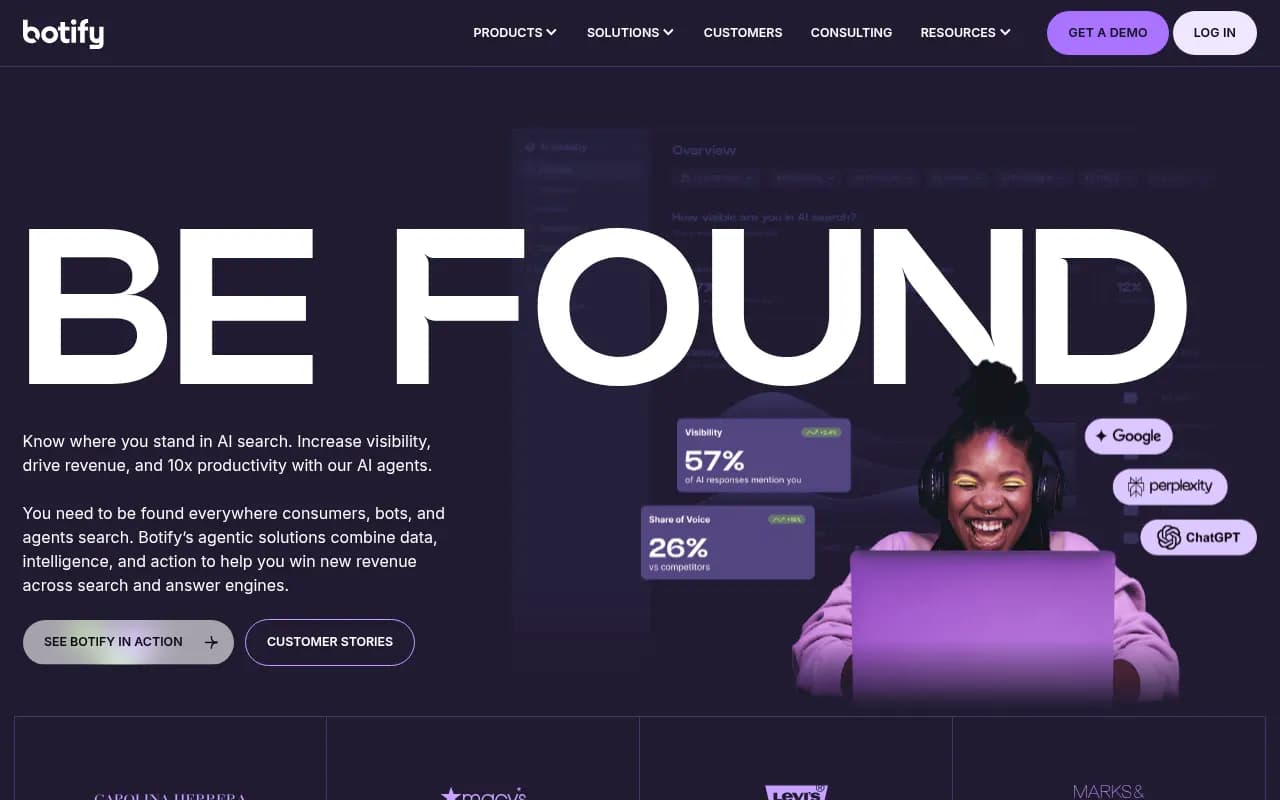
Botify is an enterprise AI search optimization platform that combines deep technical SEO, AI visibility tracking, and agentic automation. It's not a simple rendering proxy—it's an end-to-end solution for brands that need to control their presence across Google, ChatGPT, Perplexity, Claude, and other AI engines.
Botify's core strength: it connects the dots between crawlability, indexing, AI citations, and revenue. The platform analyzes log files to see exactly how search and AI bots interact with your site, identifies technical blockers, and uses AI agents to automate fixes. The AI Visibility module tracks how your brand appears in AI-generated answers and recommendations, similar to Promptwatch but with tighter integration into the broader SEO workflow.
What sets Botify apart from Prerender.io: it's not just rendering. Botify handles JavaScript rendering as part of a larger optimization stack that includes crawler log analysis, content gap identification, automated metadata generation, internal linking optimization, and ROI attribution. The platform is built for large sites (thousands to millions of pages) with complex technical requirements.
In a 2025 Forrester Wave report, Botify was named a Strong Performer in SEO solutions. The platform is used by enterprise brands like Ralph Lauren, Farfetch, and L'Oréal. Expect a 30-day time-to-value and 5x ROI within 3 years, according to Botify's customer data.
Pricing: Custom enterprise pricing—expect $10k-$50k+/month depending on site size, features, and contract length. Annual commitments standard. Not suitable for small businesses or startups.
Best for: Enterprise brands with large, complex sites (e-commerce, publishing, SaaS). Teams that need end-to-end AI search optimization, not just rendering. Organizations with dedicated SEO and engineering resources.
Trade-offs: Expensive and complex—overkill for small sites or teams without technical SEO expertise. Longer implementation timeline than plug-and-play rendering tools. Requires buy-in from multiple stakeholders (marketing, engineering, product).
SEO4Ajax
SEO4Ajax is a dynamic rendering service that's been around since before Prerender.io became the market leader. It solves the same core problem: serving pre-rendered HTML snapshots to search engine crawlers and social media bots while preserving the AJAX experience for human visitors.
SEO4Ajax works with any JavaScript framework (React, Vue, Angular, Ember, Backbone) and any server stack (Apache, nginx, PHP, Java, Ruby, Python, Node.js). The setup requires a few lines of configuration—more involved than DataJelly's DNS-only approach, but less complex than self-hosting Rendertron.
The platform is built to scale, handling sites with thousands or millions of pages. It's fully compatible with search engines (Google, Bing, Yandex) and social networks (Facebook, Twitter, Flipboard). The REST API allows for customization and automation.
SEO4Ajax's dashboard provides bot activity insights, cache freshness monitoring, duplicate detection, and broken link reports. It's a solid middle-ground option—more affordable than Prerender.io's higher tiers, more established than newer alternatives like DataJelly.
Pricing: From $39/mo (Project), $132/mo (Growth), $265/mo (Business). Annual billing available at discounted rates. Free trial offered.
Best for: Mid-sized sites that need reliable rendering without enterprise pricing. Teams comfortable with server configuration but not interested in self-hosting. Projects that need REST API access for custom workflows.
Trade-offs: Less modern than DataJelly or LovableHTML—the interface and documentation feel dated. No AI-specific optimizations (Markdown output, citation tracking). Smaller community and fewer integrations than Prerender.io.
LovableHTML
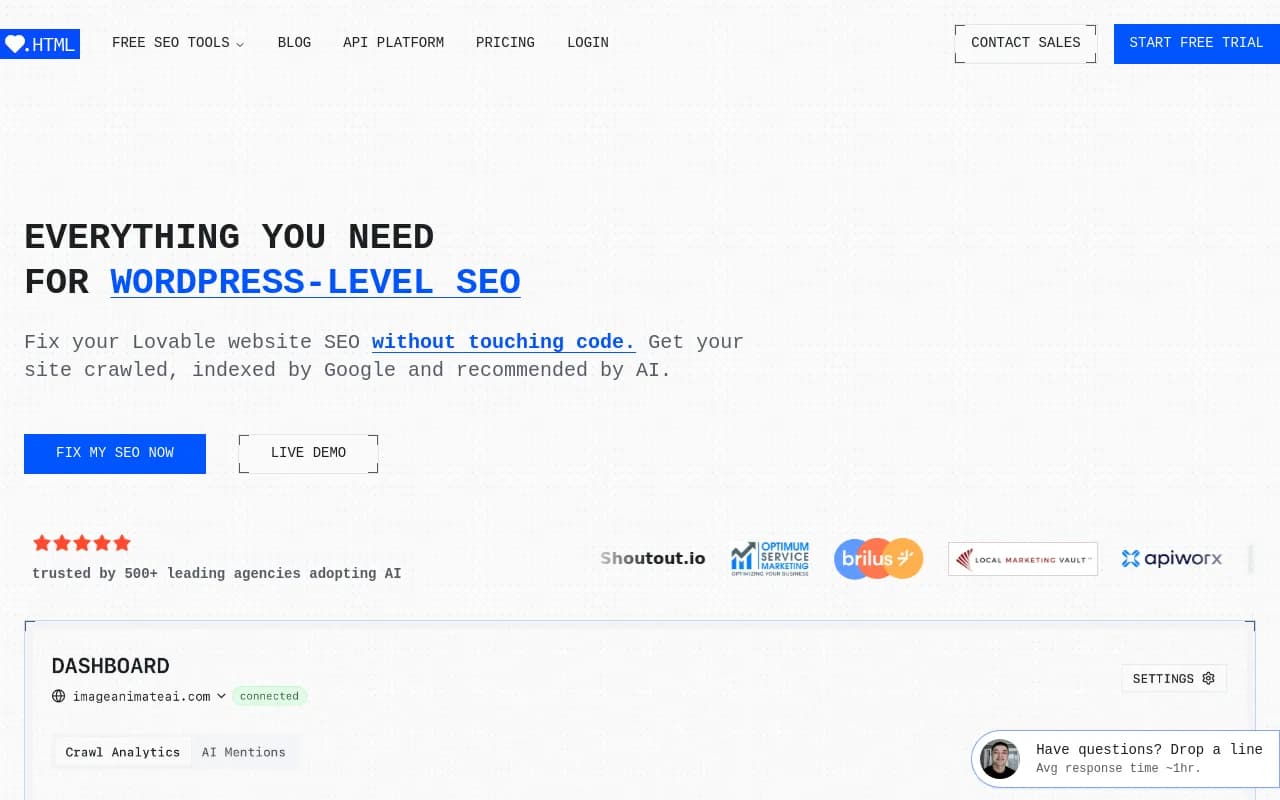
LovableHTML is a pre-rendering service built specifically for AI-generated websites—Lovable, Base44, Rocket.New, and other no-code/low-code builders. It transforms JavaScript-heavy SPAs into SEO-friendly HTML in under 5 minutes with zero code changes.
The setup is DNS-only, just like DataJelly. Point your domain to LovableHTML, and it automatically generates pre-rendered snapshots of your routes. Google, ChatGPT, Claude, and other crawlers get fully-rendered HTML with proper meta tags, canonical URLs, and internal links. Humans see your original app unchanged.
LovableHTML's niche: it's the #1 choice for Lovable.dev builders. The platform is optimized for the specific challenges of AI-built sites—missing H1 tags, empty meta descriptions, incorrect canonicals, and shell-only HTML. The dashboard includes an SEO audit tool that flags these issues and tracks fixes over time.
The service is powered by Cloudflare's edge network, ensuring fast delivery worldwide. Social previews (Open Graph tags) are automatically generated for Slack, Twitter, and LinkedIn. The platform also tracks AI crawler activity, showing which bots are visiting your site and when.
Pricing: Starter $19/mo (1 site), Pro $49/mo (5 sites), Agency $99/mo (20 sites). 14-day free trial. Significantly cheaper than Prerender.io for agencies managing multiple client sites.
Best for: Agencies and freelancers building sites with Lovable, Base44, or other AI tools. Teams that need fast, affordable rendering without technical setup. Projects that prioritize AI search visibility (ChatGPT, Perplexity, Claude).
Trade-offs: Niche focus—less suitable for traditional React/Vue apps built with custom code. Newer platform with a smaller track record than Prerender.io or SEO4Ajax. Limited customization compared to self-hosted solutions.
Rendertron
Rendertron is an open-source headless Chrome rendering solution built by Google. It pre-renders JavaScript-heavy sites on-the-fly using Puppeteer, serializing fully-rendered pages for search engine crawlers and bots.
The key advantage: it's free and self-hosted. You control the infrastructure, data, and rendering logic. No monthly fees, no vendor lock-in, no usage limits. For teams with DevOps resources, Rendertron offers maximum flexibility and cost savings at scale.
The major caveat: Rendertron was archived by Google in October 2022. The repository is read-only, and Google now recommends modern alternatives like dynamic rendering or server-side rendering frameworks (Next.js, Nuxt, SvelteKit). The project still works, but it's no longer maintained—no security patches, no feature updates, no official support.
If you choose Rendertron, you're committing to maintaining it yourself. That means monitoring for vulnerabilities, updating dependencies, scaling infrastructure, and troubleshooting issues without community help. For large organizations with dedicated platform teams, that's manageable. For small teams or startups, it's a significant ongoing cost.
Pricing: Free and open-source. Hosting costs vary (AWS, GCP, Azure, or self-managed servers). Expect to pay for compute, storage, and bandwidth—potentially $100-$500+/month depending on traffic.
Best for: Large organizations with DevOps teams that need full control over rendering infrastructure. Projects with strict data privacy requirements (no third-party services). Teams already running self-hosted infrastructure who can absorb the maintenance burden.
Trade-offs: Deprecated and unmaintained—you're on your own for security and updates. Requires significant technical expertise to deploy, scale, and monitor. No customer support, no SLAs, no guaranteed uptime. Hidden costs in engineering time and infrastructure management.
Netlify Prerender
Netlify isn't a dedicated rendering service—it's a complete web development platform that includes pre-rendering as one of many features. If you're already deploying on Netlify, enabling pre-rendering is a checkbox. If you're not, it's probably overkill just for rendering.
Netlify's pre-rendering works by generating static HTML snapshots at build time for specified routes. It's not dynamic rendering (on-the-fly like Prerender.io)—it's static pre-rendering. That means it works best for sites with a finite number of routes that don't change frequently. E-commerce sites with thousands of dynamic product pages or news sites with constantly updating content are less ideal.
The advantage: if you're building with frameworks like Next.js, Astro, or SvelteKit on Netlify, pre-rendering is built into the deployment workflow. No separate service, no additional cost, no configuration beyond framework settings. Netlify also handles hosting, serverless functions, forms, image optimization, and edge delivery—everything in one platform.
Netlify is used by Meta, Riot Games, Stack Overflow, and thousands of other companies. The free tier (100GB bandwidth, 300 build minutes/month) is generous enough for small projects. Pro plans start at $19/user/month.
Pricing: Free tier available. Pro from $19/user/month. Enterprise custom pricing. Pre-rendering included in all plans—no separate charge.
Best for: Teams already deploying on Netlify who need basic pre-rendering for static or semi-static sites. Developers building with modern frameworks (Next.js, Astro, SvelteKit) that support static generation. Projects that want an all-in-one platform (hosting + rendering + functions + CDN).
Trade-offs: Not a dedicated rendering solution—less flexible than Prerender.io or DataJelly for complex SPAs. Static pre-rendering only (not dynamic on-the-fly rendering). Requires committing to Netlify's ecosystem. Overkill if you just need rendering and already have hosting elsewhere.
How to Choose the Right Alternative
The best Prerender.io alternative depends on your specific needs, budget, and technical resources. Here's a decision framework:
If you need AI visibility tracking and content optimization (not just rendering): Promptwatch is the only platform that shows you what's missing and helps you create content that ranks in ChatGPT, Claude, and Perplexity. Pair it with DataJelly or LovableHTML for rendering.
If you're building with Lovable, Bolt, or AI tools: LovableHTML ($19/mo) is purpose-built for your workflow. DNS-only setup, AI-optimized output, and agency-friendly pricing.
If you want the easiest setup and lowest cost: DataJelly ($19/mo) offers DNS-only configuration, Markdown output for AI bots, and a free tier to test. No middleware, no code changes.
If you need enterprise scale and end-to-end optimization: Botify delivers AI search visibility, technical SEO, and agentic automation—but expect $10k-$50k+/month and a longer implementation timeline.
If you're doing technical SEO audits: Screaming Frog (free up to 500 URLs, $259/year unlimited) is the desktop standard for crawling and diagnosing issues. Use it alongside any rendering solution.
If you need full control and have DevOps resources: Rendertron is open-source and free, but deprecated by Google. Only choose this if you can maintain it yourself.
If you're already on Netlify: Use Netlify's built-in pre-rendering for static sites. For dynamic SPAs, add DataJelly or another dedicated rendering service.
The rendering landscape has matured significantly since Prerender.io launched. In 2026, you have options that are faster to set up, cheaper to run, and better optimized for AI search engines. The right choice depends on whether you're optimizing for cost, speed, control, or AI visibility—and whether you need rendering alone or a complete optimization stack.