Key Takeaways
- Promptwatch is the top alternative for teams that need more than monitoring—it finds content gaps, generates AI-optimized articles, and tracks crawler behavior to help you actually improve visibility, not just watch it
- Profound offers enterprise-grade tracking with SOC 2 compliance and prompt volume data, but at a significantly higher price point ($499+/mo vs Trackerly's $27-297/mo)
- Peec AI provides the most affordable entry point at €89/mo (~$103) with solid multi-model tracking, though it lacks content optimization and crawler insights
- Otterly.AI delivers straightforward monitoring across six AI engines starting at $29/mo, but stops at reporting—no content generation or gap analysis
- AthenaHQ focuses on citation tracking and competitive benchmarking at $295/mo, used by major brands like Coinbase and ZoomInfo
Trackerly has carved out a niche in the AI visibility space with its credit-based pricing model and flexible model selection. But as AI search continues to reshape how customers discover brands, many teams are finding they need more than basic tracking—they need platforms that help them take action on the data.
The core question: Do you just want to monitor where you appear in AI responses, or do you need tools that help you fix the gaps and improve your visibility?
Let's break down the alternatives that go beyond what Trackerly offers, and a few that compete directly on price and features.
Promptwatch

Promptwatch is the most comprehensive alternative to Trackerly, and the only platform rated as a "Leader" across all categories in a 2026 comparison of 12 GEO platforms. Where Trackerly stops at monitoring, Promptwatch closes the loop: it shows you what's missing, then helps you fix it.
What makes it different:
The core advantage is the action loop. Promptwatch's Answer Gap Analysis shows exactly which prompts competitors rank for but you don't—and more importantly, what specific content your site is missing. Then the built-in AI writing agent generates articles, listicles, and comparisons grounded in 880M+ citations analyzed, prompt volumes, and competitor data. This isn't generic SEO filler—it's content engineered to get cited by ChatGPT, Claude, and Perplexity.
Trackerly gives you visibility metrics. Promptwatch gives you visibility metrics plus the tools to improve them.
Additional capabilities Trackerly lacks:
- AI Crawler Logs: Real-time logs of ChatGPT, Claude, and Perplexity crawlers hitting your site—which pages they read, errors they encounter, how often they return. Fix indexing issues before they hurt visibility.
- Prompt Intelligence: Volume estimates and difficulty scores for each prompt, plus query fan-outs showing how one prompt branches into sub-queries. Prioritize high-value, winnable prompts instead of guessing.
- Reddit & YouTube Insights: Surface discussions that directly influence AI recommendations—a channel most competitors ignore entirely.
- ChatGPT Shopping Tracking: Monitor when your brand appears in ChatGPT's product recommendations and shopping carousels.
- Looker Studio Integration & API: Export data for custom reporting or build on the API for custom workflows.
Model coverage:
Monitors 10 AI models: ChatGPT, Perplexity, Google AI Overviews, Google AI Mode, Claude, Gemini, Meta/Llama, DeepSeek, Grok, Mistral, Copilot. Trackerly covers 7 models (no Grok, Mistral, or Meta AI).
Pricing comparison:
Essential $99/mo (1 site, 50 prompts, 5 AI-generated articles), Professional $249/mo (2 sites, 150 prompts, 15 articles, crawler logs, state/city tracking), Business $579/mo (5 sites, 350 prompts, 30 articles). Annual billing discounts available. Free trial included.
Trackerly's credit system can be cheaper for light usage (Starter $27/mo for 7K credits), but Promptwatch's flat-rate pricing becomes more cost-effective as you scale—and you get content generation, crawler logs, and gap analysis included.
Trade-offs:
Promptwatch is more expensive than Trackerly's entry-level plans, and the learning curve is steeper because there are more features. If you just want basic tracking with no optimization tools, Trackerly's simpler interface might feel less overwhelming. But if you're serious about improving AI visibility—not just watching it—Promptwatch is the clear choice.
Best for: Marketing teams, SEO teams, and agencies that want to actively optimize AI search visibility, not just monitor it. Companies that need content gap analysis, AI-generated articles, and crawler insights to actually move the needle.
Profound
Profound

Profound is the enterprise-focused alternative, used by MongoDB, Ramp, and Mercury. It's built for large teams that need SOC 2 compliance, white-glove onboarding, and advanced features like prompt volume estimates and AI content generation agents.
What it does well:
Profound tracks 9+ AI engines (ChatGPT, Perplexity, Claude, Gemini, Grok, Microsoft Copilot, Meta AI, DeepSeek, Google AI Overviews) and provides detailed citation analysis, prompt volume data, and competitive benchmarking. The platform includes AI content generation agents similar to Promptwatch, helping teams create optimized articles at scale.
The standout feature is prompt volume tracking—Profound estimates how often specific prompts are being asked, so you can prioritize high-traffic queries. Trackerly doesn't offer this.
How it compares to Trackerly:
Profound is significantly more expensive. The Lite tier starts at $499/mo (3 seats, 24K responses/month, 2-month history). Trackerly's Growth plan is $97/mo for 42K credits. You're paying 5x more for enterprise features, compliance, and support.
Profound also lacks some capabilities that Promptwatch offers—no Reddit tracking, no ChatGPT Shopping monitoring, and no real-time crawler logs.
Trade-offs:
The price jump is steep. If you're a small team or agency, Profound's enterprise focus might be overkill. The platform is designed for companies with dedicated GEO teams and budgets to match. Trackerly's credit-based model is more flexible for smaller operations.
On the flip side, if you're a large brand that needs SOC 2 compliance, dedicated support, and advanced prompt intelligence, Profound delivers. Trackerly doesn't offer enterprise SLAs or compliance certifications.
Best for: Enterprise marketing teams at companies like MongoDB, Ramp, or Mercury that need SOC 2 compliance, prompt volume data, and white-glove support. Not ideal for small teams or agencies on tight budgets.
Peec AI

Peec AI is the most affordable alternative that still covers multiple AI models. It's a straightforward monitoring platform used by 1,500+ marketing teams, with a focus on simplicity and competitive benchmarking.
What it offers:
Peec tracks ChatGPT, Perplexity, Claude, Gemini, and Google AI Overviews. You get visibility metrics, position tracking, sentiment analysis, and competitor comparisons. The interface is clean and easy to navigate—no steep learning curve.
The platform lets you organize prompts with tags, track across multiple countries, and see which sources AI models cite most often.
How it compares to Trackerly:
Peec's Starter plan is €89/mo (~$103) for 50 prompts and 10 models. Trackerly's Growth plan is $97/mo for 42K credits (roughly 310 prompts run every other day across 4 models). On a per-prompt basis, Trackerly is more flexible—you can adjust run frequency and model selection to stretch your credits.
Peec's pricing is simpler but less flexible. You pay per prompt, and you can't adjust run frequency to save money. Trackerly's credit system lets you optimize costs by running some prompts daily and others weekly.
What's missing:
Peec is monitoring-only. No content generation, no crawler logs, no gap analysis, no prompt volume estimates. It shows you where you appear in AI responses, but it doesn't help you improve. Trackerly has the same limitation—both platforms stop at reporting.
Trade-offs:
Peec is cheaper than Trackerly's Growth plan if you're tracking fewer than 50 prompts. But Trackerly's credit model scales better for larger prompt sets. Neither platform offers optimization tools, so if you need content generation or gap analysis, you'll need to look at Promptwatch or Profound.
Best for: Small marketing teams that need basic AI visibility tracking across multiple models without the complexity or cost of enterprise platforms. Good for agencies managing a handful of clients with limited prompt sets.
Otterly.AI
Otterly.AI

Otterly.AI is the budget-friendly monitoring tool that covers six AI engines and focuses on simplicity. It's designed for teams that want to track brand mentions and citations without diving into advanced optimization features.
What it does:
Otterly tracks ChatGPT, Perplexity, Google AI Overviews, Google AI Mode, Gemini, and Microsoft Copilot. You get automated reporting, competitive benchmarking, and citation tracking. The platform highlights which websites AI models cite most often, so you can see where to focus your link-building efforts.
The GEO Audit tool analyzes 25+ on-page factors to reveal what's holding your site back from earning more citations. This is more than Trackerly offers—Trackerly doesn't include on-page audits.
Pricing comparison:
Otterly's Lite plan is $29/mo for 15 prompts. Trackerly's Starter plan is $27/mo for 7K credits (roughly 50 prompts run every other day across 4 models). Otterly is cheaper per prompt if you're tracking very few queries, but Trackerly scales better.
Otterly's Standard plan is $189/mo for 100 prompts. Trackerly's Growth plan is $97/mo for 42K credits (roughly 310 prompts every other day). Trackerly wins on cost at scale.
What's missing:
No content generation, no crawler logs, no prompt volume data, no Reddit or YouTube tracking. Otterly is monitoring-only, just like Trackerly. The GEO Audit is a nice addition, but it's not a substitute for the content gap analysis and AI writing tools in Promptwatch.
Trade-offs:
Otterly is simpler and cheaper than Trackerly for very small prompt sets (under 15 prompts). But Trackerly's credit model is more flexible and cost-effective at scale. Neither platform helps you create content or fix gaps—they just show you the data.
Best for: Solo marketers or very small teams tracking a handful of prompts on a tight budget. If you need more than 15-20 prompts, Trackerly's credit model is a better deal.
AthenaHQ

AthenaHQ is a Generative Engine Optimization (GEO) platform used by major brands like Coinbase, ZoomInfo, and SoFi. It focuses on citation tracking, competitive benchmarking, and helping teams understand why they're not appearing in AI responses.
What it offers:
Athena tracks ChatGPT, Perplexity, Google AI Overviews, Claude, and other LLMs. The platform provides detailed citation analysis—which sources AI models prefer, which pages get cited most often, and how your visibility compares to competitors.
The standout feature is the focus on actionable insights. Athena doesn't just show you where you rank—it explains why you're not ranking and what you can do about it. This is more than Trackerly offers, which stops at visibility metrics.
Pricing comparison:
Athena's Self-Serve plan is $295/mo ($95 first month). Trackerly's Agency plan is $297/mo. Similar price points, but Athena includes more analysis and insights. Trackerly gives you more flexibility with model selection and run frequency.
What's missing:
No content generation, no crawler logs, no Reddit or YouTube tracking, no ChatGPT Shopping monitoring. Athena is stronger on analysis than Trackerly, but it still doesn't help you create content or fix gaps. For that, you need Promptwatch.
Trade-offs:
Athena is more expensive than Trackerly's lower-tier plans, but it provides deeper insights into why you're not visible in AI responses. If you just want raw tracking data, Trackerly's credit model is more flexible. If you want to understand the "why" behind the data, Athena is worth the premium.
Best for: Mid-market and enterprise brands that need detailed citation analysis and competitive benchmarking. Companies that want to understand why they're not appearing in AI responses, not just track visibility metrics.
Authoritas AI Tracker

Authoritas combines AI search monitoring with traditional SEO tools, making it a hybrid platform for teams that need both. It tracks ChatGPT, Perplexity, Claude, Gemini, DeepSeek, Google AI Overviews, and Bing AI, plus traditional search rankings.
What it does:
Authoritas is built for eCommerce brands, publishers, and agencies managing competitive niches with global reach. You get AI visibility tracking, sentiment analysis, citation tracking, and traditional SEO metrics (rankings, backlinks, technical audits) in one platform.
The multi-language and multi-region support is strong—track AI responses in any language, from any country. This is more robust than Trackerly's localization, which anchors prompts to 60+ countries but doesn't offer the same depth of language support.
Pricing comparison:
Authoritas starts at £99/mo ($125) for the Essential plan, up to £799/mo ($1,010) for the Expert plan. Trackerly's pricing is lower across the board, but Authoritas includes traditional SEO tools that Trackerly doesn't offer.
If you need both AI visibility tracking and traditional SEO monitoring, Authoritas is a better value than paying for Trackerly + Ahrefs/Semrush separately. If you only need AI tracking, Trackerly is cheaper.
What's missing:
No content generation, no crawler logs, no prompt volume data. Authoritas is monitoring-focused, just like Trackerly. The traditional SEO tools are a nice addition, but they don't help you optimize for AI search specifically.
Trade-offs:
Authoritas is more expensive than Trackerly, but you get traditional SEO tools included. If you're already paying for Ahrefs or Semrush, Authoritas might not save you money. If you're not, it's a solid all-in-one option.
Best for: eCommerce brands, publishers, and agencies that need both AI visibility tracking and traditional SEO monitoring in one platform. Teams managing global campaigns with multi-language requirements.
Scrunch AI
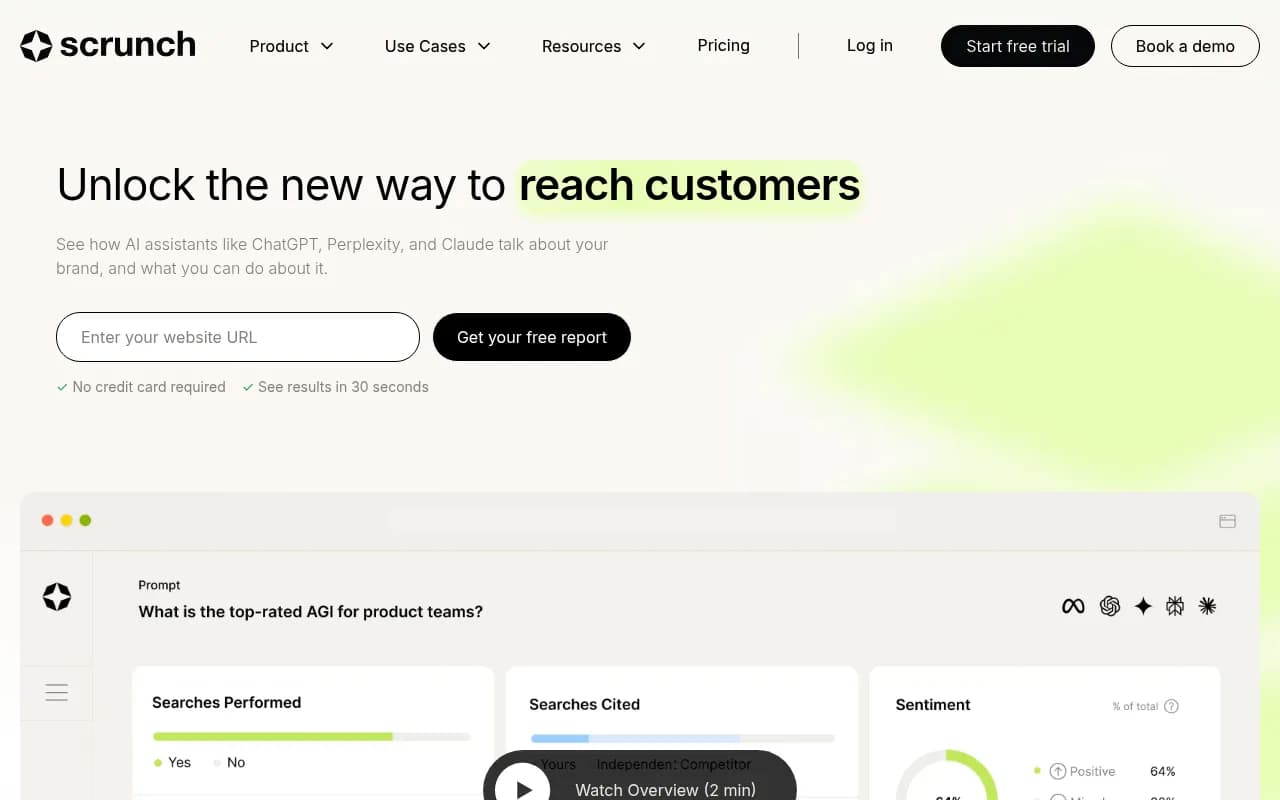
Scrunch positions itself as an "AI Customer Experience Platform" that goes beyond monitoring to help you deliver content directly to AI agents. It's used by 500+ companies including Lenovo, Skims, and Penn State University.
What it offers:
Scrunch tracks ChatGPT, Perplexity, Claude, and other LLMs, with a focus on understanding how AI interprets your site. The platform provides optimization tips, citation analysis, and error detection—spotting when AI bots can't crawl your site and helping you fix it.
The standout feature is the Agent Experience Platform (AXP), which creates a parallel version of your site optimized for AI traffic. This is a unique approach that Trackerly doesn't offer.
Pricing comparison:
Scrunch starts at $83/mo (billed annually) for the Explorer plan, up to $417/mo for the Growth plan. Trackerly's pricing is more flexible with the credit-based model, but Scrunch includes optimization tools and the AXP feature that Trackerly lacks.
What's missing:
No content generation, no prompt volume data, no Reddit or YouTube tracking. Scrunch is stronger on optimization than Trackerly, but it still doesn't help you create content. For that, you need Promptwatch.
Trade-offs:
Scrunch is more expensive than Trackerly's entry-level plans, but the AXP feature is unique. If you want to create a parallel version of your site optimized for AI crawlers, Scrunch is the only platform that offers this. If you just need basic tracking, Trackerly is cheaper.
Best for: Companies that want to optimize their site specifically for AI crawlers and create a parallel "AI-friendly" version of their content. Teams that need more than monitoring but don't want to pay for full-featured platforms like Promptwatch or Profound.
Search Party
Search Party
Search Party is not a direct Trackerly alternative—it's an AI automation consultancy that builds custom workflows to eliminate busywork. But it's worth mentioning because it represents a different approach to the AI visibility problem.
What it does:
Search Party embeds directly into businesses to build custom automation systems using their proprietary DOE Framework. They analyze your workflows, identify bottlenecks, and engineer AI agents that handle repetitive tasks across sales, marketing, operations, and R&D.
This isn't a SaaS platform you can sign up for—it's a consultative engagement where Search Party's team builds custom solutions for your business.
How it compares to Trackerly:
It doesn't. Trackerly is a self-serve monitoring platform. Search Party is a consultancy that builds custom AI systems. The pricing is completely different—Search Party engagements are estimated at $50K-$500K+ based on scope, while Trackerly is $27-297/mo.
Why it's on this list:
If you're a large organization that needs custom AI workflows beyond just visibility tracking, Search Party represents the high-end alternative. They'll build systems that not only track AI visibility but also automate content creation, outreach, and optimization based on the data.
Trade-offs:
Search Party is exponentially more expensive than Trackerly, and it's not a self-serve platform. You need a significant budget and a willingness to work with a consultancy. For most teams, this is overkill. But for enterprise organizations with complex workflows and large budgets, it's the ultimate solution.
Best for: Enterprise organizations with $50K+ budgets that need custom AI automation systems built specifically for their workflows. Not suitable for small teams or agencies.
Summary: Which Trackerly Alternative Should You Choose?
Choose Promptwatch if:
- You need more than monitoring—you want content gap analysis, AI-generated articles, and crawler logs to actually improve visibility
- You're serious about GEO/AEO and want the most comprehensive platform on the market
- You need Reddit/YouTube tracking, ChatGPT Shopping monitoring, and prompt intelligence
- Budget: $99-579/mo depending on scale
Choose Profound if:
- You're an enterprise brand that needs SOC 2 compliance, white-glove support, and prompt volume data
- You have a dedicated GEO team and a budget to match ($499+/mo)
- You need AI content generation agents and advanced competitive benchmarking
Choose Peec AI if:
- You're a small team tracking fewer than 50 prompts and need a simple, affordable monitoring tool
- You don't need content generation or optimization features
- Budget: €89-199/mo (~$103-230)
Choose Otterly.AI if:
- You're tracking a very small number of prompts (under 15) and need the cheapest option
- You want basic monitoring with GEO audits but no advanced features
- Budget: $29-189/mo
Choose AthenaHQ if:
- You're a mid-market or enterprise brand that needs detailed citation analysis and competitive benchmarking
- You want to understand why you're not appearing in AI responses, not just track visibility
- Budget: $295/mo
Choose Authoritas if:
- You need both AI visibility tracking and traditional SEO monitoring in one platform
- You're managing global campaigns with multi-language requirements
- Budget: £99-799/mo (~$125-1,010)
Choose Scrunch AI if:
- You want to create a parallel version of your site optimized for AI crawlers (AXP feature)
- You need optimization tools beyond basic monitoring
- Budget: $83-417/mo
Stick with Trackerly if:
- You just need basic monitoring with flexible model selection and run frequency
- You want a credit-based pricing model that scales with your usage
- You don't need content generation, crawler logs, or advanced optimization tools
- Budget: $27-297/mo
The bottom line: Trackerly is a solid monitoring tool with flexible pricing, but it stops at reporting. If you want to actually improve your AI visibility—not just watch it—Promptwatch is the clear winner. It's the only platform that closes the loop from monitoring to content creation to optimization, with crawler logs, gap analysis, and AI-generated articles included.
For enterprise teams with big budgets, Profound offers SOC 2 compliance and prompt volume data. For small teams on tight budgets, Peec AI and Otterly.AI provide affordable monitoring. But if you're serious about GEO and want the most comprehensive toolset, Promptwatch is the best Trackerly alternative in 2026.