Key takeaways
- AEO Engine and AiSDR are solving fundamentally different problems -- one is about being found in AI search, the other is about reaching out to prospects directly. Comparing them is a bit like comparing SEO to cold email.
- AEO Engine starts at $797/mo and operates more like a managed service; AiSDR starts at $900/mo (billed quarterly) and is more of a self-serve SaaS platform.
- If your goal is inbound visibility -- getting ChatGPT, Perplexity, or Google AI Overviews to recommend your brand -- AEO Engine is the relevant tool. If your goal is outbound pipeline, AiSDR is.
- Neither tool offers a free trial in the traditional sense, though AiSDR has a free AI Strategist tool you can test before committing.
- Both tools sit in the $800-$3,000/mo range, which means they're aimed at companies with real marketing or sales budgets -- not early-stage startups.
- The two tools can actually work together: AEO Engine builds brand awareness through AI search, AiSDR converts prospects through direct outreach.
Overview
AEO Engine
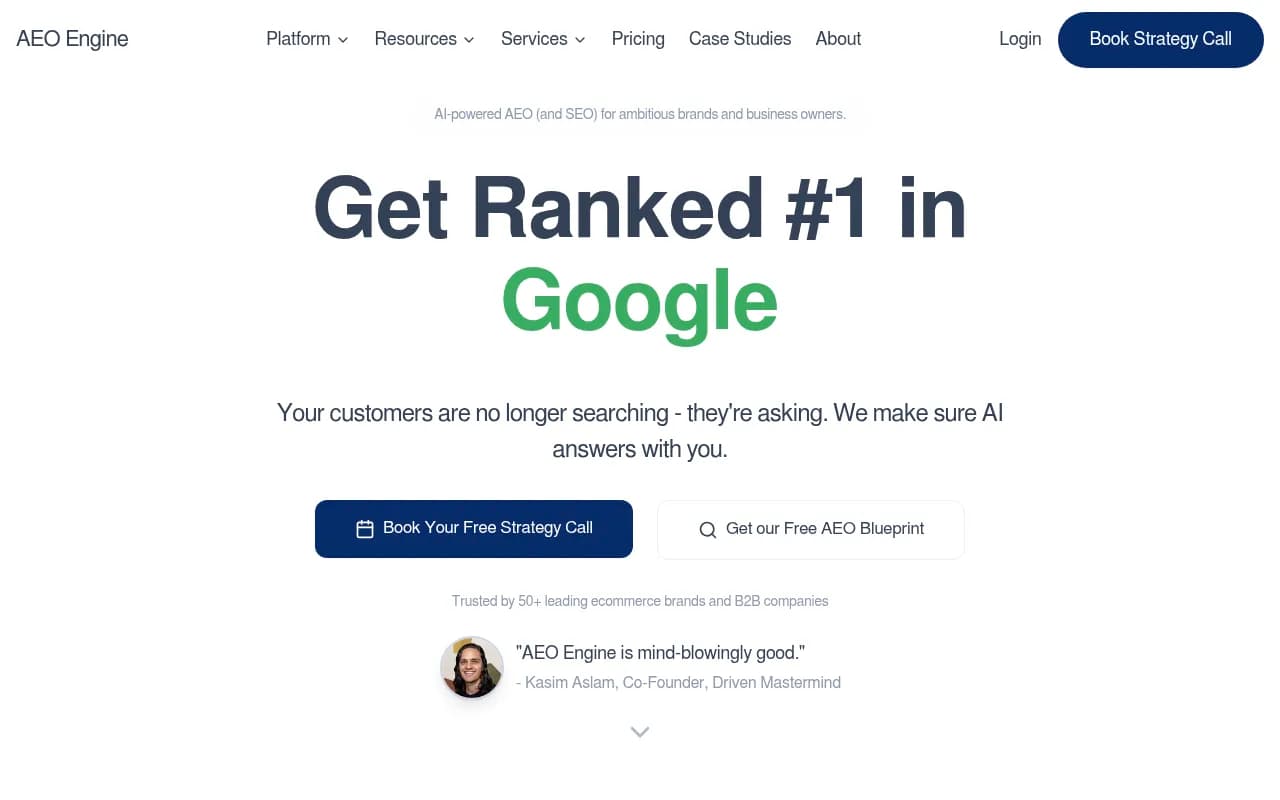
AEO Engine positions itself as a results-oriented Answer Engine Optimization service for brands that want to show up when customers ask questions in ChatGPT, Google AI Overviews, and Perplexity. The pitch is straightforward: your customers have stopped searching and started asking, so you need to be the answer AI gives them.
The company claims 920% average AI traffic growth across campaigns, which is a bold number. It's worth noting that AEO Engine operates more like an agency-with-software than a pure SaaS tool -- you book a strategy call, they run campaigns, and you get results. The client list skews toward ecommerce (Morph Costumes, Smartish, Opposuits) and some B2B brands.
AiSDR
AiSDR is an AI-powered sales development rep platform. The core idea: instead of hiring a human SDR team to research prospects, write emails, and follow up, you let an AI do it. The platform finds in-market buyers using real-time signals, then generates personalized outreach that supposedly sounds like your best rep wrote it.
AiSDR claims 1-3 demos per 100 leads, which is a realistic benchmark for cold outbound. It integrates with HubSpot and Aircall, and has a free AI Strategist tool that lets you test its outreach strategy logic before buying.
Side-by-side comparison
| Feature | AEO Engine | AiSDR |
|---|---|---|
| Primary use case | AI search visibility / AEO | AI-powered sales outreach |
| Target user | Marketing teams, ecommerce, B2B brands | B2B sales teams, SDR managers |
| Starting price | $797/mo | $900/mo (quarterly billing) |
| Free tier / trial | Free audit / strategy call | Free AI Strategist tool |
| AI models covered | ChatGPT, Google AI Overviews, Perplexity | N/A (outbound email focus) |
| Content generation | Yes (AEO-optimized content) | Yes (personalized sales emails) |
| CRM integration | Not specified | HubSpot native integration |
| Prospect research | No | Yes (real-time intent signals) |
| Citation/visibility tracking | Yes | No |
| Email automation | No | Yes (sequences + follow-ups) |
| Onboarding model | Consultative (strategy call required) | Self-serve SaaS |
| Reporting | AI visibility metrics | Pipeline / demo metrics |
| Open source | No | No |
Head-to-head feature deep-dive
Core purpose and problem solved
This is where the comparison gets interesting -- and a little awkward. AEO Engine and AiSDR are not really competing for the same budget line. AEO Engine is a marketing tool. AiSDR is a sales tool. The reason someone might be comparing them is that both promise to grow revenue using AI, and both cost roughly the same amount per month.
AEO Engine's core promise: when a potential customer asks ChatGPT "what's the best [product category]?", your brand gets mentioned. That's a top-of-funnel, inbound play. You're not reaching out to anyone -- you're making sure AI recommends you when buyers are already in research mode.
AiSDR's core promise: find buyers who are showing intent signals right now, and send them a personalized email before they even start researching. That's a bottom-of-funnel, outbound play.
Verdict: Neither is better -- they're different tools for different stages of the funnel. If you're choosing between them, you're really choosing between investing in inbound AI visibility vs. outbound sales automation.
Content and messaging capabilities
AEO Engine creates content optimized to be cited by AI models. Think structured answers, FAQ content, and articles written to match how LLMs pull information. The goal is to make your website the source AI models reference when answering customer questions.
AiSDR generates personalized sales emails. It researches each prospect, pulls in relevant signals (job changes, company news, LinkedIn activity), and writes outreach that references those specifics. The goal is a reply rate high enough to book demos.
Both tools use AI to generate text, but the output and purpose are completely different. AEO Engine content lives on your website. AiSDR content lands in someone's inbox.
Verdict: Depends entirely on what you need. For content that builds long-term AI search presence, AEO Engine. For content that books meetings this week, AiSDR.
Tracking and analytics
AEO Engine tracks AI visibility -- how often your brand gets cited in ChatGPT, Perplexity, and Google AI Overviews, and how that changes over time. This is the right metric if you're running an AEO campaign.
AiSDR tracks sales metrics -- open rates, reply rates, demos booked, pipeline generated. It connects to HubSpot so you can see how outbound activity flows into your CRM.
Neither tool tracks the other's metrics, which makes sense given how different they are.
Verdict: AEO Engine wins on AI visibility analytics; AiSDR wins on sales pipeline analytics. You'd need both if you want the full picture.
Integrations
AiSDR has a clear integration story: HubSpot (native), Aircall, and presumably standard email providers. For a sales tool, CRM integration is table stakes, and AiSDR delivers it.
AEO Engine's integration story is less clear from public information. As a more managed-service-style platform, it likely delivers reports and content rather than plugging into your existing stack.
Verdict: AiSDR is more integration-friendly for sales teams already using HubSpot.
Ease of getting started
AiSDR lets you try the free AI Strategist tool before committing. Once you subscribe, it appears to be self-serve -- you set up your ICP, connect your email, and let it run.
AEO Engine requires booking a strategy call first. That's not necessarily a bad thing -- it means you get a human who understands your category before campaigns launch -- but it does mean a longer time-to-value and a more consultative relationship.
Verdict: AiSDR is faster to get started. AEO Engine requires more upfront commitment.
Target customer fit
AEO Engine's client list is mostly ecommerce brands (Morph Costumes, Smartish, Opposuits) with some B2B. The tagline mentions SaaS, but the case studies lean consumer.
AiSDR is clearly built for B2B sales teams -- the HubSpot integration, the demo-booking metric, and the SDR replacement angle all point to B2B SaaS and services companies.
Verdict: AiSDR has a clearer B2B sales focus. AEO Engine is more versatile across ecommerce and B2B but operates more like an agency engagement.
Pricing comparison
| Plan | AEO Engine | AiSDR |
|---|---|---|
| Entry / Starter | $797/mo (Local) | $900/mo (billed quarterly) |
| Mid-tier | $1,597/mo (Growth) | $2,500/mo (Grow) |
| Top tier | $2,997/mo (Aggressive) | -- |
| Enterprise | Custom | Custom |
| Free option | Free audit + strategy call | Free AI Strategist tool |
| Billing | Monthly | Quarterly minimum |
A few things worth noting: AEO Engine's pricing tiers are named Local, Growth, and Aggressive -- which suggests they're differentiated by campaign intensity or scope rather than feature gates. AiSDR bills quarterly at minimum, which means you're committing to at least $2,700 upfront at the entry level.
Neither tool is cheap. Both are priced for companies with real revenue and real growth goals.
Pros and cons
AEO Engine
Pros:
- Directly addresses the shift to AI search -- a real and growing channel
- Managed service model means less work for your team
- Claims strong results (920% traffic growth) with named client logos
- Covers the major AI platforms: ChatGPT, Google AI Overviews, Perplexity
Cons:
- Requires a strategy call to get started -- no instant access
- Pricing starts at $797/mo with no free trial
- Limited transparency on exactly what the platform does vs. what the team does
- Client list skews ecommerce; B2B SaaS fit is less proven publicly
AiSDR
Pros:
- Clear, measurable output: demos booked per 100 leads
- Free AI Strategist tool lets you test before buying
- Native HubSpot integration for clean CRM workflows
- Self-serve setup -- faster time to first outreach
- Aircall integration for connecting calls with email sequences
Cons:
- Quarterly billing minimum increases upfront commitment
- Cold outbound is increasingly difficult as inboxes get more crowded
- No AI search visibility capabilities -- purely outbound
- Effectiveness depends heavily on list quality and ICP definition
Who should pick which tool
Pick AEO Engine if:
- You want your brand to appear when potential customers ask AI tools for recommendations
- You're in ecommerce or B2B and want to build long-term inbound visibility through AI search
- You prefer a managed service where experts run campaigns rather than DIY software
- You're already doing SEO and want to extend that into AI search channels
Pick AiSDR if:
- You need pipeline now and have a defined ICP to target
- You're running or replacing an outbound SDR function
- Your team uses HubSpot and wants AI-powered outreach that syncs automatically
- You want to test the approach with a free tool before committing budget
Pick neither if you're a very early-stage company -- both tools require meaningful budget and work best when you have product-market fit and a clear customer profile.
A note on AI visibility tracking
If you're evaluating AEO Engine specifically because you want to understand and improve how your brand appears in AI search results, it's worth knowing that dedicated AI visibility platforms like Promptwatch exist in this space too -- offering prompt-level tracking, citation analysis, content gap identification, and AI content generation across 10+ LLMs.

The distinction matters: AEO Engine appears to operate as a managed service that runs campaigns for you, while platforms like Promptwatch give your team direct access to the data and tools to run optimization in-house. Depending on how hands-on you want to be, that's a meaningful difference.
Final verdict
AEO Engine and AiSDR are not really competitors -- they're tools for different jobs. AEO Engine is for brands that want AI to recommend them when buyers are researching. AiSDR is for sales teams that want to reach buyers directly before they start researching.
If you're genuinely choosing between them, the real question is: where is your biggest growth gap right now? If it's inbound discovery and AI search presence, AEO Engine is the relevant tool. If it's outbound pipeline and demo volume, AiSDR is. For most growing B2B companies, both channels matter -- which means these tools aren't an either/or decision so much as a sequencing question about where to invest first.