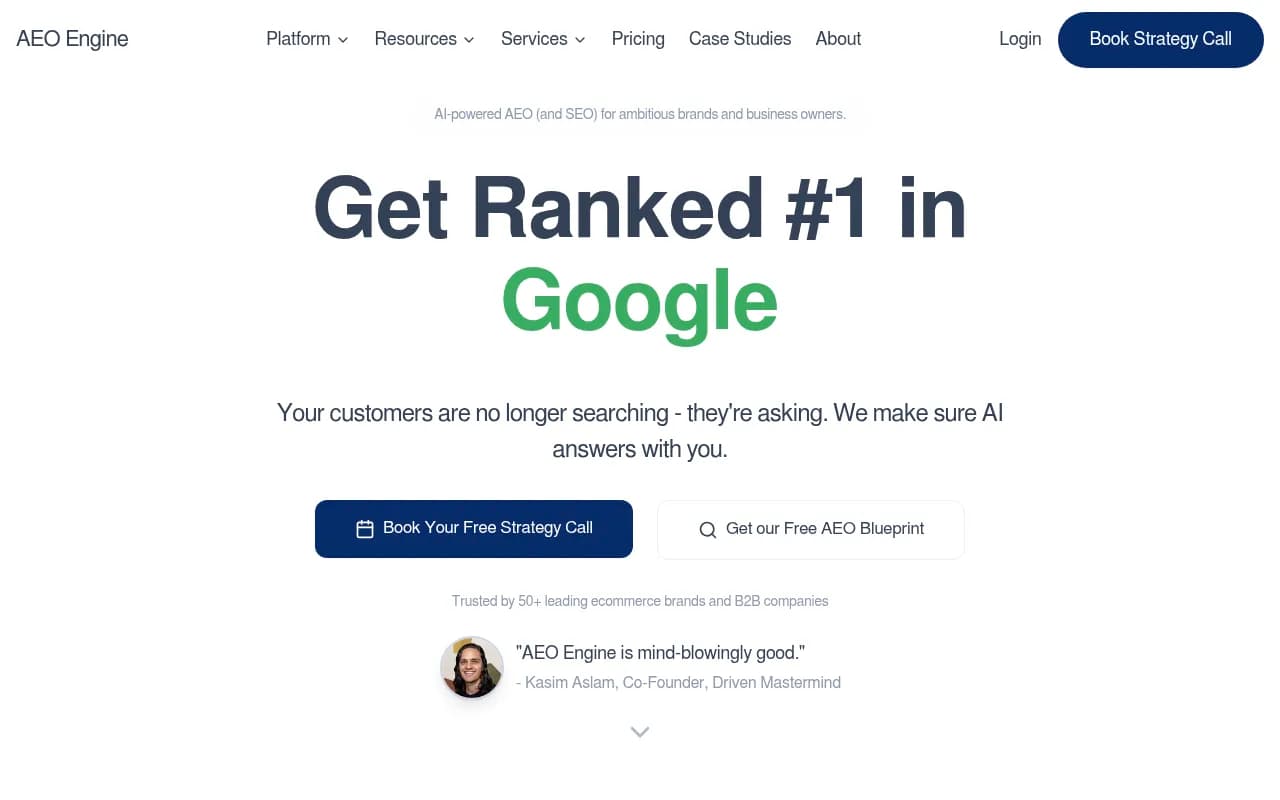
AEO Engine Review 2026
Answer Engine Optimization platform designed for SaaS teams, tracking AI citations, measuring brand visibility, and optimizing content for LLM responses.
Key takeaways
- AEO Engine is a managed service, not a self-serve SaaS platform -- you're buying an agency that runs AI-powered systems on your behalf, not a dashboard you log into
- Competes directly with Promptwatch in the AI visibility space, but takes a fundamentally different approach: done-for-you execution vs. self-serve optimization tooling
- Lacks the self-serve monitoring, content gap analysis, AI crawler logs, prompt volume data, and traffic attribution that Promptwatch provides -- you're dependent on their team for visibility into what's actually happening
- Strong case study portfolio with specific numbers (920% LLM traffic growth, 2,869% organic traffic for one pet brand) across ecommerce and B2B verticals
- Pricing starts at $797/month for local businesses and goes to $2,997/month for the "Aggressive" tier, with custom enterprise pricing above that
AEO Engine is a managed Answer Engine Optimization service built around the premise that most businesses don't have the time or expertise to optimize for AI search on their own. Founded by Vijay Jacob (who also founded ProductScope AI, used by 50,000+ brands) and Dan Ashburn (founder of Titan Network, an Inc. 5000 Amazon mastermind community), the company positions itself as an "agentic" system -- meaning AI agents handle content creation, optimization, schema markup, link building, and reporting on a continuous basis, rather than a human team doing monthly deliverables.
The core pitch is straightforward: AI search engines like ChatGPT, Perplexity, and Google AI Overviews are increasingly the first stop for buyer research, and most brands have no presence there. AEO Engine claims to fix that by combining traditional SEO fundamentals with the structural signals, authority building, and content patterns that make AI models more likely to cite a brand in their responses.
The target audience is primarily ecommerce brands (especially Shopify and DTC), B2B SaaS companies, and local businesses that want to appear in AI-generated answers but don't want to build an in-house capability to do it. The service has been running long enough to accumulate a meaningful case study library, with clients including Morph Costumes, Smartish, and Gourmend Foods.
Key features
Agentic content system The centerpiece of AEO Engine's offering is what they call an "agentic" content pipeline -- a network of AI agents that research topics, write content, publish it with AEO-optimized schema, and distribute it across social and discovery platforms. The idea is that content freshness is a ranking signal for LLMs, so the system keeps publishing and updating rather than doing a one-time optimization pass. In practice, this means clients on the Growth plan get daily optimized content published, while the Local plan gets weekly content. The Aggressive plan doubles the content volume.
Schema markup and structured data AEO Engine puts significant emphasis on schema governance -- not just adding basic schema tags but building what they describe as "adaptive data structure built for AI comprehension." This includes FAQ schema, entity markup, and structured content that helps AI models parse and cite specific answers from a page. For ecommerce clients, this extends to product schema that can surface in ChatGPT's shopping recommendations.
Authority building across AI-trusted platforms A notable part of the service is off-page work on platforms that AI models specifically draw from: Reddit, Quora, and LinkedIn. The rationale is that AI engines like ChatGPT and Perplexity frequently cite Reddit threads and Quora answers, so building presence there creates citation pathways that pure on-site optimization misses. This is included from the Growth plan upward.
Technical SEO foundation AEO Engine doesn't treat SEO and AEO as separate tracks. The service includes full technical SEO: crawlability fixes, metadata optimization, internal linking automation, and site structure improvements. The argument is that AI models can't cite content they can't crawl, so technical SEO is a prerequisite for AEO results.
AI visibility tracking All plans include some form of AI visibility tracking across ChatGPT, Perplexity, and Google AI Overviews. The reporting covers how often AI recommends the brand, traffic driven from AI sources, and keyword ranking wins. However, this is delivered as a managed reporting output rather than a self-serve dashboard -- clients receive weekly reports rather than logging into a platform to pull their own data.
Backlink and authority campaigns Link building is included across all tiers, scaling from "starter backlinks" on the Local plan to "expanded backlink campaigns" and "broader social syndication" on the Aggressive plan. The framing is around building trust signals that both Google and AI models use to evaluate authority.
Research agents (Agent Odyssey) AEO Engine references a proprietary research system called "Agent Odyssey" for topical mapping and keyword analysis. This is described as uncovering every growth opportunity across a client's market -- essentially the keyword and topic research layer that feeds the content pipeline.
Reporting agents Weekly reporting is included across all plans, tied to revenue performance metrics rather than just rankings. The reporting covers organic traffic, LLM traffic specifically, and where possible, revenue attribution. The case studies show specific LTV numbers (e.g., +$549K LTV for Cornish Seaweed Bath), suggesting they do connect visibility to revenue outcomes.
Who is it for
AEO Engine's sweet spot is ecommerce brands with established products that are losing discovery traffic to AI search. A Shopify brand selling in a competitive category (pet supplements, kitchen accessories, fashion) that's seen organic traffic plateau while AI-generated answers increasingly answer their customers' questions -- that's the core use case. The case studies are dominated by exactly this profile: DTC brands with physical products, 4-month engagements, and traffic growth measured in multiples rather than percentages.
B2B SaaS companies are a secondary but growing focus. The pitch here is that software buyers now ask ChatGPT "what's the best project management tool for a 10-person team" before they ever Google it, and SaaS brands that aren't cited in those answers are invisible at the top of the funnel. AEO Engine's approach -- building topical authority, earning citations on comparison sites and forums, and structuring content for AI comprehension -- maps reasonably well to this use case, though the case study evidence for SaaS is thinner than for ecommerce.
Local businesses (dental clinics, law firms, home services) are served by the $797/month Local plan, which is a more affordable entry point but is explicitly scoped to regional visibility rather than national reach.
Who should probably not use AEO Engine: companies that want self-serve access to their own data, teams that want to run experiments and iterate quickly, or organizations that need to understand the mechanics of what's being done on their behalf. This is a "hand it over and trust the system" service. If you want to see your prompt-level visibility data, run your own queries, analyze which specific pages are being cited, or understand why a competitor is outranking you in a particular AI model -- you need a platform like Promptwatch, not a managed service. AEO Engine's reporting is a weekly summary, not a live analytics environment.
Integrations and ecosystem
AEO Engine is a managed service rather than a software platform, so the integration story is different from a typical SaaS tool. The service works with whatever CMS the client is on -- Shopify, WooCommerce, WordPress, and custom builds are all mentioned. Content is published directly to client sites, and schema is implemented at the site level.
There's no public API, no Zapier integration, and no browser extension. The service doesn't appear to offer a client-facing dashboard for real-time data access. Reporting is delivered as weekly summaries, and strategy reviews happen quarterly on higher-tier plans.
The authority-building component involves creating and managing presence on third-party platforms (Reddit, Quora, LinkedIn), which requires some level of account access or coordination with the client. The specifics of how this is managed aren't detailed publicly.
For clients who want deeper analytics integration, the gap is significant. There's no native connection to Google Search Console, no AI crawler log analysis, and no traffic attribution tooling beyond what standard analytics platforms provide. This is a meaningful limitation for data-driven marketing teams.
Pricing and value
AEO Engine publishes four pricing tiers:
- Local: $797/month -- Core SEO + AEO setup, weekly content, essential schema optimization, starter backlinks, AI visibility tracking. Scoped to regional/local businesses.
- Growth: $1,597/month -- Full SEO + AEO setup, daily content, full schema optimization, Reddit/Quora authority building, advanced AI visibility tracking.
- Aggressive: $2,997/month -- Everything in Growth plus 2x content volume, expanded backlink campaigns, broader social syndication, advanced authority building, strategic performance reviews.
- Custom/Enterprise: Tailored pricing -- Multi-domain, multilingual, dedicated strategy support.
There's no free trial in the traditional sense -- the entry point is a free strategy call and website audit, after which you'd commit to a monthly retainer. The company notes they limit intake to 5 new clients per month, which may be genuine capacity management or a sales tactic.
Compared to traditional SEO agencies, these prices are competitive for the scope of work described. A mid-tier SEO agency doing content, link building, and technical optimization would typically charge $2,000-5,000/month for similar deliverables. AEO Engine's differentiation is the AI-specific layer (schema for AI comprehension, Reddit/Quora authority building, LLM visibility tracking) on top of that foundation.
Compared to self-serve AEO platforms, the pricing is higher but the value proposition is different -- you're buying execution, not just data. Promptwatch's Business plan at $579/month gives you the monitoring, gap analysis, and content generation tools to do this yourself; AEO Engine at $1,597/month does it for you.
Strengths and limitations
What AEO Engine does well:
- The case study portfolio is specific and credible. Numbers like "+2,869% organic traffic" and "+$549K LTV" with named clients and 4-month timeframes are more convincing than vague claims. The breadth of verticals covered (pet products, kitchen accessories, dental marketing, fashion) suggests the system generalizes reasonably well.
- The combined SEO + AEO approach is sensible. Treating them as one system rather than bolting AEO onto a separate track avoids the common failure mode of AEO work that can't be crawled or indexed properly.
- Reddit and Quora authority building is a genuine differentiator from pure on-site optimization services. AI models do cite these platforms heavily, and most SEO agencies ignore them entirely.
- The agentic content pipeline -- daily publishing, freshness updates, schema governance -- is a meaningful operational advantage over agencies doing monthly content drops.
Limitations and honest gaps:
- No self-serve platform means clients are entirely dependent on AEO Engine's reporting for visibility into their own AI search performance. If you want to know which specific prompts your brand appears in, which AI models are citing you, or how your visibility compares to a specific competitor, you can't find out without asking the team. Platforms like Promptwatch give you this data directly, with prompt-level granularity, AI crawler logs, and page-level citation tracking.
- The "monitoring-only" criticism that applies to some AEO tools applies here in reverse -- AEO Engine does execution but provides limited self-serve insight. There's no answer gap analysis you can run yourself, no prompt volume data, no query fan-out analysis, and no AI traffic attribution tooling beyond standard analytics.
- The service model means you're locked into their execution approach. If you want to test a different content angle, change your keyword strategy, or run a quick experiment, you're working through an agency relationship rather than making changes directly.
- Multi-model coverage isn't clearly specified. The website mentions ChatGPT, Perplexity, Google AI Overviews, Grok, and Copilot in various places, but there's no explicit breakdown of which AI models are tracked or how comprehensively. Platforms like Promptwatch explicitly monitor 10+ AI models including Claude, Gemini, DeepSeek, Meta AI, and Mistral.
Bottom line
AEO Engine is a well-constructed managed service for brands that want AI search visibility without building the capability in-house. The case studies are real, the approach is technically sound, and the pricing is reasonable for the scope of work. If you're an ecommerce brand or local business that wants to hand off your AI search strategy to a team that will execute it for you, this is a credible option.
That said, if you want to understand your AI visibility in depth -- which prompts you're winning, which pages are being cited, how you compare to competitors across specific AI models, and what content gaps are costing you citations -- a self-serve platform like Promptwatch gives you that analytical layer that AEO Engine's managed reporting simply doesn't provide. The two aren't mutually exclusive, but for teams that want to own their data and iterate on strategy themselves, the managed service model has real constraints.
Best for: Ecommerce and B2B brands that want done-for-you AEO execution and are comfortable with a managed service relationship rather than self-serve analytics.
Tags:
Frequently asked questions
What is AEO Engine?
How much does AEO Engine cost?
Is there a free trial or free plan?
Who is AEO Engine best suited for?
How does AEO Engine differ from self-serve AEO platforms?
What AI search engines does AEO Engine target?
Similar and alternative tools to AEO Engine