Key takeaways
- AEO Engine is a managed agency service -- you pay for a team to do the work. Ceyo is a self-serve SaaS monitoring tool. These are fundamentally different products despite overlapping goals.
- Ceyo starts at $49/mo. AEO Engine starts at $797/mo. The price gap reflects the service model, not just feature depth.
- If you want someone to handle AI visibility strategy, content creation, and optimization for you, AEO Engine is built for that. If you want a dashboard to track where your brand appears in AI responses, Ceyo is the faster, cheaper path.
- Ceyo is better suited to agencies managing multiple brands. AEO Engine is better for a single brand that wants hands-off execution.
- Neither tool offers deep prompt intelligence, crawler log analysis, or AI traffic attribution -- capabilities that matter if you want to close the loop between AI visibility and actual revenue.
- AEO Engine claims 920% average AI traffic growth across campaigns, which is a bold number worth scrutinizing. Ceyo makes no performance claims -- it just shows you the data.
Overview
AEO Engine
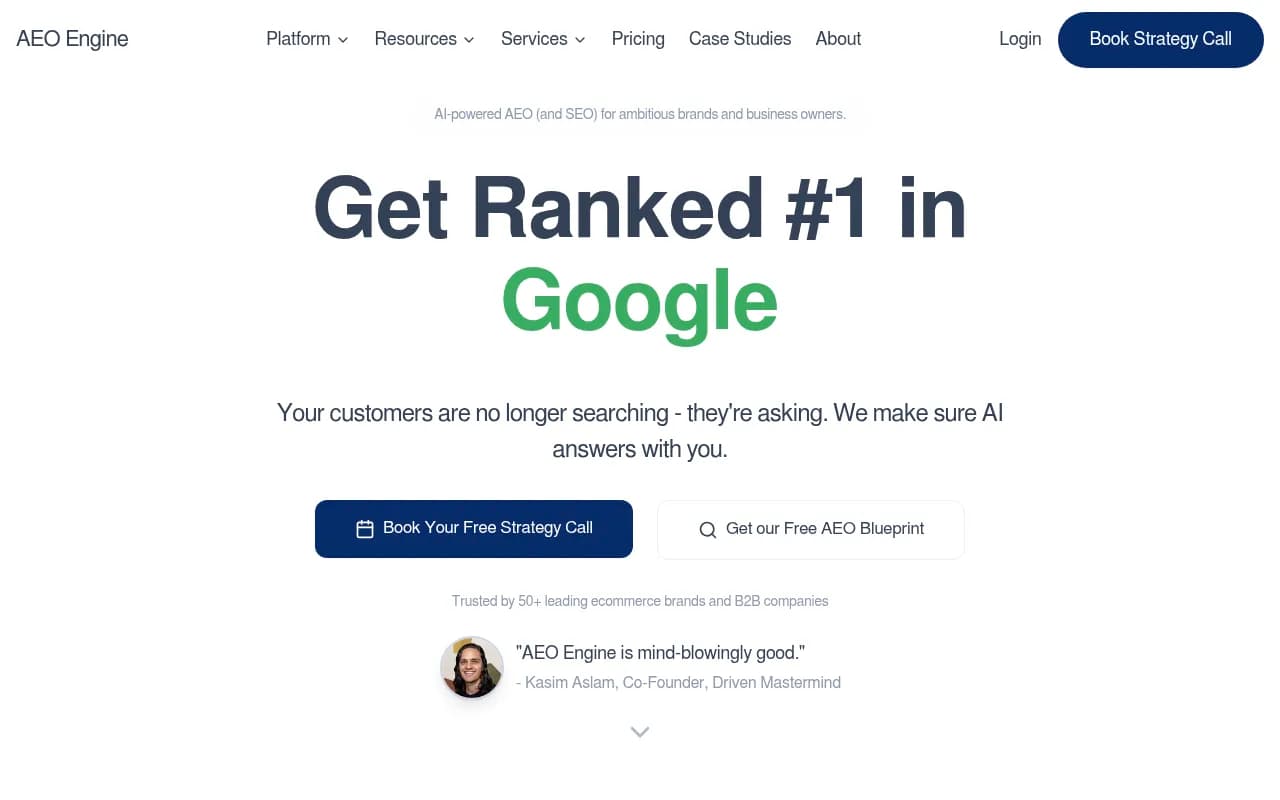
AEO Engine positions itself as a results-oriented AI SEO company for "ambitious brands." The pitch is simple: you hire them, they make AI models recommend you. It's a managed service, not a software platform -- you're buying a team's time and expertise, not a login. Their client list skews toward ecommerce brands (Morph Costumes, Smartish, Opposuits) and some B2B companies. They claim 920% average AI traffic growth across campaigns, which is an eye-catching stat, though it's not independently verified. The service covers ChatGPT, Google AI Overviews, and Perplexity as primary targets.
Ceyo
Ceyo
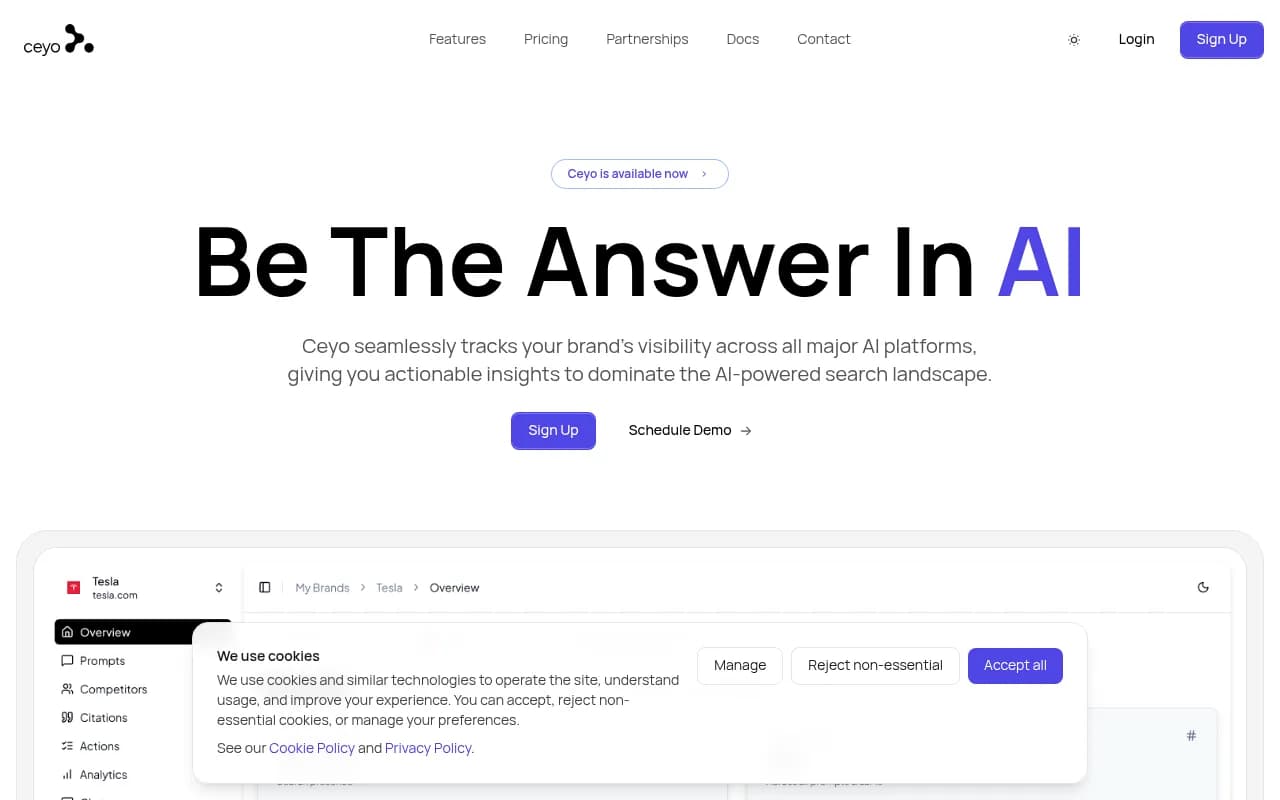
Ceyo is a monitoring platform that tracks how your brand appears across ChatGPT, Gemini, Claude, and Perplexity. It's built for SEO teams, brand managers, and agencies who want daily visibility data without hiring an external team. The interface is designed to be self-serve -- you set up your brand, define your prompts, and Ceyo tracks mentions, sentiment, and competitive positioning. Pricing starts at $49/mo, which makes it accessible for smaller teams or anyone just getting started with AI visibility tracking.
Side-by-side comparison
| Feature | AEO Engine | Ceyo |
|---|---|---|
| Product type | Managed agency service | Self-serve SaaS platform |
| Starting price | $797/mo | $49/mo |
| Free tier / trial | Free audit + strategy call | Free trial available |
| AI models tracked | ChatGPT, Google AI, Perplexity | ChatGPT, Gemini, Claude, Perplexity |
| Content creation | Yes (done-for-you) | No |
| Brand mention monitoring | Yes | Yes |
| Sentiment analysis | Not specified | Yes |
| Competitor tracking | Yes | Yes |
| Agency / multi-brand support | Limited (single brand focus) | Yes |
| Prompt customization | Managed by their team | Self-serve |
| Crawler log analysis | Not specified | No |
| AI traffic attribution | Not specified | No |
| Reporting / dashboards | Managed reports | Self-serve dashboard |
| Target audience | Ecommerce & B2B brands | Agencies, SEO teams, brand managers |
Head-to-head feature deep-dive
Service model
This is the most important difference and it shapes everything else.
AEO Engine is an agency. You're not buying software -- you're buying a team. They handle strategy, content creation, optimization, and reporting. That's valuable if you don't have internal resources or expertise, but it also means you're dependent on their team, their timelines, and their interpretation of what "AI visibility" means for your brand. You don't get a self-serve dashboard to poke around in at 11pm.
Ceyo is the opposite. It's a SaaS tool you control. You define the prompts, you read the data, you decide what to do with it. That requires more internal effort but gives you full transparency and flexibility.
Verdict: Neither is objectively better -- it depends entirely on whether you want to outsource execution or own it internally.
Pricing
| Plan | AEO Engine | Ceyo |
|---|---|---|
| Entry / Core | $797/mo (Local) | $49/mo (Core) |
| Mid-tier | $1,597/mo (Growth) | $89-$199/mo (Pro) |
| Top tier | $2,997/mo (Aggressive) | Custom (Enterprise) |
| Enterprise | Custom | Custom |
The price difference is stark. Ceyo's Core plan at $49/mo is accessible to almost any team. AEO Engine's $797/mo entry point is a real commitment -- and the $2,997/mo "Aggressive" plan is a significant budget line for most companies.
That said, comparing these prices directly is a bit misleading. AEO Engine includes human labor: strategists, writers, and presumably account management. Ceyo is software only. You'd need to factor in your own team's time when using Ceyo.
Verdict: Ceyo wins on price for monitoring. AEO Engine's cost is justified only if you genuinely need managed execution and don't have internal capacity.
AI model coverage
| AI model | AEO Engine | Ceyo |
|---|---|---|
| ChatGPT / OpenAI | Yes | Yes |
| Google AI Overviews | Yes | Not specified |
| Perplexity | Yes | Yes |
| Gemini | Not specified | Yes |
| Claude | Not specified | Yes |
| Meta AI / Llama | Not specified | Not specified |
| DeepSeek | Not specified | Not specified |
Ceyo has a slight edge on model breadth for monitoring -- it explicitly covers Gemini and Claude, which AEO Engine doesn't highlight. AEO Engine focuses on the three highest-traffic AI surfaces (ChatGPT, Google AI, Perplexity), which is a reasonable prioritization for most brands.
Verdict: Ceyo covers more models for monitoring. AEO Engine focuses on the highest-value targets for optimization.
Content creation and optimization
AEO Engine includes content creation as part of every plan. Their team writes and publishes content designed to get cited by AI models. This is the core value proposition -- not just telling you where you're invisible, but actually fixing it.
Ceyo doesn't create content. It's a monitoring tool. If Ceyo shows you that a competitor is getting cited for "best project management software for remote teams" and you're not, you're on your own to figure out what to do about it.
This gap matters a lot. Monitoring without action is just anxiety. If you're using Ceyo, you need either internal content resources or a separate tool to act on what you find. Worth noting that Promptwatch bridges this gap with a built-in AI writing agent that generates content specifically engineered to get cited by AI models -- useful if you want the monitoring-to-optimization loop without hiring an agency.

Verdict: AEO Engine wins here by a wide margin. Content creation is the whole point of optimization, and Ceyo doesn't touch it.
Reporting and transparency
With AEO Engine, you get managed reports -- meaning their team interprets the data and presents it to you. That can be useful if you trust their judgment, but it also means you're not seeing raw data or building your own analysis.
Ceyo gives you a self-serve dashboard with daily updates. You can see brand mentions, sentiment trends, and competitive positioning yourself. That transparency is genuinely valuable for teams that want to understand the data rather than just receive a summary.
Verdict: Ceyo wins for transparency and data ownership. AEO Engine's reporting is more curated, which suits some clients but frustrates others.
Agency and multi-brand support
Ceyo is explicitly built for agencies. It supports monitoring multiple brands, which is the basic requirement for any agency use case. White-label reporting appears to be part of the offering.
AEO Engine is a brand-facing service. You hire them for your brand. It's not designed for an agency to resell or manage on behalf of multiple clients.
Verdict: Ceyo is the clear choice for agencies.
Ease of getting started
Ceyo: Sign up, add your brand, define prompts, start seeing data. Probably a few hours to get meaningful results.
AEO Engine: Book a strategy call, go through an audit, agree on scope, onboard. Likely weeks before you see results.
Verdict: Ceyo is faster to start. AEO Engine requires more upfront commitment.
Pros and cons
AEO Engine
Pros:
- Done-for-you execution -- no internal resources needed
- Includes content creation, not just monitoring
- Focused on the highest-traffic AI surfaces
- Proven client results (though independently unverified)
- Good fit for brands with no internal SEO/content capacity
Cons:
- Expensive entry point ($797/mo minimum)
- No self-serve dashboard or data transparency
- You're dependent on their team's priorities and timelines
- Not suitable for agencies managing multiple clients
- Hard to evaluate ROI without independent data access
Ceyo
Pros:
- Very affordable entry point ($49/mo)
- Self-serve with daily updates
- Covers Gemini and Claude explicitly
- Good for agencies managing multiple brands
- Transparent data you control
Cons:
- Monitoring only -- no content creation or optimization
- Requires internal resources to act on insights
- Smaller company with less established track record
- No crawler log analysis or AI traffic attribution
- You still need a strategy for what to do with the data
Who should pick which tool
Pick AEO Engine if:
- You're a brand (not an agency) with a real budget and no internal AI SEO capacity
- You want someone else to handle strategy, content, and execution
- You're in ecommerce or B2B and want hands-off AI visibility growth
- You're willing to pay $797-$2,997/mo for managed results
Pick Ceyo if:
- You're an agency managing multiple brands' AI visibility
- You want affordable, self-serve monitoring without a long-term agency commitment
- You have internal content resources and just need the data to guide them
- You're early in your AI visibility journey and want to understand the landscape before investing heavily
Final verdict
AEO Engine and Ceyo are solving adjacent problems with completely different approaches. AEO Engine is an agency you hire; Ceyo is a tool you use. The right choice depends less on which has better features and more on what your team actually needs.
If you have budget and no internal capacity, AEO Engine's managed service removes the execution burden. If you want data ownership, agency flexibility, or a lower-cost entry point, Ceyo is the more practical starting point -- just know you'll need to bring your own strategy and content resources to make the monitoring data actionable.