Key takeaways
- AEO Engine is a managed service (they do the work for you); AirOps is a self-serve SaaS platform (you do the work with their tools). This is the most important distinction.
- AirOps is 4-15x cheaper depending on the plan, and it has a free tier. AEO Engine starts at $797/mo with no free option.
- AirOps has stronger content creation and workflow tooling. AEO Engine leans on human expertise and strategy rather than software depth.
- AirOps is used by recognizable SaaS and fintech brands (Webflow, Ramp, Chime, Carta). AEO Engine skews toward ecommerce and SMB brands.
- If you have an in-house content team, AirOps will likely get you more leverage per dollar. If you have no bandwidth and want someone else to handle it, AEO Engine's managed model makes sense.
- Neither tool covers the full AI visibility picture (crawler logs, Reddit/YouTube tracking, prompt volume data, ChatGPT Shopping) the way more comprehensive platforms do.
Overview
AEO Engine
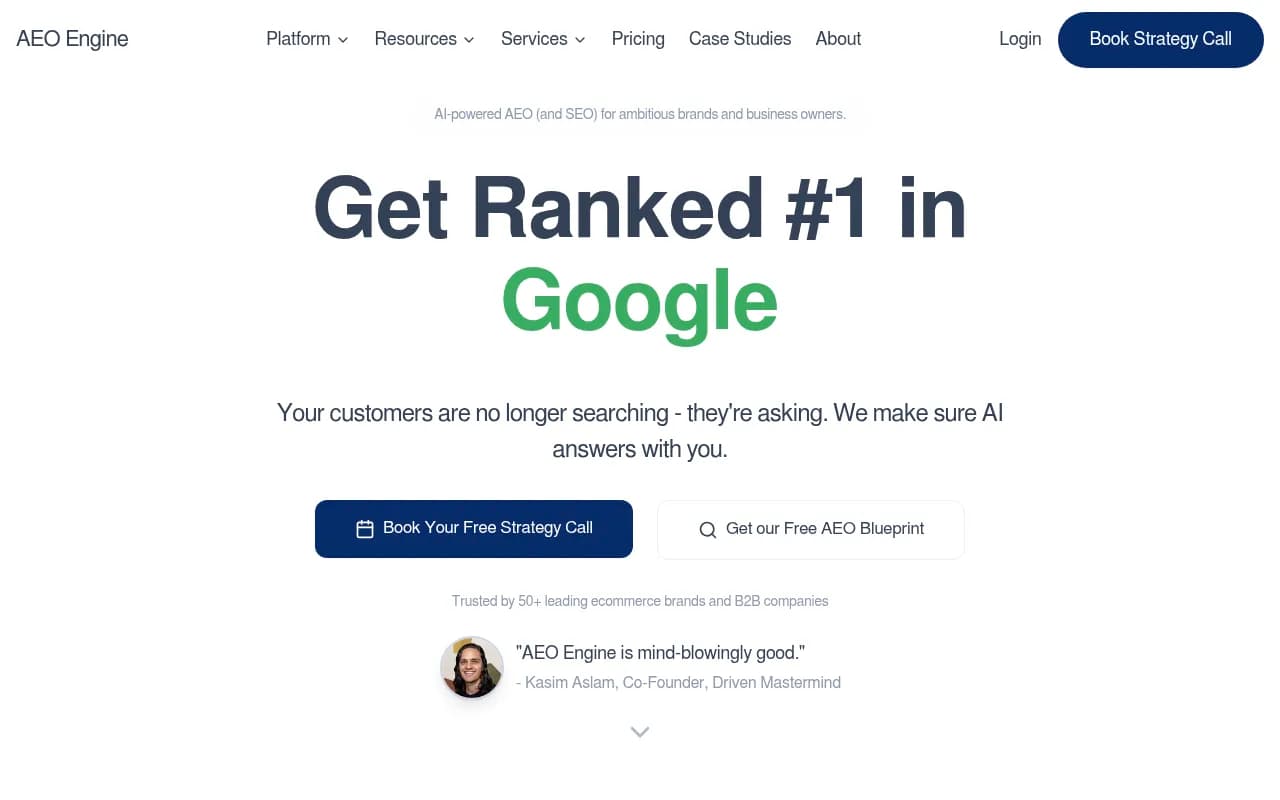
AEO Engine positions itself as a results-oriented AI SEO company, not just a software tool. Their pitch is simple: you pay them, they get your brand cited in ChatGPT, Google AI Overviews, and Perplexity. They claim 920% average AI traffic growth across campaigns, which is a bold number. The client list skews toward ecommerce (Morph Costumes, Smartish, Opposuits) and B2B brands, with 50+ clients listed on their site. Plans run from $797/mo (Local) up to $2,997/mo (Aggressive), with enterprise custom pricing on top of that.
The core model is agency-style: you're buying expert time and strategy, not a dashboard you log into every day. That's a meaningful distinction. You're not getting a self-serve analytics platform -- you're getting a team that runs your AEO program.
AirOps
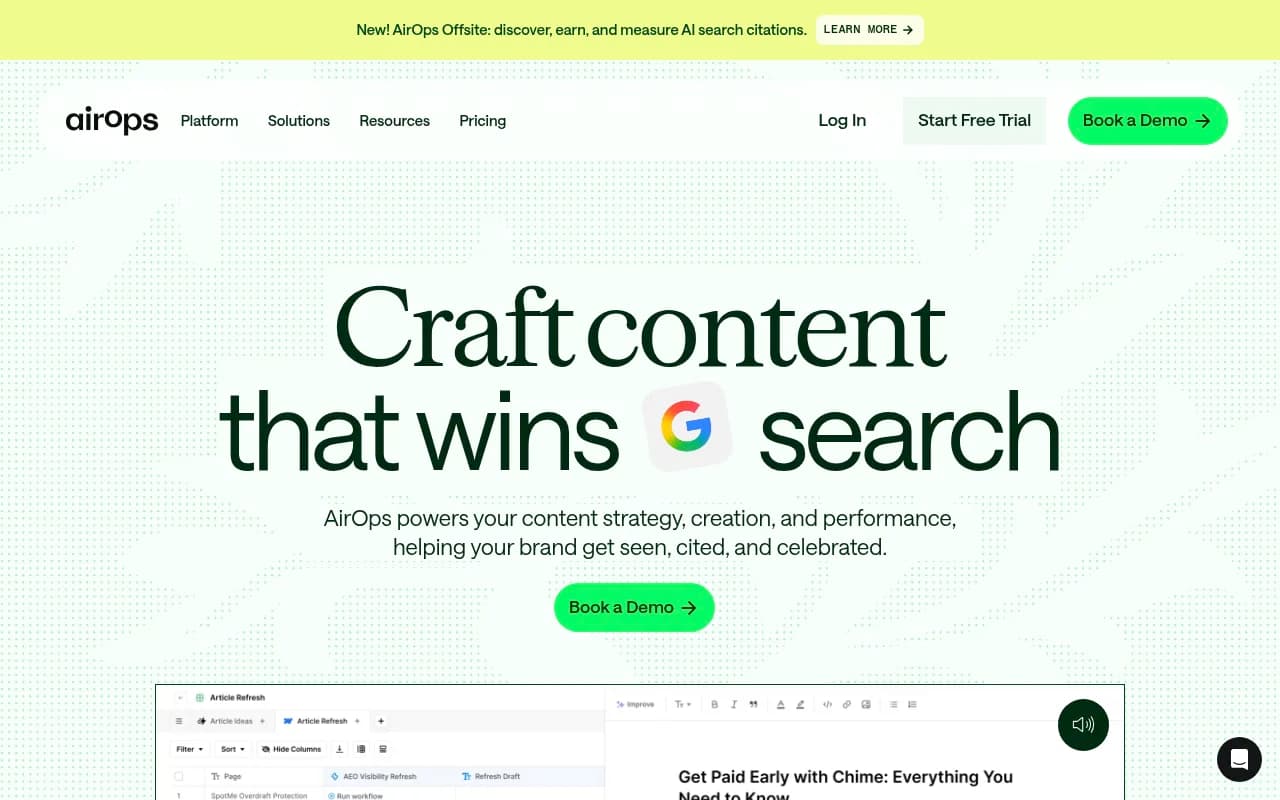
AirOps calls itself an "end-to-end content engineering platform" for AI search. The idea is that winning in AI search is fundamentally a content problem, and AirOps gives marketing teams the workflows, AI writing tools, and visibility insights to solve it at scale. Webflow, Ramp, Chime, Carta, Apollo, and Docebo are all on their client list -- a noticeably enterprise-SaaS-heavy roster.
The platform has a free tier (1,000 tasks/mo), which is rare in this space. Paid plans start at $199/mo for the Starter tier (10,000 tasks/mo), with Scale and Enterprise pricing available. AirOps recently announced a Series B and a conference ("AirOps Next"), which suggests they're scaling fast.
Side-by-side comparison
| Feature | AEO Engine | AirOps |
|---|---|---|
| Model | Managed service (agency) | Self-serve SaaS platform |
| Starting price | $797/mo | Free tier; $199/mo paid |
| Free tier | No (free audit only) | Yes (1,000 tasks/mo) |
| Content creation tools | Done-for-you by their team | AI writing workflows, templates |
| AI search tracking | Yes (ChatGPT, Google AI, Perplexity) | Yes (ChatGPT, Perplexity, Google AI Overviews) |
| Content gap analysis | Yes (via strategy team) | Yes (built-in tooling) |
| Self-serve dashboard | Limited | Full platform |
| Workflow automation | No (human-led) | Yes (agent-driven workflows) |
| Crawler log monitoring | Not documented | Not documented |
| Reddit/YouTube tracking | Not documented | Partial (Reddit workflows available) |
| Prompt volume/difficulty data | Not documented | Not documented |
| ChatGPT Shopping tracking | Not documented | Not documented |
| Target audience | Ecommerce, SMB, B2B brands | SaaS, fintech, enterprise marketing teams |
| Notable clients | Morph Costumes, Smartish, Opposuits | Webflow, Ramp, Chime, Carta, Apollo |
| Free trial/audit | Free strategy call + audit | Free tier available |
| Contract model | Monthly retainer | Subscription (monthly/annual) |
Head-to-head feature deep-dive
Service model and ownership
This is where the two tools diverge most sharply. AEO Engine is an agency. You pay a monthly retainer and their team handles the strategy, content creation, optimization, and reporting. You're not logging into a platform every morning -- you're getting deliverables and updates from a team.
AirOps is software. Your team uses it. You build content workflows, run AI search audits, generate and optimize content, and track performance through the platform. The upside is control and flexibility. The downside is that it requires internal bandwidth and someone who knows what they're doing.
Neither model is inherently better. It depends entirely on whether you have a capable in-house team or not.
Verdict: AEO Engine wins for brands without internal AI search expertise. AirOps wins for teams that want to own the process.
Content creation and optimization
AirOps has a clear edge here on the tooling side. Their platform is built around content workflows -- you can create AI-assisted writing pipelines, optimize existing pages for AI citation, and scale content production without proportionally scaling headcount. Webflow reportedly 5x'd their content refresh velocity using AirOps, and Docebo cut production costs by 50%.
AEO Engine does content creation too, but it's done by their team, not through a self-serve tool. That can be a feature (you don't have to do it) or a limitation (you can't iterate quickly without going back to them).
Verdict: AirOps has more sophisticated content tooling. AEO Engine's content is human-produced but not self-serve.
AI search tracking and visibility measurement
Both platforms track brand visibility in ChatGPT, Google AI Overviews, and Perplexity. Neither publicly documents tracking across a broader set of models (Gemini, Claude, Grok, DeepSeek, Mistral, Meta AI, Copilot), which is a gap worth knowing about if you care about the full AI search picture.
AirOps shows citation data and tracks which content is getting picked up by AI models. Chime's case study is concrete: they went from being cited in 24 to 68 priority questions after using AirOps, a 3x increase in AI search citations.
AEO Engine's tracking is less transparent in their public materials -- they report results to clients but don't show a self-serve analytics dashboard in their marketing.
If comprehensive AI model coverage matters to you, it's worth looking at platforms like Promptwatch, which monitors 10 AI models including Claude, Gemini, Grok, DeepSeek, and Copilot alongside the big three.

Verdict: AirOps has more transparent, self-serve tracking. AEO Engine's reporting is managed.
Workflow automation and scalability
AirOps is built for scale. Their agent-driven workflows let teams automate repetitive content tasks -- brief generation, content refreshes, optimization passes, internal linking -- without manual effort at each step. This is genuinely useful for teams managing hundreds of pages.
AEO Engine doesn't offer workflow automation in the software sense. Scaling with AEO Engine means upgrading your plan (more budget, more work from their team). Scaling with AirOps means building smarter workflows.
Verdict: AirOps wins on automation and scalability for content teams.
Pricing and value
The price gap is significant. AirOps has a free tier and a $199/mo entry point. AEO Engine starts at $797/mo. At the high end, AEO Engine's Aggressive plan is $2,997/mo vs. AirOps' Scale/Enterprise (custom, but likely in a similar range for large teams).
The comparison isn't entirely apples-to-apples -- AEO Engine's price includes human labor, strategy, and execution. AirOps' price is software access. But for a bootstrapped team or a startup, the difference is real.
Pricing comparison
| Plan | AEO Engine | AirOps |
|---|---|---|
| Free | No | Yes (1,000 tasks/mo) |
| Entry | $797/mo (Local) | $199/mo (Starter: 10,000 tasks/mo) |
| Mid-tier | $1,597/mo (Growth) | Scale (custom pricing) |
| Top tier | $2,997/mo (Aggressive) | Enterprise (custom pricing) |
| Enterprise | Custom | Custom |
| Annual discount | Not publicly stated | Available |
Pros and cons
AEO Engine
Pros:
- Done-for-you model -- no internal expertise required
- Dedicated strategy team handles execution
- Clear results focus with reported traffic growth metrics
- Good fit for ecommerce brands without marketing depth
- Free audit to evaluate fit before committing
Cons:
- Expensive entry point ($797/mo minimum)
- No self-serve dashboard or analytics platform
- Limited transparency on which AI models are tracked
- Scaling requires paying more, not building smarter
- Less suited for teams that want to own and iterate their strategy
AirOps
Pros:
- Free tier available -- low barrier to start
- Strong content workflow and automation tooling
- Proven results with enterprise SaaS clients (Webflow, Ramp, Chime)
- Self-serve platform gives teams full control
- Reddit workflow support (a channel many tools ignore)
- Scales with content volume, not just budget
Cons:
- Requires internal bandwidth and content expertise to use well
- No managed service option -- you're on your own
- AI model coverage (which LLMs are tracked) isn't fully documented publicly
- Lacks some deeper tracking features (crawler logs, prompt volume data, ChatGPT Shopping)
- Workflow setup has a learning curve
Who should pick which tool
Pick AEO Engine if:
- You don't have an in-house content or SEO team
- You want someone else to own and execute your AI visibility strategy
- You're an ecommerce or SMB brand that needs results without building internal capability
- Budget isn't the primary constraint and you value expert execution over software access
Pick AirOps if:
- You have an active content or marketing team that can use the platform
- You want to build scalable, repeatable content workflows for AI search
- You're a SaaS or fintech company with content as a core growth lever
- You want to start free or at a lower price point before committing to a larger investment
- You want direct control over your AI search strategy and the ability to iterate quickly
Final verdict
These two tools solve the same problem -- getting your brand cited in AI search results -- but through completely different approaches. AEO Engine is an agency that does the work for you. AirOps is a platform that helps your team do the work better.
For most in-house marketing teams with content capacity, AirOps is the stronger choice: more control, lower cost, better tooling, and a free tier to test the waters. For brands without internal expertise who want to outsource AI visibility entirely, AEO Engine's managed model is worth the premium. The honest answer is that neither tool covers the full AI search monitoring picture -- if you need deep multi-model tracking, crawler log analysis, or prompt volume intelligence on top of content creation, you'll want to layer in additional tooling.