Key takeaways
- AEO Engine is a managed service, not a self-serve SaaS platform -- you're paying for a team to run your AI visibility campaigns, not just a dashboard. Bluefish AI is a software platform, but one that requires enterprise sales engagement and custom deployment.
- Pricing is dramatically different in structure: AEO Engine starts at $797/month with transparent tiers; Bluefish AI starts at an estimated $4,000+/month with no public pricing and no self-serve option.
- Bluefish AI is built specifically for Fortune 500 marketing teams and passes enterprise infosec reviews. AEO Engine serves growth-stage ecommerce and B2B brands -- a fundamentally different buyer profile.
- AEO Engine bundles content creation and optimization into its service. Bluefish AI is primarily a monitoring and analytics platform -- content generation is not a core feature.
- Bluefish AI covers agentic commerce tracking, which is a genuine differentiator for large retail brands. AEO Engine focuses on AI search channels (ChatGPT, Google AI Overviews, Perplexity) without this layer.
- Neither tool is a good fit if you want a self-serve, transparent platform you can spin up and manage yourself -- for that, you'd be looking at a different category of tool entirely.
Overview
AEO Engine
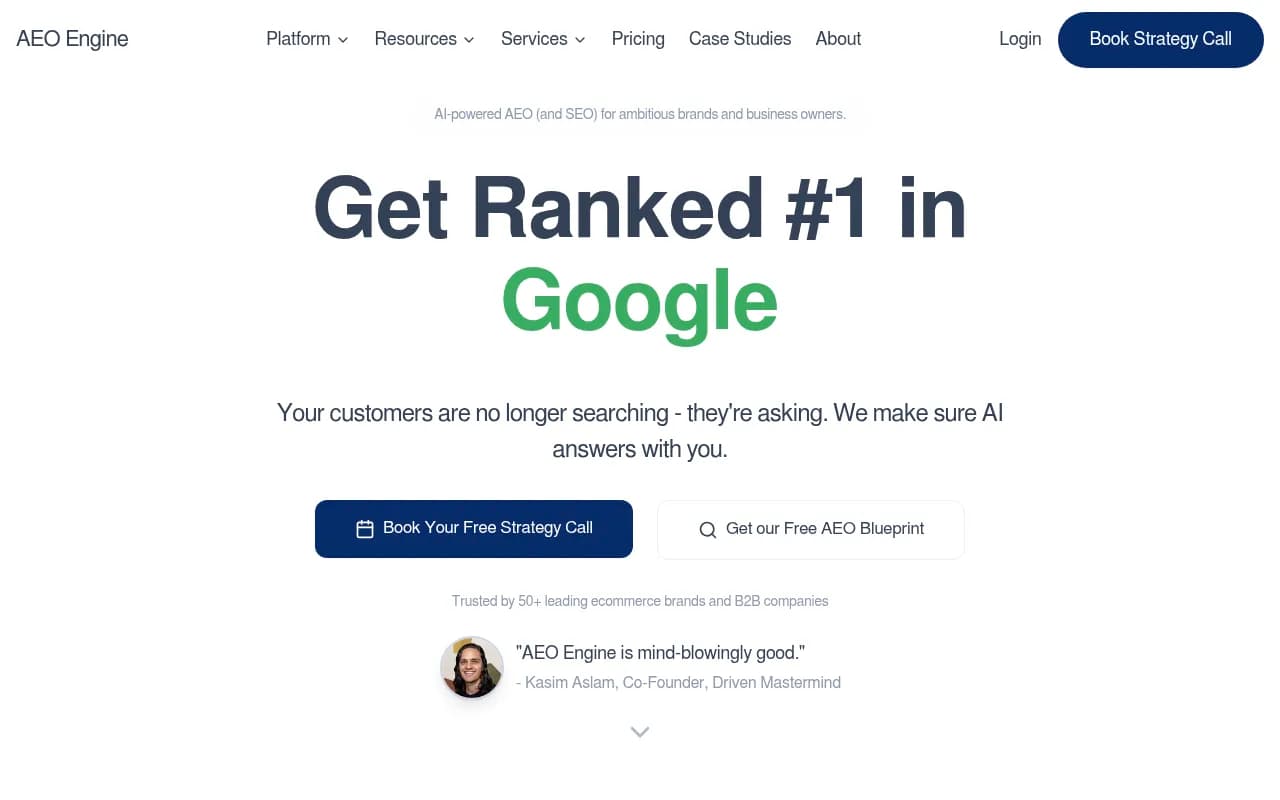
AEO Engine positions itself as a results-oriented AEO agency-platform hybrid. The pitch is simple: your customers are asking AI instead of searching Google, and AEO Engine makes sure AI recommends your brand. They claim 920% average AI traffic growth across campaigns, which is a bold number -- and one that's hard to verify independently, though their client list (50+ ecommerce and B2B brands) suggests real traction.
What makes AEO Engine unusual is that it's not really a SaaS tool in the traditional sense. You're not logging into a dashboard and running your own campaigns. You're hiring a team. The platform component exists, but the value proposition is the managed service: strategy, content, optimization, and reporting handled for you. That's either a relief or a dealbreaker depending on how you operate.
Their client base skews toward ecommerce brands (Morph Costumes, Smartish, Opposuits) and B2B companies, with a focus on dominating ChatGPT, Google AI Overviews, and Perplexity results.
Bluefish AI
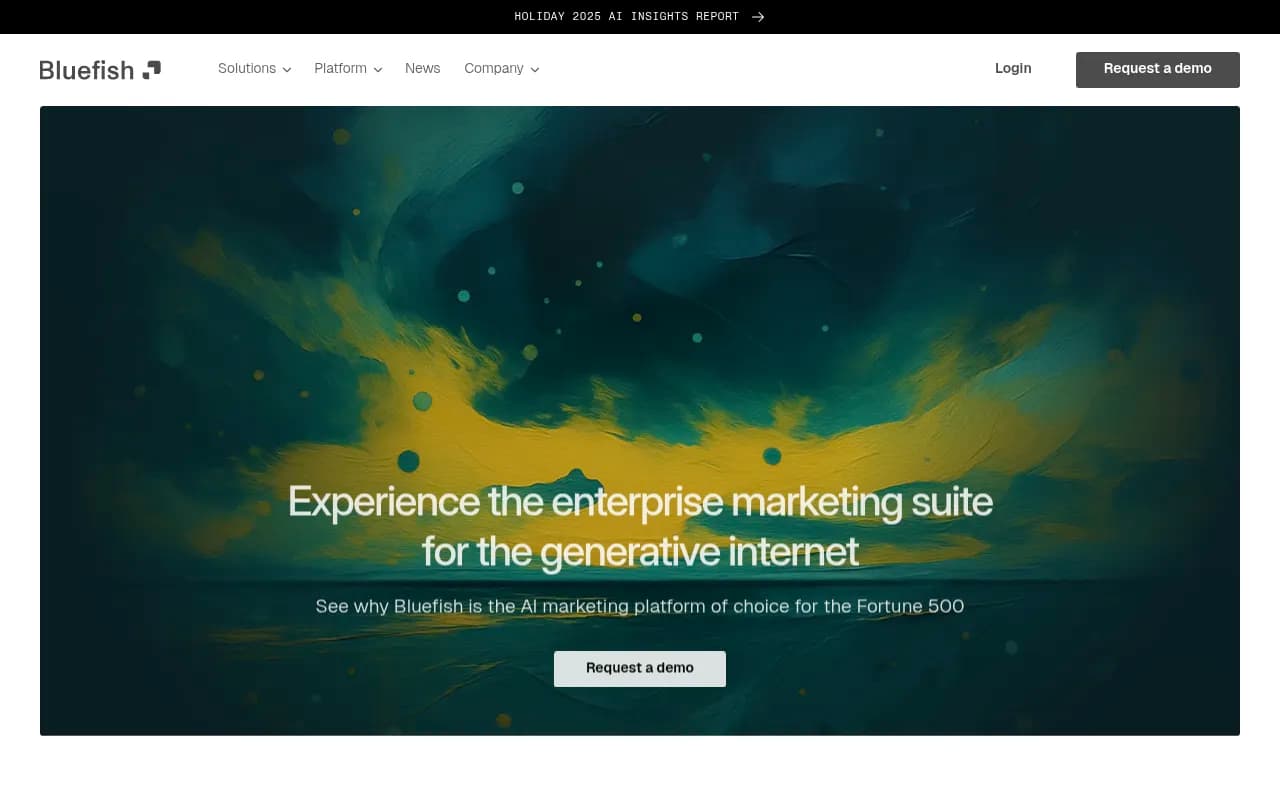
Bluefish AI targets a completely different buyer. The homepage says "Fortune 500" three times in the first scroll, and that's not an accident. This is an enterprise AI marketing platform built for large marketing teams that need custom audience segmentation, tailored prompt libraries, deep performance analytics, and the kind of infosec compliance that enterprise procurement requires.
Bluefish covers AI monitoring, GEO (Generative Engine Optimization), GEO measurement, and agentic commerce tracking. The "agentic commerce" angle is genuinely interesting -- as AI agents start making purchasing decisions on behalf of users, tracking brand presence in those flows matters. Most platforms haven't caught up to this yet.
The trade-off is that Bluefish is opaque about pricing, requires a sales process, and doesn't offer self-serve access. If you're not a Fortune 500 brand with a dedicated marketing ops team, you're probably not the target customer.
Side-by-side comparison
| Feature | AEO Engine | Bluefish AI |
|---|---|---|
| Pricing model | Transparent tiers ($797-$2,997/mo) | Custom quote only (~$4,000+/mo) |
| Free trial / audit | Free AEO Blueprint audit | Demo only (sales-led) |
| Target customer | Growth-stage ecommerce & B2B | Fortune 500 enterprise |
| Service model | Managed service (done-for-you) | Software platform + enterprise support |
| AI models tracked | ChatGPT, Google AI, Perplexity | Multiple (custom per client) |
| Content creation | Yes (included in service) | No (monitoring/analytics focus) |
| Agentic commerce tracking | No | Yes |
| Custom audience segmentation | Limited | Yes (core feature) |
| Infosec / enterprise compliance | Not emphasized | Yes (passes enterprise reviews) |
| Self-serve dashboard | Partial (managed service) | No (sales-led) |
| Transparent pricing | Yes | No |
| Onboarding | Strategy call + campaign setup | Custom enterprise deployment |
| Best for | Brands wanting hands-off AI SEO | Large teams needing deep analytics |
Head-to-head feature deep-dive
Service model and who actually does the work
This is the most important difference between these two tools, and it's one that most comparison articles gloss over.
AEO Engine is a managed service. When you sign up, you're not getting a login and a tutorial -- you're getting a team. They handle strategy, content production, optimization, and reporting. The platform exists to support that workflow, but the human element is central to what you're buying. This is great if you don't have in-house AEO expertise and want results without building a team. It's less great if you want full transparency into methodology, want to run experiments yourself, or need to integrate deeply with your own martech stack.
Bluefish AI is software, but enterprise software that requires significant setup and customization. You get a platform with dashboards, analytics, and workflow automation -- but you need a team on your side to use it effectively. It's not a "plug in and go" tool either. The difference is that with Bluefish, your team is in the driver's seat; with AEO Engine, their team is.
Verdict: Depends entirely on your situation. In-house team with capacity? Bluefish gives you more control. No dedicated AEO resource? AEO Engine's managed approach removes the execution burden.
Pricing and accessibility
| Plan | AEO Engine | Bluefish AI |
|---|---|---|
| Entry-level | $797/mo (Local) | ~$4,000+/mo (estimated) |
| Mid-tier | $1,597/mo (Growth) | Custom |
| Top tier | $2,997/mo (Aggressive) | Custom |
| Enterprise | Custom | Custom |
| Free option | Free AEO Blueprint audit | Demo only |
| Self-serve | No | No |
AEO Engine wins on price accessibility and transparency. You know exactly what you're paying before you talk to anyone. The Local plan at $797/month is within reach for a mid-size ecommerce brand. The Aggressive plan at $2,997/month is still cheaper than Bluefish's estimated entry point.
Bluefish doesn't publish pricing, which is a deliberate choice -- enterprise deals are negotiated, not listed. But it creates friction for anyone trying to evaluate the tool without committing to a sales process. If you're not already a Fortune 500 brand with budget to match, the conversation probably ends before it starts.
Verdict: AEO Engine is significantly more accessible on price. Bluefish is priced for enterprise procurement cycles.
AI model coverage and monitoring depth
Both platforms monitor brand presence across major AI channels, but the approach differs.
AEO Engine focuses on the three channels that drive the most traffic for their client base: ChatGPT, Google AI Overviews, and Perplexity. This is a practical choice -- these are where most AI-driven traffic originates for ecommerce and B2B brands right now. The monitoring feeds into their campaign management, so the data directly informs what content they produce and optimize.
Bluefish AI offers broader and more customizable monitoring. Custom audiences and tailored prompts mean you can track how your brand appears to specific customer segments asking specific types of questions -- not just generic brand mentions. For a Fortune 500 brand with multiple product lines, customer segments, and regional markets, this depth matters. They also cover agentic commerce channels, which is forward-looking and relevant for retail brands thinking about where AI purchasing decisions happen.
Verdict: Bluefish has more monitoring depth and customization. AEO Engine covers the channels that matter most for its target customer without the complexity.
Content creation and optimization
AEO Engine includes content creation as part of its managed service. They produce content designed to get cited by AI models -- articles, FAQs, structured content -- and optimize existing pages. This is baked into every plan. You don't need to figure out what to write or how to structure it; that's part of what you're paying for.
Bluefish AI is primarily an analytics and monitoring platform. Content optimization guidance exists (they published a blog post in April 2026 about AI-optimized content), but content generation is not a core product feature. You'd need your own content team to act on the insights Bluefish surfaces.
This is a meaningful gap. Knowing you're invisible in AI results is only useful if you can do something about it. AEO Engine closes that loop within the service. Bluefish surfaces the data and leaves execution to you.
Worth noting: if you're looking for a self-serve platform that combines AI visibility tracking with built-in content generation, Promptwatch covers both -- it's worth a look if neither of these tools quite fits your model.

Verdict: AEO Engine wins on content creation. Bluefish is monitoring-first and relies on your team to act on insights.
Enterprise features and compliance
Bluefish AI is built for enterprise from the ground up. They explicitly mention passing infosec reviews, which matters for large organizations with procurement and security requirements. Custom audience segmentation, tailored prompt libraries, and data team customization options are all features that enterprise marketing ops teams need and that smaller platforms don't offer.
AEO Engine doesn't emphasize enterprise compliance or infosec capabilities. Their client list includes established brands, but the product is designed for growth-stage companies, not Fortune 500 procurement processes.
Verdict: Bluefish wins on enterprise readiness. AEO Engine isn't built for that buyer.
Agentic commerce tracking
This is a Bluefish-only feature in this comparison. As AI agents increasingly make or influence purchasing decisions -- think ChatGPT plugins, AI shopping assistants, and autonomous agents completing transactions -- tracking brand presence in those flows becomes important for retail and ecommerce brands.
AEO Engine doesn't cover this channel. Their focus is on AI search results (what AI says when someone asks a question), not on agentic purchasing flows.
Verdict: Bluefish wins here by default. AEO Engine doesn't offer this.
Pros and cons
AEO Engine
Pros:
- Transparent, tiered pricing with no sales call required to understand costs
- Managed service means you don't need in-house AEO expertise
- Content creation and optimization included in every plan
- Free AEO Blueprint audit to evaluate fit before committing
- Proven results with 50+ clients across ecommerce and B2B
- Lower entry price point ($797/month) than most enterprise alternatives
Cons:
- Not a self-serve platform -- you're dependent on their team's execution
- Less transparency into methodology and campaign decisions
- Limited customization compared to enterprise platforms
- No agentic commerce tracking
- Monitoring depth is narrower (three main AI channels)
- Harder to integrate with complex martech stacks
Bluefish AI
Pros:
- Built for enterprise with infosec compliance and custom deployment
- Custom audience segmentation and tailored prompt libraries
- Agentic commerce tracking is a genuine differentiator
- Deep analytics for large marketing teams
- Designed to handle complex, multi-brand, multi-region monitoring
Cons:
- No transparent pricing -- requires sales engagement
- Estimated cost ($4,000+/month) puts it out of reach for most brands
- Content generation is not a core feature
- No self-serve trial or free audit
- Overkill for brands that don't have dedicated marketing ops teams
- Less accessible for teams that want to move fast without enterprise procurement
Who should pick which tool
Pick AEO Engine if:
- You're a growth-stage ecommerce or B2B brand with a budget between $800 and $3,000/month
- You don't have in-house AEO expertise and want a team to handle execution
- You want content creation included, not just monitoring
- You need to show AI visibility results without building a new internal capability
- You want to understand costs before talking to sales
Pick Bluefish AI if:
- You're a Fortune 500 brand with enterprise procurement requirements
- Your marketing team has the capacity to use a sophisticated analytics platform
- You need custom audience segmentation and tailored prompt tracking
- Agentic commerce tracking is relevant to your business model
- You can commit to a custom enterprise contract and deployment process
Final verdict
These two tools don't really compete for the same customer. AEO Engine is a managed AEO service for growth-stage brands that want results without building internal expertise -- it's accessible, transparent on price, and includes content creation. Bluefish AI is an enterprise analytics platform for Fortune 500 marketing teams that need deep customization, compliance, and agentic commerce coverage.
If you're a mid-size brand trying to show up in ChatGPT and Google AI results, AEO Engine is the more practical choice. If you're a large enterprise with complex monitoring needs and a dedicated team to act on the data, Bluefish is built for you -- budget permitting. The mistake would be choosing Bluefish because it sounds more sophisticated, or choosing AEO Engine because it's cheaper, without matching the tool to how your team actually operates.