Key takeaways
- AEO Engine is a managed service (agency model), not a SaaS tool -- you're buying execution, not just software. Bear AI is a self-serve platform your team operates.
- Bear AI costs 4x less at entry level ($199/mo vs $797/mo), but the comparison isn't apples-to-apples since AEO Engine includes human strategy and content work.
- AEO Engine is built around ecommerce and B2B brands wanting done-for-you results; Bear AI targets growth teams who want to own the AI visibility process themselves.
- Bear AI has a stronger focus on converting AI traffic into leads and revenue -- it tracks high-intent visitors from AI sources, not just citation counts.
- Neither tool covers the full breadth of AI models that enterprise-grade platforms do. Bear AI's Basic plan only covers 2 models; AEO Engine focuses primarily on ChatGPT, Google AI Overviews, and Perplexity.
- If you want to understand and act on AI visibility without outsourcing it entirely, there are more feature-complete self-serve platforms worth considering alongside Bear AI.
Overview
AEO Engine
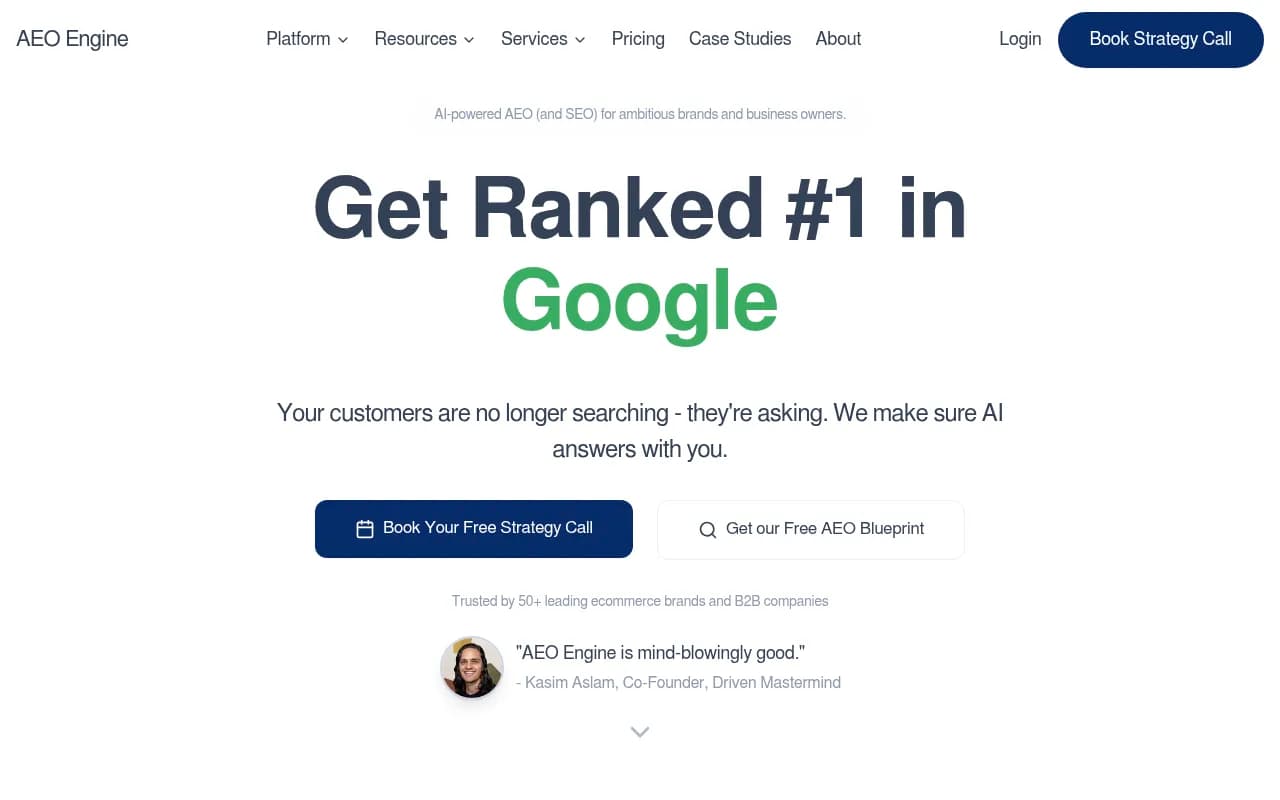
AEO Engine positions itself as a results-oriented AEO company, not just a software tool. Their pitch is essentially: "We'll make you rank in AI search, and here's the proof -- 920% average traffic growth." They handle strategy, content creation, and optimization for you. The client list skews toward ecommerce (Morph Costumes, Smartish, Opposuits) and B2B brands, and they claim 50+ active clients. The pricing reflects the managed-service model -- you're not buying a dashboard, you're buying a team.
Bear AI
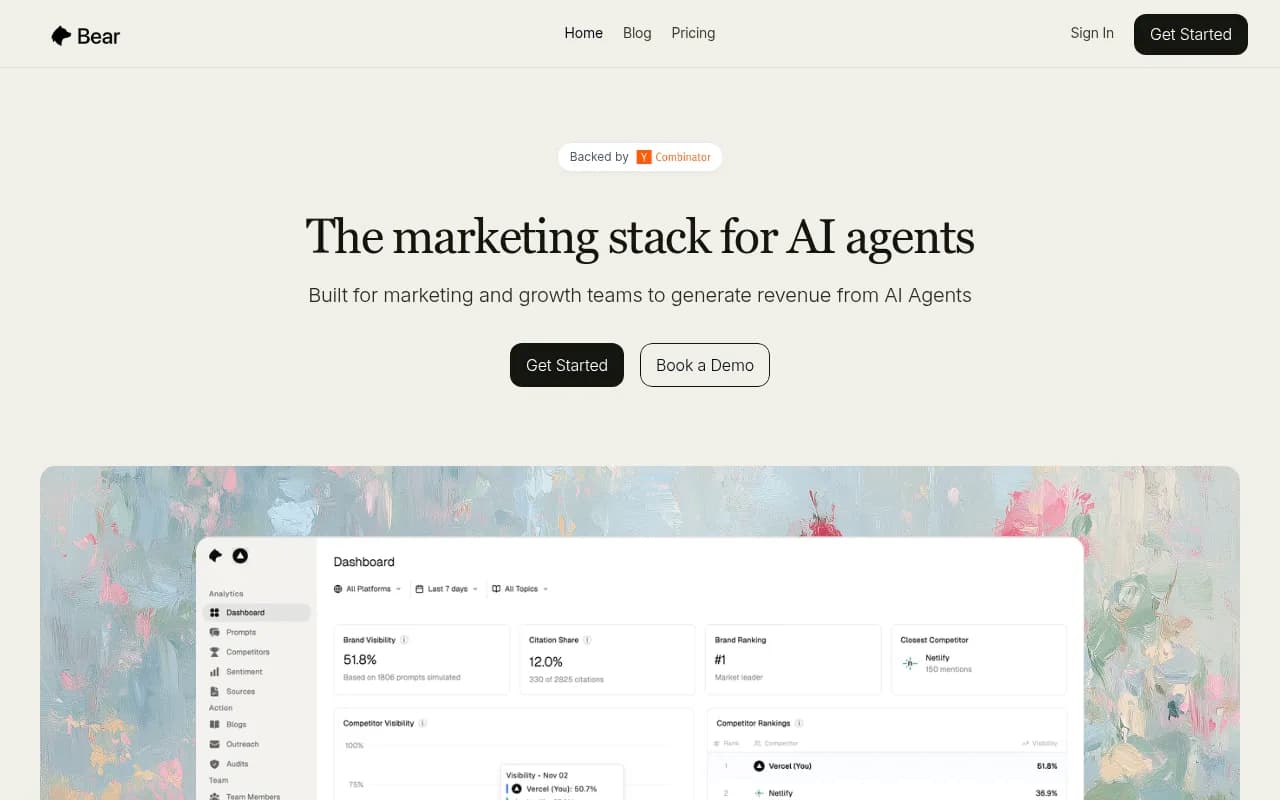
Bear AI is a Y Combinator-backed SaaS platform built for marketing and growth teams. The core idea is that AI agents are becoming a meaningful traffic source, and most businesses have no visibility into that channel. Bear AI gives you a dashboard to track how AI models discover and mention your brand, identify high-intent visitors arriving from AI sources, and generate content to improve your visibility. It's self-serve, relatively affordable, and aimed at teams who want to own this workflow internally.
Side-by-side comparison
| Feature | AEO Engine | Bear AI |
|---|---|---|
| Model type | Managed service (agency) | Self-serve SaaS |
| Entry price | $797/mo | $199/mo |
| Free tier | Free audit + strategy call | No (demo available) |
| AI models tracked | ChatGPT, Google AI, Perplexity (primary) | 2 models (Basic), 6+ (Enterprise) |
| Content creation | Done-for-you by their team | 2 blogs/mo (Basic), more on higher tiers |
| Citation tracking | Yes | Yes |
| Lead/conversion tracking | Not explicitly featured | Yes (high-intent AI visitor identification) |
| Prompt tracking | Yes | 75 prompts (Basic) |
| Competitor analysis | Yes | Limited info available |
| Ecommerce focus | Strong (50+ ecommerce clients) | General (SaaS/growth teams) |
| Setup effort | Low (managed) | Medium (self-serve) |
| YC-backed | No | Yes |
| Target user | Brands wanting done-for-you results | In-house marketing/growth teams |
Head-to-head feature deep-dive
Service model and setup
This is the most fundamental difference between the two tools. AEO Engine is an agency that happens to have a platform -- you onboard, they do the work. Bear AI is a platform that your team uses.
With AEO Engine, you book a strategy call, they audit your current AI visibility, and then their team builds and executes an AEO strategy for you. That includes content creation, schema optimization, and ongoing monitoring. The upside: you don't need internal expertise. The downside: you're dependent on their team's bandwidth and priorities, and the cost reflects that.
Bear AI requires your team to log in, interpret data, and take action. The platform surfaces which prompts are driving traffic, which AI models are mentioning you, and which visitors are arriving with high purchase intent. You then use that data to brief your content team or use Bear AI's built-in blog generation (2 posts/mo on Basic). It's more work, but you own the process.
Verdict: If you have a lean team or no in-house AEO expertise, AEO Engine's managed model removes friction. If you have a capable marketing team and want control, Bear AI makes more sense.
AI model coverage
| AI model | AEO Engine | Bear AI (Basic) | Bear AI (Enterprise) |
|---|---|---|---|
| ChatGPT | Yes | Yes | Yes |
| Google AI Overviews | Yes | Yes | Yes |
| Perplexity | Yes | Unclear | Yes |
| Claude | Not confirmed | Unclear | Yes |
| Gemini | Not confirmed | Yes | Yes |
| DeepSeek | Not confirmed | Not confirmed | Not confirmed |
| Grok | Not confirmed | Not confirmed | Not confirmed |
AEO Engine's marketing focuses on ChatGPT, Google AI Overviews, and Perplexity -- the three highest-traffic AI search channels right now, which is a reasonable prioritization. Bear AI's Basic plan covers just 2 models, which feels limiting for the price. Enterprise unlocks 6+, but that's a significant jump.
Neither platform comes close to the 10-model coverage that more comprehensive platforms offer. If you need to track visibility across Grok, DeepSeek, Mistral, and Meta AI alongside the big three, you'll need to look elsewhere.
Verdict: AEO Engine covers the right models for most use cases. Bear AI's model coverage at the entry tier is a real limitation.
Content creation and optimization
AEO Engine's managed model means their team writes and publishes content optimized for AI citation. You're not doing keyword research or briefing writers -- they handle it. The quality and volume depend on which plan you're on, but the "done-for-you" framing is consistent across all tiers.
Bear AI includes blog generation as a feature (2 posts/mo on Basic), but this is clearly a supporting tool rather than the main event. The primary value proposition is visibility tracking and lead identification, not content production.
Verdict: AEO Engine wins on content volume and quality control, simply because you're paying for a team. Bear AI's content tools are supplementary.
Traffic attribution and revenue tracking
This is where Bear AI has a genuine edge in its product philosophy. The platform explicitly tracks high-intent visitors arriving from AI sources and connects that to conversion signals. The framing -- "turn AI agent traffic into revenue" -- suggests the product is built around the full funnel, not just top-of-funnel citation counts.
AEO Engine claims 920% average traffic growth and references a TechCrunch stat about Shopify AI-driven orders being up 11x, but their product page doesn't detail a specific traffic attribution or revenue tracking feature. The results they cite are compelling, but it's harder to verify how granularly they attribute outcomes.
Verdict: Bear AI has a clearer story around revenue attribution. AEO Engine has stronger outcome claims but less transparency on the measurement methodology.
Pricing and value
| Plan | AEO Engine | Bear AI |
|---|---|---|
| Entry | $797/mo (Local) | $199/mo (Basic) |
| Mid-tier | $1,597/mo (Growth) | Not publicly listed |
| Top tier | $2,997/mo (Aggressive) | Enterprise (custom) |
| Enterprise | Custom | Custom |
The price gap is stark, but the comparison isn't straightforward. AEO Engine's $797/mo includes human strategy and execution work. Bear AI's $199/mo is software only -- you still need to invest your own team's time.
If you factor in the cost of an in-house content writer or SEO specialist, AEO Engine's pricing becomes more defensible. But for a startup or small team that just wants visibility data and some content tooling, Bear AI's entry price is much easier to justify.
Verdict: Bear AI wins on raw price. AEO Engine may win on total cost of ownership if you'd otherwise hire someone to do this work.
Reporting and analytics
Bear AI's dashboard shows how AI agents are discovering your brand, which prompts are trending, and which visitors are arriving with high intent. The UI appears clean and built for non-technical marketers.
AEO Engine, as a managed service, presumably provides reporting through client dashboards or regular reports, but the specifics aren't detailed publicly. You're trusting their team to surface the right metrics.
Verdict: Bear AI gives you more direct access to your own data. AEO Engine's reporting is less transparent from the outside.
Pricing comparison
| Plan | AEO Engine | Bear AI |
|---|---|---|
| Entry | $797/mo | $199/mo |
| Growth/Mid | $1,597/mo | Not listed |
| Aggressive/Top | $2,997/mo | -- |
| Enterprise | Custom | Custom |
| Free option | Free audit + strategy call | Demo only |
| Annual discount | Not confirmed | Not confirmed |
Pros and cons
AEO Engine
Pros:
- Fully managed -- no internal expertise required
- Strong ecommerce track record with named clients
- Covers the three highest-traffic AI search channels
- Content creation is included in the service
- Free audit lowers the barrier to getting started
Cons:
- Expensive entry point ($797/mo minimum)
- Less transparency on platform features vs. service deliverables
- You're dependent on their team's execution quality
- Limited public detail on AI model coverage beyond the big three
- Not a self-serve tool -- harder to scale or customize independently
Bear AI
Pros:
- Affordable entry at $199/mo
- Y Combinator-backed (suggests product quality and roadmap investment)
- Clear focus on revenue attribution, not just citation tracking
- Self-serve -- your team owns the data and workflow
- High-intent visitor identification is a genuinely useful feature
Cons:
- Only 2 AI models on the Basic plan -- very limited
- Content generation is minimal (2 blogs/mo on Basic)
- Requires internal bandwidth to act on the data
- Less established track record vs. AEO Engine's client list
- Enterprise pricing is opaque
Who should pick which tool
Pick AEO Engine if:
- You're an ecommerce or B2B brand with budget but limited in-house AEO expertise
- You want someone else to handle strategy, content, and execution
- You're willing to pay a premium for a managed outcome rather than a software subscription
- You've already tried self-serve tools and found them too time-consuming
Pick Bear AI if:
- You have an in-house marketing or growth team that can act on data
- You're earlier stage and need to keep costs low
- Revenue attribution and lead identification from AI traffic is a priority
- You want to own your AI visibility data and workflow
- You're comfortable with a newer, YC-backed product still building out its feature set
A note on the broader landscape
Both tools occupy a specific niche in the AI visibility space, and neither covers the full picture. If you're a larger brand or agency that needs to track visibility across 10+ AI models, run content gap analysis, monitor AI crawlers hitting your site, and connect all of that to actual revenue -- tools like Promptwatch are worth evaluating alongside these two.

Promptwatch sits in a different category: it's a self-serve platform with managed-service depth, covering everything from prompt intelligence and competitor heatmaps to AI crawler logs and a built-in content generation agent. It's not a replacement for AEO Engine's done-for-you model, but for teams that want Bear AI's self-serve approach with significantly more capability, it's the more complete option.
Final verdict
AEO Engine and Bear AI are solving the same problem from opposite ends. AEO Engine says "we'll do it for you" -- Bear AI says "here are the tools, now go do it." The right choice depends almost entirely on your team's capacity and your budget.
If you have the budget and want results without building internal expertise, AEO Engine is a reasonable bet -- their client outcomes are credible and the managed model removes execution risk. If you're a growth team that wants to own the AI visibility channel and keep costs manageable, Bear AI's self-serve approach makes sense, though the 2-model limit on the Basic plan is a real constraint you'll hit quickly.
Neither tool is the obvious winner for every buyer. The honest answer: evaluate both against your actual team capacity and the AI models your customers actually use before committing.