Key takeaways
- Ahrefs is a full SEO platform first -- AI search tracking (Brand Radar) is one feature among dozens. Airefs is built from the ground up for AI search visibility and nothing else.
- Ahrefs starts at $83/mo for meaningful usage; Airefs is reported to start around $24/mo, making it roughly 3-4x cheaper for teams that only need AI monitoring.
- Ahrefs Brand Radar uses fixed prompts and has no AI traffic attribution. Airefs tracks brand mentions in ChatGPT and Perplexity with competitor benchmarking built in.
- If you need backlink analysis, keyword research, site audits, or rank tracking, Airefs doesn't touch any of that. Ahrefs does all of it.
- Airefs is a very early-stage product (100+ teams as of 2025). Ahrefs is used by 44% of Fortune 500 companies and has years of data infrastructure behind it.
- Neither tool offers the full action loop of finding content gaps, generating AI-optimized content, and tracking results -- for that, you'd want to look at a dedicated GEO platform.
Overview
Ahrefs
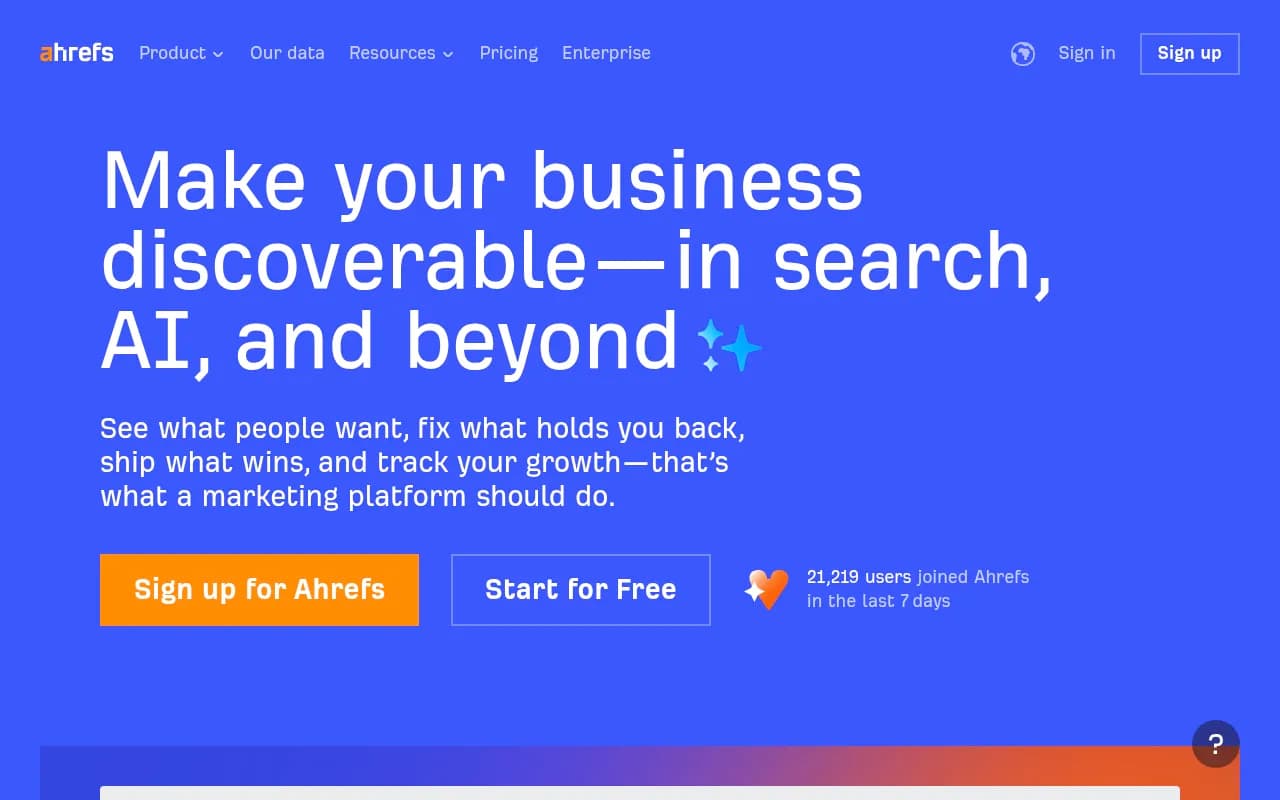
Ahrefs started as a backlink analysis tool and grew into one of the most widely used SEO platforms in the world. Today it covers keyword research, site audits, rank tracking, content explorer, competitive analysis, PPC research, and social media monitoring. It added AI search tracking through Brand Radar as the market shifted toward AI-generated answers. The platform is genuinely powerful for traditional SEO -- its backlink index is the largest available commercially, and its keyword database covers billions of queries across dozens of countries.
The AI search piece is newer and more limited. Brand Radar monitors brand mentions in AI responses, but it works with fixed prompts rather than custom ones, and there's no traffic attribution to connect AI visibility to actual site visits or revenue.
Airefs
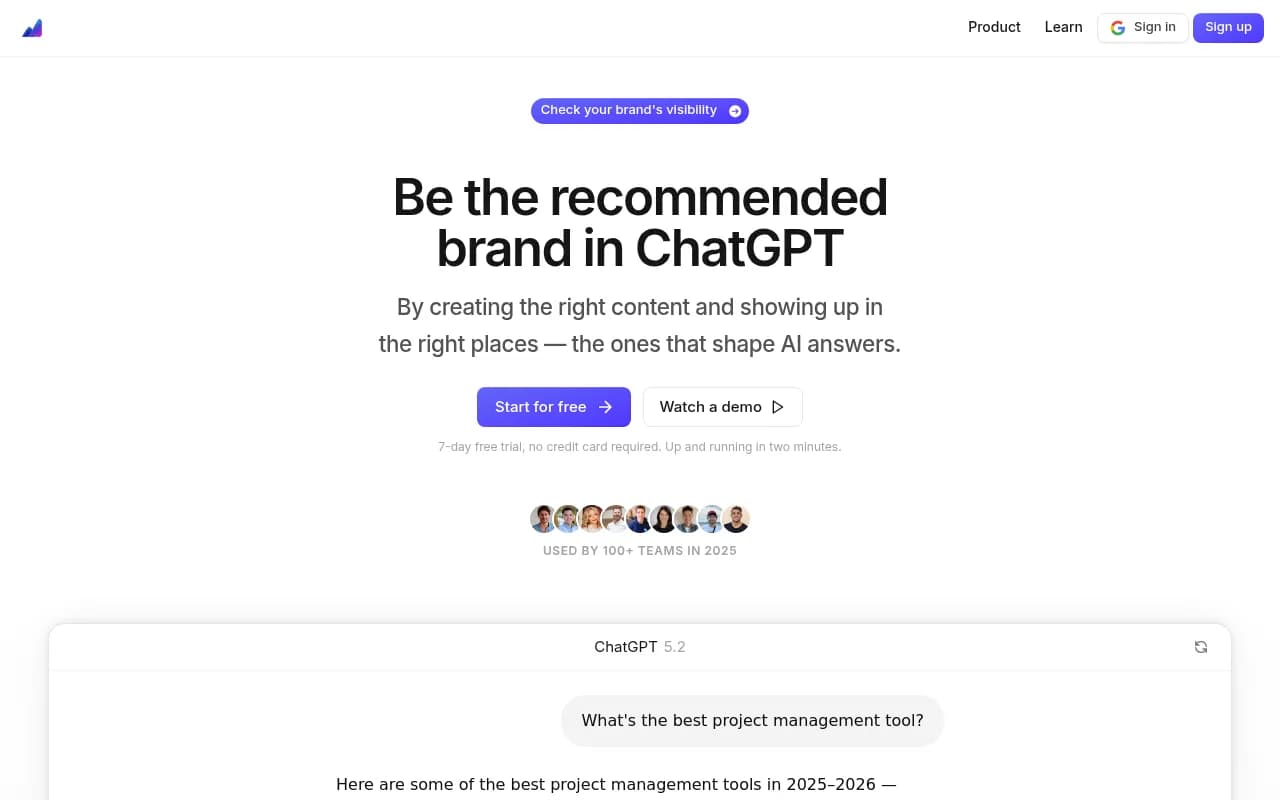
Airefs (getairefs.com -- not to be confused with Ahrefs) is a purpose-built AI search visibility tool. It tracks whether your brand appears in ChatGPT and Perplexity answers for relevant queries, shows competitor mention rates, and helps identify what content influences AI responses. The product is early-stage -- used by around 100+ teams -- but it's focused on a specific problem that larger platforms haven't fully solved yet.
The pitch is simple: AI answers are increasingly shaped by LinkedIn posts, Reddit threads, G2 reviews, and YouTube videos rather than your website. Airefs helps you understand where you stand and what content to create to show up more often.
Side-by-side comparison
| Feature | Ahrefs | Airefs |
|---|---|---|
| Primary focus | Full SEO platform | AI search visibility only |
| AI search tracking | Yes (Brand Radar) | Yes (core feature) |
| Custom prompts | No (fixed prompts) | Yes |
| Competitor AI benchmarking | Limited | Yes |
| Backlink analysis | Yes (industry-leading) | No |
| Keyword research | Yes (billions of keywords) | No |
| Site audit | Yes | No |
| Rank tracking | Yes (traditional + AI) | No |
| Content gap analysis | Basic (SEO-focused) | AI-focused |
| Content creation tools | Yes (AI writing features) | Guidance-based |
| AI traffic attribution | No | No |
| Crawler log monitoring | No | No |
| Pricing (entry) | $83/mo (Lite) | ~$24/mo (estimated) |
| Free trial | Yes | 7-day free trial |
| Team size fit | SMB to Enterprise | SMB / early-stage |
| Customer base | 44% of Fortune 500 | 100+ teams |
| Maturity | Established (10+ years) | Early-stage (2024/2025) |
Head-to-head feature deep-dive
AI search tracking
This is where the comparison gets interesting, because it's the only area where both tools actually overlap.
Ahrefs Brand Radar monitors brand mentions across AI engines including ChatGPT, Perplexity, and Google AI Overviews. The limitation is that it uses a fixed set of prompts -- you can't define your own queries or test specific customer questions. There's also no way to connect AI visibility data to actual traffic or conversions. For a platform of Ahrefs' scale, Brand Radar feels like a first version rather than a mature product.
Airefs takes a narrower but deeper approach. It tracks brand mentions in ChatGPT and Perplexity for queries you care about, shows how your mention rate changes over time, and benchmarks you against competitors. The interface is built around this single use case, so the workflow is cleaner for someone whose primary goal is AI visibility.
Verdict: Airefs wins on AI search depth and flexibility. Ahrefs Brand Radar is functional but limited.
Traditional SEO capabilities
There's no contest here. Ahrefs has one of the largest backlink indexes available (over 35 trillion links), a keyword database covering billions of queries, a site audit tool that crawls millions of pages, and rank tracking across 190+ countries. These tools are genuinely best-in-class and have been refined over a decade.
Airefs has none of this. It doesn't do backlinks, keywords, audits, or traditional rank tracking. If you need any of those capabilities, Airefs isn't a replacement -- it's a complement at best.
Verdict: Ahrefs wins decisively. Airefs doesn't compete in this category.
Content strategy and creation
Ahrefs has a Content Explorer that surfaces high-performing content in any niche, plus AI writing features to help create and optimize content for search. It's built around traditional SEO signals -- traffic, backlinks, keyword difficulty.
Airefs approaches content differently. It focuses on the sources that actually shape AI answers: Reddit, LinkedIn, G2, YouTube. The idea is that if you want ChatGPT to recommend your brand, you need to be present in the places ChatGPT reads. Airefs helps identify those gaps and guides what content to create and where to publish it.
Both approaches have merit, but they're solving different problems. Ahrefs helps you rank in Google. Airefs helps you get cited in ChatGPT.
Verdict: Depends on your goal. For traditional content SEO, Ahrefs. For AI citation strategy, Airefs.
Pricing
| Plan | Ahrefs | Airefs |
|---|---|---|
| Free / trial | Free Webmaster Tools (limited) | 7-day free trial |
| Entry paid | Starter $29/mo (very limited) | ~$24/mo (estimated, not public) |
| Core plan | Lite $83/mo | Not publicly listed |
| Mid-tier | Standard $166/mo | Not publicly listed |
| Advanced | Advanced $333/mo | Not publicly listed |
| Enterprise | Custom | Not listed |
Ahrefs pricing is transparent and well-documented. The Starter plan at $29/mo is quite restricted -- most serious users end up on Lite ($83/mo) or Standard ($166/mo). Annual billing saves 20%.
Airefs doesn't publish its pricing publicly, which is a minor frustration. Based on third-party comparisons, it starts around $24/mo -- significantly cheaper than Ahrefs for teams that only need AI visibility monitoring. You need to sign up or book a consultation to get exact numbers.
Verdict: Airefs is cheaper for AI-only use cases. Ahrefs is better value if you need the full SEO toolkit.
Ease of use and onboarding
Ahrefs has a lot of features, which means a steeper learning curve. New users often feel overwhelmed by the number of tools and reports. That said, the documentation is excellent, and there's a large community of tutorials, YouTube walkthroughs, and blog posts. Ahrefs Academy offers structured courses for free.
Airefs promises "up and running in 2 minutes" and that's plausible given its narrow scope. There's less to learn because there's less to do. The tradeoff is that you'll hit the ceiling of what it can do fairly quickly.
Verdict: Airefs is faster to start. Ahrefs has more depth but takes longer to master.
Integrations and ecosystem
Ahrefs integrates with Google Search Console, Google Analytics, and has an API for custom reporting. It also has Looker Studio connectors and supports bulk data exports. The ecosystem is mature.
Airefs is early-stage and integration details aren't prominently documented. Given its age and size, expect limited integrations compared to Ahrefs.
Verdict: Ahrefs wins on integrations and ecosystem maturity.
Trust and reliability
Ahrefs has been around since 2011 and is used by some of the largest companies in the world. Its data infrastructure is substantial -- the platform crawls the web continuously and updates its index regularly. When you pull data from Ahrefs, you can generally trust it.
Airefs is very new. The 100+ teams figure on its homepage suggests it's still finding product-market fit. That's not a criticism -- every tool starts somewhere -- but it does mean less battle-tested data, fewer case studies, and more uncertainty about long-term reliability.
Verdict: Ahrefs wins on trust and data reliability. Airefs is a bet on an early-stage product.
Pros and cons
Ahrefs
Pros:
- Best-in-class backlink index and keyword database
- Covers every major SEO workflow in one platform
- Trusted by large enterprises and agencies worldwide
- Excellent documentation, tutorials, and community
- AI search tracking included (Brand Radar)
- Regular product updates and new features
Cons:
- Brand Radar uses fixed prompts -- can't customize AI queries
- No AI traffic attribution (can't connect AI visibility to revenue)
- Expensive for teams that only need AI monitoring
- AI features feel like add-ons rather than core capabilities
- No crawler log monitoring for AI bots
Airefs
Pros:
- Purpose-built for AI search visibility
- Cheaper entry point for AI-only use cases
- Tracks competitor mention rates in ChatGPT and Perplexity
- Focused on the sources that actually shape AI answers (Reddit, LinkedIn, etc.)
- Fast onboarding -- simple, narrow scope
- Agency mode available
Cons:
- No traditional SEO capabilities whatsoever
- Pricing not publicly listed
- Very early-stage product with a small customer base
- Limited integrations and ecosystem
- No AI traffic attribution either
- Uncertain long-term roadmap and reliability
Who should pick which tool
Pick Ahrefs if:
- You need a full SEO platform and want AI search tracking included
- Your team already uses Ahrefs for backlinks, keywords, or audits
- You work at a larger company that needs enterprise-grade reliability
- You want one tool that covers traditional and AI search in a single subscription
- You need extensive integrations, API access, or white-label reporting
Pick Airefs if:
- Your only goal is tracking and improving AI search visibility
- You're a small team or startup with a tight budget
- You want a tool built specifically for ChatGPT and Perplexity monitoring
- You don't need backlink analysis or traditional SEO features
- You're comfortable adopting an early-stage product
Worth noting: if you want to go beyond monitoring and actually take action on AI visibility -- finding content gaps, generating content engineered to get cited by AI models, and tracking the results -- Promptwatch is worth looking at. It covers the full optimization loop that neither Ahrefs nor Airefs fully addresses.

Final verdict
These two tools share a name similarity but serve genuinely different purposes. Ahrefs is a mature, comprehensive SEO platform that added AI search monitoring as one feature among many. Airefs is a focused, early-stage tool built specifically for AI search visibility.
If you're an SEO team that wants everything in one place, Ahrefs is the obvious choice -- Brand Radar isn't perfect, but it's good enough alongside everything else the platform does. If you're a marketing team whose primary concern is showing up in ChatGPT and Perplexity, and you don't need traditional SEO tools, Airefs is cheaper and more focused on that specific problem.
The honest answer for most teams: Ahrefs for SEO, a dedicated AI visibility platform for AI search. Airefs can fill that second role if you're budget-conscious and comfortable with an early-stage product.