Key Takeaways
- Completely different tools: Airtop is a no-code web automation platform; Authoritas AI Tracker monitors brand visibility in AI search engines. They don't compete -- they solve unrelated problems.
- Airtop is for automation: If you need to scrape websites, automate browser tasks, monitor competitors, or build workflows without code, Airtop is the tool. It doesn't track AI search visibility.
- Authoritas is for AI visibility: If you need to know how ChatGPT, Perplexity, Claude, or Gemini talk about your brand, Authoritas tracks citations, sentiment, and share of voice across LLMs. It doesn't automate browser tasks.
- Pricing starts low for both: Airtop from $26/mo, Authoritas from £99/mo (~$125/mo). Both scale up significantly for enterprise use.
- Integration ecosystems differ: Airtop connects to Zapier, Slack, Sheets, and CRMs for workflow automation. Authoritas integrates with GSC and analytics platforms for SEO reporting.
- Use them together: Authoritas shows you where your brand is invisible in AI search; Airtop can automate the competitive research and data collection that informs your content strategy.
Overview: Two tools, two missions
Airtop: No-code web automation
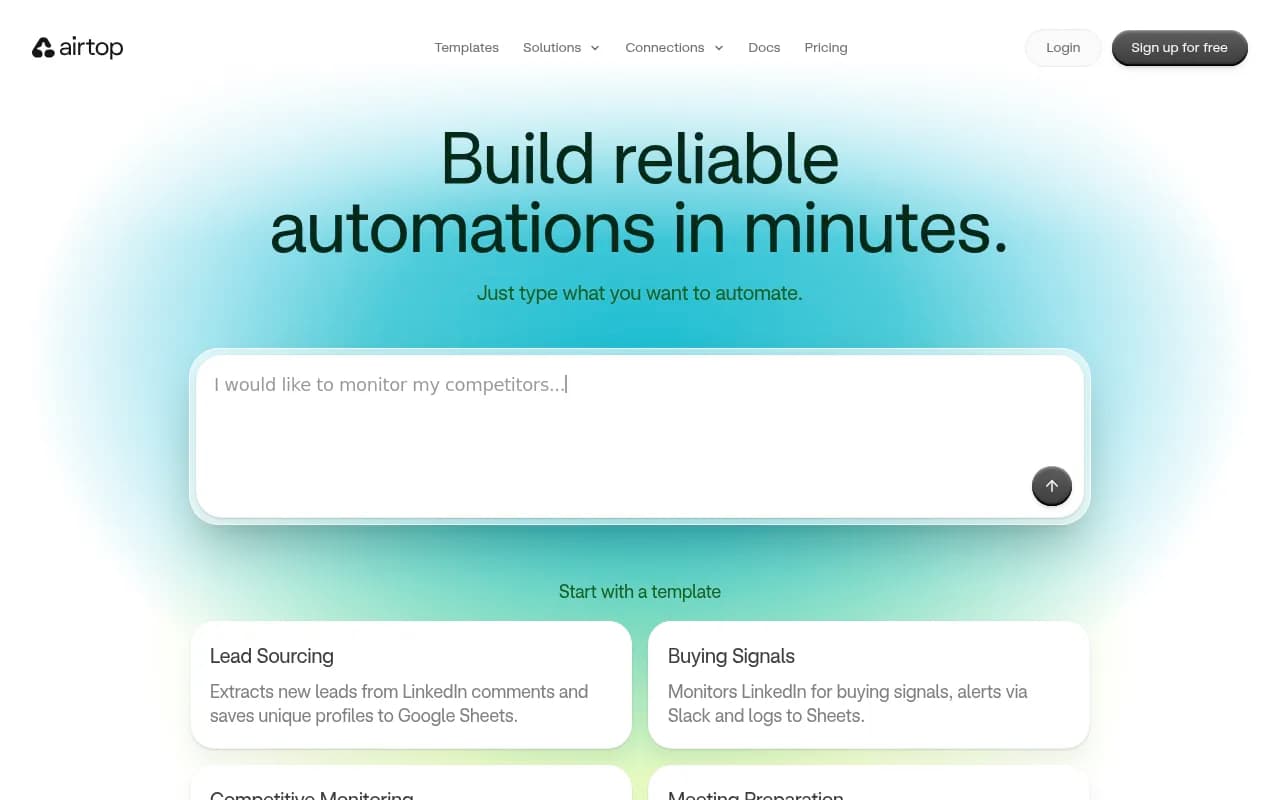
Airtop is a cloud-based platform that lets you build browser automations using plain English. You describe what you want to automate -- "monitor competitor LinkedIn posts weekly and report to Slack" or "extract new leads from LinkedIn comments and save to Google Sheets" -- and Airtop generates the workflow. It runs deterministic code in the cloud, so your automations behave consistently. The platform works on any website, even behind logins or without APIs, and integrates with Slack, Gmail, Google Sheets, Airtable, HubSpot, Zapier, n8n, and Make.
Airtop is used by teams that need to automate repetitive browser tasks: lead sourcing, competitive monitoring, invoice reconciliation, meeting prep research, data scraping. It's not an SEO tool or an AI search tracker -- it's a workflow automation engine.
Authoritas AI Tracker: AI search visibility monitoring

Authoritas AI Tracker is part of the larger Authoritas SEO platform, focused on tracking how your brand appears in AI-driven search. It monitors ChatGPT, Perplexity, Claude, Gemini, DeepSeek, Google AI Overviews, and Bing AI to show you where your brand is mentioned, what sentiment those mentions carry, and how your share of voice compares to competitors. The platform is built for eCommerce brands, publishers, and agencies managing competitive niches with global reach.
Authoritas doesn't automate browser tasks or scrape websites. It tracks AI search visibility, analyzes citations, and helps you understand which prompts drive brand mentions. It's an AI SEO and brand monitoring tool, not a workflow automation platform.
Side-by-Side Comparison
| Feature | Airtop | Authoritas AI Tracker |
|---|---|---|
| Primary use case | No-code web automation | AI search visibility tracking |
| AI models tracked | None (not a tracking tool) | ChatGPT, Perplexity, Claude, Gemini, DeepSeek, Google AI Overviews, Bing AI |
| Browser automation | ✓ Full automation with plain English commands | ✗ Not a feature |
| Brand mention tracking | ✗ Not a feature | ✓ Tracks citations, sentiment, share of voice |
| Works behind logins | ✓ Yes, automates any website | ✗ Not applicable |
| Integrations | Slack, Gmail, Sheets, Airtable, HubSpot, Zapier, n8n, Make | Google Search Console, Looker Studio, API |
| Pricing starts at | $26/mo (Starter) | £99/mo (~$125/mo, Essential) |
| Free tier | No | No |
| Target audience | Teams automating browser workflows | eCommerce brands, publishers, agencies tracking AI visibility |
| Code required | No -- plain English commands | No -- dashboard and reports |
| Competitive analysis | ✓ Automate scraping competitor data | ✓ Compare brand visibility vs competitors in AI search |
| API access | ✓ Yes | ✓ Yes |
| Multi-language support | ✓ Works on any website in any language | ✓ Tracks AI responses in multiple languages |
Head-to-head feature deep-dive
Core functionality
Airtop is a web automation platform. You describe a task in plain English -- "scrape product prices from competitor sites daily and log to Sheets" -- and Airtop builds the automation. It runs in the cloud, handles logins, navigates dynamic pages, and integrates with your existing tools. The platform uses deterministic code generation (not just LLM prompting), so your automations behave the same way every time.
Authoritas AI Tracker monitors how AI search engines talk about your brand. It tracks mentions across ChatGPT, Perplexity, Claude, Gemini, and others, analyzes sentiment, and compares your visibility to competitors. You define a set of prompts (queries) relevant to your industry, and Authoritas shows you which brands AI models recommend, how often you're cited, and what content drives those citations.
Verdict: These tools don't overlap. Airtop automates browser tasks; Authoritas tracks AI search visibility. Pick based on whether you need workflow automation or brand monitoring.
AI search visibility tracking
Airtop doesn't track AI search visibility. It's not built for that. You could theoretically use Airtop to automate querying ChatGPT or Perplexity and scraping responses, but that's a DIY workaround -- not a core feature.
Authoritas AI Tracker is purpose-built for this. It tracks brand mentions, citations, sentiment, and share of voice across 7+ AI models. You see which prompts trigger your brand, how competitors rank, and what content AI engines cite. The platform includes prompt libraries, persona-based tracking, and licensing insights for publishers.
Verdict: If AI search visibility matters to your business, Authoritas is the tool. Airtop doesn't compete here.
Web automation and data scraping
Airtop excels at this. It automates any browser-based task: scraping data from websites (even behind logins), filling forms, monitoring competitor activity, extracting leads from LinkedIn, reconciling invoices across platforms. The no-code interface means you describe the task in plain English and Airtop generates the workflow. It integrates with Zapier, n8n, and Make to extend your existing automations.
Authoritas AI Tracker doesn't automate browser tasks or scrape websites. It's a monitoring dashboard, not a workflow tool.
Verdict: If you need to automate repetitive browser work, Airtop is the only option here. Authoritas doesn't play in this space.
Integrations and workflow connectivity
Airtop integrates with Slack (for alerts), Gmail (for email automation), Google Sheets and Airtable (for data storage), HubSpot (for CRM updates), and workflow platforms like Zapier, n8n, and Make. The integrations are designed to push data from your automations into the tools you already use.
Authoritas AI Tracker integrates with Google Search Console (to correlate traditional SEO with AI visibility), Looker Studio (for custom reporting), and offers API access for building custom dashboards. The integrations are analytics-focused, not workflow-focused.
Verdict: Different integration ecosystems for different purposes. Airtop connects to workflow and productivity tools; Authoritas connects to analytics and reporting platforms.
Ease of use and learning curve
Airtop markets itself as "no-code" and "build with words, not code." You type what you want to automate in plain English, and Airtop generates the workflow. The interface includes templates for common tasks (lead sourcing, competitive monitoring, meeting prep). The learning curve is low if you're familiar with automation concepts, but you still need to think through the logic of your workflow.
Authoritas AI Tracker is a dashboard-driven tool. You set up prompts, define competitors, and the platform runs queries across AI models to generate reports. The interface is more traditional SaaS -- configure settings, view reports, export data. The learning curve is low for anyone familiar with SEO or analytics tools.
Verdict: Both are accessible to non-technical users. Airtop requires more upfront thinking about workflow logic; Authoritas is more plug-and-play for monitoring.
Pricing and value
Airtop starts at $26/mo (Starter plan) and scales to $80/mo (Professional) with custom Enterprise pricing. Pricing is based on automation usage (number of runs, complexity of workflows). The Starter plan is affordable for small teams testing automation; Professional adds more capacity and integrations.
Authoritas AI Tracker starts at £99/mo (~$125/mo, Essential plan) and goes up to £799/mo (Expert plan) with custom enterprise pricing. Pricing scales with the number of sites, prompts, and AI models tracked. The Essential plan is entry-level for small brands; Expert is for agencies or large eCommerce operations tracking hundreds of prompts.
| Plan | Airtop | Authoritas AI Tracker |
|---|---|---|
| Entry-level | $26/mo (Starter) | £99/mo (~$125/mo, Essential) |
| Mid-tier | $80/mo (Professional) | £299/mo (~$375/mo, Professional) |
| High-tier | Custom (Enterprise) | £799/mo (~$1000/mo, Expert) |
| What you get | Automation runs, integrations, cloud execution | Sites tracked, prompts monitored, AI models covered |
Verdict: Airtop is cheaper at the entry level, but you're paying for different things. Airtop pricing is usage-based (how much you automate); Authoritas pricing is scope-based (how much you monitor). Both scale up significantly for enterprise use.
Competitive analysis capabilities
Airtop can automate competitive research tasks: scraping competitor websites for pricing changes, monitoring their LinkedIn posts, extracting product listings, tracking their ad copy. You build the automation yourself using Airtop's no-code interface, and it runs on a schedule. The output is raw data (saved to Sheets, sent to Slack, etc.) that you analyze manually.
Authoritas AI Tracker includes built-in competitive analysis for AI search visibility. You define competitors, and the platform shows you how their share of voice compares to yours across AI models. You see which prompts they win, what content AI engines cite, and how sentiment differs. The analysis is automated and presented in dashboards.
Verdict: Airtop gives you the tools to automate competitive data collection; Authoritas gives you ready-made competitive analysis for AI search. Different approaches for different needs.
Support and documentation
Airtop offers documentation, templates, and case studies (like the Cared.io invoice reconciliation example). The platform includes a visual workflow builder and plain-English command interface, so the tool itself is somewhat self-documenting. Support details aren't prominently listed on the website, but the focus is on making the tool intuitive enough that you don't need heavy support.
Authoritas AI Tracker is part of the larger Authoritas platform, which has been around since the traditional SEO era. The company offers onboarding, training, and support as part of the package. Documentation includes prompt libraries, best practices for AI search optimization, and licensing insights for publishers.
Verdict: Authoritas likely has more robust support infrastructure given its enterprise focus. Airtop emphasizes self-service ease of use.
Pricing comparison
| Plan | Airtop | Authoritas AI Tracker |
|---|---|---|
| Starter / Essential | $26/mo | £99/mo (~$125/mo) |
| Professional | $80/mo | £299/mo (~$375/mo) |
| Expert | N/A | £799/mo (~$1000/mo) |
| Enterprise | Custom pricing | Custom pricing |
| Free trial | Not specified | Not specified |
| Annual discount | Not specified | Likely available |
Airtop's pricing is based on automation usage (how many workflows you run, how complex they are). Authoritas pricing is based on monitoring scope (how many sites, prompts, and AI models you track). The two pricing models reflect the different value propositions: Airtop charges for compute and execution; Authoritas charges for data coverage.
Pros and cons
Airtop pros
- No-code automation using plain English commands
- Works on any website, even behind logins or without APIs
- Integrates with Slack, Gmail, Sheets, Airtable, HubSpot, Zapier, n8n, Make
- Deterministic code execution (consistent behavior)
- Affordable entry-level pricing ($26/mo)
- Templates for common tasks (lead sourcing, competitive monitoring)
Airtop cons
- Doesn't track AI search visibility (not built for that)
- Requires thinking through workflow logic (not just plug-and-play)
- Pricing scales with usage (heavy automation can get expensive)
- Support and documentation less prominent than enterprise-focused tools
Authoritas AI Tracker pros
- Tracks brand visibility across 7+ AI models (ChatGPT, Perplexity, Claude, Gemini, DeepSeek, Google AI Overviews, Bing AI)
- Built-in competitive analysis (share of voice, sentiment, citations)
- Prompt libraries and persona-based tracking
- Licensing insights for publishers
- Integrates with Google Search Console and Looker Studio
- Part of a larger SEO platform (traditional + AI search)
Authoritas AI Tracker cons
- Doesn't automate browser tasks or scrape websites (not built for that)
- Higher entry-level pricing (£99/mo vs $26/mo)
- Pricing scales quickly for larger monitoring scopes
- Requires defining prompts and competitors upfront (setup overhead)
Who should pick which tool
Pick Airtop if you:
- Need to automate repetitive browser tasks (data scraping, form filling, monitoring)
- Want to build workflows without writing code
- Need to work with websites that don't have APIs or require logins
- Want to integrate browser automation with Slack, Sheets, CRMs, or workflow tools like Zapier
- Are a small team or solo operator looking for affordable automation ($26/mo entry)
- Don't care about AI search visibility tracking
Pick Authoritas AI Tracker if you:
- Need to track how your brand appears in ChatGPT, Perplexity, Claude, Gemini, and other AI search engines
- Want to monitor competitor visibility in AI search and compare share of voice
- Are an eCommerce brand, publisher, or agency managing competitive niches
- Need to understand which prompts drive brand mentions and what content AI models cite
- Want licensing insights (if you're a publisher)
- Don't need browser automation or workflow tools
Consider both if you:
- Want to monitor AI search visibility (Authoritas) AND automate competitive research or data collection tasks (Airtop)
- Are building a content strategy that requires both visibility tracking and workflow automation
- Have the budget to run complementary tools ($26/mo + £99/mo = ~$150/mo combined entry-level)
If you're specifically focused on tracking how your brand shows up in AI search results and want a tool that goes beyond monitoring to help you optimize content and close visibility gaps, Promptwatch is worth a look. It combines AI search tracking with content gap analysis and an AI writing agent that generates articles grounded in real citation data. Unlike monitoring-only tools, Promptwatch helps you find what's missing, create content that ranks in AI, and track the results -- all in one platform.

Final verdict
Airtop and Authoritas AI Tracker don't compete. They solve completely different problems. Airtop is a no-code web automation platform for teams that need to scrape data, monitor competitors, or automate browser workflows. Authoritas AI Tracker is an AI search visibility monitoring tool for brands that need to track how ChatGPT, Perplexity, and other LLMs talk about them.
If you need automation, pick Airtop. If you need AI visibility tracking, pick Authoritas. If you need both, run them side by side -- they complement each other. Authoritas shows you where you're invisible in AI search; Airtop can automate the competitive research and data collection that feeds your content strategy.
The real question isn't "which is better" -- it's "which problem are you solving?"