Airtop Review 2026
Platform combining traditional SEO visibility metrics with AI search tracking capabilities to monitor brand performance across search channels.
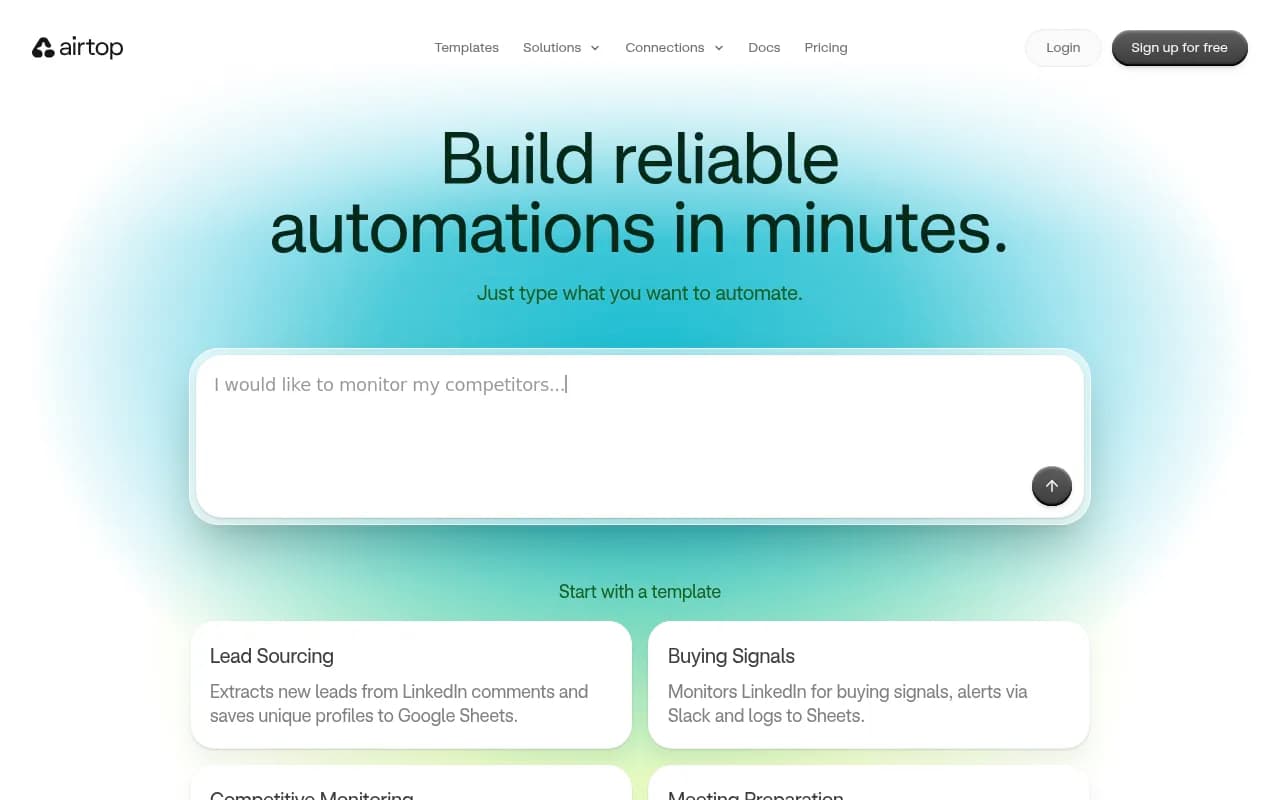
Summary
- Best for: Marketing teams, sales ops, operations managers, and agencies who need to automate repetitive browser tasks without writing code
- Standout feature: Natural language agent builder—describe what you want in plain English and Airtop generates the automation
- Works everywhere: Automates any website, even behind logins or without APIs, using real browser sessions
- Enterprise-ready: SOC 2 Type II certified, HIPAA compliant, with session-level encryption and full observability
- Pricing: Starts at $26/month (Starter), $80/month (Professional), custom enterprise pricing available
Airtop is a browser automation platform that eliminates the need for coding or complex scripting. You describe what you want to automate in plain English—"monitor my competitors' LinkedIn posts weekly and send a Slack summary"—and Airtop builds the agent for you. It runs deterministic code in the cloud, so your automations behave consistently every time.
The platform targets non-technical users who are tired of manual browser work: marketers scraping competitor data, sales teams enriching CRM records, operations managers pulling invoices from vendor portals, and agencies building custom workflows for clients. Airtop handles tasks that traditional automation tools like Zapier or Make can't reach—websites behind logins, sites without APIs, or multi-step browser interactions that require clicking, scrolling, and form-filling.
Airtop launched in 2024 and quickly gained traction with companies like Huel, Finn, and Cared.io. The company is SOC 2 Type II certified and HIPAA compliant, positioning itself as an enterprise-grade solution for teams that need security and reliability alongside ease of use.
Key features
Natural language agent builder: The core differentiator. You type what you want to automate in plain English—no code, no flowcharts, no scripting. Airtop's AI interprets your instructions and generates the browser automation. For example: "Extract new leads from LinkedIn comments and save unique profiles to Google Sheets" or "Research tomorrow's meeting attendees on LinkedIn and email me personalized notes." The platform translates these descriptions into deterministic code that runs in the cloud. This is fundamentally different from traditional RPA tools that require you to manually map out every click and selector.
Works on any website: Airtop runs real browser sessions in the cloud, so it can automate any site—even those behind logins, paywalls, or CAPTCHAs. It doesn't rely on APIs or structured data feeds. If you can do it in a browser, Airtop can automate it. This includes scraping competitor pricing pages, pulling data from internal dashboards, filling out forms on vendor portals, or monitoring social media feeds. The platform handles dynamic content, JavaScript-heavy sites, and multi-step workflows that break traditional scrapers.
Pre-built templates: Airtop offers a library of ready-to-use templates for common workflows: lead sourcing from LinkedIn, buying signal detection, competitive monitoring, meeting preparation, invoice collection, and more. Each template is fully customizable—you can tweak the logic, change the data sources, or adjust the output format. Templates are organized by use case (marketing, sales, web research, operations) and serve as starting points for users who want to move fast.
Native integrations: Airtop connects directly with Slack, Gmail, Google Sheets, Airtable, HubSpot, and other popular tools. Your agents can push data to a spreadsheet, send Slack alerts, update CRM records, or trigger email notifications. This eliminates the need for manual data transfers or copy-pasting between systems. Integrations are configured within the agent builder—no API keys or webhooks required unless you're building custom workflows.
Zapier, Make, and n8n extensions: Airtop plugs into existing automation platforms via webhooks and native nodes. You can trigger an Airtop agent from a Zapier zap, a Make scenario, or an n8n workflow, then pass the results back into your automation. This extends the reach of no-code automation tools—tasks that were previously impossible (like scraping a competitor's pricing page or logging into a vendor portal) become just another step in your workflow.
Deterministic execution: Unlike LLM-based agents that can behave unpredictably, Airtop runs deterministic code. Once you've built and tested an agent, it will perform the same actions every time. This reliability is critical for production workflows—you can't have an agent that sometimes extracts the right data and sometimes doesn't. Airtop's approach combines the flexibility of natural language input with the consistency of traditional scripting.
Real-time observability: Every agent run is logged and visible in the dashboard. You see exactly what the agent did—which pages it visited, what data it extracted, where it got stuck, and how long each step took. This transparency is essential for debugging and trust. If an agent fails, you can replay the session, inspect the logs, and understand what went wrong. For compliance-sensitive teams, this level of visibility is non-negotiable.
Session-level security: Each agent runs in its own isolated, encrypted browser session. Your credentials, cookies, and session data are never shared across agents or exposed to other users. Airtop is SOC 2 Type II certified and HIPAA compliant, which means it meets enterprise standards for data protection, access control, and audit logging. The platform also guarantees that your data is never used for AI training—a key concern for companies automating sensitive workflows.
Scheduled and event-driven triggers: Agents can run on a schedule (daily, weekly, hourly) or be triggered by external events (webhook, Zapier action, API call). This flexibility supports both recurring tasks (like weekly competitor monitoring) and reactive workflows (like enriching a lead as soon as they enter your CRM).
Who is it for
Airtop is built for non-technical users who need to automate browser tasks but don't want to learn Python, Selenium, or Puppeteer. The primary audience is operations-focused professionals: marketing managers scraping competitor content, sales ops teams enriching CRM data, finance teams pulling invoices from vendor portals, and agencies building custom automations for clients.
Marketing teams use Airtop to monitor competitors (pricing changes, new product launches, top-performing social posts), source leads from LinkedIn engagement, and generate social content from trending topics. Sales teams use it to refresh CRM records with the latest web data, track job changes and company updates, and automate pre-meeting research. Operations teams use it to sync data from internal dashboards, collect invoices, auto-fill forms, and eliminate repetitive browser work.
The platform is particularly valuable for teams that have hit the limits of Zapier or Make—tasks that require logging into a website, navigating multiple pages, or extracting unstructured data. Airtop fills the gap between simple API-based automations and full-scale RPA deployments.
Airtop is less suitable for developers who want low-level control over browser automation. If you're comfortable writing Playwright or Puppeteer scripts, you'll find Airtop's natural language interface limiting. The platform is also not ideal for high-frequency, real-time scraping—it's optimized for scheduled or event-driven workflows, not continuous data extraction.
Integrations and ecosystem
Airtop integrates natively with Slack, Gmail, Google Sheets, Airtable, and HubSpot. These integrations are configured within the agent builder—no API keys or OAuth flows required. Agents can push data to a spreadsheet, send Slack messages, update CRM fields, or trigger email notifications.
For more advanced workflows, Airtop offers webhooks and native nodes for Zapier, Make, and n8n. You can trigger an Airtop agent from any of these platforms, pass in dynamic inputs (like a list of URLs to scrape or a set of search terms), and receive structured results back. This makes Airtop a powerful extension for existing automation stacks—it handles the browser interactions that other tools can't.
Airtop also provides an API for developers who want to programmatically create, run, and monitor agents. The API is RESTful and well-documented, with endpoints for triggering agents, fetching results, and accessing logs. This is useful for agencies building custom solutions or companies integrating Airtop into internal tools.
There's no browser extension or mobile app—Airtop runs entirely in the cloud. Agents are managed through the web dashboard, and results are delivered via integrations or API.
Pricing and value
Airtop offers three pricing tiers:
- Starter: $26/month (billed annually) or $39/month (billed monthly). Includes 30 transcription hours per month, 4K export, and unlimited use of basic and advanced AI features. This tier is designed for individuals or small teams testing the platform.
- Professional: $80/month (billed annually) or higher monthly. Includes more execution hours, advanced integrations, and priority support. This tier is for teams running multiple agents in production.
- Enterprise: Custom pricing. Includes dedicated support, SLAs, SSO, advanced security controls, and custom execution limits. This tier is for large organizations with compliance requirements or high-volume automation needs.
All plans include access to the natural language agent builder, pre-built templates, native integrations, and observability tools. The main difference between tiers is execution volume and support level.
Compared to traditional RPA tools (UiPath, Automation Anywhere), Airtop is significantly cheaper and faster to deploy. Compared to developer-focused tools (Playwright, Puppeteer), Airtop is more expensive per execution but eliminates the need for engineering resources. For non-technical teams, the value proposition is clear: you can build and deploy automations in minutes instead of weeks, without hiring developers or consultants.
The pricing is transparent and predictable—you pay based on execution volume, not per agent or per user. This makes it easy to scale as your automation needs grow.
Strengths and limitations
Airtop excels at making browser automation accessible to non-technical users. The natural language interface is genuinely intuitive—you describe what you want, and the platform builds it. This eliminates the learning curve associated with traditional automation tools. The deterministic execution model ensures reliability, and the observability features provide transparency into what agents are doing. The platform's security posture (SOC 2 Type II, HIPAA) makes it viable for enterprise use cases.
The pre-built templates are a strong onboarding tool—they demonstrate what's possible and give users a starting point for customization. The integrations with Slack, Sheets, and CRMs are seamless, and the Zapier/Make/n8n extensions make Airtop a natural fit for existing automation stacks.
However, Airtop has limitations. The natural language interface, while powerful, can struggle with highly complex or ambiguous instructions. You may need to iterate on your prompt or break a workflow into multiple agents. The platform is optimized for scheduled or event-driven workflows—it's not designed for high-frequency, real-time scraping or continuous monitoring. If you need to scrape thousands of pages per hour, you'll need a different tool.
Airtop also lacks advanced features found in developer-focused tools: custom JavaScript injection, proxy rotation, CAPTCHA-solving integrations, or fine-grained control over browser behavior. If you need these capabilities, you'll need to use Playwright or Puppeteer directly.
The pricing can add up for high-volume use cases. If you're running dozens of agents multiple times per day, the execution costs may exceed the cost of hiring a developer to build custom scripts. However, for most teams, the time savings and ease of use justify the expense.
Bottom line
Airtop is the best choice for non-technical teams that need to automate browser tasks without writing code. If you're a marketer scraping competitor data, a sales ops manager enriching CRM records, or an operations lead pulling invoices from vendor portals, Airtop will save you hours of manual work every week. The natural language interface makes it accessible to anyone, and the deterministic execution ensures your automations run reliably.
Best use case in one sentence: Automating repetitive browser tasks across websites that don't offer APIs, without needing to write code or hire developers.
Frequently asked questions
What is Airtop and what does it do?
Who is Airtop best for?
How much does Airtop cost?
Does Airtop work on websites behind logins or without APIs?
Is Airtop secure and compliant?
How does Airtop compare to Zapier or Make?
Similar and alternative tools to Airtop