Key Takeaways
- Completely different tools: Airtop builds no-code web automations (browser workflows, scraping, task automation). Bluefish AI monitors brand visibility in AI search engines (ChatGPT, Perplexity, etc.). They don't compete -- they solve unrelated problems.
- Pricing gap: Airtop starts at $26/mo with transparent self-service tiers. Bluefish AI requires custom quotes estimated at $4,000+/month with no public pricing.
- Target audience: Airtop serves ops teams, sales teams, and anyone automating repetitive browser tasks. Bluefish AI targets Fortune 500 marketing teams tracking AI brand presence.
- Content creation: Neither platform generates or optimizes content. Bluefish monitors AI visibility but leaves you to fix gaps yourself. Airtop automates workflows but isn't an SEO or content tool.
- Enterprise focus: Bluefish AI is enterprise-only with custom audiences and infosec compliance. Airtop offers self-service plans suitable for teams of any size.
- Integration ecosystems: Airtop connects with Slack, Gmail, Sheets, HubSpot, Zapier, n8n, Make. Bluefish AI focuses on AI channel monitoring without workflow automation integrations.
Overview: Two tools, two completely different jobs
Airtop: No-code web automation platform
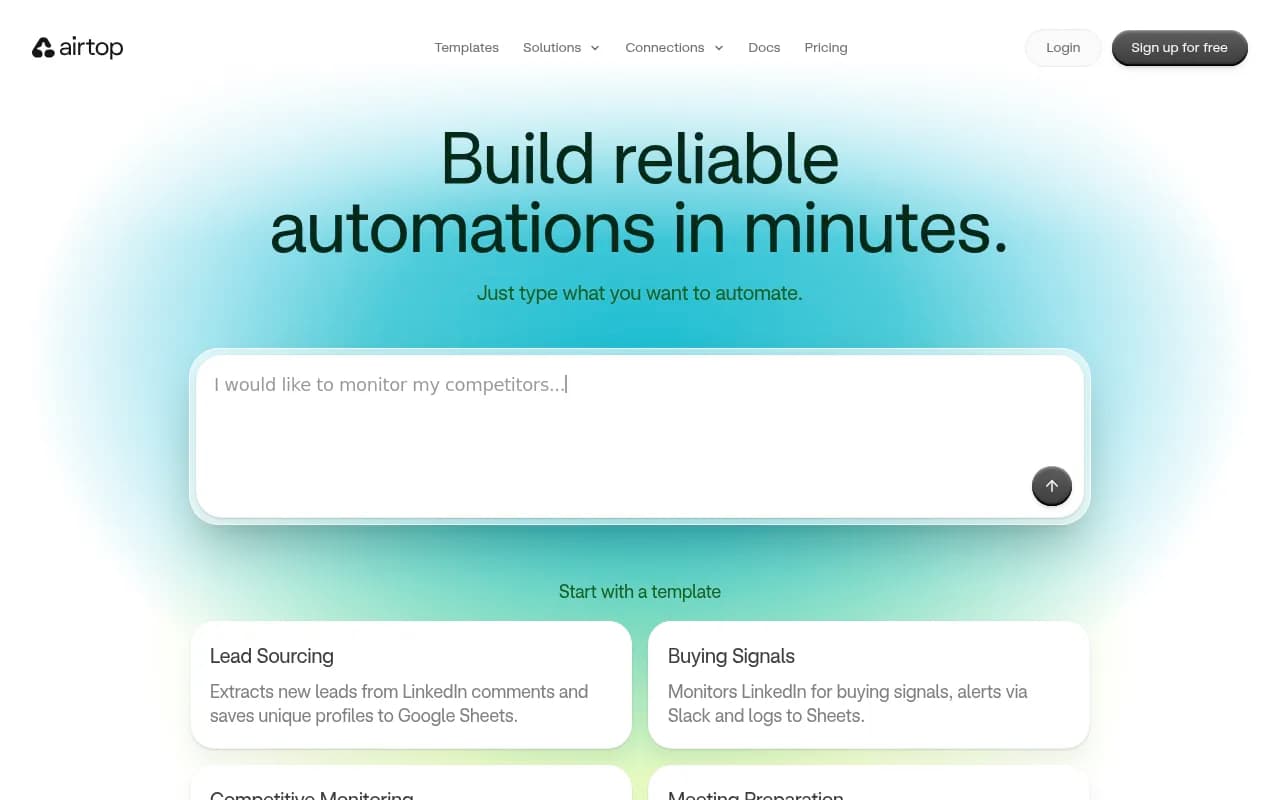
Airtop is a no-code platform for building browser-based automations. You describe what you want to automate in plain English -- "monitor competitor LinkedIn posts and log engagement to Sheets" or "extract new leads from LinkedIn comments" -- and Airtop generates the automation. It runs deterministic code in the cloud, works on any website (even behind logins or without APIs), and integrates with tools like Slack, Gmail, Google Sheets, Airtable, HubSpot, Zapier, n8n, and Make.
Use cases: lead sourcing, competitive monitoring, invoice reconciliation, meeting prep research, data extraction, repetitive browser tasks. Airtop is built for ops teams, sales teams, and anyone who needs to automate manual web workflows without writing code.
Bluefish AI: Enterprise AI marketing platform
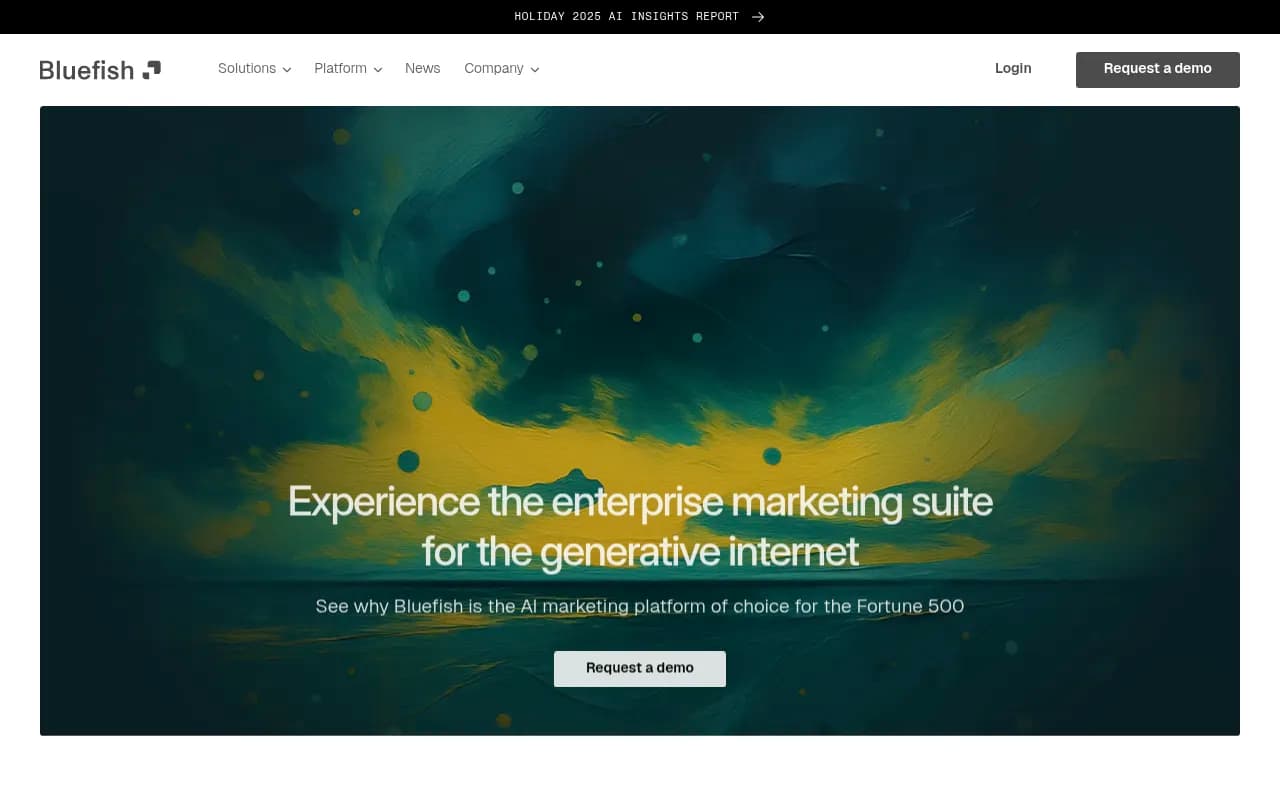
Bluefish AI is an enterprise-focused platform that monitors brand visibility across AI search engines and agentic commerce channels. It tracks how your brand appears in ChatGPT, Perplexity, and other LLM responses, provides custom audiences and tailored prompts, and offers deep performance analytics. Bluefish positions itself as the "AI marketing platform of choice for the Fortune 500" with enterprise-grade infosec compliance and custom data segmentation.
Use cases: AI brand monitoring, share-of-voice tracking in LLMs, competitive AI visibility analysis, measuring AI channel performance. Bluefish is built for large marketing teams at Fortune 500 brands who need to understand and influence their AI search presence.
Side-by-Side Comparison
| Feature | Airtop | Bluefish AI |
|---|---|---|
| Primary function | No-code web automation | AI search visibility monitoring |
| Use case | Automate browser workflows, scrape data, extract leads | Track brand mentions in ChatGPT/Perplexity/LLMs |
| Target audience | Ops teams, sales teams, SMBs to enterprise | Fortune 500 marketing teams |
| Pricing | From $26/mo (Starter), $80/mo (Pro), custom Enterprise | Custom quotes only (est. $4,000+/mo) |
| Self-service | Yes -- sign up and start building | No -- requires sales demo and custom quote |
| Content generation | No | No |
| AI visibility tracking | No | Yes (core feature) |
| Browser automation | Yes (core feature) | No |
| Integrations | Slack, Gmail, Sheets, Airtable, HubSpot, Zapier, n8n, Make | AI channel monitoring (no workflow integrations) |
| Custom audiences | No | Yes (enterprise feature) |
| Crawler logs | No | No |
| Free trial | Available | Not specified |
| Transparent pricing | Yes | No |
Head-to-head feature deep-dive
Core functionality: Automation vs monitoring
Airtop and Bluefish AI operate in completely separate categories. Airtop builds browser automations -- you tell it "scrape competitor pricing pages weekly and email me a summary" and it generates the workflow. It handles logins, navigates complex sites, extracts data, and pushes results to your tools. The value is eliminating repetitive manual browser tasks.
Bluefish AI monitors AI search engines. It tracks when ChatGPT, Perplexity, or Gemini mention your brand, analyzes share-of-voice vs competitors, and surfaces which prompts trigger your brand's appearance. The value is understanding your AI channel presence so you can optimize it.
These are fundamentally different problems. If you need to automate data extraction or repetitive web tasks, Airtop is the answer. If you need to track brand visibility in AI search results, Bluefish AI is the answer. They don't overlap.
Pricing and accessibility
| Plan | Airtop | Bluefish AI |
|---|---|---|
| Entry tier | $26/mo (Starter) | No entry tier |
| Mid tier | $80/mo (Professional) | No mid tier |
| Enterprise | Custom pricing | Custom quotes (est. $4,000+/mo) |
| Self-service | Yes | No |
| Free trial | Yes | Not specified |
Airtop offers transparent self-service pricing starting at $26/month. You can sign up, build automations, and scale as needed. Bluefish AI requires a sales demo and custom quote -- no public pricing, no self-service. Industry estimates put Bluefish's enterprise plans at $4,000+/month, positioning it squarely in the Fortune 500 budget range.
For small to mid-sized teams, Airtop is accessible. Bluefish AI is enterprise-only.
Target audience and positioning
Airtop serves ops teams, sales teams, marketing teams, and anyone who needs to automate browser-based workflows. The messaging emphasizes "no code" and "build with words" -- it's designed for non-technical users who want to eliminate manual tasks. Case studies include invoice reconciliation (Cared.io), lead sourcing, and competitive monitoring.
Bluefish AI explicitly targets Fortune 500 brands. The homepage leads with "the AI marketing platform of choice for the Fortune 500" and emphasizes enterprise features like custom audiences, tailored prompts, and infosec compliance. The platform is built for large marketing teams managing AI channel strategy at scale.
If you're a startup or SMB, Airtop is built for you. If you're a Fortune 500 CMO, Bluefish AI is built for you.
Integration ecosystems
Airtop integrates with Slack, Gmail, Google Sheets, Airtable, HubSpot, Zapier, n8n, and Make. Automations can pull data from these tools, push results back, and trigger workflows. The Zapier/n8n/Make integrations let you embed Airtop automations into existing workflows -- for example, "when a new lead hits my CRM, run an Airtop automation to research them on LinkedIn and log notes to Sheets."
Bluefish AI focuses on AI channel monitoring without workflow automation integrations. It tracks AI search engines and provides analytics dashboards, but it doesn't connect to Slack, Sheets, or CRMs to automate actions based on that data. The platform is monitoring-focused, not action-focused.
If you need automations that connect your tools and move data around, Airtop is the choice. If you need AI visibility dashboards for strategic analysis, Bluefish AI is the choice.
Content optimization and generation
Neither platform creates or optimizes content. Bluefish AI monitors your AI visibility and shows you where you're losing share-of-voice, but it doesn't help you fix the gaps. You see the problem, then you're on your own to create content that improves your AI search presence.
Airtop doesn't touch content at all -- it's a workflow automation tool, not an SEO or content platform.
If you need content gap analysis and AI-optimized content generation to actually improve your AI visibility, you'd need a platform like Promptwatch that combines monitoring with content creation tools.

Enterprise features and compliance
Bluefish AI emphasizes enterprise-grade features: custom audiences (segment prompts by persona, region, or use case), tailored prompts (test specific queries relevant to your brand), and infosec compliance ("consistently pass infosec reviews with ease"). The platform is built for large organizations with complex data segmentation needs and strict security requirements.
Airtop offers enterprise plans with custom pricing but positions itself as accessible to teams of any size. The focus is on deterministic, reliable automations that "act the same every time" -- important for production workflows but not the same as enterprise infosec compliance.
For Fortune 500 procurement and infosec teams, Bluefish AI is designed to meet those requirements. Airtop serves a broader market.
What each platform is missing
Airtop doesn't monitor AI search engines, track brand visibility in LLMs, or provide AI channel analytics. If that's what you need, Airtop isn't the tool.
Bluefish AI doesn't automate workflows, scrape data, or integrate with productivity tools. It also lacks content generation, crawler logs (tracking how AI bots crawl your site), and visitor analytics (connecting AI visibility to actual traffic). Compared to more comprehensive GEO platforms, Bluefish is monitoring-only -- it shows you the problem but doesn't help you fix it.
Pricing comparison
| Plan | Airtop | Bluefish AI |
|---|---|---|
| Starter/Entry | $26/mo | Not available |
| Professional/Mid | $80/mo | Not available |
| Enterprise | Custom pricing | Custom quotes (est. $4,000+/mo) |
| Free trial | Yes | Not specified |
| Annual discount | Available | Unknown |
| Self-service signup | Yes | No |
Airtop's transparent pricing makes it easy to evaluate and get started. Bluefish AI's quote-based model reflects its enterprise positioning but creates a barrier for smaller teams.
Pros and cons
Airtop pros:
- No-code automation builder -- describe tasks in plain English
- Works on any website, even behind logins or without APIs
- Affordable self-service pricing starting at $26/mo
- Integrates with Slack, Gmail, Sheets, HubSpot, Zapier, n8n, Make
- Deterministic cloud execution (automations run reliably)
- Suitable for teams of any size
Airtop cons:
- Doesn't monitor AI search engines or track brand visibility in LLMs
- Not an SEO or content optimization tool
- No AI channel analytics or competitive AI visibility tracking
- Limited to workflow automation use cases
Bluefish AI pros:
- Purpose-built for AI search visibility monitoring
- Enterprise-grade with custom audiences and tailored prompts
- Designed for Fortune 500 brands with infosec compliance
- Deep performance analytics and competitive benchmarking
- Tracks multiple AI channels (ChatGPT, Perplexity, etc.)
Bluefish AI cons:
- No content generation or optimization tools (monitoring-only)
- No crawler logs or visitor analytics
- Custom quote-based pricing (estimated $4,000+/mo) with no self-service
- Not accessible to SMBs or startups
- Doesn't automate workflows or integrate with productivity tools
- Leaves you to fix AI visibility gaps on your own
Who should pick which tool
Pick Airtop if you:
- Need to automate repetitive browser tasks (data extraction, lead sourcing, competitive monitoring)
- Want to eliminate manual workflows without writing code
- Need automations that integrate with Slack, Sheets, CRMs, or other tools
- Are an ops team, sales team, or marketing team looking to save time on manual web tasks
- Want transparent self-service pricing starting under $30/month
- Don't need AI search visibility monitoring
Pick Bluefish AI if you:
- Are a Fortune 500 marketing team tracking brand visibility in AI search engines
- Need to monitor share-of-voice in ChatGPT, Perplexity, and other LLMs
- Require custom audiences, tailored prompts, and enterprise-grade data segmentation
- Have budget for custom enterprise pricing ($4,000+/month)
- Need infosec compliance and custom data controls
- Don't need workflow automation or content generation
Pick neither if you:
- Need a comprehensive GEO platform that monitors AI visibility AND helps you optimize it with content gap analysis, AI content generation, crawler logs, and visitor analytics. In that case, look at Promptwatch -- it combines monitoring with action tools to actually improve your AI search presence, not just track it.
Final verdict
Airtop and Bluefish AI don't compete because they solve completely different problems. Airtop automates browser workflows -- scraping, data extraction, repetitive web tasks. Bluefish AI monitors brand visibility in AI search engines. Comparing them is like comparing a task automation tool to a brand monitoring platform.
If you need to automate manual browser tasks, Airtop is a strong choice with transparent pricing and no-code simplicity. If you're a Fortune 500 marketing team tracking AI channel performance, Bluefish AI is purpose-built for that use case (though it's monitoring-only and leaves content optimization to you).
For most teams, the question isn't "Airtop or Bluefish AI?" -- it's "Do I need workflow automation or AI visibility monitoring?" Answer that, and the choice is obvious.