Key takeaways
- Addlly AI and Airtop are fundamentally different tools -- comparing them directly is like comparing a content SEO platform to a CRM automation tool. They share almost no functional overlap.
- Addlly AI is built specifically for Generative Engine Optimization (GEO): auditing how AI models cite your brand, identifying content gaps, and generating AI-optimized content to improve visibility in ChatGPT, Perplexity, and Google AI.
- Airtop is a no-code AI agent builder for sales and marketing automation -- its core jobs are lead generation, prospect enrichment, and outbound workflow automation via cloud browsers.
- If you're a marketing or SEO team trying to rank in AI search engines, Addlly AI is the relevant tool here. Airtop simply doesn't do that.
- Airtop is the better pick if your problem is "we spend too much time stitching together scraping, enrichment, and outreach tools" -- it replaces a messy stack of automation tools with one agent-based platform.
- Neither tool is a direct substitute for the other. The only reason someone might be comparing them is confusion about what each actually does.
Overview
Addlly AI
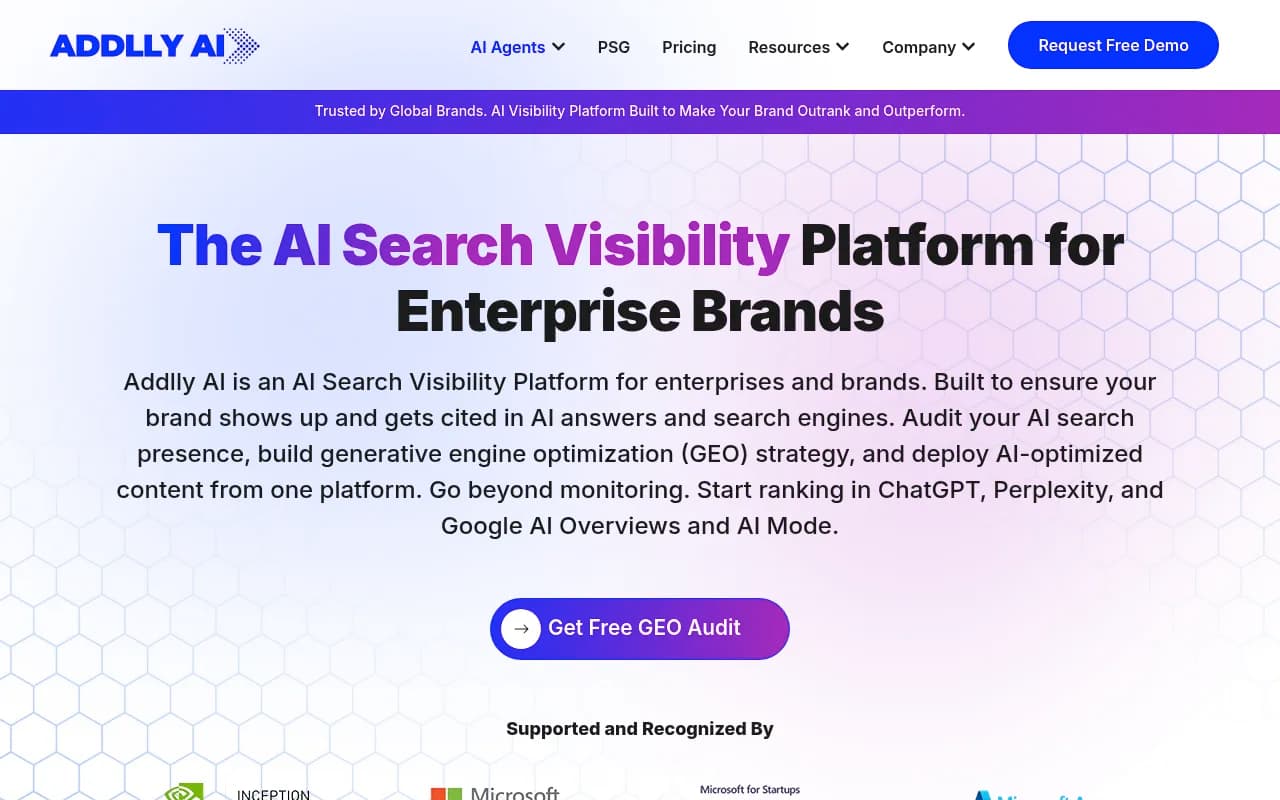
Addlly AI positions itself as an enterprise-grade AI Search Visibility platform. The core workflow is a three-step loop: audit how generative AI platforms currently cite and represent your brand, build a prioritized GEO action plan based on those gaps, then execute AI-optimized content at scale. It's backed by NVIDIA Inception, Microsoft Azure, and AWS Startups -- which gives it some credibility as a serious enterprise product rather than a side project.
The platform targets marketing and SEO teams at larger organizations that need to show up in ChatGPT answers, Google AI Overviews, and Perplexity results. Its AI agents handle citation monitoring, content gap identification, and content generation in a unified workflow.
Airtop
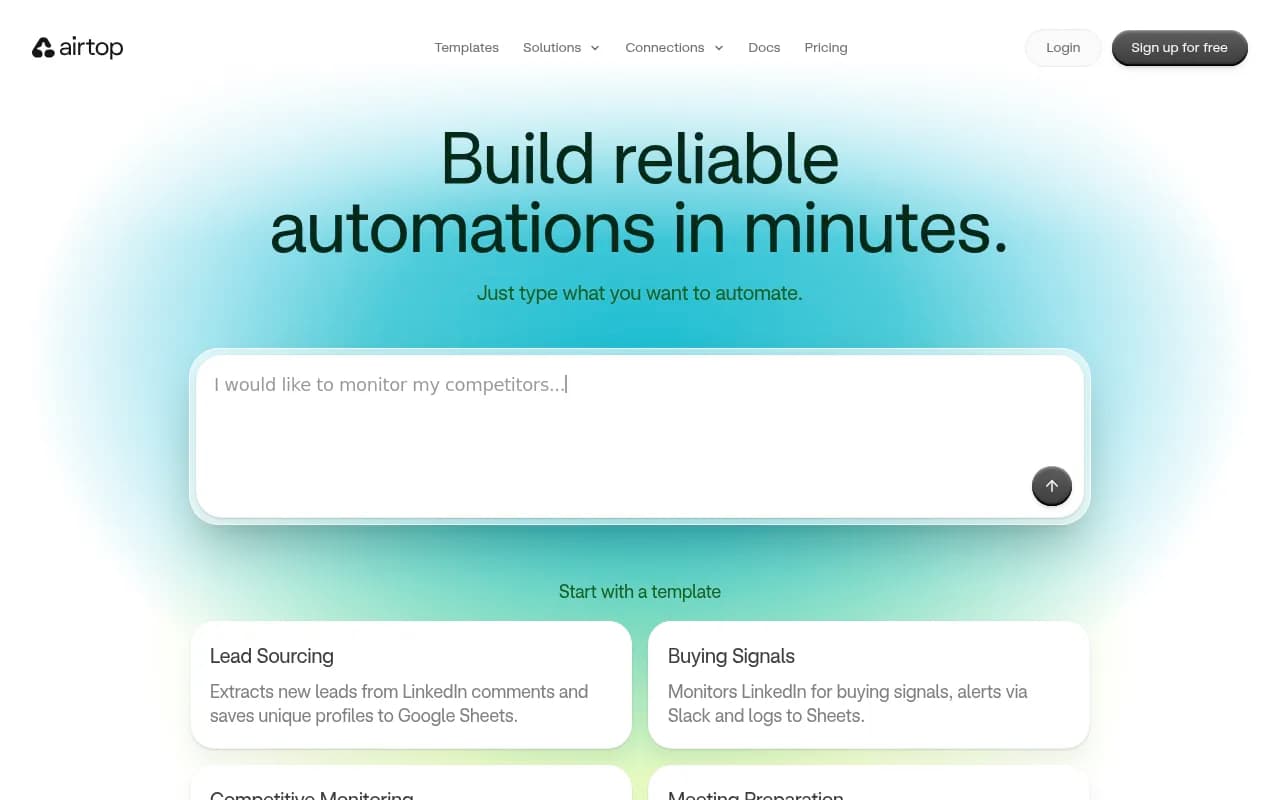
Airtop is a no-code AI agent builder focused on sales and marketing automation. The pitch is simple: describe any workflow in plain English, and Airtop builds, tests, and deploys an agent that runs in the cloud. The main use cases are lead generation (mining LinkedIn for warm leads), data enrichment, buying signal monitoring, and personalized outreach.
What makes Airtop interesting is the cloud browser angle -- it runs browser automation in the cloud rather than on your local machine, which means it doesn't stop when you close your laptop and doesn't get your IP blocked. It's essentially a more reliable, scalable replacement for tools like n8n or Zapier when those workflows involve web scraping and browser interaction.
Side-by-side comparison
| Feature | Addlly AI | Airtop |
|---|---|---|
| Primary use case | GEO / AI search visibility | Sales & marketing automation |
| AI search monitoring | Yes (ChatGPT, Perplexity, Google AI) | No |
| Citation tracking | Yes | No |
| Content gap analysis | Yes | No |
| AI content generation | Yes (GEO-optimized) | No |
| Lead generation | No | Yes |
| Data enrichment | No | Yes |
| Outbound automation | No | Yes |
| No-code agent builder | Partial (AI agents for GEO workflows) | Yes (core feature) |
| Cloud browser automation | No | Yes |
| Free tier | Free GEO audit | Free sign-up (limited) |
| Paid plans start at | $99/mo | $26/mo |
| Target user | Marketing/SEO teams, enterprises | Sales teams, growth teams |
| Competitor benchmarking | Yes (AI citation benchmarks) | No |
| CRM integration | No | Yes (Salesforce, etc.) |
Head-to-head feature deep-dive
Core purpose and positioning
This is where the comparison gets awkward: these tools don't compete. Addlly AI is an AI search visibility platform. Airtop is a workflow automation platform. The only surface-level similarity is that both use the word "AI agents" in their marketing.
Addlly AI's agents are specialized for GEO tasks -- auditing brand citations, identifying content gaps, generating optimized articles. Airtop's agents are general-purpose automation workers that browse the web, scrape data, enrich leads, and trigger outbound sequences.
Verdict: No meaningful comparison here. They solve different problems for different teams.
AI search visibility and GEO features
Addlly AI covers the full GEO workflow:
- Audits how AI platforms (ChatGPT, Google AI, Perplexity) currently cite and describe your brand
- Benchmarks your citation presence against competitors
- Identifies gaps in how AI models interpret your brand and content
- Generates a prioritized action plan for improving AI visibility
- Produces AI-optimized content at scale to fill those gaps
Airtop has zero GEO or AI search visibility features. It doesn't monitor citations, track brand mentions in LLMs, or generate content for AI search. That's simply not what it's built for.
Verdict: Addlly AI wins by default. Airtop doesn't play in this space.
Sales and marketing automation
Airtop's strength is automating the messy, multi-step workflows that sales and growth teams deal with daily:
- Drop a LinkedIn URL, get a list of everyone who engaged with a post, enriched with contact details
- Monitor buying signals across multiple data sources
- Build personalized outreach sequences
- Run all of this in cloud browsers that don't get rate-limited or blocked
Addlly AI has no sales automation features. It doesn't do lead generation, enrichment, or outbound.
Verdict: Airtop wins by default. Addlly AI doesn't play in this space.
Content generation
Addlly AI generates content specifically engineered for AI search visibility -- articles, structured knowledge assets, and optimization signals designed to get cited by LLMs. The content generation is tied directly to the audit and gap analysis workflow, so what gets written is informed by actual citation data and competitor analysis.
Airtop doesn't generate marketing or SEO content. It can generate personalized outreach copy as part of a sales automation workflow, but that's a narrow, transactional use case -- not content strategy.
Verdict: Addlly AI is the clear choice for content teams. Airtop's "content generation" is limited to outreach personalization.
Ease of use and setup
Airtop's no-code approach is genuinely accessible. You describe a workflow in plain English, and the platform builds the agent. For sales teams without technical resources, this is a real advantage -- you don't need to understand APIs or write code to automate a lead enrichment workflow.
Addlly AI is more structured. The GEO audit, planning, and execution workflow requires some understanding of what GEO is and why it matters. It's not technically complex, but it's not as "describe it and go" as Airtop. Enterprise deployments likely involve onboarding support.
Verdict: Airtop has a lower barrier to entry for non-technical users. Addlly AI requires more domain knowledge but that's inherent to the problem it solves.
Integrations and ecosystem
Airtop connects to CRMs (Salesforce), LinkedIn, Google Sheets, Slack, and various outreach tools. The integrations are sales-stack oriented.
Addlly AI integrates with content management and publishing workflows, with a focus on deploying optimized content across sites and markets. It's backed by Microsoft Azure infrastructure, which suggests enterprise-grade reliability.
Verdict: Different integration ecosystems for different teams. Neither is better in absolute terms -- it depends on your stack.
Reliability and scale
Airtop's cloud browser architecture is a genuine technical differentiator for automation use cases. Local browser automation breaks when your laptop closes, gets IP-blocked, and can't scale. Airtop runs in the cloud with built-in proxies, which means agents run reliably at scale without the fragility of local setups.
Addlly AI's scale story is about content and GEO execution -- running optimization workflows across multiple sites and markets simultaneously. The NVIDIA Inception and Microsoft Azure backing suggests the infrastructure is enterprise-ready.
Verdict: Both tools are built for scale, but in completely different dimensions.
Pricing comparison
| Plan | Addlly AI | Airtop |
|---|---|---|
| Free | Free GEO audit | Free sign-up (limited) |
| Starter/Entry | $99/mo | $26/mo |
| Professional | Custom (enterprise) | $80/mo |
| Enterprise | Custom | Custom |
Airtop is cheaper at entry level, but the comparison is meaningless because the tools do different things. A $26/mo Airtop plan and a $99/mo Addlly AI plan are not substitutes for each other.
If you're evaluating Addlly AI, the free GEO audit is a reasonable starting point -- it gives you a concrete picture of your current AI search visibility before committing to a paid plan.
Pros and cons
Addlly AI
Pros:
- Purpose-built for GEO and AI search visibility -- one of the few platforms with a full audit-to-execution workflow
- Free GEO audit lowers the barrier to getting started
- AI agents handle citation monitoring, gap analysis, and content generation in one platform
- Enterprise-grade infrastructure (NVIDIA, Microsoft Azure, AWS)
- Covers major AI platforms: ChatGPT, Perplexity, Google AI Overviews
Cons:
- Requires understanding of GEO concepts to get full value
- Pricing transparency is limited beyond the entry tier
- No sales automation or CRM features
- Relatively newer platform -- less established than some competitors in the GEO space
- No crawler log visibility or Reddit/YouTube citation tracking (features some competitors like Promptwatch include)

Airtop
Pros:
- Genuinely no-code -- describe a workflow, get an agent
- Cloud browser architecture solves the reliability and scaling problems of local automation
- Covers the full sales pipeline: lead gen, enrichment, buying signals, outreach
- Lower entry price ($26/mo)
- Pre-built agent templates reduce setup time
Cons:
- Zero GEO or AI search visibility features
- No content generation for SEO or marketing purposes
- Primarily useful for sales/growth teams -- limited value for pure marketing or content teams
- Cloud browser automation can still hit rate limits on some platforms
- Relatively niche -- doesn't replace a full marketing stack
Who should pick which tool
Pick Addlly AI if:
- Your team needs to improve how your brand appears in ChatGPT, Perplexity, or Google AI answers
- You're building a GEO strategy and need audit, planning, and content execution in one place
- You're at a mid-to-large enterprise with multiple sites or markets to optimize
- You want AI-generated content that's specifically engineered to get cited by LLMs, not just generic SEO articles
Pick Airtop if:
- Your team spends too much time manually finding, enriching, and reaching out to leads
- You've tried Zapier or n8n for browser-based automation and found it too fragile
- You need scalable, cloud-based agents that can scrape LinkedIn, enrich contacts, and trigger outreach without breaking
- You're a sales or growth team, not a content or SEO team
Don't pick either if:
- You need a traditional SEO platform (keyword tracking, backlink analysis, rank tracking) -- neither tool covers that well
- You're a small team or solo operator on a tight budget -- both tools are oriented toward teams with real workflows to automate
Final verdict
Addlly AI and Airtop are not competitors. Anyone choosing between them has likely encountered both in a search or directory listing and assumed they overlap -- they don't. Addlly AI is for marketing and SEO teams that want to rank in AI search engines. Airtop is for sales and growth teams that want to automate lead generation and outbound. The decision isn't "which is better" -- it's "which one solves my actual problem." If your problem is AI search visibility, Addlly AI is the relevant tool. If your problem is sales pipeline automation, Airtop is the relevant tool. You might even use both without any conflict.