Addlly AI Review 2026
Built for large teams needing automated GEO workflows. Uses AI agents to monitor citations, identify gaps, and generate optimized content for AI search visibility.
Key takeaways
- Addlly AI targets enterprise marketing teams that need a full GEO workflow -- audit, strategy, content generation, and citation tracking -- in one platform rather than stitching together separate tools.
- Compared to Promptwatch, Addlly AI lacks AI crawler logs, prompt volume and difficulty scoring, query fan-out analysis, ChatGPT Shopping tracking, Reddit and YouTube citation insights, and page-level traffic attribution -- capabilities that matter when you want to close the loop between AI visibility and actual revenue.
- The "zero prompt workflow" and brand-trained agents are genuinely useful for large content teams that need to publish at scale without heavy manual oversight.
- Pricing starts at $99/month but enterprise-grade features likely require custom contracts; the pricing page is not fully transparent.
- Best suited for mid-to-large enterprises in Asia-Pacific markets (the company is Singapore-based) that want a managed-service option alongside the self-serve platform.

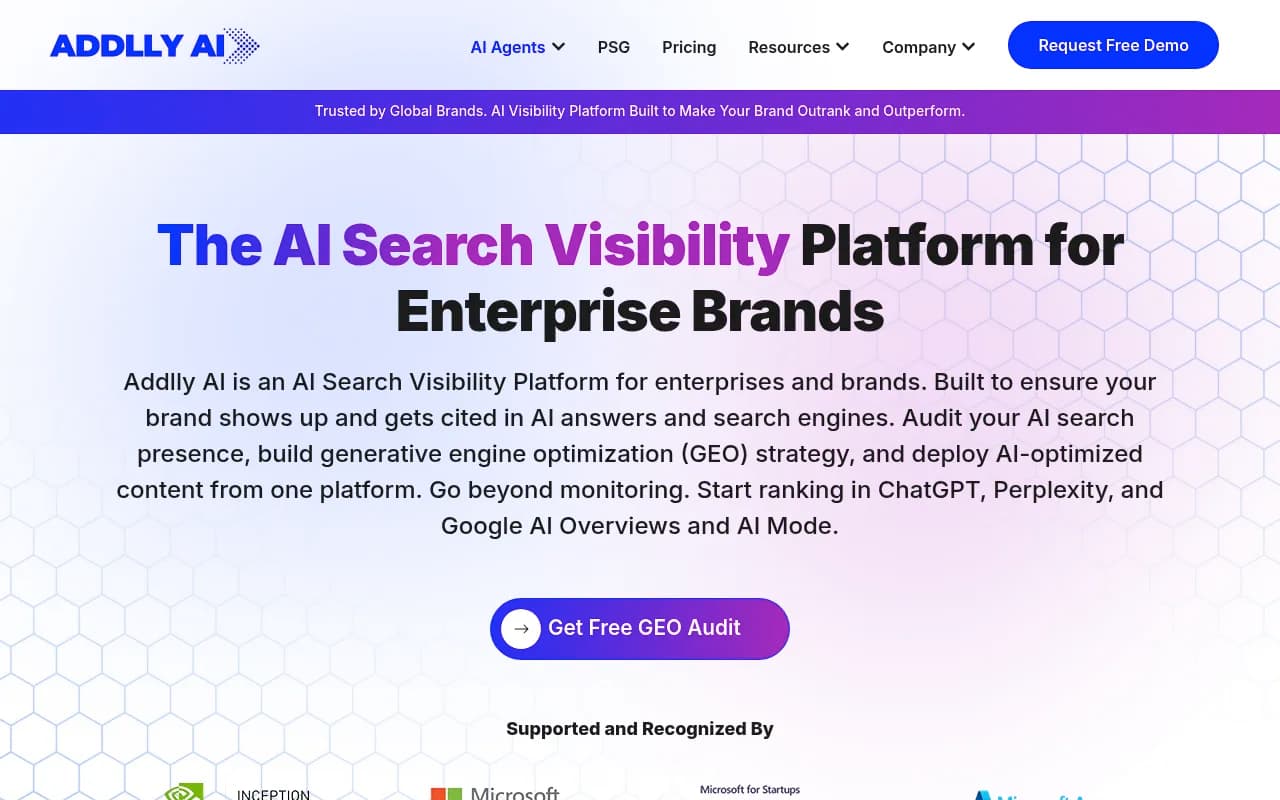
Addlly AI is a Singapore-based AI Search Visibility platform aimed squarely at enterprise marketing and digital teams. The pitch is straightforward: most brands have no idea how AI engines like ChatGPT, Perplexity, or Google AI Overviews describe them, and Addlly AI wants to fix that with a structured workflow that goes from audit to optimization to content publishing without requiring users to jump between tools. The company is backed by NVIDIA's Inception program, is a Microsoft Solutions Partner, and has received support from AWS Startups and Singapore's IMDA -- a credible set of institutional endorsements for a relatively young platform.
The target audience is clearly enterprise. The homepage leads with case studies from Shiseido, MetLife, Kenvue, and Johnson's Baby alongside regional brands like Oona Insurance and ATT Systems. The managed-service option -- where Addlly AI's own specialists run the GEO program on your behalf -- signals that the company is going after organizations that want outcomes, not just software licenses. That's a different positioning from most GEO tools, which hand you a dashboard and leave you to figure out what to do with it.
The platform has roots in AI content generation (the original Addlly product was an AI writing tool) and has evolved toward full GEO visibility. That heritage shows in the content generation side, which is more mature than what you'd find in pure-play monitoring tools. The GEO monitoring and citation forensics capabilities appear to have been layered on more recently, which means the depth of tracking data may not yet match platforms that have been doing this longer.
Key features
AI visibility audits and citation forensics
The core workflow starts with an audit that maps how generative platforms currently cite, describe, and represent your brand. Addlly AI queries ChatGPT, Google AI Overviews, Gemini, Perplexity, and Claude, then consolidates the results into a visibility baseline. The "citation forensics" layer goes further -- it identifies which competitors are being cited in your place and surfaces specific gaps where your brand is absent from AI answers. This is the foundation for everything else on the platform, and it's a reasonable starting point for enterprise teams that have never done a formal GEO audit.
Brand-trained AI agents
Addlly AI's agents are trained on your brand's tone, existing blog content, and social assets. The idea is that content generated by the platform sounds like your brand rather than generic AI output. In practice, this kind of brand training is only as good as the inputs -- teams that have well-documented brand guidelines and a substantial content library will get better results than those starting from scratch. The agents handle visibility audits, citation pattern analysis, and content generation, and the "zero prompt workflow" means they can run these tasks automatically without requiring a human to write prompts each time.
GEO recommendation engine
After the audit, the platform translates findings into a prioritized action plan. This is where Addlly AI tries to differentiate from monitoring-only tools: instead of just showing you a visibility score, it tells you what to do next. Recommendations cover content gaps, structural signals, and knowledge assets that affect how AI engines interpret your brand. The quality of these recommendations depends heavily on how well the citation forensics layer has mapped the competitive landscape.
AI-optimized content generation
This is arguably the most mature part of the platform, given Addlly's content generation origins. Teams can generate SEO and GEO-optimized blog posts, product pages, and marketing copy directly within the platform. The content is informed by citation data -- the system knows which content types and structures are getting cited in AI answers and tries to replicate those patterns. Multilingual generation is supported, which matters for the enterprise brands operating across Southeast Asia, Europe, and other regions that Addlly AI targets.
Multilingual and multi-market support
Addlly AI generates localized content in multiple languages and can track AI visibility across regional markets. For global brands managing content in five or ten languages, this is a real operational advantage. The platform claims to optimize for regional search behavior and AI engine interpretation, though the depth of regional LLM coverage (especially for non-English AI models) isn't fully documented in public materials.
Managed service delivery
Beyond the self-serve platform, Addlly AI offers a fully managed option where their specialists handle end-to-end GEO -- from initial audit through strategy, content production, and ongoing citation improvement. This is unusual in the GEO space and makes Addlly AI more of a service provider than a pure SaaS tool. For enterprises that lack internal GEO expertise, this is genuinely useful. For teams that want to build internal capability, the in-house platform option is available.
Enterprise security and governance
The platform runs on Azure and AWS infrastructure with role-based access controls, encryption, and a commitment that customer data is never used to train external AI models. For enterprise procurement teams, these are table-stakes requirements, and Addlly AI appears to have addressed them. The governance layer also supports multi-team workflows with approval processes, which matters when multiple regional teams are publishing content under a single brand.
Multi-LLM architecture
Addlly AI monitors citation behavior across GPT, Claude, Gemini, and Perplexity. The platform describes this as producing "360° GEO recommendations." In practice, this means the audit and recommendation outputs reflect patterns across multiple AI engines rather than optimizing for just one. The LLM-agnostic infrastructure also means the platform can swap in different underlying models for content generation depending on the task.
Who is it for
The clearest fit is enterprise marketing and digital teams at mid-to-large companies that are serious about AI search visibility but don't have the internal bandwidth to build a GEO program from scratch. Think a regional marketing director at a consumer goods company managing brands across Southeast Asia, or a digital team at an insurance company that needs to appear in AI answers when customers ask about coverage options. The Oona Insurance case study -- zero to 7,700 organic visitors in six months with GEO-optimized content -- is the kind of outcome this audience cares about.
Agencies that manage AI visibility for enterprise clients are another natural fit, particularly given the managed-service option and the affiliate program. An agency that wants to offer GEO as a service without building its own tooling could white-label or resell Addlly AI's capabilities. The platform's governance and multi-team features also support agency-client workflows where the agency needs to maintain brand consistency across multiple accounts.
eCommerce and product brands with large catalogs are called out specifically on the platform, and the content generation capabilities do seem well-suited to scaling product page optimization. A brand with hundreds of SKUs that needs each product page to be accurately interpreted by AI engines could use Addlly AI's agents to systematically work through that catalog.
Who should probably look elsewhere: small businesses or solo marketers who need a lightweight monitoring tool. The enterprise positioning, the managed-service model, and the likely pricing at higher tiers all point toward organizations with real marketing budgets. Developers or technical SEOs who want raw API access and granular data will also find the platform less flexible than they'd like -- Addlly AI is built for marketing workflows, not data pipelines.
Integrations and ecosystem
Addlly AI's integration story is relatively thin based on publicly available information. The platform connects to your website and knowledge base during onboarding, and the content generation workflows presumably support publishing to CMS platforms, though specific integrations (WordPress, HubSpot, Contentful, etc.) aren't prominently documented.
The enterprise security architecture built on Azure and AWS suggests compatibility with enterprise identity providers and SSO, which matters for large organizations. The LLM-agnostic design means the platform can work with OpenAI, Anthropic, and Meta Llama models, giving some flexibility in the underlying AI stack.
There's no mention of a public API, Zapier integration, or developer documentation in the publicly available materials. For teams that want to pipe GEO data into their own BI tools or build custom workflows, this is a gap. Platforms like Promptwatch offer Looker Studio integration and an API for custom reporting -- Addlly AI doesn't appear to match this yet.
The affiliate and partner program is worth noting as part of the ecosystem. Addlly AI is actively building a network of consultants and agencies, which could expand the platform's reach and support resources over time.
Pricing and value
Addlly AI's pricing starts at $99/month for a Basic Pack and $249/month for a Pro Pack, based on third-party sources (SaaSworthy). The company's own pricing page doesn't publish specific tier details publicly, which is a common enterprise SaaS approach but frustrating for buyers doing initial research.
Given the enterprise positioning and the managed-service option, it's likely that the plans covering full citation forensics, multi-market tracking, and managed delivery are priced well above the entry-level tiers. Enterprise contracts are almost certainly custom-quoted.
For comparison, Promptwatch's Professional plan at $249/month covers 2 sites, 150 prompts, 15 AI-generated articles, crawler logs, and state/city tracking -- a more transparent value proposition at a similar price point. Addlly AI's $249 Pro Pack likely covers comparable monitoring features, but the depth of prompt intelligence, traffic attribution, and crawler log data that Promptwatch provides at that tier isn't clearly matched.
The free GEO audit offer on the homepage is a genuine lead-generation tool -- you submit your website and get a visibility baseline without signing up for a paid plan. This is a reasonable way to experience the audit workflow before committing.
Strengths and limitations
What Addlly AI does well:
- The audit-to-content workflow is genuinely more complete than pure monitoring tools. Most GEO platforms show you where you're invisible and stop there. Addlly AI at least attempts to close the loop with content generation.
- Brand-trained agents that write in your brand voice are a real differentiator for large content teams. Generic AI content is a liability for enterprise brands; brand-aware generation reduces that risk.
- The managed-service option is rare in this space and valuable for organizations that want GEO outcomes without building internal expertise.
- Multilingual content generation and multi-market tracking address a real need for global brands, particularly in Asia-Pacific where the company has strong customer traction.
- Enterprise security credentials (NVIDIA Inception, Microsoft Solutions Partner, Azure/AWS infrastructure) give procurement teams something concrete to evaluate.
Where it falls short:
- No AI crawler logs. Knowing which pages AI crawlers are visiting, how often, and what errors they're encountering is critical for understanding why your content isn't being cited. Promptwatch tracks this in real time; Addlly AI doesn't appear to offer it.
- No prompt volume or difficulty scoring. Without knowing which prompts have high query volume or are realistically winnable, teams are guessing at prioritization. Promptwatch's prompt intelligence layer (volume estimates, difficulty scores, query fan-outs) makes this systematic.
- No AI traffic attribution. Connecting AI visibility to actual website traffic and revenue requires either a code snippet, GSC integration, or server log analysis. Addlly AI's dashboard tracks citation metrics but doesn't appear to close the loop to traffic and conversions the way Promptwatch does.
- No Reddit or YouTube citation tracking. A significant portion of what AI engines cite comes from Reddit threads and YouTube content. Ignoring these channels means the citation forensics picture is incomplete.
- No ChatGPT Shopping tracking. For eCommerce brands -- a stated target audience -- the absence of ChatGPT product recommendation monitoring is a notable gap.
- Pricing transparency is poor. Enterprise buyers shouldn't have to contact sales to understand what they're getting at each tier.
Bottom line
Addlly AI is a credible enterprise GEO platform with a stronger content generation story than most competitors and a managed-service option that genuinely differentiates it from pure SaaS tools. For large organizations in Asia-Pacific markets that want a single vendor to handle both the strategy and the execution of AI search visibility, it's worth evaluating seriously.
That said, teams that need deep prompt intelligence, AI crawler diagnostics, traffic attribution, or Reddit/YouTube citation tracking will find Addlly AI's monitoring capabilities less complete than Promptwatch, which covers all of these and connects visibility data to actual revenue outcomes. Best use case: an enterprise brand with a large content team that needs to systematically generate and publish GEO-optimized content at scale across multiple markets and languages.
Frequently asked questions
What is Addlly AI?
How much does Addlly AI cost?
Is there a free trial or free plan?
How does Addlly AI compare to other GEO tools like Promptwatch or Profound?
Who is Addlly AI built for?
Does Addlly AI support multiple languages and markets?
Similar and alternative tools to Addlly AI