Key takeaways
- Addlly AI starts at $99/month with a free tier; AthenaHQ starts at $295/month with no ongoing free plan -- a 3x price gap that matters a lot for smaller teams.
- Addlly AI is built around AI agent-driven content generation, meaning it doesn't just tell you what's missing -- it helps you create the content to fix it. AthenaHQ is stronger on monitoring and executive reporting but leans on recommendations rather than automated creation.
- AthenaHQ has a more recognizable enterprise client list (Coinbase, ZoomInfo, SoFi, PagerDuty) and has been featured in Forbes and the Wall Street Journal, which matters if you need to justify the tool internally.
- Both platforms cover the audit-plan-execute GEO workflow on paper, but the depth of "execute" differs significantly: Addlly AI automates content production at scale; AthenaHQ gives you the roadmap and expects your team to do the writing.
- AthenaHQ tracks 8+ LLMs with a credit-based query model; Addlly AI's exact model coverage is less transparent but includes the major platforms (ChatGPT, Google AI, Perplexity).
- Neither tool is a clear winner for every team -- the right choice depends almost entirely on whether your bottleneck is insight or execution.
Overview
Addlly AI
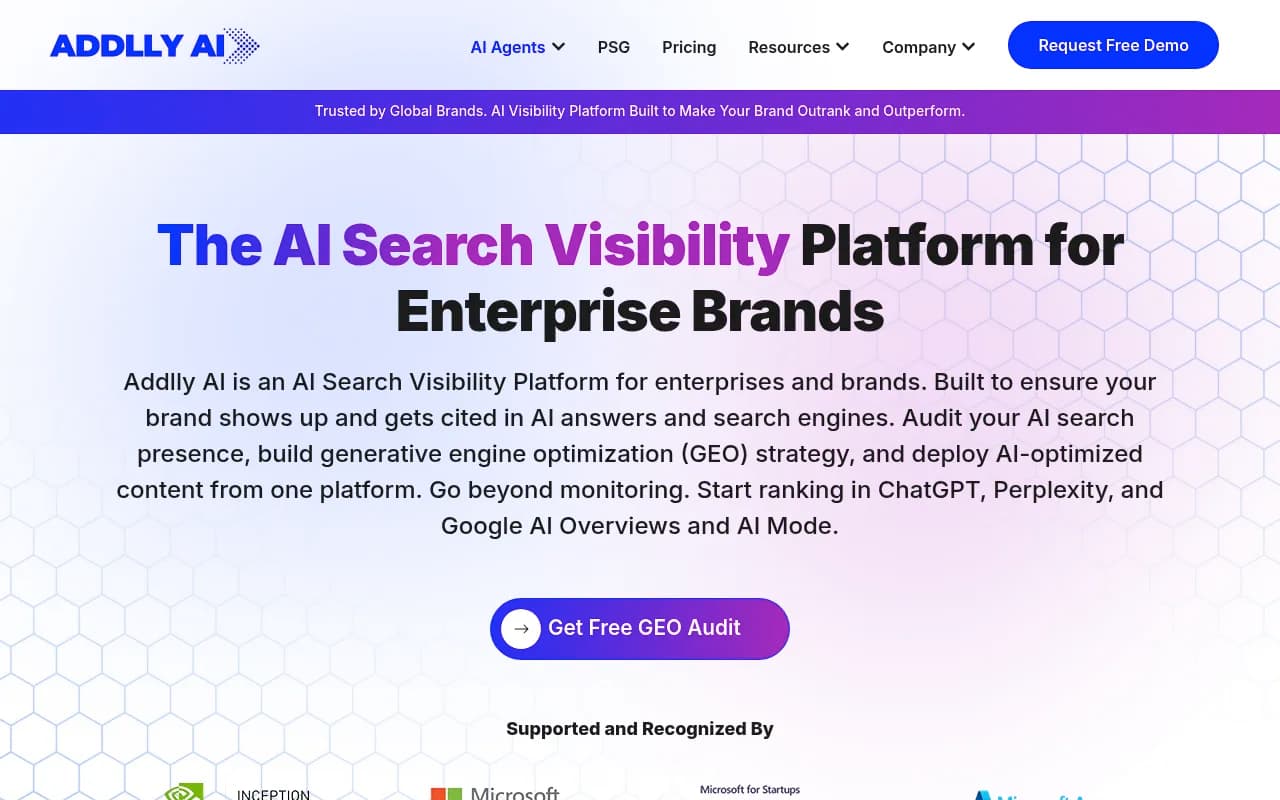
Addlly AI positions itself as an AI Search Visibility Platform built for enterprises that need to do more than watch dashboards. The core idea is a three-step GEO workflow: audit how AI platforms currently cite and interpret your brand, plan the improvements, then execute them at scale using customizable AI agents. The content generation angle is central to the pitch -- Addlly AI isn't just a tracker, it's meant to be the tool that actually produces the AI-optimized content your brand needs. It's backed by NVIDIA Inception, Microsoft Azure, and AWS Startups, which signals real infrastructure investment. The free GEO audit is a genuine entry point, and paid plans start at $99/month, making it accessible to teams that aren't ready to commit enterprise budgets.
AthenaHQ

AthenaHQ calls itself an "end-to-end AEO & GEO platform" and has the client logos to back up the enterprise claim: Coinbase, ZoomInfo, SoFi, PagerDuty, and R/GA are all on the roster. It's been covered in Forbes and the Wall Street Journal, and it came out of Y Combinator, which gives it a certain credibility in the startup-to-enterprise pipeline. The platform tracks 8+ LLMs, provides citation source analysis, and offers executive-level dashboards designed to help CMOs and VPs make the case for AI search investment. The credit-based pricing model (1 credit = 1 AI query) is flexible but can get expensive fast if you're running high query volumes. Self-serve starts at $295/month, with a $95 first-month promotional rate.
Side-by-side comparison
| Feature | Addlly AI | AthenaHQ |
|---|---|---|
| Starting price | $99/month | $295/month ($95 first month) |
| Free tier | Yes (free GEO audit + freemium) | Free audit only (10 min) |
| AI models tracked | ChatGPT, Google AI, major LLMs | 8+ LLMs (ChatGPT, Perplexity, Google AI, Claude, etc.) |
| Content generation | Yes -- AI agents generate optimized content | Recommendations only, no direct generation |
| Citation tracking | Yes | Yes |
| Competitor benchmarking | Yes | Yes |
| Executive dashboard | Basic | Strong (ROI tracking, C-suite reporting) |
| AI agent automation | Yes -- customizable agents | No -- manual/guided workflow |
| Credit-based pricing | No | Yes (1 credit = 1 AI query) |
| Enterprise plan | Yes (custom) | Yes (custom) |
| Annual discount | Yes | Yes (~17%) |
| Notable clients | Enterprise brands (undisclosed) | Coinbase, ZoomInfo, SoFi, PagerDuty |
| Backed by / recognized | NVIDIA, Microsoft, AWS, IMDA | Y Combinator, Forbes, WSJ |
| Content gap analysis | Yes | Yes (recommendations) |
| Structured knowledge optimization | Yes | Partial |
Head-to-head feature deep-dive
GEO workflow and automation
Addlly AI's workflow is genuinely automated in a way AthenaHQ's isn't. The AI agents don't just surface gaps -- they can execute content updates, expand existing pages, and apply optimization signals across multiple sites and markets. For a large team managing dozens of brand properties, that's a real time saver. The "customizable agents" angle means you can tailor the automation to your specific brand voice and governance requirements, which matters for enterprises with strict content approval processes.
AthenaHQ's workflow is more analyst-driven. It gives you a prioritized list of GEO actions, citation source analysis, and cross-platform tracking, but the actual execution happens outside the platform. Your content team still has to write the articles, update the pages, and implement the recommendations. That's not necessarily a flaw -- some teams prefer to stay in control of what gets published -- but it does mean AthenaHQ is more of a strategy tool than an execution tool.
Verdict: Addlly AI wins on automation depth. AthenaHQ wins if you want human oversight over every content decision.
Monitoring and citation tracking
AthenaHQ is strong here. It tracks 8+ LLMs, provides citation source analysis, and gives you visibility into which sources AI models are pulling from when they answer queries in your category. The executive dashboard is well-designed for showing stakeholders where the brand stands and how it's trending over time.
Addlly AI covers the major platforms and provides competitive benchmarking, but its monitoring capabilities are less prominently detailed in public-facing materials. The audit functionality is solid -- it analyzes how AI systems cite and describe your brand and benchmarks against competitors -- but the depth of per-LLM tracking isn't as clearly documented as AthenaHQ's.
Verdict: AthenaHQ has the edge on monitoring transparency and multi-LLM coverage.
Content generation
This is where the comparison gets lopsided. Addlly AI was built partly as a content platform -- the AI agents can generate AI-optimized articles, update existing content, and scale production across sites. That's a genuine capability, not just a checkbox.
AthenaHQ doesn't generate content. It tells you what to create and why, but the writing is on you. For teams with strong content operations already in place, that's fine. For teams that are stretched thin or trying to move fast, it's a meaningful gap.
Verdict: Addlly AI wins clearly. AthenaHQ doesn't compete here.
Executive reporting and ROI tracking
AthenaHQ was clearly designed with CMOs in mind. The executive dashboard tracks ROI for AI optimization efforts, shows visibility trends over time, and is built to support the kind of reporting that justifies budget decisions. The Y Combinator pedigree and Forbes/WSJ coverage also help when you're trying to convince a skeptical CFO that GEO is worth investing in.
Addlly AI has reporting, but the emphasis is on workflow and execution rather than executive storytelling. If your primary audience is a VP of Marketing who wants a clean slide for the quarterly review, AthenaHQ is the better fit.
Verdict: AthenaHQ wins on executive reporting. Addlly AI is more operator-focused.
Pricing model and accessibility
Addlly AI's freemium model is a genuine advantage for teams that want to test before committing. The free GEO audit gives you real data, and the $99/month entry point is low enough that a single marketer can justify it without a procurement process.
AthenaHQ's $295/month starting price (with a $95 first-month hook) is a bigger commitment. The credit-based model adds a layer of complexity -- you need to estimate how many AI queries you'll run per month to budget accurately, and heavy users can burn through credits faster than expected. The 17% annual discount helps, but the baseline cost is still 3x Addlly AI's entry point.
Verdict: Addlly AI wins on accessibility. AthenaHQ's pricing reflects its enterprise positioning but creates friction for smaller teams.
Integrations and ecosystem
AthenaHQ integrates with standard marketing stacks and supports cross-platform tracking across 8+ LLMs. Addlly AI runs on Microsoft Azure and AWS infrastructure and has partnerships with NVIDIA, which suggests solid technical foundations for enterprise integrations, though specific integration details aren't prominently documented.
Neither platform has published a comprehensive integration directory, so this is a "ask during the demo" category for both.
Verdict: Roughly even -- both need more transparency here.
Pricing comparison
| Plan | Addlly AI | AthenaHQ |
|---|---|---|
| Free / audit | Free GEO audit + freemium tier | Free 10-min audit only |
| Entry paid plan | $99/month | $295/month ($95 first month promo) |
| Annual discount | Yes | ~17% |
| Enterprise / custom | Yes | Yes |
| Pricing model | Flat monthly | Credit-based (1 credit = 1 AI query) |
The credit-based model at AthenaHQ deserves a closer look before you sign up. If you're tracking 50+ prompts across 8 LLMs on a daily refresh cadence, the math can add up quickly. Make sure you get a clear credit estimate for your actual use case before committing to the self-serve plan.
Pros and cons
Addlly AI
Pros:
- Genuinely affordable entry point ($99/month, freemium available)
- AI agent-driven content generation is a real differentiator -- not just monitoring
- Structured GEO workflow covers audit, planning, and execution in one platform
- Strong infrastructure backing (NVIDIA, Microsoft, AWS)
- Free GEO audit lowers the barrier to getting started
- Scales well for teams managing multiple sites and markets
Cons:
- Less transparent about exact LLM coverage and monitoring depth
- Executive reporting is less polished than AthenaHQ's
- Newer brand with less public client recognition than AthenaHQ
- Customizable agents require setup time -- not plug-and-play for every team
AthenaHQ
Pros:
- Strong enterprise client list (Coinbase, ZoomInfo, SoFi, PagerDuty)
- Excellent executive dashboard with ROI tracking
- 8+ LLM coverage is clearly documented
- Y Combinator-backed with Forbes and WSJ coverage -- credibility is easy to sell internally
- Citation source analysis is detailed and actionable
- Free 10-minute audit is a low-friction entry point
Cons:
- No content generation -- you get the roadmap, not the execution
- $295/month starting price is steep for smaller teams
- Credit-based model can be unpredictable for high-volume users
- Monitoring-focused -- the "end-to-end" claim is a stretch if your team can't act on recommendations quickly
Who should pick which tool
Pick Addlly AI if:
- You need to produce AI-optimized content at scale, not just identify gaps
- Your team is lean and needs automation to keep up with GEO demands
- Budget is a real constraint and you want to start small before scaling
- You're managing multiple brand properties or markets and need workflow automation
- You want a free GEO audit before spending anything
Pick AthenaHQ if:
- You're at a larger organization where executive buy-in and ROI reporting matter as much as the actual optimization work
- Your content team is strong and just needs better intelligence to direct their efforts
- You want the most transparent multi-LLM monitoring coverage available
- The Y Combinator / Forbes / WSJ credibility helps you justify the tool internally
- You're at a brand like Coinbase or ZoomInfo where the peer-company validation matters
Consider neither if:
- You want a platform that combines monitoring, content generation, AI crawler logs, traffic attribution, and Reddit/YouTube citation tracking in one place. Tools like Promptwatch cover that broader action loop -- from finding gaps to generating content to tracking whether it's actually getting cited.

Final verdict
Addlly AI and AthenaHQ are solving the same problem from different angles. Addlly AI is an execution platform -- it automates the content work that GEO actually requires. AthenaHQ is an intelligence platform -- it gives you the clearest picture of where you stand and what to do next, then trusts your team to act on it.
If your bottleneck is knowing what to fix, AthenaHQ is worth the premium. If your bottleneck is actually fixing it, Addlly AI's agent-driven approach and lower price point make it the more practical choice for most teams in 2026.