Key takeaways
- Searchable is a capable AI visibility platform, but it's primarily a monitoring tool — it shows you data without much help acting on it
- Small businesses in 2026 need tools that go beyond tracking: content gap analysis, AI-optimized content generation, and traffic attribution matter
- The best alternatives vary by use case: some are cheaper, some cover more AI models, some include content creation built in
- Promptwatch is the only platform in this category rated as a "Leader" across all evaluation criteria, and it's the only one with a full action loop (find gaps → create content → track results)
- Most tools on this list start under $100/month, making them realistic for small business budgets
AI search has changed how customers find businesses. ChatGPT, Perplexity, Google AI Overviews, and a dozen other models now answer questions that used to send people to a search results page. If your brand isn't showing up in those answers, you're invisible to a growing chunk of your potential customers.
Searchable was one of the earlier tools to tackle this problem. It tracks brand mentions across AI models and gives you a visibility score. For some businesses, that's enough. But a lot of small business owners hit a wall pretty quickly: the dashboard shows them they're not being cited, but doesn't tell them what to do about it.
That's the gap this guide addresses. The five tools below are all legitimate Searchable alternatives — but they differ significantly in what they actually help you accomplish.
What to look for in a Searchable alternative
Before jumping into the list, it's worth being clear about what matters for a small business specifically.
Price is obvious, but it's not the only thing. A $29/month tool that only shows you a visibility score isn't more valuable than a $99/month tool that also tells you which content to create and helps you create it. Think about the full workflow, not just the monthly line item.
Coverage matters too. Some tools only monitor ChatGPT and Perplexity. Others cover Google AI Overviews, Gemini, Claude, Grok, DeepSeek, and more. If your customers use a range of AI tools, narrow coverage means blind spots.
And then there's the action question. Monitoring tells you where you stand. Optimization tells you what to do. The best tools in 2026 do both.
| Tool | Starting price | AI models covered | Content generation | Best for |
|---|---|---|---|---|
| Promptwatch | $99/mo | 10+ (ChatGPT, Perplexity, Claude, Gemini, Grok, DeepSeek, Copilot, Meta AI, Google AIO, Google AI Mode) | Yes (built-in AI writing agent) | Full action loop: gaps → content → tracking |
| Otterly.AI | $29/mo | ChatGPT, Perplexity, Google AIO | No | Budget monitoring for early-stage businesses |
| Peec AI | €89/mo | ChatGPT, Perplexity, AI Overviews | No | European SMBs, multi-language tracking |
| LLM Pulse | Contact for pricing | Multiple LLMs | Limited | Agencies and growing brands |
| Rankshift | €77/mo | Multiple LLMs | No | Credit-based flexibility, citation gap analysis |
1. Promptwatch — best for small businesses that want to actually improve visibility
Most AI visibility tools are dashboards. They show you a number, maybe a chart, and leave you to figure out the rest. Promptwatch is different because it's built around what happens after you see the data.
Promptwatch starts with Answer Gap Analysis: you can see exactly which prompts your competitors are being cited for that you're not. Not vague categories — specific questions and topics that AI models are answering with competitor content instead of yours. That's genuinely useful for a small business owner who doesn't have time to guess.
From there, the built-in AI writing agent generates content specifically designed to get cited — articles, listicles, comparisons — grounded in citation data from over 880 million analyzed citations. This isn't generic SEO content. It's engineered around what AI models actually cite and why.
Then you track results. Page-level tracking shows which of your pages are being cited, by which models, and how often. Traffic attribution (via a code snippet, Google Search Console integration, or server log analysis) connects AI visibility to actual revenue. That's a complete loop, and it's rare in this category.
For small businesses specifically, the Essential plan at $99/month covers one site, 50 prompts, and 5 articles per month. That's a realistic starting point. The Professional plan at $249/month adds crawler logs, city-level tracking, and 15 articles — worth it once you're seeing traction and want to scale.
A few things that stand out beyond the core loop: Promptwatch logs AI crawler activity in real time (which pages ChatGPT, Claude, and Perplexity are actually reading on your site), tracks Reddit and YouTube discussions that influence AI recommendations, and monitors ChatGPT Shopping carousels if you sell products. Most competitors don't touch any of these.

2. Otterly.AI — best for businesses on a tight budget
If $99/month feels like a stretch right now, Otterly.AI is worth a look. At $29/month, it's one of the most affordable entry points in the AI visibility space.
The trade-off is scope. Otterly.AI monitors ChatGPT, Perplexity, and Google AI Overviews — the three most important platforms for most small businesses, so the coverage isn't bad. But it's a monitoring tool, not an optimization tool. You'll see where you stand, but you won't get content recommendations or gap analysis.
That said, for a business that's just starting to think about AI search visibility and wants to understand the landscape before committing to a more expensive platform, Otterly.AI is a reasonable starting point. The interface is clean, setup is quick, and the data is actionable enough to inform basic content decisions.
Otterly.AI

3. Peec AI — best for European small businesses and multi-language tracking
Peec AI is a strong option if you're operating in Europe or need to track AI visibility across multiple languages. It supports 115+ languages and unlimited countries on its standard plan, which is genuinely unusual in this category.
At €89/month for 25 prompts, it's priced similarly to Promptwatch's Essential tier. Coverage includes ChatGPT, Perplexity, and AI Overviews, with unlimited seats — useful if you have a small team that needs access.
The limitation is the same as Otterly.AI: Peec AI is primarily a monitoring platform. There's no built-in content generation, no crawler logs, and no traffic attribution. For a business that needs to track visibility across multiple markets and languages, it's well-suited. For a business that needs to close the loop between visibility and revenue, you'll need to pair it with other tools.

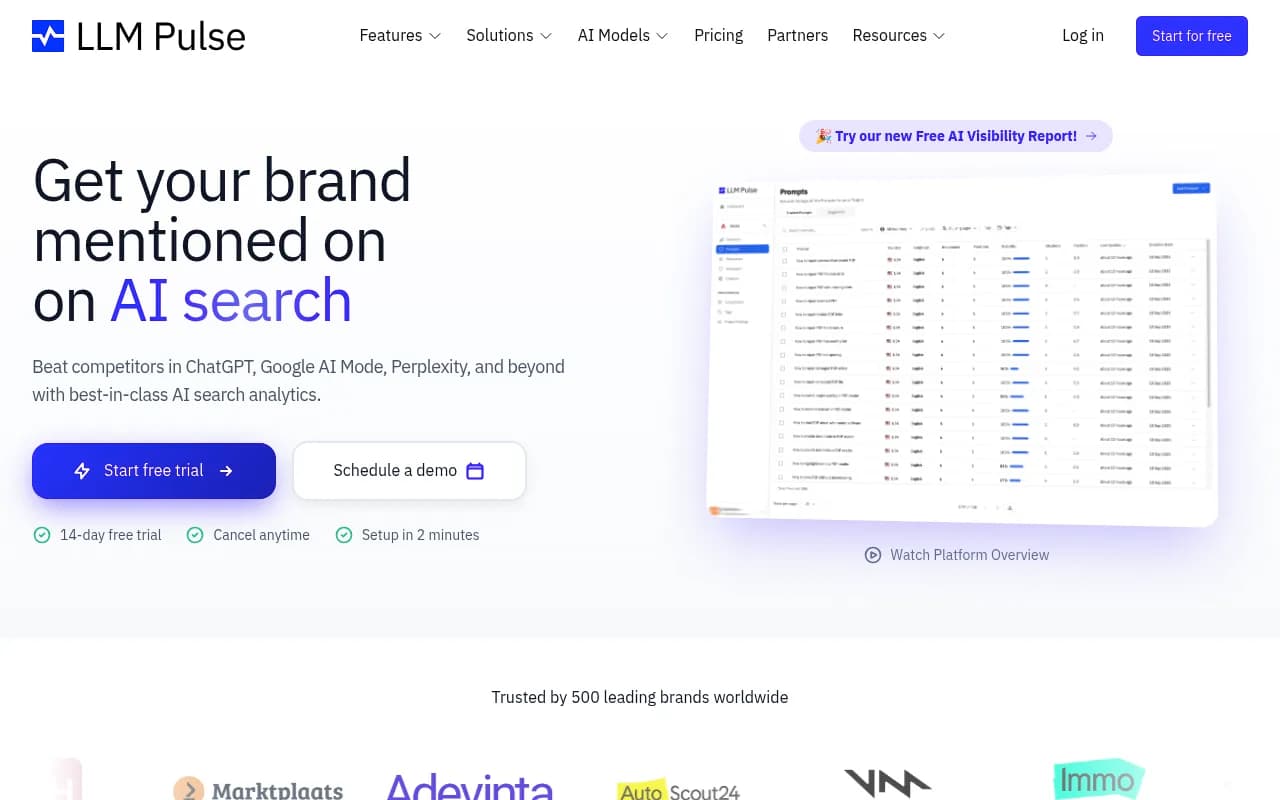
4. LLM Pulse — best overall Searchable alternative for growing brands
LLM Pulse positions itself as the top Searchable alternative and has a solid case. It covers multiple LLMs, offers brand mention tracking, and has a cleaner interface than some of the older tools in this space.
The pricing isn't publicly listed, which is a minor frustration for small businesses doing budget comparisons. You'll need to contact them for a quote, which adds friction to the evaluation process.
Where LLM Pulse earns its place on this list is in its breadth of coverage and the quality of its monitoring data. If you're a growing brand that needs reliable tracking across multiple AI models and you're comfortable with a monitoring-first approach, it's worth evaluating.
5. Rankshift — best for flexible, credit-based pricing
Rankshift takes a different approach to pricing: instead of fixed prompt limits, it uses a credit-based model starting at €77/month. For small businesses with variable monitoring needs, this can be more efficient than paying for a fixed number of prompts you may not always use.
Beyond pricing, Rankshift has some genuinely useful features for small businesses. Its citation gap analysis is solid, and it includes AI crawler analytics that connect visibility data to on-site action. Coverage spans multiple LLMs, and there's no limit on projects or users — useful if you're managing multiple brands or client accounts.
The main gap is content generation. Like most tools in this category, Rankshift shows you where you're missing visibility but doesn't help you create the content to fix it. You'll need a separate content workflow.

How these tools compare on the features that matter most
Here's a more detailed breakdown of the capabilities that actually move the needle for small businesses:
| Feature | Promptwatch | Otterly.AI | Peec AI | LLM Pulse | Rankshift |
|---|---|---|---|---|---|
| Answer gap analysis | Yes | No | No | Limited | Yes |
| AI content generation | Yes (built-in) | No | No | No | No |
| Crawler log monitoring | Yes | No | No | No | Yes |
| Traffic attribution | Yes | No | No | No | No |
| Reddit/YouTube tracking | Yes | No | No | No | No |
| ChatGPT Shopping tracking | Yes | No | No | No | No |
| Multi-language support | Yes | Limited | Yes (115+ languages) | Yes | Yes |
| Starting price | $99/mo | $29/mo | €89/mo | Contact | €77/mo |
| Free trial | Yes | Yes | Yes | Yes | Yes |
The pattern is clear. If you only need to monitor, you have several affordable options. If you need to monitor and act on what you find, Promptwatch is the only tool on this list with the full workflow built in.
Which tool should you actually use?
The honest answer depends on where you are right now.
If you're just starting out and want to understand AI visibility before committing to a bigger tool, Otterly.AI at $29/month is a low-risk way to get your bearings. It won't tell you what to do, but it'll tell you where you stand.
If you're in Europe or need multi-language tracking, Peec AI is purpose-built for that use case and priced reasonably.
If you want flexible pricing and solid citation gap analysis without a fixed prompt limit, Rankshift is worth a look.
But if you're a small business that's serious about growing through AI search — not just tracking it — Promptwatch is the right tool. The combination of gap analysis, built-in content generation, crawler logs, and traffic attribution means you're not just watching your visibility score; you're actually improving it. For most small businesses, that's the difference between a tool that costs money and a tool that makes money.
The AI search shift is real. AI Overviews now appear in nearly half of all searches, and 93% of AI Mode sessions end without a click — meaning if you're not in the AI answer, you're often not in the consideration set at all. Monitoring that fact is a start. Fixing it is the goal.