Key takeaways
- Searchable is useful for exploring AI answers, but it doesn't tell you why you're invisible or what content would fix it
- Answer gap analysis — knowing which prompts competitors rank for that you don't — is the most actionable thing you can do for AI visibility in 2026
- Most monitoring-only tools (Otterly.AI, Peec AI, Gumshoe AI) show you the problem but leave you to solve it alone
- A small number of platforms (Promptwatch, Rankshift, AthenaHQ) go further by connecting visibility data to content recommendations
- Your choice should come down to one question: do you need a dashboard, or do you need a system that helps you close the gaps?
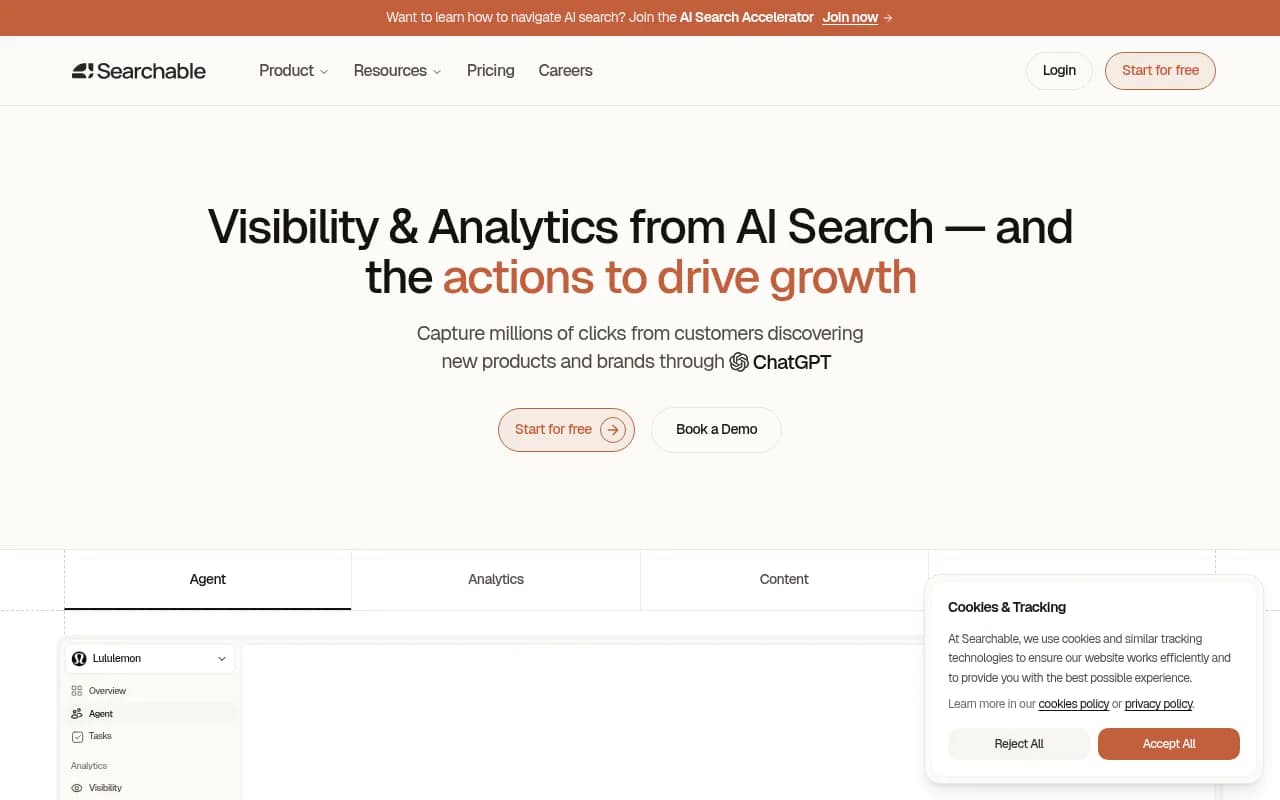
Searchable has a clear use case. You can explore how AI engines respond to queries about your brand, run quick experiments, and get a feel for your AI visibility. For teams just getting started, that's genuinely useful.
But here's where it breaks down: once you know you're invisible for certain prompts, what do you actually do? Searchable doesn't tell you which prompts your competitors are winning. It doesn't show you what content is missing from your site. It doesn't help you create anything. You're left staring at a gap with no map to close it.
That's the real problem with most AI visibility tools in 2026. They've built monitoring dashboards when what teams actually need is an optimization loop: find the gaps, understand why they exist, create content that fixes them, and track whether it worked.
This guide covers 8 tools that do more than monitor. Some are better at gap analysis. Some are better at content generation. A few try to do both. Here's how they compare.
Why answer gap analysis matters more than brand monitoring
Brand monitoring tells you when you appear in AI responses. Answer gap analysis tells you when you should appear but don't.
The distinction matters because most AI visibility work isn't about protecting existing mentions — it's about capturing new ones. When ChatGPT, Perplexity, or Google AI Overviews answer a question in your category, they're drawing from a pool of content they've indexed and deemed authoritative. If your content doesn't cover the right topics, angles, and questions, you simply won't be cited.
Answer gap analysis surfaces the specific prompts where competitors are visible and you're not. That's not just interesting data — it's a content brief. Each gap is a piece of content your site is missing.
The tools that do this well share a few traits:
- They run real queries across multiple AI models (not just one)
- They compare your visibility against named competitors
- They surface the specific prompts driving the gap
- The best ones connect those gaps to content recommendations
The 8 best Searchable alternatives with answer gap analysis
1. Promptwatch
Promptwatch is the most complete option here if you want to go from gap identification to published content without switching tools. The Answer Gap Analysis feature shows you exactly which prompts competitors are appearing for that you're not — with prompt volume estimates and difficulty scores so you can prioritize the ones worth going after.
What separates it from the monitoring-only crowd is the built-in AI writing agent. Once you've identified a gap, you can generate content directly inside the platform — articles, listicles, comparisons — grounded in citation data from 880M+ analyzed citations. That content is engineered to get cited by AI models, not just to rank in Google.
It also has AI crawler logs (real-time logs of ChatGPT, Claude, and Perplexity crawling your site), page-level citation tracking, and traffic attribution via GSC integration or server logs. So you can close the loop: gap identified → content created → citations tracked → traffic attributed.
Monitors 10 AI models including ChatGPT, Claude, Perplexity, Gemini, Grok, DeepSeek, and Google AI Overviews. Pricing starts at $99/month.

2. Rankshift
Rankshift takes a credit-based approach that works well for teams running a high volume of prompts across multiple projects. The competitor and content gap analysis compares your visibility against competitors and flags missing content opportunities — and it covers multiple LLMs simultaneously, which matters when you're trying to understand where the gaps actually live.
The platform also includes AI crawler analytics that connect visibility insights to on-site action, which is more than most tools offer. Starting around €77/month with unlimited projects and users, it's a solid mid-market option.

3. Profound
Profound is the enterprise option. It has deep reporting, SOC 2 compliance, multi-AI engine coverage, and the kind of data depth that large organizations need when AI visibility becomes a board-level concern. The AI crawler and conversation analysis goes further than most tools.
The tradeoff is price — starter plans begin around $99/month but the features that matter for serious gap analysis are in the Growth tier at $399/month and above. There's no built-in content generation, so you'll still need a separate workflow for acting on the gaps you find.
Profound

4. AthenaHQ
AthenaHQ focuses on tracking and optimizing brand visibility across AI search engines. It's monitoring-focused, which means it's good at showing you where you stand and how that changes over time. The gap analysis features are present but less developed than Promptwatch or Rankshift.
Good choice for teams that want clean, reliable visibility data and are comfortable handling content strategy separately.

5. Otterly.AI
Otterly.AI covers the basics well — brand mention tracking across ChatGPT, Perplexity, and Google AI Overviews, with a clean interface that's easy to get started with. It's one of the more accessible entry points into AI visibility monitoring.
The limitation is that it stops at monitoring. There's no answer gap analysis in the sense of comparing your visibility against competitors at the prompt level, and no content generation. For teams that just want to know "are we appearing?" it works. For teams that want to know "why aren't we appearing, and what do we do about it?" it falls short.
Otterly.AI

6. Peec AI
Peec AI sits in a similar position to Otterly.AI — solid monitoring across ChatGPT, Perplexity, and AI Overviews, with unlimited countries and seats at around €89/month for 25 prompts. The multi-country support is genuinely useful for international brands.
Like Otterly.AI, it's primarily a monitoring tool. The gap analysis capabilities are limited compared to the platforms higher on this list.

7. SE Visible (by SE Ranking)
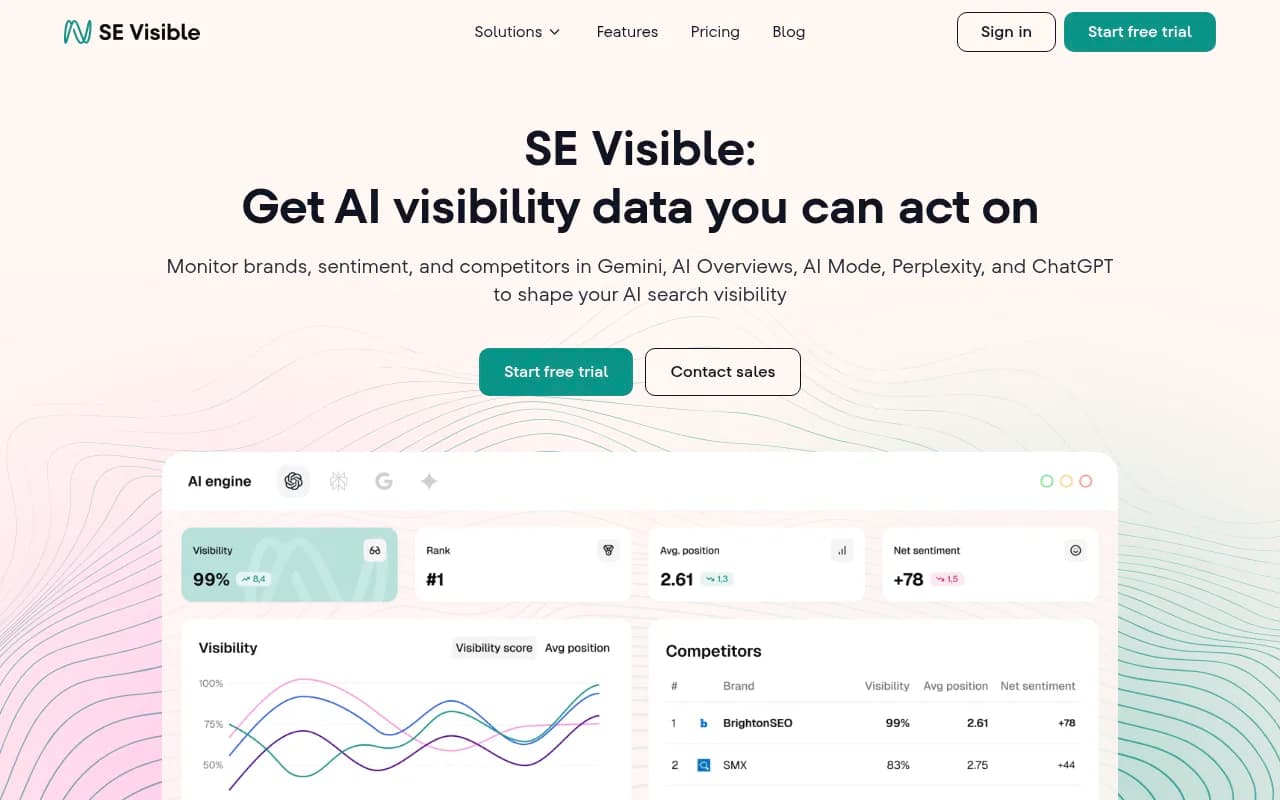
SE Ranking's AI visibility product, SE Visible, brings the credibility of an established SEO platform to AI search monitoring. If your team already uses SE Ranking for traditional SEO, adding AI visibility tracking through the same platform makes workflow sense.
The coverage is solid and the data integrates well with SE Ranking's existing rank tracking and content tools. The gap analysis is less sophisticated than dedicated AI visibility platforms, but the combination of traditional SEO data and AI visibility data in one place has real value for SEO teams.
8. Scrunch AI
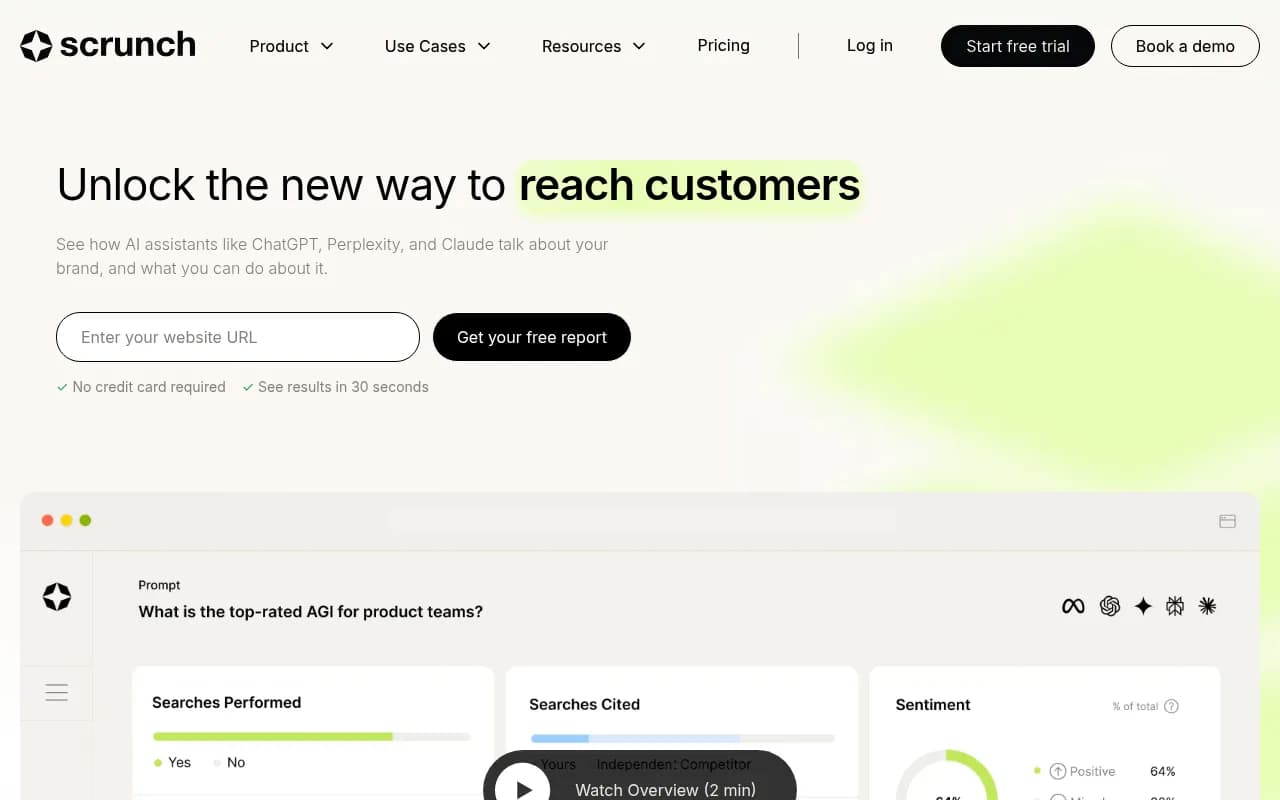
Scrunch AI tracks brand mentions across LLMs and includes some competitive visibility features. It's a reasonable option for teams that want AI visibility monitoring with a bit more depth than the lightest tools offer.
The platform has been building out its feature set, and it covers the major AI models. Worth evaluating if you're comparing mid-market options.
Feature comparison
| Tool | Answer gap analysis | Content generation | AI crawler logs | Models covered | Starting price |
|---|---|---|---|---|---|
| Promptwatch | Yes (with prompt volumes) | Yes (built-in AI writer) | Yes | 10 | $99/mo |
| Rankshift | Yes (competitor comparison) | No | Yes | Multiple | ~€77/mo |
| Profound | Partial | No | Yes | 9+ | $99/mo |
| AthenaHQ | Partial | No | No | Multiple | Custom |
| Otterly.AI | No | No | No | 3 | ~$49/mo |
| Peec AI | No | No | No | 3 | ~€89/mo |
| SE Visible | Partial (via SE Ranking) | No | No | Multiple | Varies |
| Scrunch AI | Partial | No | No | Multiple | Custom |
What to look for when evaluating these tools
Prompt-level competitor comparison
The most useful form of gap analysis isn't "your competitor has higher visibility than you" — that's too vague to act on. What you want is: "your competitor appears for these 47 specific prompts that you don't." That's actionable. You can turn each of those prompts into a content brief.
Ask any tool you're evaluating: can you show me the exact prompts where Competitor X appears and I don't?
Multi-model coverage
AI search isn't just ChatGPT. Perplexity is growing fast. Google AI Overviews affects organic traffic directly. Claude, Gemini, and Grok each have different citation patterns. A tool that only monitors one or two models is giving you an incomplete picture.
The minimum useful coverage in 2026 is ChatGPT, Perplexity, and Google AI Overviews. Anything beyond that is a bonus.
The path from gap to content
This is where most tools fail. They show you the gap, then leave you to figure out what to write, how to write it, and whether it worked. The best platforms close this loop — they connect gap data to content recommendations, and then track whether the content you create actually improves your citations.
If a tool can't answer "what should I write, and how do I know if it worked?" it's a monitoring dashboard, not an optimization platform.
Traffic attribution
AI visibility without traffic attribution is interesting but not actionable for most marketing teams. You need to connect "we're being cited by Perplexity for these prompts" to "that's driving X visitors and Y conversions." Look for tools that offer GSC integration, a tracking snippet, or server log analysis.
How to actually run an answer gap analysis
Whether you're using Promptwatch, Rankshift, or any other tool on this list, the process looks roughly the same:
-
Define your prompt set. These are the questions your target customers ask AI engines — "best [category] tools for [use case]", "how do I [solve problem]", "what's the difference between X and Y". Start with 20-50 prompts.
-
Run the prompts across multiple AI models and record which sources each model cites.
-
Do the same for 2-3 competitors. Note which prompts they appear for that you don't.
-
Prioritize gaps by prompt volume and competitive difficulty. High volume + low competition = go first.
-
Create content that directly answers the prompt. Not generic blog posts — specific, authoritative answers to the exact question the AI is being asked.
-
Track citations over the following 4-8 weeks. AI models re-crawl and update their knowledge bases, so results aren't instant, but they do come.
The manual version of this process takes days. A good tool compresses it to hours and automates the tracking.
Which tool should you choose?
If you want the full loop — gap analysis, content creation, and citation tracking in one place — Promptwatch is the most complete option. It's the only platform in this comparison that handles all three stages without requiring you to switch tools.
If you're primarily an SEO team that wants to add AI visibility to an existing workflow, SE Ranking with SE Visible is a natural fit. You get AI monitoring layered onto traditional rank tracking.
If budget is the main constraint and you just need to start tracking, Otterly.AI or Peec AI get you in the door cheaply. Just know you'll outgrow them once you want to act on what you find.
If you're at enterprise scale with compliance requirements, Profound is worth the price.
The honest answer is that most teams start with a monitoring tool, realize it doesn't help them fix anything, and then upgrade to something with gap analysis and content capabilities. Skipping that first step saves time and money.
The bottom line
Searchable is fine for exploration. But "exploration" isn't a content strategy.
The teams winning in AI search right now are the ones running a systematic loop: find the prompts they're missing, understand why competitors are winning those prompts, create content that fills the gap, and track whether it works. That loop requires tools that go beyond monitoring.
The 8 tools in this guide all improve on Searchable in at least one dimension. The ones at the top of the list improve on it in all of them.