Key takeaways
- Searchable is a capable AI visibility platform, but white-label reporting only unlocks at $400/month, Gemini and Google AI Mode aren't covered, and API access requires a custom enterprise deal.
- Most Searchable alternatives fall into two camps: monitoring-only dashboards (cheap but limited) and full optimization platforms (more expensive but actually help you fix visibility gaps).
- For agencies managing multiple clients, the ability to generate content, track crawler activity, and attribute AI traffic to revenue matters far more than the number of AI engines monitored.
- Promptwatch is the strongest full-stack option for agencies that need to go beyond tracking -- it covers 10 AI models, includes built-in content generation grounded in citation data, and offers white-label reporting without locking it behind a $400+ plan.
- Budget-conscious agencies can get by with tools like Otterly.AI or Peec AI, but expect to hit walls quickly once clients ask "what do we do about it?"
Searchable launched in late 2025 and scaled fast -- 12,000+ users is genuinely impressive for a tool that's less than a year old. The pitch is clean: an end-to-end AI search operating system with monitoring, content generation, GA4 integration, and technical audits, starting at $50/month.
But agencies running multiple clients tend to hit the same friction points. White-label reporting is locked to the $400/month Scale plan. Gemini and Google AI Mode aren't in the platform at all. API access requires a custom enterprise conversation. And the content generation features, while present, aren't built around citation data or prompt volume intelligence -- which is where the real optimization work happens.
If any of those are dealbreakers, here are eight alternatives worth a serious look.
What to look for in a Searchable alternative
Before jumping into the list, it helps to know what actually separates good agency tools from mediocre ones in this category.
Multi-client management is table stakes. You need separate workspaces, separate prompt sets, and ideally separate billing or seat structures per client. Tools that treat "multi-client" as "multiple tabs open" aren't worth your time.
White-label reporting should be available at a reasonable price point -- not gated behind a plan that costs more than most clients' entire SEO budgets.
AI engine coverage matters, but not in the way vendors want you to think. Covering 10 engines sounds impressive; covering the 3-4 engines your clients' customers actually use is what matters. ChatGPT, Perplexity, Google AI Overviews, and Gemini cover the vast majority of AI search traffic for most industries.
Optimization capability is the real differentiator. Monitoring tells you where you're invisible. Optimization helps you fix it. Most tools in this space stop at step one.
Traffic attribution is increasingly non-negotiable. Clients want to know if AI visibility is actually driving traffic and revenue -- not just impressions in an LLM response.
Comparison table
| Tool | White-label | AI engines | Content generation | Crawler logs | Starting price |
|---|---|---|---|---|---|
| Promptwatch | Yes | 10 | Yes (citation-grounded) | Yes | $99/mo |
| Searchable | Scale plan only ($400) | 5 | Yes (surface-level) | No | $50/mo |
| Otterly.AI | Limited | 3 | No | No | ~$49/mo |
| Peec AI | No | 4 | No | No | ~$49/mo |
| Profound | Yes | 9+ | No | No | Custom |
| SE Ranking | Yes | 3 | Yes (traditional SEO) | No | $65/mo |
| Semrush | Yes | Limited | Yes (traditional SEO) | No | $139/mo |
| Rankscale | Yes | 5+ | No | No | Custom |
| Scrunch AI | Limited | 5+ | No | No | Custom |
The 8 best Searchable alternatives for agencies
1. Promptwatch
Promptwatch is the most complete option on this list for agencies that need to do more than monitor. The core difference from Searchable -- and from most tools in this category -- is that it's built around an optimization loop, not just a dashboard.

Here's how that plays out in practice. Promptwatch's Answer Gap Analysis shows you the specific prompts where competitors are getting cited but you're not. Not just "you're missing coverage in X category" -- the actual prompts, with volume estimates and difficulty scores. From there, the built-in AI writing agent generates articles, listicles, and comparisons grounded in 880M+ citations analyzed across real AI responses. That's not generic SEO content -- it's content engineered to get cited by ChatGPT, Claude, Perplexity, and others.
For agencies, a few things stand out. White-label reporting is available on the Professional plan at $249/month -- not locked behind a $400+ enterprise tier. The platform covers 10 AI models (ChatGPT, Perplexity, Google AI Overviews, Google AI Mode, Claude, Gemini, Meta/Llama, DeepSeek, Grok, Mistral, Copilot), which means Gemini and Google AI Mode gaps that Searchable leaves open are covered. AI crawler logs show exactly which pages ChatGPT, Claude, and Perplexity are crawling on your clients' sites, and which pages they're ignoring or encountering errors on. Most competitors don't have this at all.
Traffic attribution closes the loop: connect AI visibility to actual clicks via a code snippet, GSC integration, or server log analysis. Clients asking "is this actually driving results?" get a real answer.
Pricing: $99/mo (Essential, 1 site, 50 prompts), $249/mo (Professional, 2 sites, 150 prompts, crawler logs), $579/mo (Business, 5 sites, 350 prompts). Agency and enterprise plans available. Free trial included.
2. Otterly.AI
Otterly.AI is one of the more established names in AI visibility monitoring, and it's a reasonable starting point for agencies with smaller clients or tighter budgets.
Otterly.AI

The platform covers ChatGPT, Perplexity, and Google AI Overviews. Prompt tracking is straightforward, the UI is clean, and setup is fast. For an agency that needs to show a client "here's where you appear in AI search," Otterly gets the job done.
The limitations show up quickly at scale. There's no content generation, no crawler logs, no traffic attribution, and no meaningful way to act on what you find. It's a monitoring dashboard, and it's priced like one. White-label reporting is limited. If a client asks "what do we do about the gaps?" you're on your own.
Best for: agencies that need basic AI visibility monitoring for a handful of clients and aren't yet ready to invest in optimization tooling.
3. Peec AI
Peec AI covers ChatGPT, Perplexity, Claude, and Google AI Overviews with a clean interface and competitive pricing.
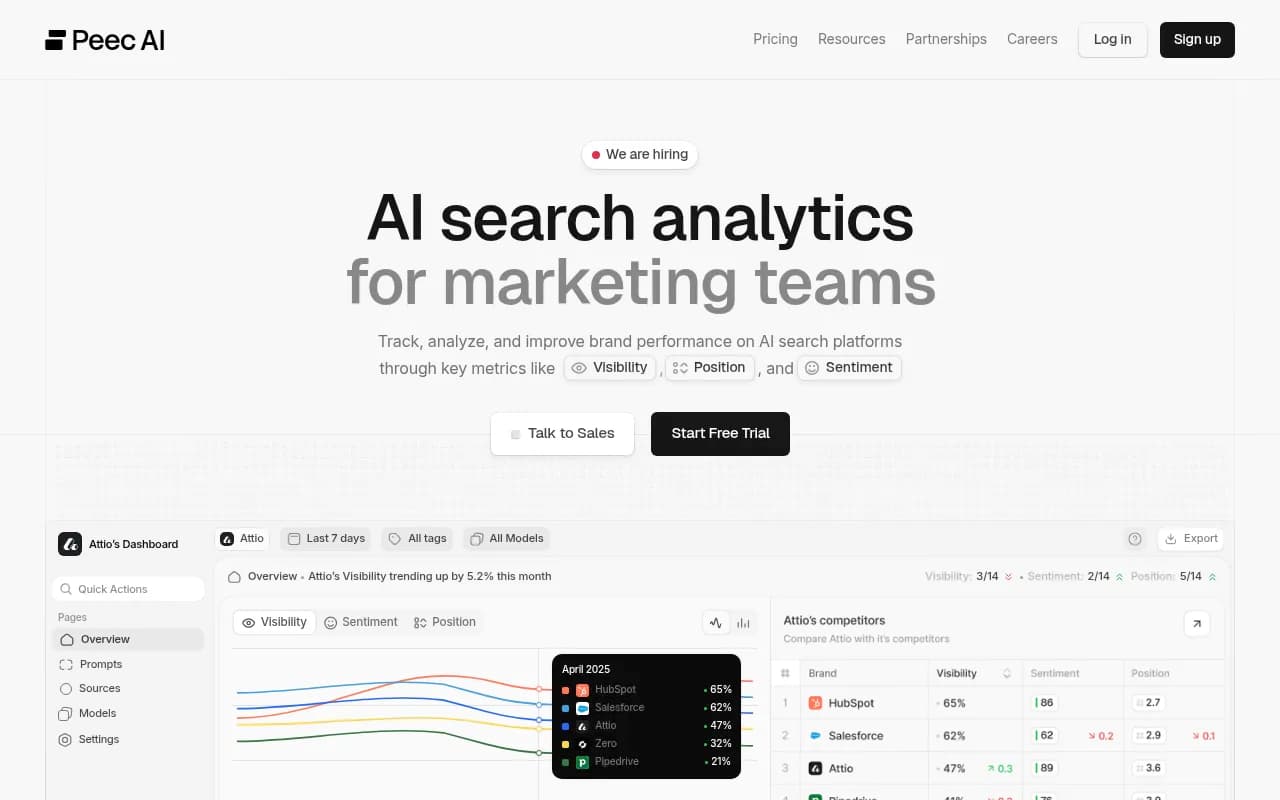
Like Otterly, it's a monitoring-first tool. You can track brand mentions, compare visibility against competitors, and export data. The prompt management is decent for the price point. But there's no content generation, no crawler analysis, and no white-label reporting -- which makes it hard to recommend for agencies managing multiple clients who need polished deliverables.
Where Peec AI earns its place on this list: it's genuinely affordable and the data quality is solid. For freelancers or small agencies testing the AI visibility waters before committing to a full platform, it's a reasonable entry point.
Best for: solo consultants and small agencies doing initial AI visibility audits.
4. Profound
Profound is an enterprise-grade AI visibility platform with strong coverage (9+ AI engines) and a clean competitive analysis layer.
Profound

The platform is built for larger brands and agencies with serious budgets. Reporting is polished, the competitive benchmarking is genuinely useful, and the data depth is impressive. White-label options exist for agency accounts.
The gaps: no content generation, no crawler logs, and pricing is custom (which typically means expensive). If you're running a mid-size agency and need to show ROI quickly, the cost-to-value equation gets harder to justify compared to platforms that include optimization tools alongside monitoring.
Best for: enterprise agencies with large clients who need deep visibility data and can justify premium pricing.
5. SE Ranking
SE Ranking is a traditional SEO platform that has added AI search monitoring features, making it an interesting option for agencies that want one tool covering both traditional and AI search.
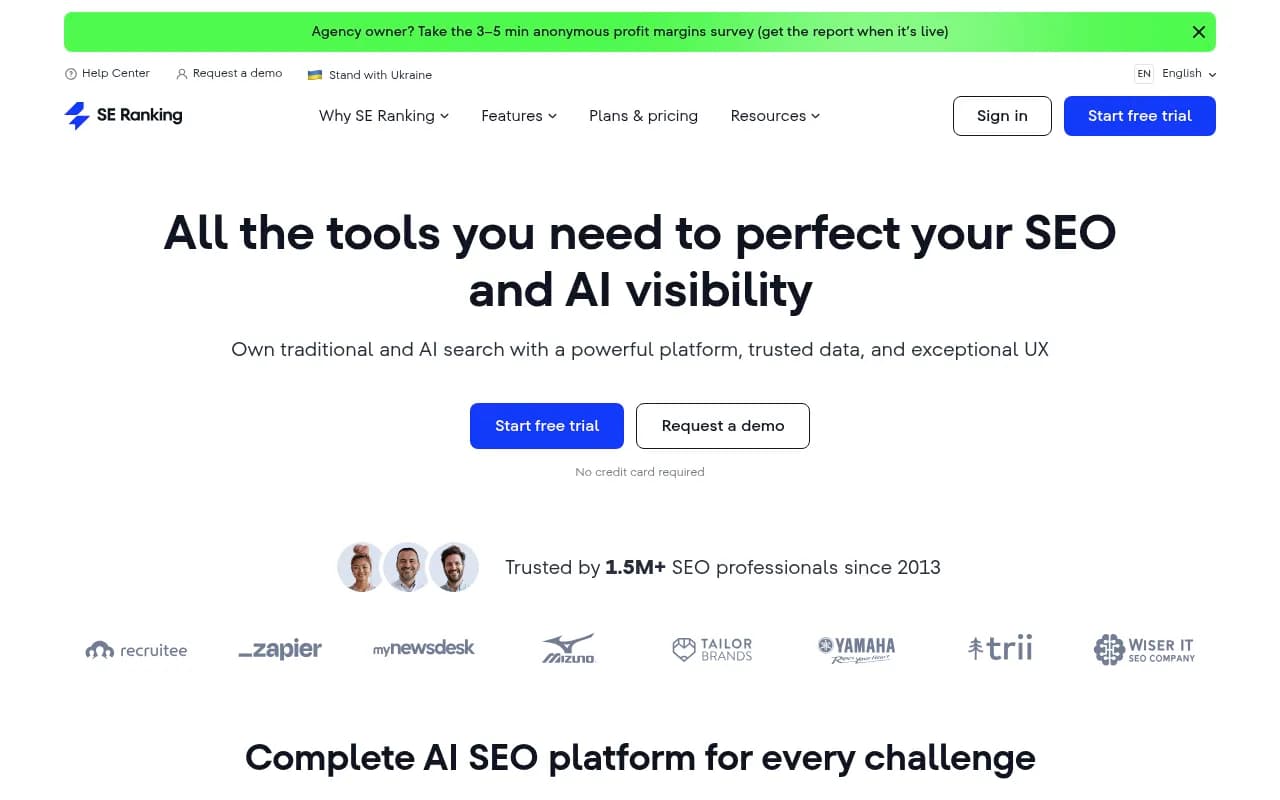
The white-label capabilities are strong and available at reasonable price points -- this is one area where SE Ranking genuinely outperforms most dedicated AI visibility tools. Client dashboards, branded reports, and custom domains are all included. The rank tracking for traditional search is excellent.
The AI search monitoring side is more limited: ChatGPT, Perplexity, and Google AI Overviews are covered, but Gemini, Claude, and others aren't. Content generation is focused on traditional SEO rather than AI citation optimization. If your clients are asking specifically about AI search visibility, SE Ranking's AI features feel like an add-on rather than a core capability.
Best for: agencies that primarily do traditional SEO and want to add basic AI visibility monitoring without switching platforms.
6. Semrush
Semrush is the 800-pound gorilla of SEO platforms, and it has been adding AI search features over the past year.
For agencies already on Semrush, the AI Overviews tracking and AI content tools (ContentShake, the Writing Assistant) are worth exploring. White-label reporting is solid. The breadth of traditional SEO data -- backlinks, keyword research, competitive analysis -- is unmatched.
The AI search coverage is the weak spot. Semrush uses fixed prompt sets rather than custom prompts, which limits how useful it is for tracking specific brand queries. There's no AI traffic attribution, no crawler logs for AI bots, and the AI visibility features feel bolted on rather than built from the ground up. For agencies whose clients are asking specifically about ChatGPT and Perplexity visibility, Semrush isn't the right primary tool.
Best for: agencies already invested in the Semrush ecosystem who want to add AI visibility as a secondary capability.
7. Rankscale
Rankscale is an agency-focused AI visibility platform with multi-client management and white-label reporting built in from the start.
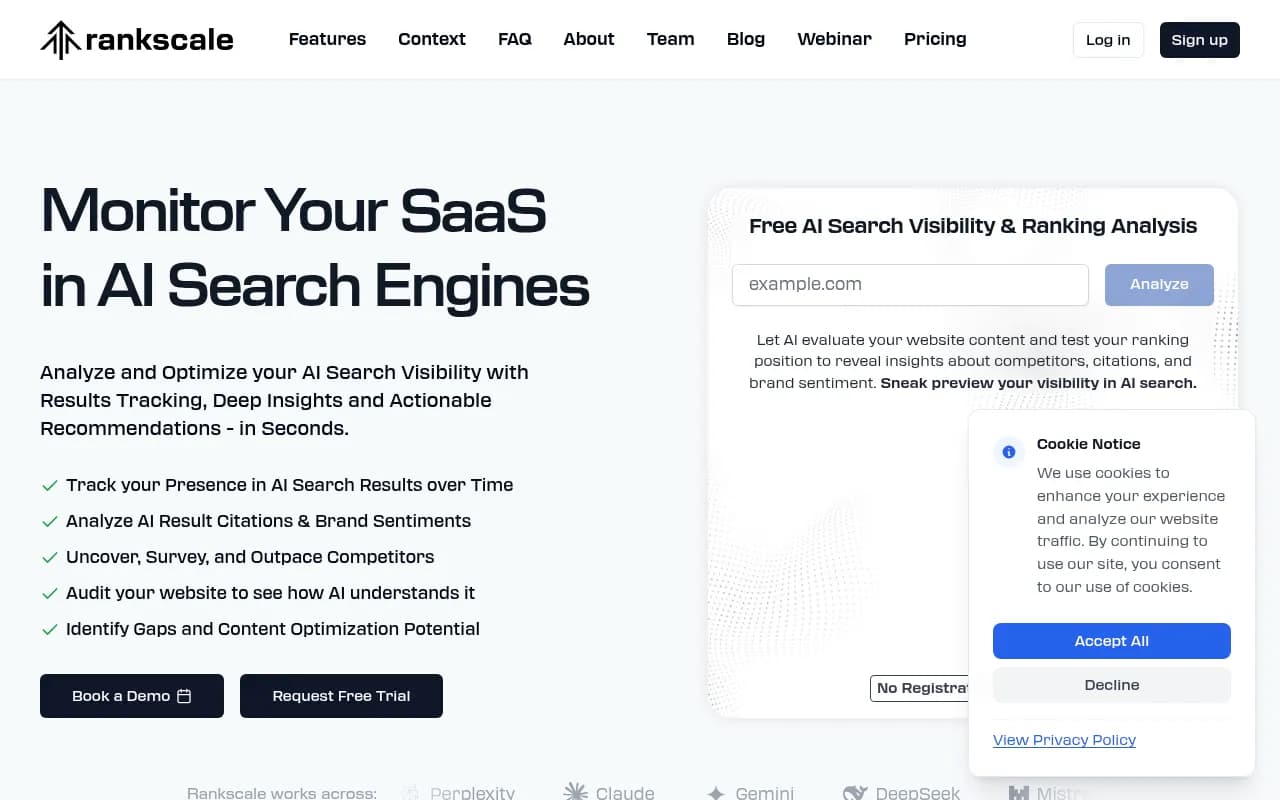
The platform covers multiple AI engines and is designed specifically for agency workflows -- client workspaces, branded reporting, and team collaboration are all present. It's a cleaner agency experience than most tools that started as single-brand products and retrofitted multi-client support.
The limitation is depth. Rankscale is primarily a monitoring and reporting tool. There's no content generation, no crawler logs, and no traffic attribution. For agencies that want to deliver optimization work (not just reports), you'll need to pair it with other tools.
Best for: agencies that prioritize clean client reporting and multi-client management over optimization capabilities.
8. Scrunch AI
Scrunch AI covers AI visibility monitoring across multiple engines with a focus on brand sentiment and citation analysis.
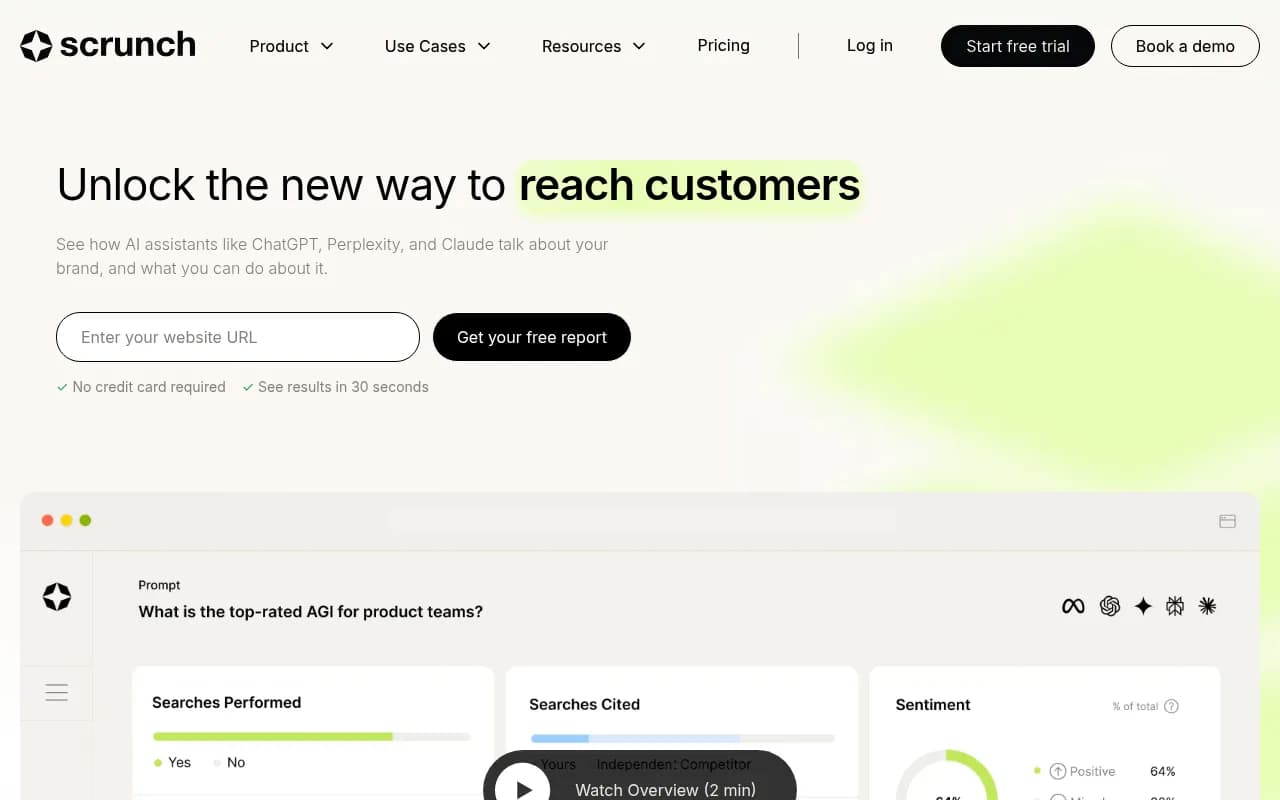
The platform tracks how AI models describe and recommend brands, which is useful for clients in reputation-sensitive industries. The competitive benchmarking is reasonable, and the reporting layer is polished enough for client-facing use.
Like most tools in this category, Scrunch AI is monitoring-first. Content optimization and generation aren't part of the platform. Pricing is custom, which makes it harder to evaluate without a sales conversation. For agencies that need to show clients "here's how AI models talk about you vs. your competitors," it's a solid option.
Best for: agencies with clients in brand-sensitive industries who need to track AI-generated brand narratives.
Which tool should you actually use?
The honest answer depends on where your agency is in the AI visibility journey.
If you're just starting to offer AI visibility as a service and need to demonstrate value quickly without a large investment, Otterly.AI or Peec AI get you to a demo-ready dashboard fast. Expect to outgrow them.
If you're running a traditional SEO agency and want to add AI visibility without switching your entire stack, SE Ranking or Semrush let you extend what you already have. The AI features aren't deep, but they're good enough for clients who are just starting to ask questions.
If you're building a serious AI visibility practice -- one where clients expect not just reports but actual improvement in their AI search presence -- the only tool on this list that covers the full loop is Promptwatch. Finding gaps, generating content to close them, tracking crawler behavior, and attributing traffic to revenue: that's the work agencies need to do, and most tools here only handle one piece of it.
The $400/month white-label gate on Searchable is a real problem for agencies. Promptwatch's Professional plan at $249/month includes white-label reporting, crawler logs, and content generation -- which is a better deal for most agency use cases.
Final thoughts
The AI visibility tool market is maturing fast, and the gap between monitoring tools and optimization platforms is getting harder to ignore. Clients don't just want to know where they're invisible -- they want to fix it. Agencies that can deliver both the diagnosis and the treatment are going to win more retainers than those that show up with a dashboard and a shrug.
Searchable is a legitimate product with a clean vision, but the pricing structure and missing AI engines create real friction for agencies at scale. The alternatives above cover most of those gaps -- the right choice depends on how deep you need to go and what your clients are actually asking for.