Key takeaways
- Searchable is a capable AI search visibility monitor, but it lacks content generation, crawler log access, and actionable optimization tools that growing teams need.
- The best alternatives in 2026 don't just show you where you're invisible — they help you do something about it.
- Promptwatch is the only platform in this category rated as a "Leader" across all evaluation criteria, combining monitoring, content generation, and traffic attribution in one loop.
- Budget options like Rankshift and Promptmonitor work for basic tracking; enterprise teams need platforms like Profound or Promptwatch for depth and action.
- Choosing the right tool comes down to one question: do you need a dashboard, or do you need a system that helps you rank?
What Searchable does — and where it falls short
Searchable is an AI search visibility platform that lets brands track how they appear across AI engines like ChatGPT, Claude, and Perplexity. It has a clean interface, covers the major LLMs, and includes some content generation features. For teams just getting started with AI visibility, it's a reasonable starting point.
But once you move past basic monitoring, the gaps become obvious. Entry-level pricing is restrictive. There's no crawler log access to see how AI bots are actually reading your site. The content generation is limited compared to platforms built around optimization workflows. And there's no clear way to close the loop between what you publish and what actually gets cited.
That's the core problem with most AI visibility tools right now: they show you the problem but leave you to figure out the solution. If you're running a real content or SEO program, that's not enough.
These 9 alternatives are worth considering in 2026, depending on what you actually need.
Quick comparison: 9 Searchable alternatives
| Tool | Best for | AI models tracked | Content generation | Starting price |
|---|---|---|---|---|
| Promptwatch | End-to-end optimization (monitor + fix + track) | 10+ | Yes (AI writing agent) | $99/mo |
| Profound | Enterprise AI visibility research | Up to 10 | No | $99/mo |
| Otterly.AI | Affordable daily monitoring | 4 base | No | $29/mo |
| Peec AI | Multilingual, multi-region tracking | Up to 10 | No | €85/mo |
| Rankshift | Simple, affordable brand tracking | 3-4 | No | Low |
| Promptmonitor | Maximum platform coverage, low cost | Multiple | No | Low |
| Semrush | AI visibility inside an existing SEO suite | 5 | Via ContentShake | $199/mo |
| Scrunch AI | Brand mention tracking with competitive context | Multiple | No | Varies |
| Airefs | Budget opportunity discovery | Multiple | No | $24/mo |
The 9 best Searchable alternatives in 2026
1. Promptwatch — best for teams that want to actually fix their AI visibility
Promptwatch is the most complete AI visibility platform available right now. Most tools in this category are monitoring dashboards. Promptwatch is built around a different idea: find the gaps, create the content, track the results.

The Answer Gap Analysis shows you exactly which prompts competitors are getting cited for that you're not. You see the specific topics and questions AI models want to answer but can't find on your site. That's genuinely useful intelligence — not just a list of keywords, but a map of what's missing.
From there, the built-in AI writing agent generates articles, listicles, and comparisons grounded in real citation data (880M+ citations analyzed). This isn't generic content — it's engineered to match what AI models actually cite. Then page-level tracking shows you whether those new pages start getting picked up by ChatGPT, Claude, Perplexity, and the rest.
The crawler log feature is something most competitors skip entirely. You can see in real time which AI crawlers (ChatGPT, Claude, Perplexity) are visiting your site, which pages they're reading, and where they're hitting errors. That's the kind of technical insight that separates serious optimization from guesswork.
Promptwatch monitors 10+ AI models including Google AI Overviews, Google AI Mode, Grok, DeepSeek, Meta AI, Mistral, and Copilot. It also tracks Reddit and YouTube discussions that influence AI recommendations — a channel most competitors ignore. ChatGPT Shopping tracking, competitor heatmaps, and multi-language/multi-region support round out a feature set that's hard to match.
Pricing starts at $99/mo for the Essential plan (1 site, 50 prompts, 5 articles). Professional is $249/mo, Business $579/mo. A free trial is available.
Who it's for: Marketing and SEO teams that want a complete system, not just a tracker. If you're serious about AI search visibility and want to connect your efforts to actual revenue, this is the platform to evaluate first.
2. Profound — best for enterprise AI visibility research
Profound is a well-regarded enterprise platform that goes deep on AI crawler analysis and prompt research. It tracks up to 10 AI models and has strong multi-region capabilities. The data quality is solid, and it's a legitimate choice for large brands that need rigorous monitoring.
Profound

The limitation is that Profound is fundamentally a research and monitoring tool. There's no content generation, no built-in writing workflow, and no direct path from "we're invisible for this prompt" to "here's the content that will fix it." For enterprise teams with dedicated content operations, that might be fine. For everyone else, it means paying for data and then figuring out what to do with it separately.
Pricing starts at $99/mo but enterprise plans run significantly higher.
3. Otterly.AI — best for affordable daily monitoring
Otterly.AI is one of the more established names in AI visibility monitoring. It covers ChatGPT, Perplexity, Google AI Overviews, and a few others, with location-specific GEO audit capabilities that are genuinely useful for local and regional brands.
Otterly.AI

At $29/mo, it's accessible for small teams and freelancers. The interface is clean and the daily monitoring is reliable. But it's a monitoring-only tool. No content generation, no crawler logs, no traffic attribution. If you want to understand your AI visibility, Otterly works. If you want to improve it, you'll need something else alongside it.
4. Peec AI — best for multilingual and multi-region tracking
Peec AI has built a strong reputation for international AI visibility tracking. It covers up to 10 AI models and handles multiple languages and regions better than most tools in this price range.

For global brands that need to understand how they appear in AI search across different markets, Peec AI is worth a serious look. The €85/mo starting price is reasonable for what you get. Like most competitors, though, it stops at monitoring — there's no content optimization workflow built in.
5. Rankshift — best for simple, affordable brand tracking
Rankshift is a straightforward AI visibility tracker that covers the major platforms: ChatGPT, Perplexity, and a few others. The interface is clean, setup is fast, and it does what it says.

It's a good fit for small businesses or solo operators who want to know whether they're showing up in AI search without a lot of complexity. Don't expect advanced analytics, competitor heatmaps, or content tools — this is basic monitoring done well at a low price point.
6. Promptmonitor — best for maximum platform coverage at low cost
Promptmonitor covers a wide range of AI platforms at a price point that undercuts most competitors. If your main goal is broad coverage across as many AI models as possible without spending much, it's worth considering.
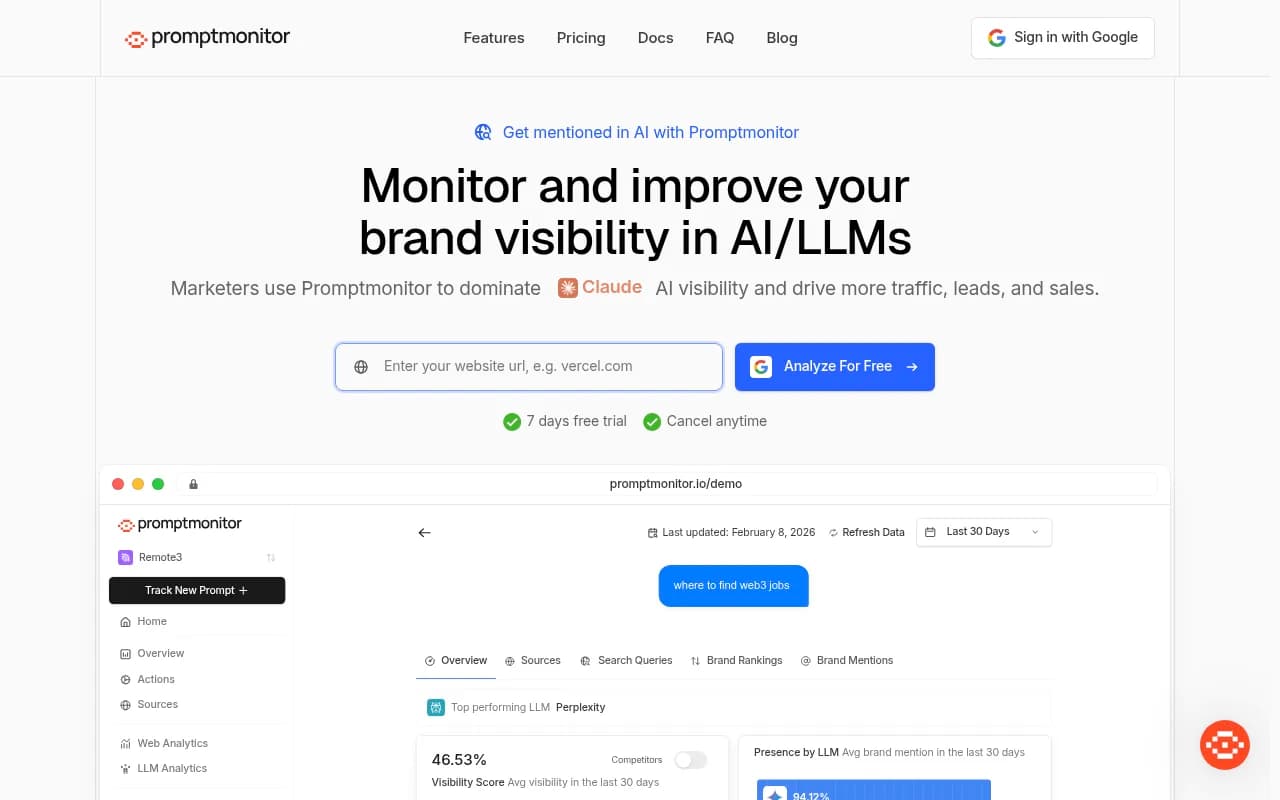
The tradeoff is depth. Promptmonitor lacks crawler logs, visitor analytics, and content generation. It's a monitoring tool in the most literal sense. For teams that just need a pulse check on AI visibility across multiple platforms, it does the job.
7. Semrush — best for teams already invested in the Semrush ecosystem
Semrush has added AI visibility features to its existing suite, which makes it a convenient option if you're already paying for Semrush and don't want to add another tool.
The AI tracking covers about 5 models and uses fixed prompts rather than custom ones, which limits how precisely you can monitor your specific competitive landscape. It's also worth noting that Semrush's AI visibility features are add-ons to a traditional SEO platform — they weren't built from the ground up for this use case. For teams that need AI visibility as a primary focus, a purpose-built platform will go deeper.
That said, if you're a Semrush user and want a basic view of AI visibility without switching tools, the built-in features are a reasonable starting point.
8. Scrunch AI — best for brand mention tracking with competitive context
Scrunch AI focuses on tracking brand mentions across LLMs with a competitive framing — you can see how you stack up against competitors in AI-generated responses.
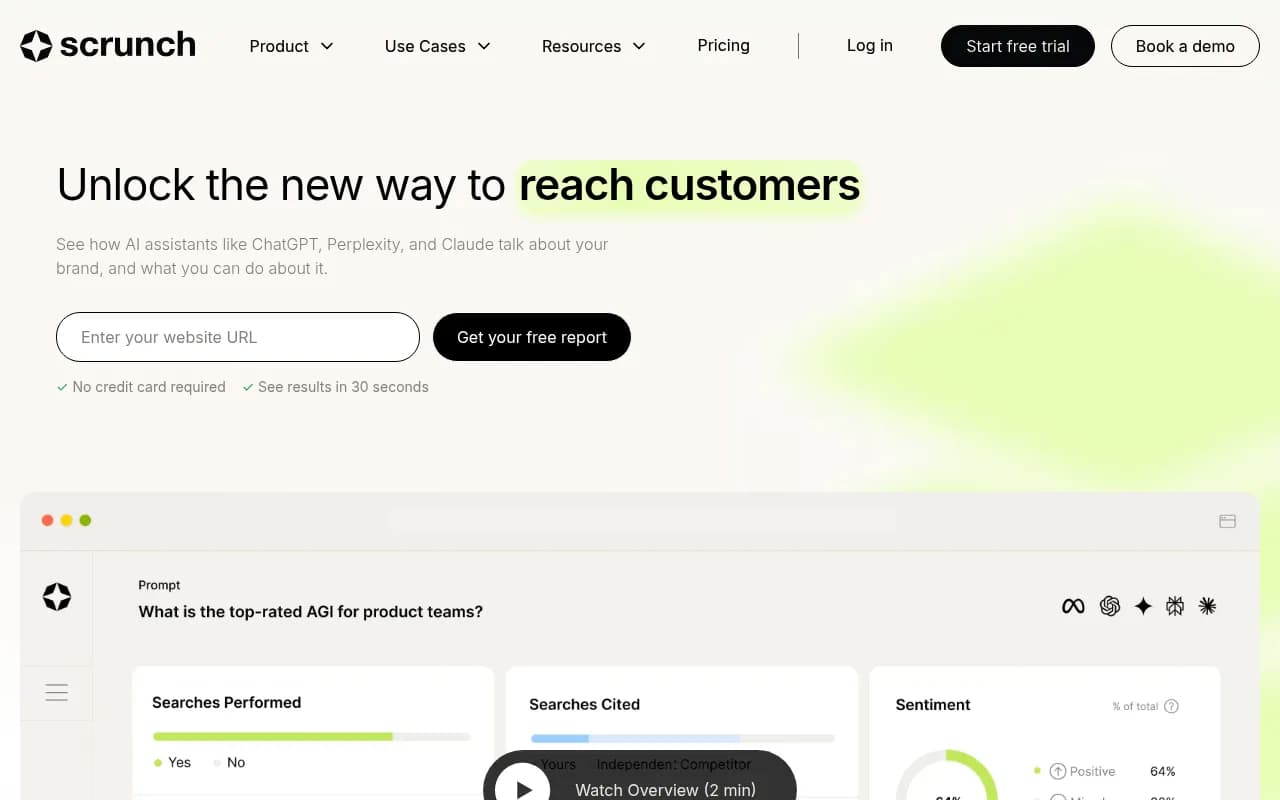
It's a solid monitoring tool with a clean competitive overlay. The limitation is the same as most tools in this list: it shows you the data but doesn't help you act on it. No content generation, no crawler access, no traffic attribution. Good for competitive intelligence; less useful as a full optimization platform.
9. Airefs — best budget option for opportunity discovery
Airefs positions itself as a budget-friendly alternative to more expensive platforms, starting at $24/mo. It covers the major AI search engines and has some useful features for discovering where you're missing visibility.
For small teams or individuals who want to explore AI visibility without committing to a higher-priced platform, Airefs is a reasonable entry point. It's not going to replace a full-featured platform for serious optimization work, but as a discovery tool it punches above its price.
How to choose the right Searchable alternative
The most important question isn't "which tool has the most features?" It's "what do I actually need to do?"
If you just need to monitor whether your brand shows up in AI search responses, most tools on this list will serve you. Otterly.AI at $29/mo is hard to beat for pure monitoring value. Peec AI is the right call if you need multilingual coverage.
If you need to understand the competitive landscape and see where gaps exist, Profound and Scrunch AI offer strong research capabilities. Promptwatch's competitor heatmaps and Answer Gap Analysis go further than either.
If you need to actually fix your AI visibility — create content, track whether it gets cited, and connect that to traffic and revenue — the list gets much shorter. Most tools in this category are monitoring dashboards. Promptwatch is the only platform that closes the full loop from gap identification to content creation to results tracking.
A few other factors worth considering:
- Crawler log access is rare but valuable. Knowing which AI bots are reading your site (and which pages they're ignoring) is foundational for optimization. Only a handful of platforms offer this.
- Traffic attribution matters if you need to justify the investment. Being cited in AI responses is only valuable if you can connect it to actual visits and conversions.
- Prompt volume and difficulty data helps you prioritize. Not all prompts are worth targeting — you want to know which ones have real volume and are actually winnable.
- Content generation built into the platform is a significant time saver. Generating content in a separate tool and then trying to connect it back to your visibility data creates friction.
The monitoring-only trap
One pattern worth naming directly: most AI visibility tools launched in 2024 and 2025 were built as monitoring dashboards. They answered the question "are we visible?" but not "how do we become more visible?"
That made sense when the category was new. Brands needed to understand the problem before they could solve it. But in 2026, the question has shifted. Teams that have been monitoring their AI visibility for a year now have the data. What they need is a system for acting on it.
That's the gap that separates the tools in this list. Otterly.AI, Peec AI, Promptmonitor, Airefs — these are good monitoring tools. Profound is a good research tool. Promptwatch is the platform that was built to answer the next question: now that we know where we're invisible, what do we do about it?
If you're evaluating Searchable alternatives because you want better data, most options on this list will serve you. If you're evaluating them because you want better results, that narrows the field considerably.
Final thoughts
Searchable isn't a bad tool. For teams just starting to think about AI visibility, it's a reasonable place to begin. But the category has matured quickly, and the bar for what a serious AI visibility platform should do has risen.
The best alternative depends on your situation. Small team, limited budget, just want to monitor? Otterly.AI or Airefs. Global brand needing multilingual tracking? Peec AI. Already on Semrush and want to add AI visibility without another tool? Use what you have. Need to actually move the needle on AI citations and connect it to revenue? That's where Promptwatch earns its place at the top of this list.
The tools that will matter in 2026 aren't the ones that show you the most data. They're the ones that help you do something with it.