Key takeaways
- AirOps, Gushwork, CapGo AI, and Addlly AI all generate content at scale, but they take meaningfully different approaches to GEO (Generative Engine Optimization).
- Addlly AI is the most GEO-native of the four, with built-in citation tracking and AI agent workflows designed specifically to improve visibility in LLMs.
- AirOps is the most technically flexible, suited to teams that want to build custom content workflows on top of LLM infrastructure.
- Gushwork focuses on volume and lead generation, producing 100+ pages to build topical authority rather than targeting specific AI citations.
- CapGo AI sits in the middle: scalable SEO and GEO content with less customization than AirOps but more structure than Gushwork.
- None of these four tools replace a dedicated GEO monitoring platform -- they generate content, but tracking whether that content actually gets cited by AI engines requires a separate layer.
The GEO space has gotten crowded fast. Two years ago, most marketing teams had never heard of "AI search visibility." Now there are dozens of tools claiming to help you rank in ChatGPT, Perplexity, and Google AI Overviews -- and the category is splitting into two camps: tools that monitor AI visibility, and tools that create content to improve it.
This guide focuses on the second camp. AirOps, Gushwork, CapGo AI, and Addlly AI are all content-generation platforms with GEO ambitions. They're not the same thing, though, and picking the wrong one for your workflow is an easy mistake to make.
Let's break down what each actually does, where they differ, and which one makes sense for which type of team.
What GEO content engines actually do
Before comparing tools, it's worth being precise about the problem they're solving.
AI search engines like ChatGPT, Perplexity, and Google AI Overviews don't rank pages the way Google does. They synthesize answers from content they've crawled and indexed, citing sources they consider authoritative and relevant. To appear in those answers, your content needs to:
- Exist on topics that AI models are being asked about
- Be structured in a way that's easy for AI to extract and cite
- Cover questions thoroughly enough that the model trusts it as a source
That's the content problem. GEO content engines try to solve it by generating articles, FAQs, comparison pages, and topic clusters at a scale that would take a human team months to produce manually.
What they don't do (for the most part) is tell you whether the content is actually working -- whether AI models are citing it, how often, and for which queries. That's a monitoring problem, and it requires a different kind of tool. More on that later.
AirOps
AirOps describes itself as an "end-to-end content engineering platform for AI search visibility." That framing is accurate. It's built for teams that want to treat content production as a repeatable, data-driven process rather than a creative exercise.

The core of AirOps is its workflow builder. You can connect data sources (keyword research, competitor content, your own CMS), define content templates, and run them through LLMs at scale. It's not a one-click article generator -- it's closer to a content operations layer that sits on top of AI models.
What makes AirOps interesting for GEO specifically is its focus on structured content. The platform encourages you to build content that answers specific questions, includes structured data, and follows formats that AI engines tend to cite. It also integrates with SEO data sources, so you can ground content in actual search demand rather than guessing.
The tradeoff is complexity. AirOps has a steeper learning curve than the other tools in this comparison. You're essentially building workflows, not just generating articles. Teams without a technical marketing or content ops background will find it harder to get value quickly.
Best for: Content engineering teams, growth marketers who think in systems, and companies that want to build proprietary content workflows rather than use off-the-shelf templates.
Gushwork
Gushwork takes a different angle. Its pitch is volume: generate 100+ pages to turn your website into a "predictable lead generation machine." That's a classic topical authority play -- cover a subject area so thoroughly that both AI models and traditional search engines treat you as the authoritative source.
Gushwork
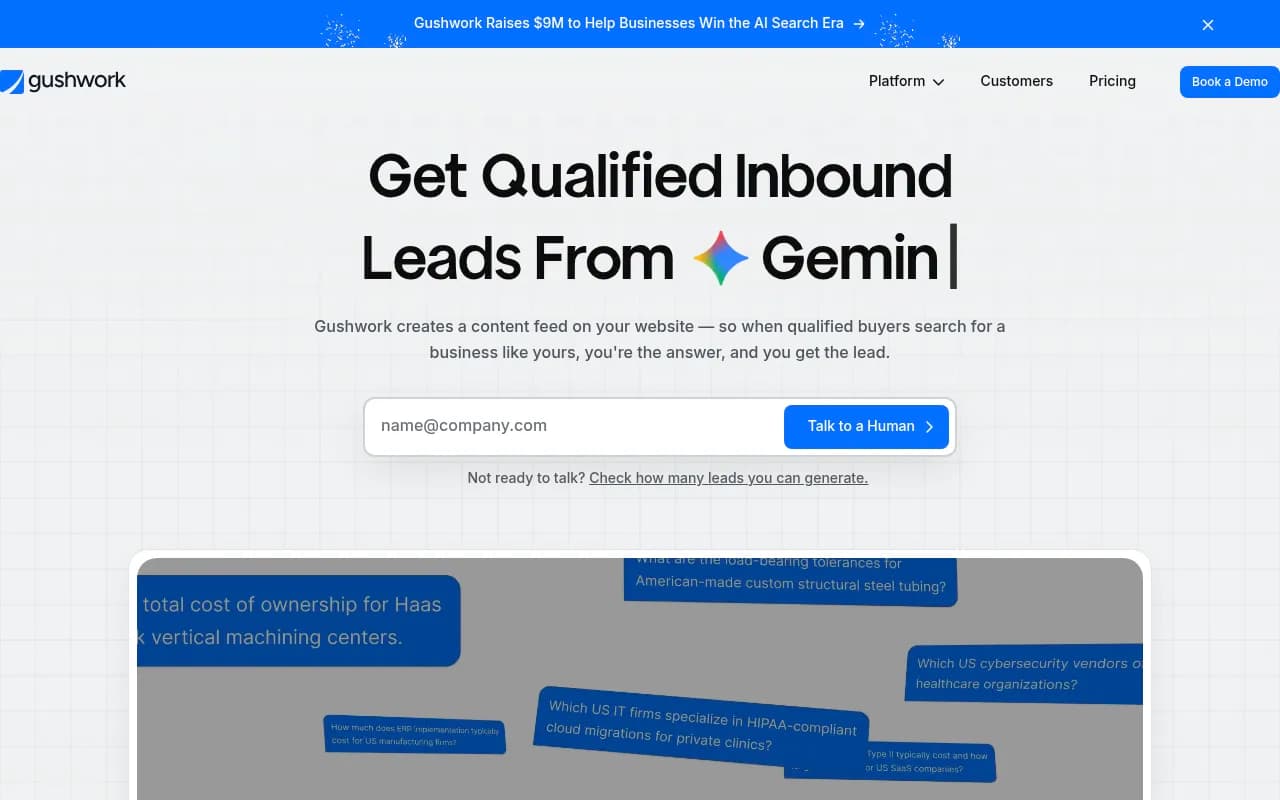
Gushwork is more opinionated than AirOps. You tell it your business, your target audience, and your goals, and it handles the content strategy and production. There's less configuration involved, which makes it faster to get started but less flexible if you have specific requirements.
The GEO angle here is implicit rather than explicit. By building topical authority at scale, you increase the probability that AI models will encounter your content and cite it. It's a volume strategy rather than a precision strategy -- you're casting a wide net rather than targeting specific prompts.
This works, but it's a slower burn. Building 100+ pages of content and waiting for AI models to crawl and incorporate it takes time. If you need to improve AI visibility for specific high-value queries quickly, Gushwork's approach may feel too broad.
Best for: SMBs and growth-stage companies that want to build organic and AI search presence simultaneously, and don't have the internal resources to manage a complex content operation.
CapGo AI
CapGo AI positions itself as a scalable AI SEO and GEO content platform. It sits between AirOps and Gushwork in terms of flexibility -- more structured than AirOps's workflow builder, more customizable than Gushwork's opinionated approach.

CapGo AI focuses on generating content that's optimized for both traditional search and AI search engines. It incorporates GEO-specific formatting guidance -- things like FAQ sections, clear entity definitions, and structured answers -- into its content output by default.
The platform is designed to scale without requiring significant human editing. That's a meaningful claim in a space where AI content often needs heavy revision before it's publishable. Whether CapGo AI delivers on it depends on your content standards and the complexity of your subject matter.
One thing worth noting: CapGo AI's GEO features are more about content formatting than citation tracking. It helps you create content that's more likely to be cited, but it doesn't tell you whether it's actually being cited. That's a gap shared by most content generation tools in this category.
Best for: Marketing teams that want a balance of scale and quality, and need content that works for both Google and AI search without managing a complex workflow.
Addlly AI
Addlly AI is the most explicitly GEO-focused of the four. It describes itself as an "AI agent-driven GEO content and citation platform," and that framing captures something real -- it's built around the specific problem of earning citations in AI search engines, not just generating content at scale.

The key differentiator is Addlly's citation-aware content generation. Rather than just producing articles optimized for keywords or topics, Addlly's agents analyze what AI engines are currently citing for relevant queries, identify gaps, and generate content designed to fill those gaps. It's a more targeted approach than volume-based strategies.
Addlly also includes tools for tracking citation opportunities in real time across AI engines. This puts it closer to the monitoring end of the spectrum than the other three tools, though it's primarily a content generation platform.
The tradeoff is that Addlly is more specialized. If you need broad content coverage across many topics, a volume-focused tool like Gushwork may produce more output. Addlly is better when you have specific queries or topic areas where you want to improve AI visibility and you're willing to invest in a more targeted approach.
Best for: Marketing and SEO teams that are serious about GEO and want content generation tied directly to citation opportunity analysis rather than general topical authority building.
Head-to-head comparison
| Feature | AirOps | Gushwork | CapGo AI | Addlly AI |
|---|---|---|---|---|
| Primary focus | Content workflow engineering | Volume/topical authority | Scalable SEO + GEO content | GEO citation targeting |
| GEO-specific features | Structured content templates | Implicit (topical authority) | GEO formatting guidance | Citation gap analysis |
| Ease of setup | Complex (workflow builder) | Simple (opinionated) | Moderate | Moderate |
| Content volume | High (depends on workflow) | Very high (100+ pages) | High | Moderate (targeted) |
| Citation tracking | No | No | No | Partial |
| Best for | Technical content teams | SMBs, growth-stage companies | Mid-market marketing teams | GEO-focused SEO teams |
| Customization | Very high | Low | Moderate | Moderate-high |
The monitoring gap all four share
Here's the honest limitation of every tool in this comparison: they generate content, but they don't close the loop on whether that content is actually being cited by AI engines.
This matters more than it might seem. AI search visibility is volatile -- Yotpo's 2026 GEO research notes 40-60% monthly variance in AI citations as models retrain and context windows shift. Content that earns citations today may lose them next month. Content you published three months ago might suddenly start getting cited. Without monitoring, you're flying blind.
To actually know whether your GEO content is working, you need a platform that tracks citations across AI engines, shows you which pages are being cited, and connects that visibility to traffic and revenue. That's a different category of tool.
Promptwatch is built specifically for this. It tracks citations across 10 AI models (ChatGPT, Perplexity, Google AI Overviews, Claude, Gemini, and more), shows you which of your pages are being cited and how often, and includes Answer Gap Analysis to identify which prompts competitors are visible for but you're not. The content generation side -- creating articles and briefs grounded in real prompt data -- is also there, which means you can use it alongside any of the four tools above or instead of them.

The practical recommendation: use a content engine (AirOps, Gushwork, CapGo AI, or Addlly AI) to produce content at scale, and use a monitoring platform to track whether it's working. These aren't competing categories -- they're complementary.
Which tool should you choose?
The right answer depends on what your team actually looks like and what problem you're trying to solve.
If you have a technical content team that wants to build custom workflows and treat content production as a system, AirOps is the most powerful option. The learning curve is real, but so is the flexibility.
If you're a smaller team or a growth-stage company that needs to build topical authority quickly without a lot of configuration, Gushwork's volume-first approach is the fastest path to broad coverage.
If you need a balance of scale and GEO-specific formatting without managing complex workflows, CapGo AI is a reasonable middle ground.
If you're specifically trying to improve AI citation rates for targeted queries and want content generation tied to citation opportunity analysis, Addlly AI is the most purpose-built option.
And if you're not sure which content gaps to fill in the first place, that's actually a monitoring question before it's a content question. Knowing which prompts your competitors are visible for -- and you're not -- is the starting point for any GEO content strategy worth running.
Other tools worth knowing
These four aren't the only options in the content-for-GEO space. A few others worth considering depending on your needs:

Jasper has evolved into a full marketing platform with content pipelines and agent workflows. It's more brand-focused than GEO-specific, but it's mature and well-integrated with marketing stacks.
Surfer SEO's content optimization is primarily Google-focused, but its structure and NLP-based guidance produces content that tends to perform well in AI search too.

Search Atlas combines AI-powered content generation with SEO automation, including some GEO-oriented features. Worth evaluating if you want a single platform for both.
Relixir is an end-to-end GEO engine built for enterprise brands, with content generation and monitoring in one platform. More expensive, but more complete.
Bottom line
The GEO content engine category is genuinely useful, but it's easy to over-invest in content production while under-investing in understanding whether that content is actually earning AI citations. The tools in this comparison -- AirOps, Gushwork, CapGo AI, and Addlly AI -- each solve a real problem, but none of them fully closes the loop from content creation to citation tracking to revenue attribution.
The teams getting the most out of GEO in 2026 are the ones treating it as a system: generate content based on real gap data, publish it, track whether AI models cite it, and iterate. That requires both a content engine and a monitoring layer working together.