Key takeaways
- ChatGPT and other AI search engines silently expand a single user query into multiple sub-queries before generating an answer -- this is called query fan-out.
- Pages covering 26-50% of an AI's fan-out sub-queries get cited more often than pages trying to cover 100% of them. Focused beats comprehensive.
- Mapping your content library against fan-out sub-queries reveals exactly which topics you're missing, which pages are redundant, and where competitors are eating your lunch.
- The process has four steps: generate the fan-out, audit your existing content, score the gaps, and create or update content to fill them.
- Tools like Promptwatch can automate fan-out discovery, gap scoring, and content generation -- saving the hours of manual work this process otherwise requires.
What query fan-out actually is (and why it matters for your content)
When someone types "best way to save for retirement" into ChatGPT, the model doesn't just search for that exact phrase. It quietly expands the question into a cluster of related sub-queries -- something like:
- 401(k) contribution limits 2026
- Roth IRA vs traditional IRA comparison
- How much should I have saved by age 40
- Common retirement planning mistakes
- Best retirement savings accounts for self-employed people
Then it pulls from sources that answer those sub-queries and synthesizes a response. Your page on "retirement savings" might be excellent, but if it only addresses the top-level question and misses the sub-queries, ChatGPT has nothing to cite from you.
This is the core problem with traditional SEO thinking applied to AI search. You optimized for a keyword. The AI is answering a question cluster. Those are two very different targets.
The good news: once you understand the fan-out structure for your key topics, you can map your existing content against it and see exactly where you're covered, where you're thin, and where you're completely absent.
Step 1: Generate the fan-out for your target topics
Before you can map anything, you need the sub-queries. There are a few ways to get them.
The manual method
Open ChatGPT and ask it directly: "If someone asked you [your target query], what sub-questions would you need to answer to give a complete response?" You'll get a reasonable starting list. Run the same prompt several times -- the outputs vary, and you want to capture the full range.
Daniel Hinckley's approach on LinkedIn is worth borrowing here: run the fan-out repeatedly until no new sub-queries appear. That's your full topical space. Then embed each unique query, mean-center the vectors, and cluster them. This sounds technical, but the practical version is simpler -- just keep prompting until you stop seeing new angles.
Using tools to extract fan-outs at scale
Doing this manually for one topic is fine. Doing it for 50 topics across your site is a different story. A few tools help here:
Promptwatch tracks query fan-outs as part of its Prompt Intelligence feature -- showing you how a single prompt branches into sub-queries, with volume estimates and difficulty scores for each branch. That's useful because not all sub-queries are worth pursuing. Some have almost no search volume; others are highly competitive. Knowing which is which before you start writing saves a lot of wasted effort.

Tools like AlsoAsked and AnswerThePublic surface related questions from Google's "People Also Ask" data, which overlaps significantly with AI fan-out patterns.
For a more SEO-native approach, Ahrefs and Semrush both surface related keyword clusters that approximate fan-out structure, though they're not purpose-built for AI search.

Step 2: Audit your existing content against the sub-queries
Now you have a list of sub-queries. The next step is brutal honesty: which of these does your site actually answer?
Build a simple mapping spreadsheet
Create a table with your sub-queries in one column and your existing pages in another. For each sub-query, ask:
- Do I have a page that directly addresses this?
- Does that page answer it well, or just mention it in passing?
- Is the answer buried in a long-form guide, or is it the main focus of a dedicated page?
That last point matters more than most people realize. Kevin Indig's research found that pages covering 26-50% of ChatGPT's fan-out sub-queries get cited more often than pages trying to cover 100%. The implication is that focused, specific pages outperform sprawling guides that touch everything lightly. If your 5,000-word pillar page mentions all the sub-queries but answers none of them deeply, it's probably not getting cited.
Score each sub-query
Give each sub-query a simple status:
| Sub-query | Existing page | Coverage quality | Priority |
|---|---|---|---|
| 401(k) contribution limits 2026 | /retirement/401k-limits | Strong | Low (covered) |
| Roth IRA vs traditional IRA | /retirement/ira-types | Thin | High |
| Savings benchmarks by age | None | None | High |
| Self-employed retirement options | /business/sep-ira | Moderate | Medium |
| Common retirement mistakes | /blog/retirement-tips | Weak | High |
This table becomes your content roadmap. High-priority gaps with no existing page are your biggest opportunities. Thin coverage on an existing page is often a faster win -- update the page rather than create a new one.
Step 3: Understand what's actually getting cited
Knowing your gaps is half the battle. The other half is understanding why competitors are getting cited for those sub-queries and you're not.
Look at what AI models are pulling from
For each high-priority sub-query, ask ChatGPT (or Perplexity, or Claude) the question directly and look at what gets cited. Pay attention to:
- What format are the cited pages? (Step-by-step guides, comparison tables, FAQ sections, data-heavy pages?)
- How long are they? (Often shorter and more focused than you'd expect)
- Are they from your competitors' main sites, or from Reddit, YouTube, industry publications?
That last point is important. AI models don't just pull from brand websites. They pull from wherever the best answer lives -- Reddit threads, YouTube transcripts, review sites, trade publications. If a Reddit discussion is answering a sub-query better than your blog post, that's worth knowing.
Check your citation footprint
Tools like Promptwatch track which of your pages are actually being cited by AI models, how often, and for which queries. This is different from knowing which pages rank in Google. A page can have strong traditional rankings and zero AI citations, or vice versa.
Promptwatch's page-level tracking shows exactly which pages are being cited, by which models, and at what frequency. The Agent Analytics feature shows the timeline from when AI crawlers first hit a page to when it starts appearing in citations -- useful for understanding how long your new content takes to get picked up.
Step 4: Fix the gaps (create or update content)
With your gap map in hand, you have two types of work: creating new pages for uncovered sub-queries, and updating existing pages where coverage is thin.
When to create new pages
Create a dedicated page when:
- The sub-query has meaningful volume and no existing page covers it
- The topic is distinct enough that adding it to an existing page would make that page unfocused
- The sub-query represents a specific intent (comparison, how-to, data lookup) that deserves its own URL
When to update existing pages
Update an existing page when:
- You have a page that's topically relevant but answers the sub-query too briefly
- The page is already getting some AI citations and you want to strengthen it
- Creating a new page would cause overlap with existing content
What makes content AI-citation-worthy
A few patterns consistently show up in pages that get cited:
- Direct, specific answers near the top of the page (AI models often pull from the first substantive paragraph)
- Data, statistics, or concrete numbers (AI models prefer citable facts over general advice)
- Clear structure -- headers that match the sub-query phrasing, so the model can identify the relevant section
- Appropriate length -- not too long, not too short. A 400-word page that answers one sub-query precisely often outperforms a 3,000-word guide that answers it vaguely
For content creation at scale, tools like MarketMuse help with content briefs grounded in topical authority data.
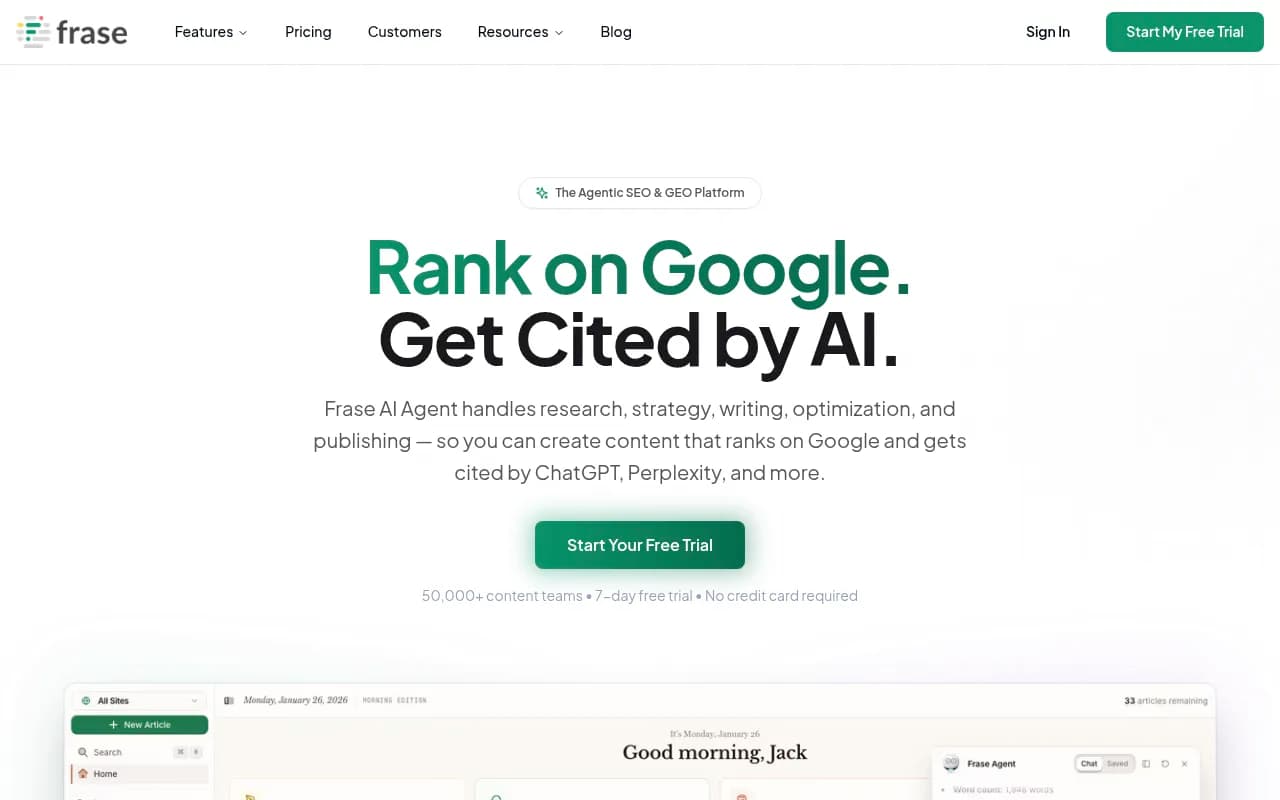
Frase is another option for building content briefs that map against what's ranking.
If you want content generation that's specifically engineered for AI citation (not just traditional SEO), Promptwatch's Content Agents generate articles and briefs grounded in real prompt data, citation data, and competitor analysis. The output is tied directly to the gap analysis, so you're not writing content in a vacuum.
Step 5: Track whether it's working
This is where most teams drop the ball. They do the gap analysis, create the content, and then... check Google rankings. That's the wrong metric.
What you actually want to know is: are AI models now citing your new pages for the sub-queries you targeted?
What to track
- Citation frequency by page and by AI model
- Which sub-queries your pages are appearing for
- How your citation share compares to competitors for each topic cluster
- Traffic from AI search engines (look for referrals from ChatGPT, Perplexity, etc. in your analytics)
Tools for tracking AI visibility
Several tools in this space focus on monitoring brand mentions across AI models:
Otterly.AI

Profound

The meaningful difference between them is what happens after you see the data. Monitoring-only tools show you where you're invisible. Promptwatch's action loop -- find gaps, generate content, track results -- closes the loop so you're not just watching the problem, you're fixing it.
Putting it all together: a practical workflow
Here's the full process condensed into a repeatable workflow:
| Step | What you do | Time investment |
|---|---|---|
| 1. Generate fan-out | Run target queries through ChatGPT 3-5 times, collect all sub-queries | 1-2 hours per topic |
| 2. Cluster sub-queries | Group similar sub-queries, remove duplicates | 30 min per topic |
| 3. Map existing content | Match each sub-query to your best existing page | 2-4 hours (site-wide) |
| 4. Score gaps | Rate coverage quality, prioritize by volume and competition | 1-2 hours |
| 5. Create/update content | Write new pages or strengthen existing ones | Ongoing |
| 6. Track citations | Monitor which pages AI models cite for target sub-queries | Ongoing |
If you're doing this manually for a site with hundreds of pages, steps 1-4 alone can take days. Tools that automate fan-out discovery and content mapping cut that to hours.
A note on the "cover everything" trap
One thing worth repeating: the instinct to create one massive, comprehensive page that covers every sub-query in a cluster is usually wrong for AI citation purposes.
The research is pretty clear on this. Focused pages that deeply answer a specific sub-query outperform sprawling guides that touch everything. This runs counter to the "pillar page" model that dominated SEO thinking for years.
The better model for AI search is a cluster of focused pages, each targeting a specific sub-query, linked together by a lighter hub page. Each focused page can be cited independently for its specific sub-query. The hub page provides context and internal linking but isn't trying to be the definitive answer to everything.
This is also why the content mapping exercise matters so much. You're not just looking for topics you haven't covered. You're looking for sub-queries where your existing coverage is too shallow -- and deciding whether to deepen a page or spin out a new focused one.
Where to start if you're doing this for the first time
Pick your three highest-revenue topics. Not your highest-traffic topics -- your highest-revenue ones. Generate the fan-out for each, map your existing content, and score the gaps. You'll almost certainly find that your most important topics have significant sub-query coverage gaps.
Fix those first. The ROI on closing AI visibility gaps for high-revenue topics is immediate and measurable -- you'll see citation share improve within weeks of publishing well-targeted content.
If you want to skip the manual work and go straight to the gaps, Promptwatch's Answer Gap Analysis shows exactly which prompts competitors are visible for that you're not, with the specific content your site is missing. It's the fastest way to turn fan-out analysis from a research exercise into an actual content plan.