Key takeaways
- These five platforms solve fundamentally different problems: Jasper and Copy.ai focus on content generation and brand voice, Writer targets enterprise compliance, AirOps automates content workflows at scale, and Promptwatch is the only one built specifically to track and improve your visibility in AI search engines.
- If your goal is GEO (Generative Engine Optimization), only AirOps and Promptwatch are designed with AI search visibility in mind -- and they approach it very differently.
- Content generation alone won't get you cited by ChatGPT or Perplexity. You need to know which prompts you're missing, why AI models aren't citing you, and what to publish to fix it.
- Promptwatch is the only platform in this comparison that closes the full loop: find gaps, generate content grounded in real prompt data, then track whether AI models start citing you.
- Most teams will end up using more than one of these tools -- but knowing which one to anchor your GEO strategy around matters a lot.
The AI content platform market has fractured into two distinct camps in 2026. On one side: tools that help you write faster. On the other: tools that help you get found by AI search engines. The problem is that most buyers -- especially GEO teams -- don't realize these are different things until they've spent six months generating content that ChatGPT and Perplexity still won't cite.
This comparison covers five platforms that come up constantly in GEO conversations: AirOps, Jasper AI, Copy.ai, Writer, and Promptwatch. They're not all competing for the same job. Understanding what each one actually does -- and where it stops -- is the whole point.
What each platform is actually built for
Before comparing features, it's worth being direct about the category each tool occupies.
Jasper AI is a marketing content platform. It generates long-form articles, ad copy, emails, and social posts, with strong brand voice controls and a growing suite of marketing agents. It's built for marketing teams that need to produce a lot of content consistently.
Copy.ai is a copywriting and workflow automation tool. It's faster to start with than Jasper, covers a wide range of short-form templates, and has added GTM workflow automation. It's best for teams that need quick copy outputs across many formats.
Writer is an enterprise AI platform. Its differentiator is governance: it lets large organizations deploy AI writing with strict brand, legal, and compliance guardrails. It's less about volume and more about control.
AirOps is a content engineering platform with a GEO angle. It automates content workflows at scale and, since launching its Quill agent in May 2026, has leaned harder into AI search visibility -- including tracking brand sentiment in AI-generated answers.
Promptwatch is a GEO and AI visibility platform. It's not primarily a content generation tool. It tracks how your brand appears across 10+ AI models, identifies which prompts competitors are winning that you're not, generates content specifically designed to fill those gaps, and then tracks whether that content actually gets cited.
Promptwatch sits in a different category from the other four -- it's the only one where the primary output is AI search visibility, not just content.

Feature-by-feature comparison
| Feature | AirOps | Jasper AI | Copy.ai | Writer | Promptwatch |
|---|---|---|---|---|---|
| AI content generation | Yes | Yes | Yes | Yes | Yes (via Content Agents) |
| Brand voice / style controls | Limited | Strong | Basic | Very strong | Brand guidance in briefs |
| Long-form article writing | Yes | Yes | Limited | Yes | Yes |
| Short-form / ad copy | Limited | Yes | Yes | Yes | Limited |
| Enterprise compliance / governance | No | Limited | No | Yes | No |
| Prompt tracking (GEO) | Partial | No | No | No | Yes (10 AI models) |
| Citation analytics | Partial | No | No | No | Yes |
| AI crawler logs | No | No | No | No | Yes |
| Answer gap analysis | Partial | No | No | No | Yes |
| Competitor AI visibility | Limited | No | No | No | Yes (heatmaps) |
| Traffic attribution from AI | No | No | No | No | Yes |
| Reddit / YouTube insights | No | No | No | No | Yes |
| ChatGPT Shopping tracking | No | No | No | No | Yes |
| Multi-model monitoring | Limited | No | No | No | Yes (10 models) |
| Content briefs from prompt data | Partial | No | No | No | Yes |
| Pricing (starting) | Custom | ~$49/mo | ~$49/mo | Custom | $99/mo |
Jasper AI: the marketing team's workhorse
Jasper has matured considerably since its early days as a GPT-3 wrapper. In 2026, it's a full marketing platform with AI agents that can run campaign workflows, generate SEO content, personalize at scale, and maintain brand voice across a large team.
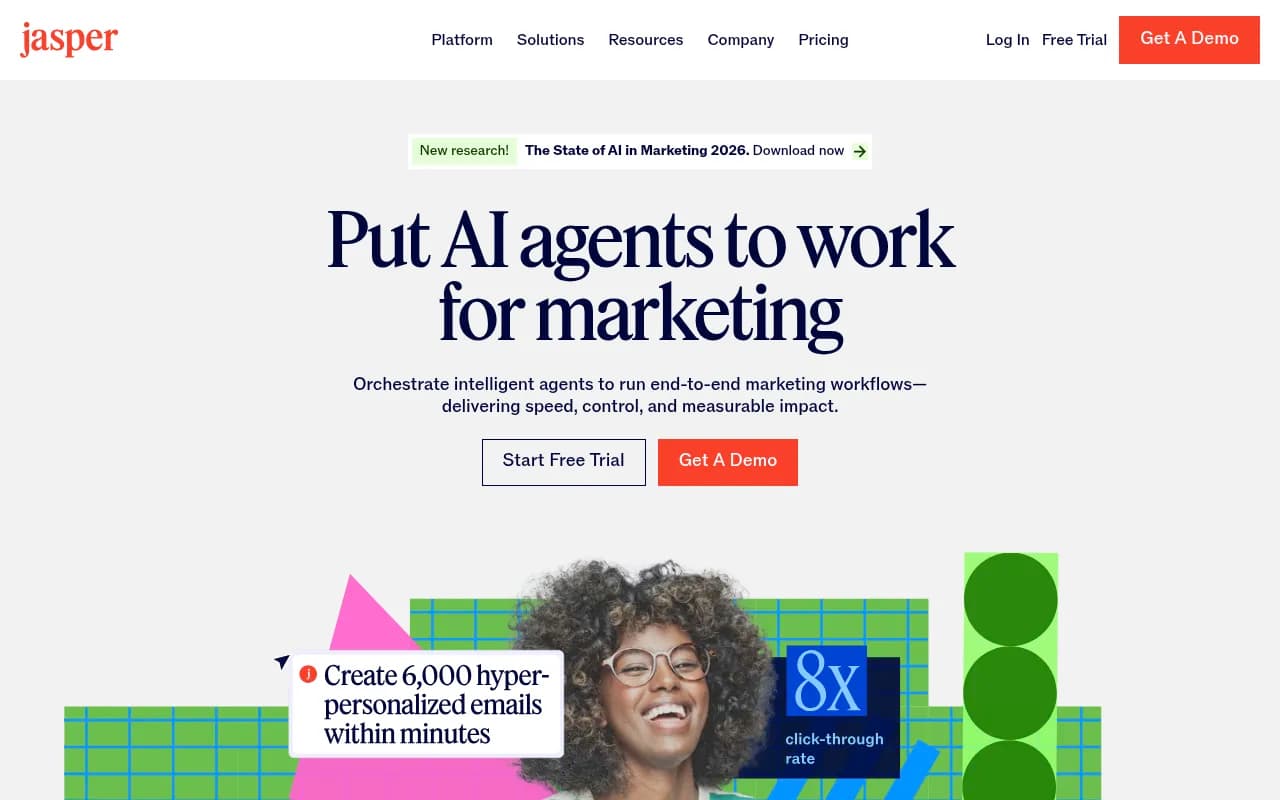
The brand voice feature is genuinely good. You can train Jasper on your existing content, set tone guidelines, and have it enforce those rules across everything the team generates. For organizations where off-brand copy is a real problem, this matters.
Where Jasper falls short for GEO teams: it has no visibility into how AI search engines are responding to your content. You can generate a hundred articles with Jasper, but you won't know which prompts those articles are being cited for, whether ChatGPT is recommending your brand, or what gaps remain. It's a content production tool, not a visibility tool.
According to ColdIQ's 2026 comparison, Jasper leads on keeping AI-targeted content on-brand, while AirOps leads on sustained AI visibility and automation. That's a fair summary of the tradeoff.
Best for: Marketing teams that need high-volume, on-brand content production across multiple formats and channels.
Copy.ai: fast and flexible, but shallow on GEO
Copy.ai is the easiest of these five tools to get started with. The template library is wide, the interface is clean, and you can go from zero to usable copy in minutes. It's added GTM workflow automation that lets you chain content tasks together, which is useful for teams running repeatable content processes.

The honest assessment: Copy.ai is a copywriting tool that has added workflow features. It's not built for GEO. There's no prompt tracking, no citation analysis, no understanding of how AI search engines are responding to your content. For teams that need quick copy for ads, emails, and social posts, it works well. For teams trying to improve their AI search visibility, it's the wrong tool.
The Jasper vs. Copy.ai debate that's been running since 2022 mostly comes down to this: Jasper is better for long-form marketing content and brand governance; Copy.ai is faster for short-form copy and has a lower learning curve. Neither is a GEO platform.
Best for: Small teams and individuals who need fast, varied copy output without a steep learning curve.
Writer: enterprise governance at the cost of flexibility
Writer occupies a specific niche: large enterprises where AI-generated content needs to pass through legal, compliance, and brand review before it ships. It's used by companies that have been burned by AI hallucinations in regulated industries, or where brand consistency is a legal matter, not just a style preference.
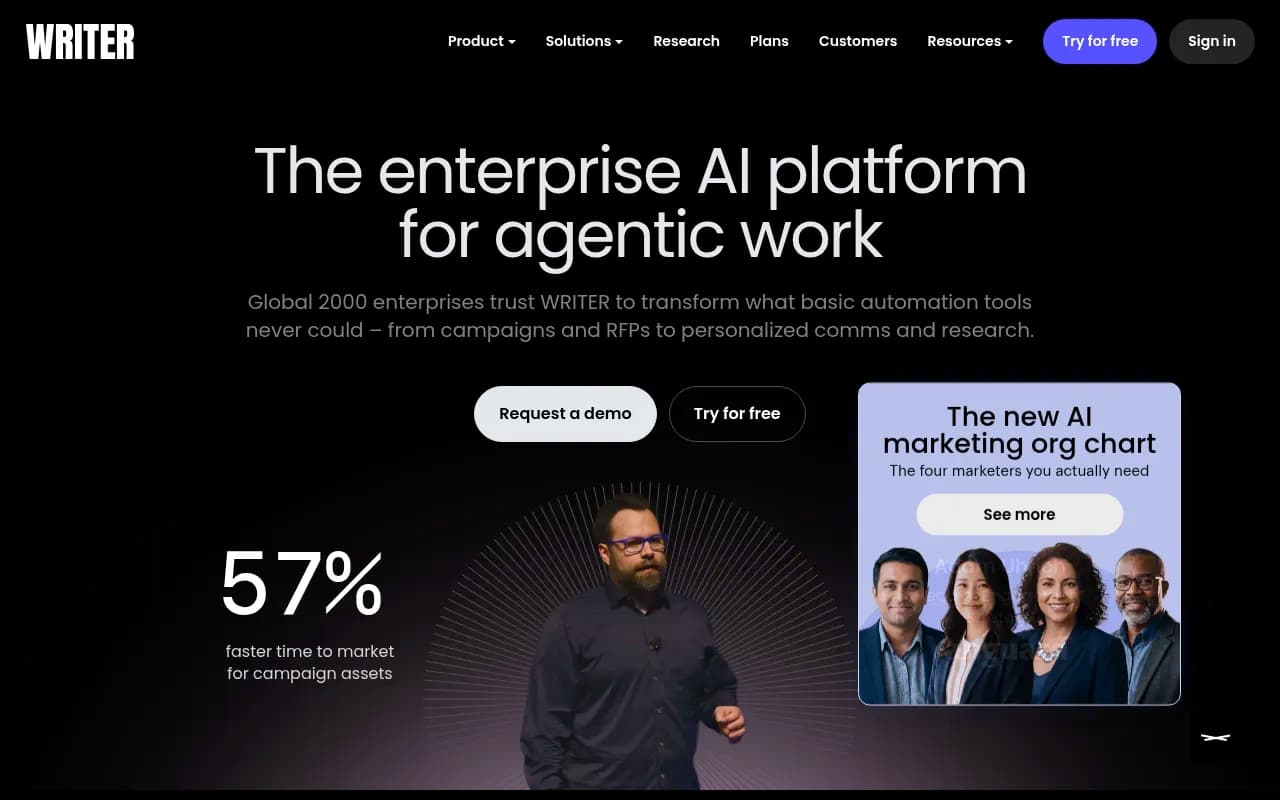
The platform's strength is its ability to lock down what AI can and can't say. You can define terminology, prohibited phrases, required disclosures, and brand rules that the AI enforces automatically. For a financial services firm or healthcare company, that's genuinely valuable.
For GEO teams, Writer has the same blind spot as Jasper and Copy.ai: it doesn't track AI visibility. It can help you produce compliant content, but it can't tell you whether that content is being cited by Perplexity or what prompts your competitors are winning. It's a governance layer on top of content generation, not a visibility platform.
Best for: Enterprise teams in regulated industries where AI content needs strict compliance and brand governance controls.
AirOps: the closest thing to a GEO content engine (before Promptwatch)
AirOps has made the most deliberate pivot toward GEO of the pure content tools in this comparison. Its Quill agent, launched in May 2026, is specifically designed to generate content for AI search visibility. The platform tracks brand sentiment in AI-generated answers, scores tone and context alongside citation frequency, and automates content workflows at scale.
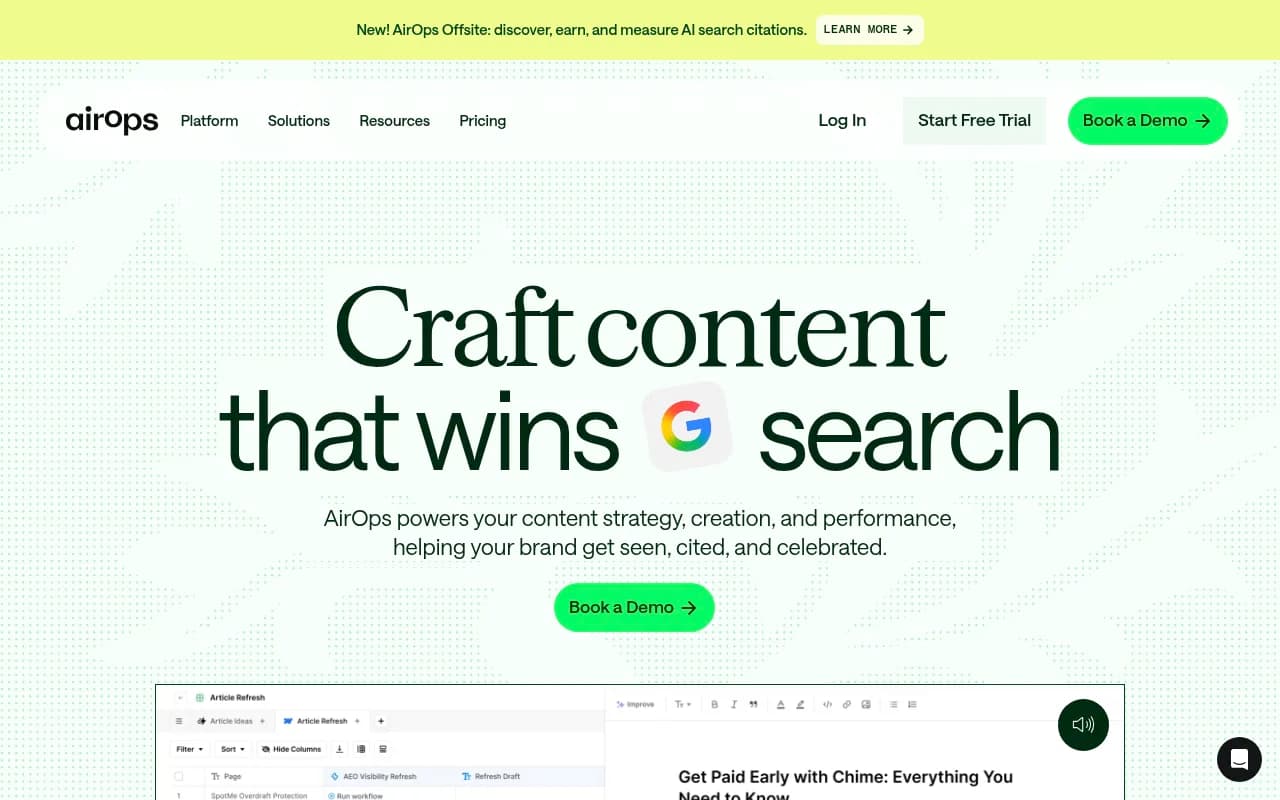
This is meaningfully different from what Jasper or Copy.ai do. AirOps is thinking about AI search, not just content production. The workflow automation is also strong -- you can build pipelines that pull data, generate content, and publish at scale without manual intervention.
The limitation: AirOps is still primarily a content generation and automation platform. Its AI visibility tracking is partial compared to a dedicated GEO platform. It doesn't have the depth of prompt tracking, citation analytics, crawler logs, or competitor heatmaps that a platform built specifically for GEO visibility provides. It's the best content tool for GEO teams, but it's not a full GEO platform.
Best for: Content teams that want to automate large-scale content production with GEO in mind, and don't need deep visibility analytics.
Promptwatch: the only full GEO loop in this comparison
This is where the comparison gets asymmetric. Promptwatch isn't competing with Jasper or Copy.ai for the content generation job -- it's solving a different problem: how do you actually get cited by AI search engines, and how do you know when it's working?
The platform tracks your brand across 10 AI models (ChatGPT, Perplexity, Claude, Gemini, Google AI Overviews, Grok, DeepSeek, Copilot, Meta AI, Mistral). It shows you which prompts your competitors are visible for that you're not -- the Answer Gap Analysis. It generates content briefs and articles grounded in real prompt data, citation data, and competitor analysis. Then it tracks whether that content gets crawled and cited, down to the page level.
The AI crawler logs are worth calling out specifically. Most GEO teams have no idea which pages AI crawlers are actually reading, how often they return, or whether errors are blocking indexing. Promptwatch surfaces this in real time. It's the kind of data that explains why a well-written article still isn't getting cited -- and most competitors don't offer it at all.
The other capabilities that matter for GEO teams: Reddit and YouTube insights (AI models cite these sources constantly, and knowing which discussions are influencing recommendations is genuinely useful), ChatGPT Shopping tracking, and traffic attribution that connects AI visibility to actual revenue.
Used by 1,480+ brands including Booking.com and Center Parcs, Promptwatch has processed more than 4.5 billion citations, clicks, and prompts. That data scale matters because it means the prompt volume estimates and difficulty scores are based on real usage patterns, not guesses.
Best for: Marketing and SEO teams that want to understand and improve their visibility in AI search engines -- not just produce content, but actually track whether it's working.
How these tools fit together for a GEO team
The honest answer is that most GEO teams will use more than one of these tools. The question is which one anchors your strategy.
If you're trying to improve AI search visibility, Promptwatch should be the anchor. It tells you what to create (Answer Gap Analysis), helps you create it (Content Agents), and tells you whether it worked (citation tracking, crawler logs, traffic attribution). That's the full loop.
AirOps can complement Promptwatch for teams that need to produce content at very high volume with workflow automation. The two tools aren't redundant -- AirOps handles production scale, Promptwatch handles visibility intelligence.
Jasper makes sense if your team also needs to produce brand-consistent marketing content beyond GEO -- emails, ads, social posts, landing pages. It's a production tool for marketing teams, not a GEO platform.
Copy.ai is useful for quick copy tasks and short-form content. It's not a GEO tool at all.
Writer belongs in the stack only if enterprise compliance is a hard requirement. It's solving a different problem from the others.
Which tool wins for GEO teams?
| Use case | Best tool |
|---|---|
| Track AI search visibility across models | Promptwatch |
| Find prompts competitors win that you don't | Promptwatch |
| Generate content grounded in prompt data | Promptwatch |
| Automate high-volume content workflows | AirOps |
| Maintain brand voice across a large team | Jasper |
| Quick short-form copy at low cost | Copy.ai |
| Enterprise AI governance and compliance | Writer |
| Track AI crawler behavior on your site | Promptwatch |
| Connect AI visibility to revenue | Promptwatch |
The GEO-specific answer is clear: Promptwatch is the only platform in this comparison built to close the full loop from visibility gap to content creation to citation tracking. The others are content tools with varying degrees of GEO awareness.
That said, "best for GEO" and "best for your team" aren't always the same question. If your team's primary job is content production and GEO is one of several goals, AirOps or Jasper might be the right anchor with Promptwatch layered on for visibility intelligence.
What you shouldn't do is assume that generating more content with any of these tools will automatically improve your AI search visibility. It won't -- not without knowing which prompts to target, which gaps to fill, and whether AI crawlers are actually reading what you publish. That's the insight layer, and only one platform in this comparison provides it end to end.
Bottom line
Five tools, five different jobs. The confusion in the market comes from vendors positioning content generation as GEO optimization -- they're related, but they're not the same thing.
If your team's goal is to appear more often in ChatGPT, Perplexity, and Google AI Overviews, start with visibility intelligence. Know where you're invisible, why, and what to create to fix it. Then use content tools to execute at scale. That sequence matters more than which content tool you pick.
Promptwatch is where that sequence starts.