Key takeaways
- When someone asks ChatGPT or Perplexity a question, the AI silently runs 8–10 parallel sub-queries before generating its answer. These are called fan-out queries.
- 95% of fan-out sub-queries show zero monthly search volume in traditional keyword tools, so you'll never find them through conventional keyword research.
- Your competitors are already winning citations for many of these hidden sub-queries -- and you can reverse-engineer exactly which ones.
- The detection process involves prompting AI models directly, analyzing citation patterns, and mapping content gaps against what competitors publish.
- Platforms like Promptwatch surface fan-out query data automatically, including prompt volumes, difficulty scores, and which competitors are winning each sub-query.
What fan-out queries actually are (and why they're invisible)
Here's something most SEO teams don't realize: when a user types "best project management software for remote teams" into ChatGPT, the model doesn't just answer that question. It quietly fires off a series of parallel searches first -- something like:
- "project management tools comparison 2026"
- "remote team collaboration software reviews"
- "Asana vs Monday.com vs ClickUp pricing"
- "project management software complaints limitations"
- "free project management tools for small teams"
- "best project management software Reddit recommendations"
Each of these sub-queries runs simultaneously. The AI cross-references the results, looks for consensus, checks for recency, and only then assembles its final answer. Sources that show up across multiple sub-queries get cited. Sources that only answer the surface question often don't make the cut.
This is query fan-out. And it's why brands that rank perfectly well in traditional search are invisible in AI answers.
Data from a large-scale analysis of 72,000+ AI-generated queries (across 8,700+ prompts) found that a single user prompt routinely triggers 8 to 10 parallel sub-queries. The kicker: 95% of those fan-out phrases show zero monthly search volume. They don't exist in Google Keyword Planner. They won't show up in Ahrefs or Semrush. Your keyword research process was never designed to find them.
Why your competitors are winning sub-queries you don't even know exist
The AI isn't just looking for the best answer to the user's question. It's looking for confidence. Before it commits to a response, it's essentially asking itself: "Can I verify this from multiple angles?"
That means it's checking:
- Review aggregators and forum discussions (Reddit, G2, Trustpilot)
- Comparison pages ("X vs Y", "alternatives to X")
- Pricing and cost pages
- Recency signals ("2025", "2026" appear in roughly 6% of all fan-outs)
- Risk signals ("pros and cons", "limitations", "complaints")
If your competitor has a comparison page, a Reddit presence, a detailed pricing breakdown, and a "limitations" section in their docs -- and you don't -- they're winning sub-queries you've never even considered targeting. The AI cites them because they survive the cross-examination. You don't make the final answer because you only answered the top-level question.
This is the core problem. Traditional SEO optimizes for one keyword, one page, one ranking. Fan-out optimization requires you to think about the entire web of sub-questions that surround your target topic.
Step 1: Map the fan-out tree for your target topics
The first step is to make the invisible visible. You need to manually reconstruct what sub-queries an AI is likely running when your target customers ask their key questions.
Prompt AI models directly
Open ChatGPT, Perplexity, or Claude and ask your target question. Then ask the model to show its work:
"What sub-questions would you need to answer to fully respond to: [your target prompt]?"
Or try:
"If you were researching [topic] to give a comprehensive answer, what specific questions would you investigate first?"
Do this across multiple models. ChatGPT, Perplexity, and Gemini fan out differently. A sub-query that matters to Perplexity might not be one Gemini prioritizes. Collect 20-30 sub-queries per core topic.
Use "People Also Ask" and related question tools as a proxy
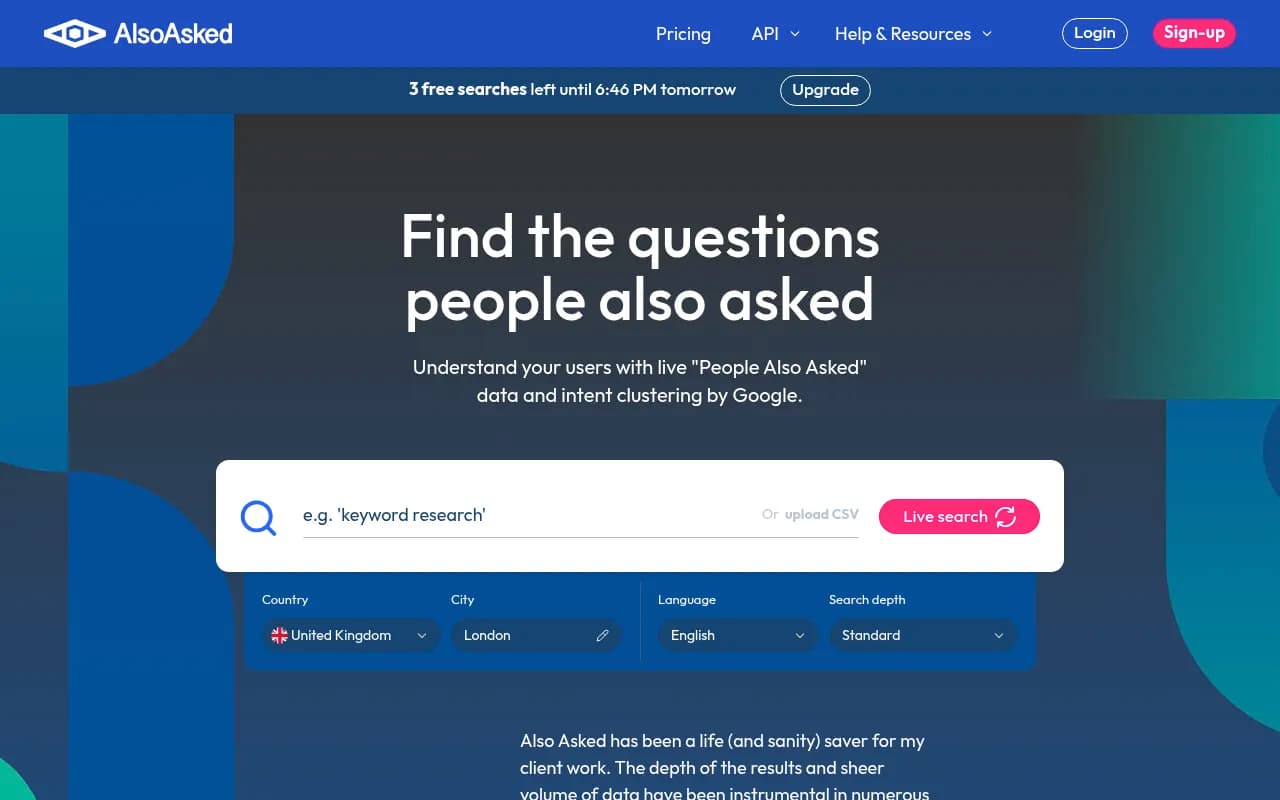
Traditional tools like AlsoAsked and AnswerThePublic were built for a different era, but they still surface question clusters that often overlap with fan-out patterns. Use them to identify the question tree around your core topic.
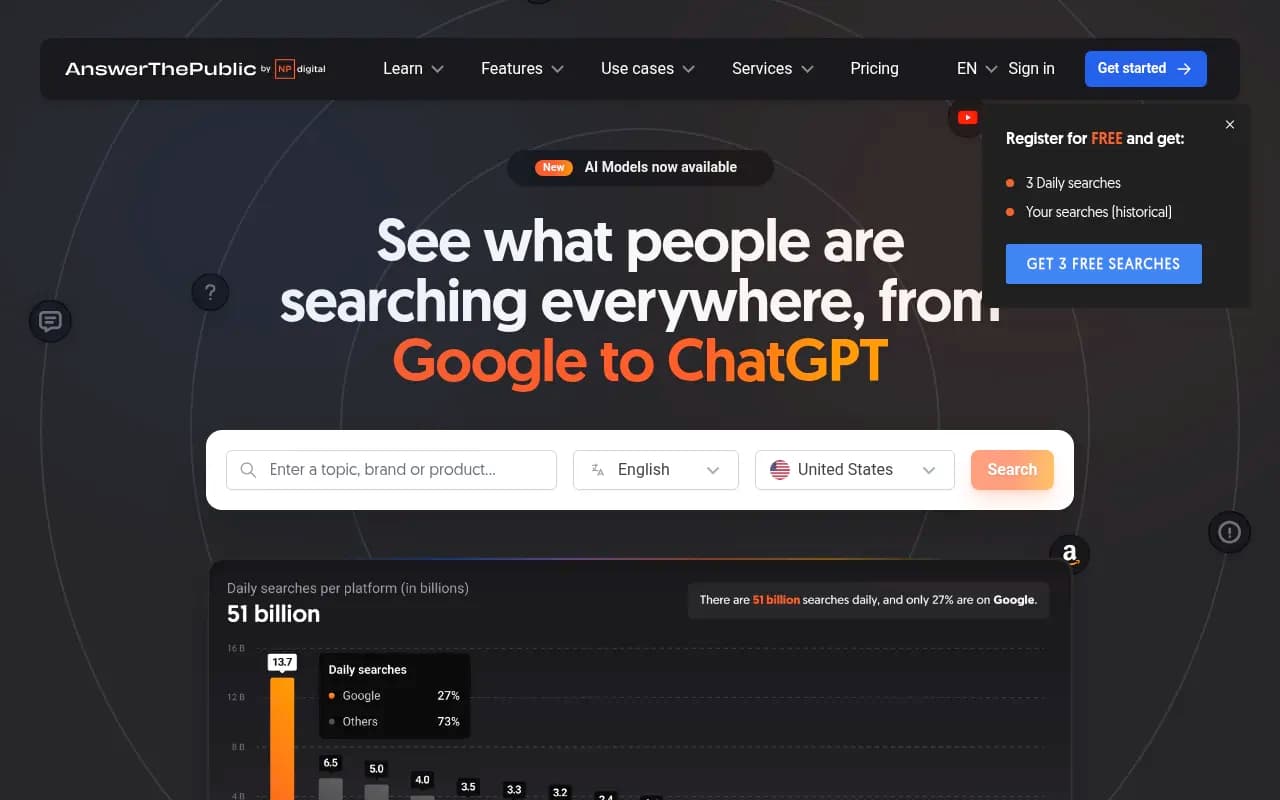
The difference is that these tools show you what people search for. Fan-out queries are what AI models search for on behalf of users -- which is related but not identical. Use these as a starting point, not a complete picture.
Check Google AI Overviews and AI Mode
When Google's AI Mode generates an answer, it sometimes surfaces the sub-queries it ran in a collapsible section. This is one of the few places you can see fan-out in the wild. Search your target topics in AI Mode and document every sub-query you can find. Screenshot everything -- these interfaces change frequently.
Step 2: Identify which sub-queries your competitors are winning
Once you have a map of the fan-out tree, you need to know who's winning each branch.
Run each sub-query and document citations
Take your list of 20-30 sub-queries and run them through ChatGPT, Perplexity, and Gemini. For each response, record:
- Which domains get cited
- What page type gets cited (blog post, comparison page, Reddit thread, YouTube video, pricing page)
- Whether your domain appears at all
Build a simple spreadsheet. Columns for each AI model, rows for each sub-query. Mark which competitor appears in each cell. After 30 sub-queries, patterns emerge fast.
You'll typically find that 2-3 competitors dominate 70-80% of the sub-queries in your category. And you'll find specific sub-query types -- usually comparison, pricing, and limitation queries -- where you have zero presence.
Look for the content types that keep winning
Don't just note which domains win. Note what kind of content wins. Is it:
- Long-form comparison articles ("X vs Y vs Z")
- Reddit threads where someone from the company participated
- Third-party review roundups
- YouTube walkthroughs
- Pricing pages with clear, structured data
This tells you not just what topics to cover, but what format to cover them in. An AI model citing Reddit threads for "limitations" queries is telling you something important about where that information needs to live.
Use a dedicated AI visibility platform for scale
Doing this manually for 30 sub-queries is feasible. Doing it for 300 -- across 10 AI models, in multiple languages, tracked over time -- is not.
Promptwatch surfaces fan-out query data directly in its interface, including prompt volumes, difficulty scores, and competitor citation breakdowns. Its Answer Gap Analysis shows you exactly which prompts competitors are visible for that you're not -- which is essentially a pre-built fan-out gap report. The query fan-out view shows how a single prompt branches into sub-queries, so you can see the full tree without manually prompting each model.

Other platforms in this space worth knowing:
Otterly.AI

Step 3: Score and prioritize the gaps
Not all sub-query gaps are worth closing. Some sub-queries are highly competitive (every major player in your space has content for them). Others are winnable with a single well-structured page.
A simple prioritization framework
| Sub-query type | Typical difficulty | Priority if you're missing |
|---|---|---|
| "[Brand] vs [Competitor]" comparisons | Medium | High -- these are high-intent |
| "[Category] pricing / cost" | Low-Medium | High -- AI cites these constantly |
| "[Category] limitations / complaints" | Low | High -- AI uses these for balance |
| "[Category] for [specific use case]" | Low | High -- often zero competition |
| "[Category] Reddit recommendations" | Hard to own | Medium -- focus on participation |
| "[Category] best practices 2026" | Medium | Medium -- table stakes content |
| "[Brand] reviews" | Depends | High if you have no review presence |
The sub-queries with the highest priority are usually the ones that feel slightly uncomfortable to write -- the "limitations" page, the honest comparison that acknowledges where you're weaker, the pricing page that's actually transparent. Those are exactly the pages AI models trust most, because they signal that a source isn't just promotional.
Check prompt volume and difficulty data
If you're using a platform that provides prompt intelligence (volume estimates, difficulty scores), use that data to rank your gaps. A high-volume sub-query where you have zero presence and competitors have thin content is your best opportunity.
Step 4: Create content that wins the sub-queries
Finding the gaps is the diagnostic. Creating content is the fix.
Match content format to sub-query type
Each sub-query type has a format that AI models prefer to cite:
- Comparison queries: Long-form comparison articles with structured tables, clear criteria, and honest assessments of each option
- Pricing queries: Dedicated pricing pages with transparent breakdowns, not "contact us for pricing"
- Limitation queries: Honest documentation pages, FAQ sections, or blog posts that acknowledge real weaknesses
- Use-case queries: Specific landing pages or guides targeting the exact vertical or persona
- Review queries: Third-party presence on G2, Capterra, Trustpilot -- you can't manufacture these, but you can encourage them
Write for the sub-query, not just the main topic
This is the mindset shift. Instead of writing one big "project management software guide," write:
- "Project management software for remote teams: what actually works in 2026"
- "Asana vs Monday.com vs ClickUp: an honest comparison for marketing teams"
- "Project management software pricing: what you'll actually pay"
- "Project management software limitations: what to know before you buy"
Each of these answers a specific sub-query. Together, they cover the fan-out tree. AI models that run those sub-queries will find your content at multiple branches -- which is exactly how you get cited in the final answer.
Don't ignore offsite content
AI models don't only cite your website. They cite Reddit threads, YouTube videos, industry publications, and review sites. If you're invisible on those channels, you're invisible in a significant portion of fan-out queries.
Specifically:
- Participate authentically in relevant Reddit communities (don't spam, actually help)
- Create YouTube content that answers specific sub-queries (a 5-minute video answering "what are the limitations of X" can rank in AI answers)
- Get your product listed and reviewed on G2, Capterra, and Trustpilot
- Pitch guest posts to industry publications that AI models regularly cite
Step 5: Track your fan-out coverage over time
Creating content is not the end of the process. You need to know whether AI models are actually finding and citing your new pages.
What to track
- Citation rate per sub-query (are you appearing in AI answers for each sub-query you targeted?)
- Which AI models are citing you vs which aren't
- How quickly new content gets crawled and cited (this varies significantly by model)
- Whether your overall visibility score improves as you close gaps
The crawl-to-citation timeline
One thing most teams don't realize: there's often a meaningful delay between when you publish content and when AI models start citing it. ChatGPT's crawler (GPTBot) and Perplexity's crawler operate on their own schedules. A page published today might not appear in AI answers for weeks.
Monitoring your AI crawler logs tells you when GPTBot, ClaudeBot, and PerplexityBot are hitting your pages -- and whether they're encountering errors. If a crawler hits your page and gets a slow response or a JavaScript rendering issue, it may not index the content properly. Fixing those issues can accelerate the crawl-to-citation timeline significantly.
Promptwatch's crawler log feature shows exactly which AI crawlers are visiting which pages, how often they return, and when pages move from crawled to cited. Most monitoring-only tools don't have this at all.
Putting it together: a practical workflow
Here's the full process condensed into a repeatable workflow:
- Pick 5-10 core topics that matter to your business
- For each topic, manually prompt 2-3 AI models to surface sub-queries (aim for 15-20 per topic)
- Run each sub-query through ChatGPT, Perplexity, and Gemini -- document who gets cited and what content type wins
- Identify your highest-priority gaps using the framework above
- Create targeted content for each gap, matching format to sub-query type
- Expand to offsite channels (Reddit, YouTube, review sites) for sub-queries where owned content won't win
- Monitor crawler logs to confirm AI models are finding your new content
- Track citation rates per sub-query and adjust based on what's working
The brands winning in AI search right now aren't the ones with the best single page. They're the ones who've mapped the fan-out tree and systematically covered it. That's a content strategy problem, not a technical SEO problem -- and it's one most teams haven't started solving yet.
Tools that help with fan-out detection and optimization
| Tool | Fan-out data | Competitor citation tracking | Content generation | Crawler logs |
|---|---|---|---|---|
| Promptwatch | Yes (query fan-outs + volumes) | Yes | Yes (Content Agents) | Yes |
| Ahrefs | Partial (Brand Radar) | Limited | No | No |
| Conductor | Partial | Yes | No | No |
| Otterly.AI | No | Basic | No | No |
| AlsoAsked | No (PAA only) | No | No | No |
| AnswerThePublic | No (PAA only) | No | No | No |
The honest summary: most tools will help you monitor whether you're being cited. Very few help you understand the fan-out structure of a prompt, and fewer still help you act on what you find. If you're serious about closing fan-out gaps systematically, you need a platform that goes beyond tracking.
The fan-out queries your competitors are winning today aren't mysterious. They're predictable, mappable, and -- with the right process -- winnable. The only question is whether you find them before your competitors extend their lead further.