Key takeaways
- These five platforms serve fundamentally different purposes -- comparing them directly is only useful if you're clear on what "citation-ready content" actually requires
- AirOps and Promptwatch are the only two with real AI visibility data baked into the content workflow; the others generate content without knowing what AI models are actually citing
- Jasper AI excels at brand-consistent, high-volume marketing copy but lacks the prompt intelligence needed to target AI search gaps
- Junia AI and Outranking are solid SEO content tools, but their optimization signals come from Google, not from LLM citation patterns
- If your goal is specifically to appear in AI-generated answers, the platform you use to write content matters less than the platform you use to understand what to write about
There's a real difference between content that ranks in Google and content that gets cited by ChatGPT. Google rewards keyword density, backlink authority, and on-page signals. AI models reward something harder to engineer: being the clearest, most authoritative answer to a specific question.
That gap is why comparing AI content platforms in 2026 requires a different lens. It's not enough to ask "does this tool write good articles?" You have to ask: "Does this tool know what AI models are actually looking for -- and can it help you fill those gaps?"
I tested five platforms against that question. Here's what I found.
What "citation-ready" actually means
Before getting into the tools, it's worth being precise about the standard we're holding them to.
A citation-ready article is one that AI models like ChatGPT, Perplexity, Claude, and Google AI Overviews will pull from when answering a user's question. That means the article needs to:
- Directly answer specific prompts that real users are typing into AI search engines
- Be structured so AI crawlers can extract clear, attributable claims
- Cover the topic with enough depth that the model trusts it as a source
- Be indexed and crawled by AI agents (GPTBot, ClaudeBot, PerplexityBot, etc.)
Most content tools optimize for none of this. They optimize for Google's ranking signals, which overlap with AI citation signals -- but only partially. An article can rank #1 on Google and never appear in a single AI-generated answer. The reverse is also true.
With that framing in place, let's look at the five platforms.
The five platforms at a glance
| Platform | Primary use case | AI visibility data | Content generation | Citation gap analysis | Pricing (approx.) |
|---|---|---|---|---|---|
| AirOps | AI search content engineering | Yes (Insights module) | Yes (Quill agent) | Partial | Custom / enterprise |
| Jasper AI | Marketing content at scale | No | Yes | No | From ~$49/mo |
| Promptwatch | GEO / AI visibility + content | Yes (full stack) | Yes (Content Agents) | Yes (Answer Gap Analysis) | From $99/mo |
| Junia AI | SEO blog content | No | Yes | No | From ~$29/mo |
| Outranking | SEO content optimization | No | Yes | No | From ~$79/mo |
AirOps
AirOps launched its Quill agent in May 2026, which marked a meaningful shift from its earlier positioning as a pure workflow automation tool. Quill generates content specifically designed for AI search -- not just SEO -- and the platform's Insights module tracks AI visibility across ChatGPT, Perplexity, and Google, showing which pages earn citations and where brand presence is growing or declining.
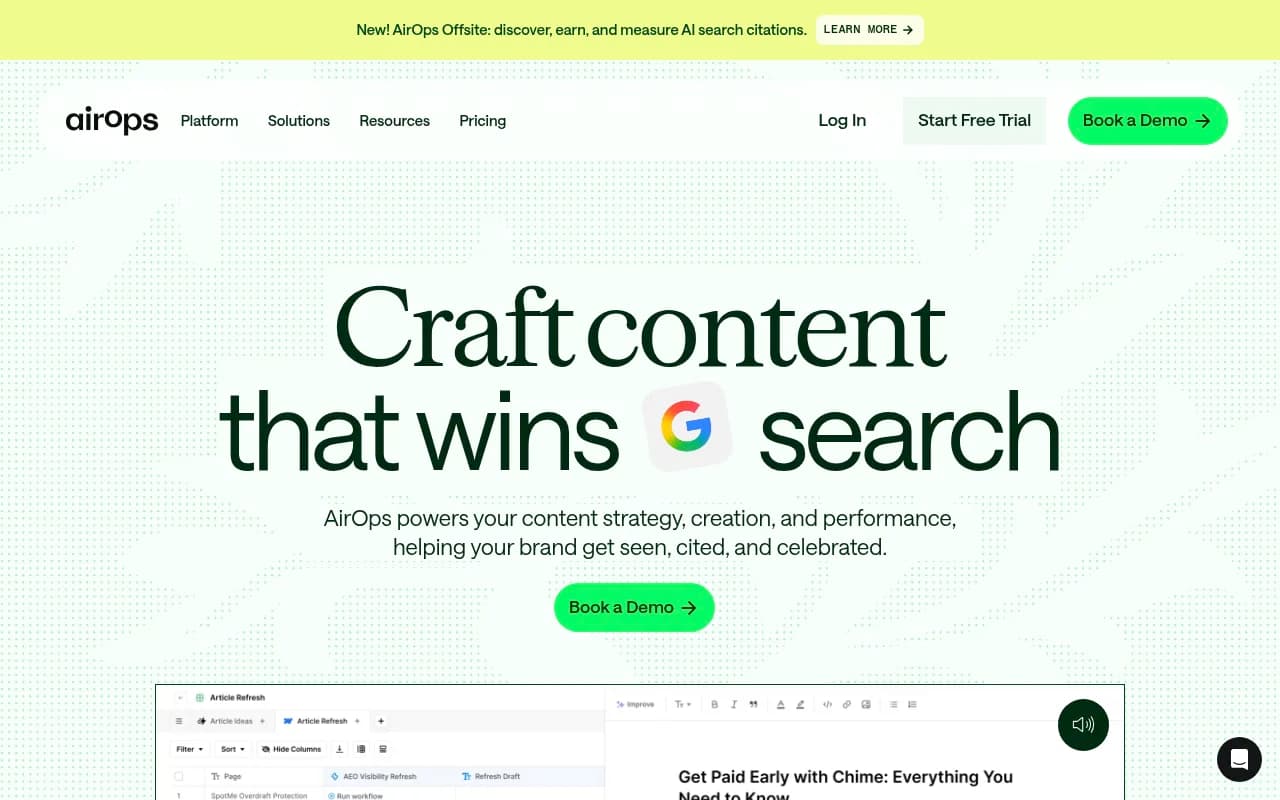
The key thing AirOps gets right: it connects visibility data to content creation. You can see which prompts your competitors are winning, then generate content targeting those gaps. That's a more defensible workflow than writing articles and hoping they get cited.
Where it falls short is depth. The Insights module tracks citation share and mention rate, but it doesn't give you the granular prompt-level data (volume estimates, difficulty scores, query fan-outs) that would let you prioritize which gaps to close first. It also lacks Reddit and YouTube citation tracking, which matter because AI models frequently pull from those sources.
AirOps is a strong choice for content teams that want AI-native workflows and some visibility feedback. It's less suited to teams that need a full GEO audit before they start writing.
Jasper AI
Jasper is the most mature brand in this group. It's been around since 2021, has a large user base, and has evolved into a platform with marketing agents, brand voice controls, and content pipelines. For teams producing high volumes of marketing copy -- emails, ads, landing pages, blog posts -- it's genuinely good.
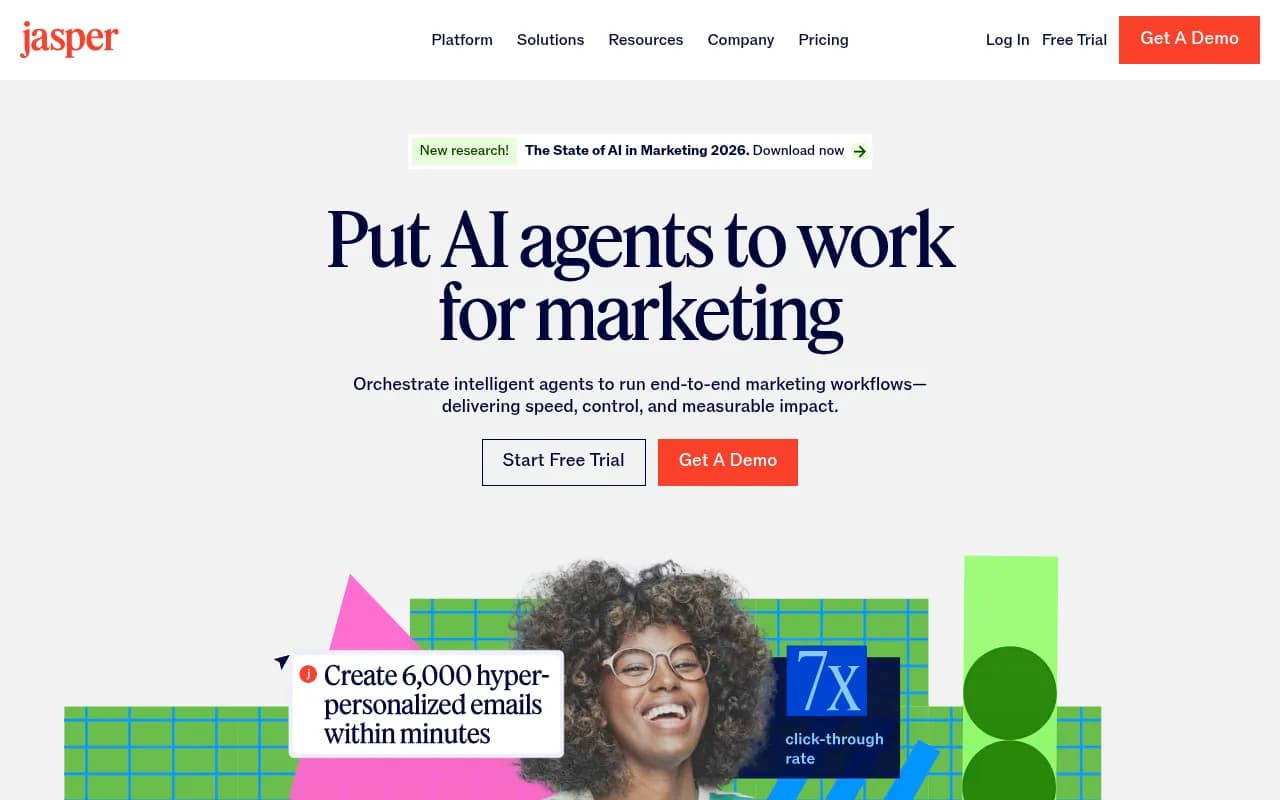
But for citation-ready content specifically, Jasper has a structural problem: it doesn't know what AI models are citing. There's no prompt tracking, no citation analysis, no answer gap detection. When you use Jasper to write an article, you're optimizing for what you think is important, not what Perplexity or ChatGPT is actually looking for.
That's not a knock on Jasper's writing quality -- the output is polished and brand-consistent. It's a limitation of the platform's design philosophy. Jasper was built to help marketers write faster, not to help brands become AI-visible. Those are related goals but not the same one.
If you're already doing GEO research elsewhere and just need a capable writing tool to execute on briefs, Jasper works. If you want the research and writing in one place, look elsewhere.
Promptwatch
Promptwatch is the only platform in this group built specifically around the full AI visibility loop: find the gaps, create content to fill them, track whether it works.

The Answer Gap Analysis shows exactly which prompts competitors are visible for that you're not -- with the specific content your site is missing. Content Agents then generate articles, listicles, and comparisons grounded in real prompt data, citation patterns, prompt volumes, and competitor analysis. After publishing, page-level tracking shows which pages AI models are citing, how often, and by which models.
What makes this different from AirOps or any of the other tools here is the data layer. Promptwatch tracks how AI search engines behave in real user interfaces (not just APIs), which matters because ChatGPT's shopping recommendations and Perplexity's citations in the actual product can differ from what the API returns. It also logs AI crawler activity -- GPTBot, ClaudeBot, PerplexityBot -- so you can see when a page gets crawled and when it moves from crawl to citation. Most platforms don't have this at all.
For teams whose primary goal is AI search visibility, Promptwatch is the most complete option here. The $99/mo Essential plan covers one site with 50 prompts and 5 articles, which is enough to run a real GEO program for a focused brand. The $249/mo Professional plan adds crawler logs and multi-location tracking, which is where it gets genuinely powerful.
The trade-off: if you need to produce hundreds of articles a month for traditional SEO, Promptwatch's content generation limits (5-30 articles/mo depending on plan) may require supplementing with another tool.
Junia AI
Junia AI is a capable SEO content platform aimed at bloggers and content marketers who want to produce long-form articles faster. It handles keyword research, content briefs, and article generation in one interface, and the output quality is solid for standard SEO content.
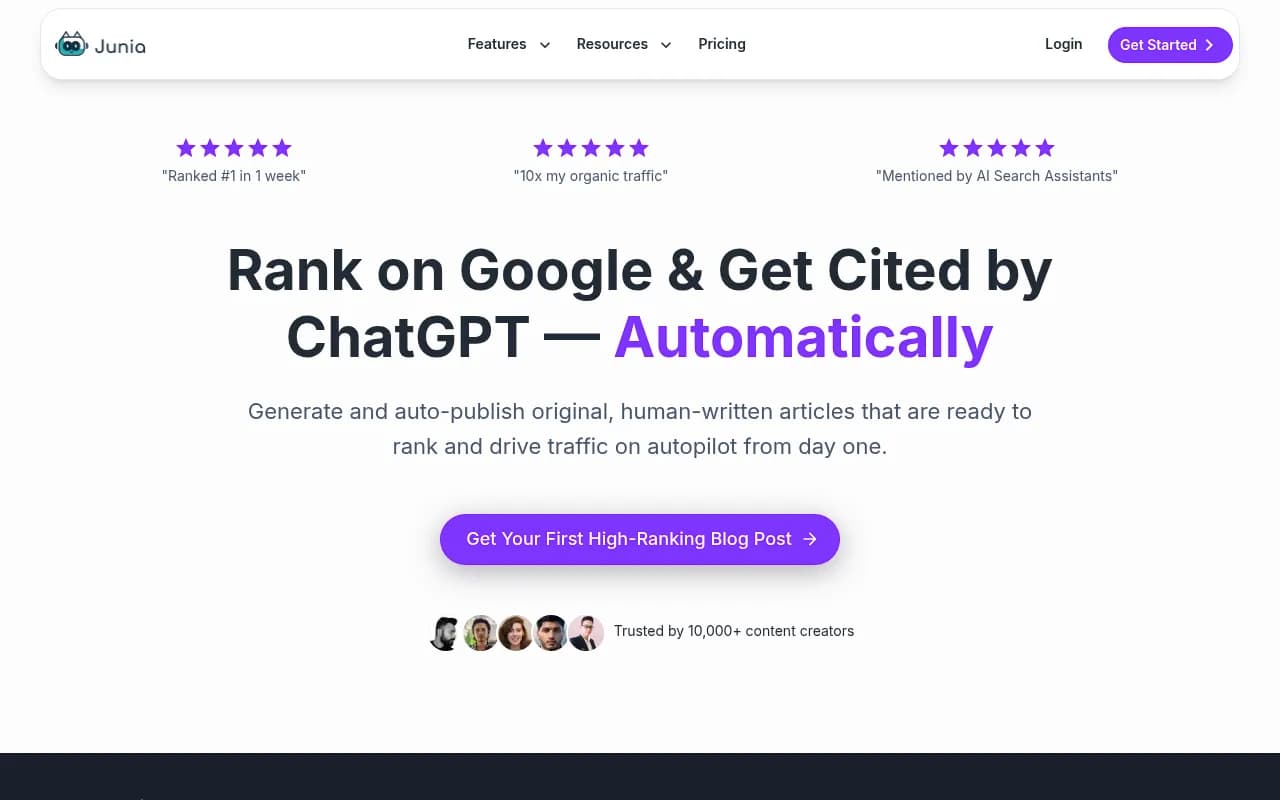
For citation-ready content, though, Junia AI has the same structural gap as Jasper: it optimizes for Google, not for AI models. The keyword research is Google-based, the optimization signals are Google-based, and there's no mechanism for understanding what prompts real users are typing into ChatGPT or what sources Perplexity is pulling from.
That said, Junia AI is worth considering as a production tool if you're using something like Promptwatch to do the strategic research. The workflow would be: use Promptwatch to identify the specific prompts and content gaps, then use Junia AI to scale article production against those briefs. It's not a native integration, but it's a workable split.
At roughly $29/mo for the entry tier, Junia AI is also the most affordable option here by a significant margin, which matters for smaller teams.
Outranking
Outranking sits in a similar position to Junia AI -- it's an SEO content platform with AI writing, content briefs, and optimization scoring. The platform has been around since 2021 and has a reasonably deep feature set for traditional SEO workflows: SERP analysis, content scoring, internal linking suggestions, and first-draft generation.
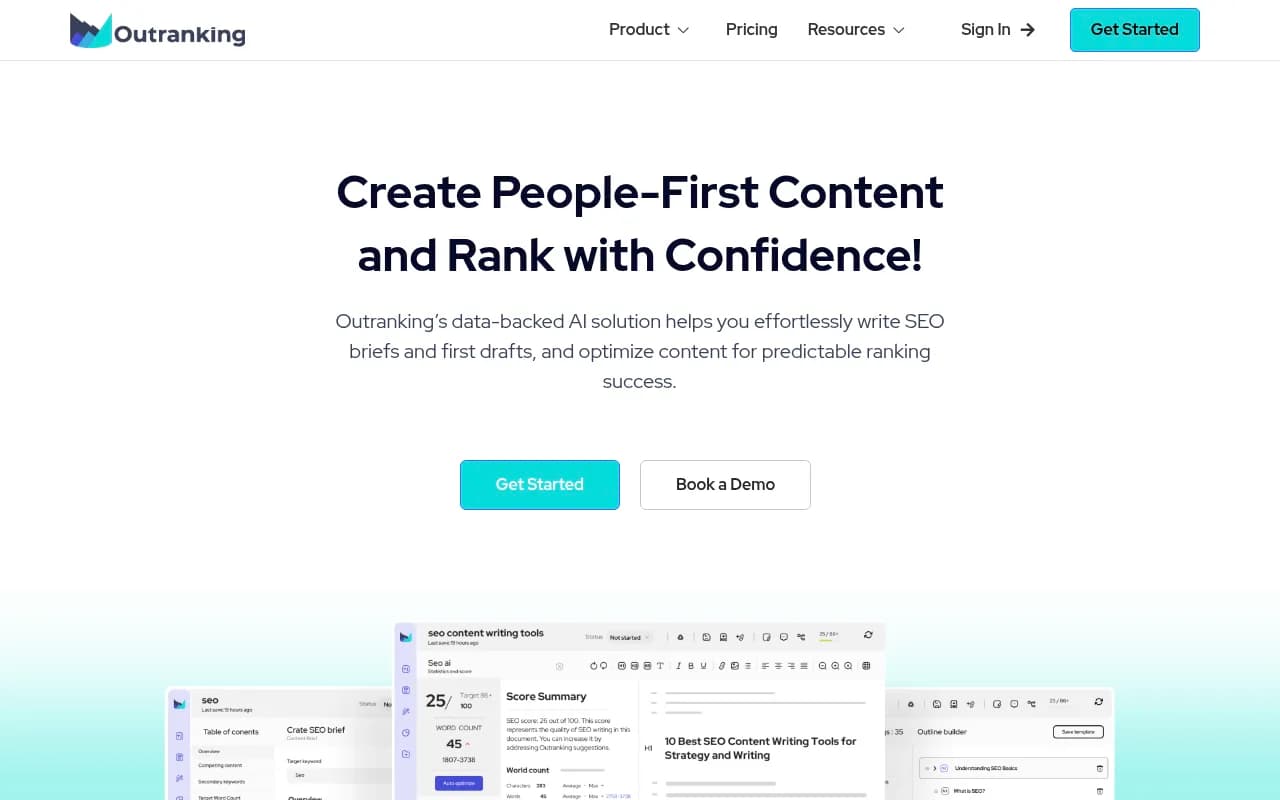
The citation-readiness problem is the same. Outranking's optimization signals come from Google SERPs, not from LLM citation patterns. There's no prompt tracking, no AI visibility data, and no mechanism for understanding what AI models are actually recommending.
Where Outranking does stand out is its content brief quality. The briefs are detailed and structured, which makes them useful as inputs for other tools. If you're running a content operation that needs well-structured briefs at scale, Outranking is a reasonable choice.
For pure AI search optimization, it's not the right tool -- but it was never designed to be.
Head-to-head: citation-ready content workflow
Here's how each platform performs across the specific capabilities that matter for getting cited in AI-generated answers:
| Capability | AirOps | Jasper AI | Promptwatch | Junia AI | Outranking |
|---|---|---|---|---|---|
| Tracks real AI search prompts | Partial | No | Yes | No | No |
| Answer gap / citation gap analysis | Partial | No | Yes | No | No |
| AI crawler log monitoring | No | No | Yes | No | No |
| Content generation | Yes | Yes | Yes | Yes | Yes |
| Prompt volume / difficulty scoring | No | No | Yes | No | No |
| Reddit / YouTube citation tracking | No | No | Yes | No | No |
| Page-level citation tracking | Partial | No | Yes | No | No |
| Brand voice / style controls | Partial | Yes | Partial | Partial | No |
| Traditional SEO optimization | Partial | Partial | Partial | Yes | Yes |
| Pricing entry point | Custom | ~$49/mo | $99/mo | ~$29/mo | ~$79/mo |
Which platform should you use?
The honest answer depends on what problem you're actually trying to solve.
If your goal is specifically to appear in AI-generated answers -- ChatGPT, Perplexity, Google AI Overviews, Claude -- you need to start with visibility data before you write a single word. That means either Promptwatch (which does both) or AirOps (which does both, with less depth on the tracking side).
If you're a content team producing high volumes of marketing copy and brand-consistent assets, Jasper AI is the most mature tool for that job. Just don't expect it to tell you which AI search gaps to target.
If you're running a traditional SEO content program and want to produce well-structured long-form articles efficiently, Junia AI and Outranking are both solid. Junia AI wins on price; Outranking wins on brief quality. Neither will help you understand what AI models are actually citing.
The most effective setup for teams serious about AI search visibility in 2026 is probably Promptwatch for strategy and tracking, with a production tool like Junia AI or Outranking handling volume if needed. But for most teams, the bottleneck isn't writing speed -- it's knowing what to write. That's where the gap between these platforms is widest.
A note on what these tools can't do
No content platform can guarantee AI citations. AI models make their own decisions about what to cite, and those decisions change as models are updated, as new content enters the web, and as citation patterns shift.
What good platforms can do is improve your odds: by helping you understand which prompts are worth targeting, which content structures AI models prefer, and whether your pages are actually being crawled by AI agents. That's the difference between guessing and having a repeatable process.
The platforms in this comparison that take that process seriously -- AirOps and Promptwatch -- are meaningfully different from the ones that don't. The others are good writing tools. That's not nothing. But in 2026, writing quality is table stakes. The competitive edge is in knowing what to write.