Jasper AI Review 2026
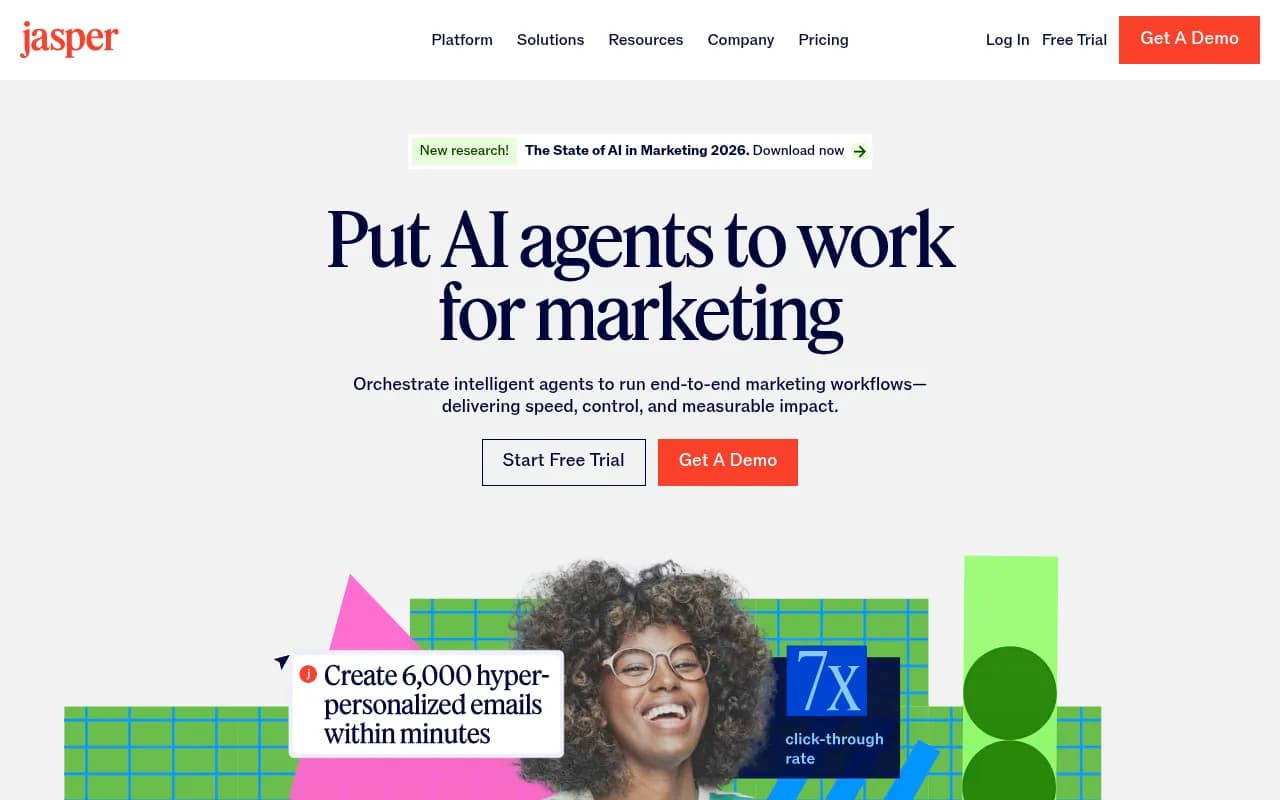
Jasper AI is an enterprise marketing platform with 100+ AI agents, content pipelines, and brand governance tools. Built for mid-market and enterprise marketing teams to automate content creation, campaigns, SEO/AEO/GEO, and personalization at scale.
Key takeaways
- Jasper is a full-stack AI marketing platform, not just a writing assistant -- it combines AI agents, automated content pipelines, and brand governance (Jasper IQ) into one system
- Trusted by enterprise brands including Boeing, L'Oreal, Adidas, Prudential, and Anthropologie, with documented results like 10,000+ hours saved annually (Cushman & Wakefield) and 7,500 product descriptions written in 24 hours (Adidas)
- Strong brand control layer (Brand Voice, Style Guide, Visual Guidelines) makes it genuinely useful for large teams where consistency is a real problem
- Pricing starts around $59/month (Pro, billed annually) but the features that matter for enterprise -- agents, pipelines, governance -- live behind higher tiers and custom pricing
- Not the right tool if you want to monitor or improve your brand's visibility in AI search engines like ChatGPT or Perplexity; for that, you'd need a dedicated GEO platform like Promptwatch
Jasper launched in 2021 as Jarvis (before a trademark dispute forced the rename) and quickly became one of the most recognized names in AI writing. It raised over $130 million in funding, hit a reported $1.5 billion valuation, and built a massive user base during the early wave of GPT-3-powered content tools. Then the market got crowded. ChatGPT arrived, every SaaS tool added an "AI" button, and Jasper had to figure out what it actually was beyond a fancy text generator.
The answer they landed on: an enterprise marketing execution platform. The current version of Jasper is genuinely different from what it was in 2022. It's less about generating a single blog post and more about orchestrating entire marketing workflows -- from brief to published asset -- across teams, channels, and markets. The 2025-2026 product is built around three pillars: AI Agents (purpose-built automations for specific marketing tasks), Content Pipelines (structured end-to-end workflows), and Jasper IQ (a brand intelligence layer that keeps everything on-brand). That's a real product vision, not just a feature list.
The target audience has shifted accordingly. Jasper today is aimed at mid-market and enterprise marketing teams -- content operations leads managing 10+ person teams, performance marketers running hundreds of ad variants, brand managers trying to maintain voice consistency across global markets. Individual freelancers and solo creators can still use it, but the platform's depth and pricing make the most sense at team scale.
Key features
AI Agents Jasper's agent library is the centerpiece of the current product. These aren't generic chatbots -- they're purpose-built automations for specific marketing tasks. The three main agent categories are Optimization (improving existing content for SEO, AEO, and GEO), Personalization (adapting content for specific audiences, accounts, or segments), and Research (gathering competitive intelligence, audience insights, and topic data). In practice, an optimization agent can take a batch of existing blog posts and rewrite them with updated keywords, structured data, and answer-engine-friendly formatting without a human touching each one. That's genuinely useful for content teams sitting on large archives.
Content Pipelines This is Jasper's workflow automation layer. A pipeline connects data inputs (briefs, keyword lists, product feeds, audience segments) to content outputs (blog posts, ad copy, landing pages, emails) through a structured sequence of AI steps. The key tools here are Canvas (the main editor), Grid (a spreadsheet-style interface for bulk content generation), and AI Studio (a no-code builder for custom automations). Grid is particularly interesting -- you can run the same prompt across hundreds of rows of data simultaneously, which is how Adidas generated 7,500 product descriptions in a single day. For ecommerce teams with large catalogs, this is a real time-saver.
Jasper IQ (brand intelligence layer) This is what separates Jasper from generic AI writing tools. Jasper IQ is a governed context hub that stores your brand's voice, visual guidelines, style rules, and knowledge base -- and injects that context into every piece of content the platform generates. Brand Voice lets you define tone, vocabulary, and personality. Style Guide enforces grammar and formatting rules. Visual Guidelines store approved imagery and design direction. Knowledge Base holds product information, FAQs, and company facts. When a new team member uses Jasper, they're not starting from scratch -- the brand context is already baked in.
SEO, AEO, and GEO content creation Jasper has a dedicated solution for search-optimized content, covering traditional SEO, Answer Engine Optimization (AEO), and Generative Engine Optimization (GEO). The platform can generate content structured to rank in AI search results -- think FAQ sections, direct answer formatting, and citation-friendly prose. The Grid interface has an "AEO-Optimized Blogs" workflow visible in their product screenshots. This is content creation for AI search, though it's worth noting that Jasper doesn't monitor your actual visibility in AI engines like ChatGPT or Perplexity -- it creates the content, but tracking whether that content gets cited requires a separate tool.
Jasper Chat A conversational interface for ad-hoc content requests, brainstorming, and quick drafts. Less structured than the pipeline tools, more flexible. Useful for marketers who want to iterate quickly on ideas before committing to a full pipeline run. It's similar in feel to ChatGPT but with your brand context loaded in.
AI Image Suite Jasper includes image generation capabilities alongside text. You can create on-brand visuals, edit images, and generate variations -- all within the same platform. Visual Guidelines from Jasper IQ feed into image generation to keep outputs consistent with brand aesthetics. This reduces the need to jump between Jasper and a separate tool like Midjourney or Adobe Firefly for basic visual needs.
Governance and compliance controls For enterprise buyers, this is often the deciding factor. Jasper's governance layer includes user permissions, content approval workflows, and compliance guardrails. The platform is LLM-agnostic (it can work with multiple underlying models) and has SOC 2 compliance, data privacy controls, and an ethics framework. For regulated industries like insurance or financial services, these controls matter a lot.
API and MCP (Model Context Protocol) Jasper offers a developer API and supports the Model Context Protocol, which lets external systems connect to Jasper's brand context and content generation capabilities. This means engineering teams can build Jasper into existing marketing tech stacks -- CMS platforms, DAMs, CRMs -- rather than forcing everyone to work inside the Jasper UI. The MCP support is a relatively new addition and positions Jasper well for teams building custom AI workflows.
Who is it for
The clearest fit is a marketing team of 10-100 people at a mid-market or enterprise company that produces a high volume of content across multiple channels. Think a B2B SaaS company with a 15-person marketing team running a blog, paid ads, email campaigns, and product pages simultaneously -- and struggling to maintain brand consistency as the team grows. Jasper's brand governance tools solve a real problem here. The content pipeline automation means a single content strategist can brief a workflow and have 50 blog posts drafted by morning.
eCommerce and retail teams are another strong fit, particularly for product description generation at scale. The Adidas example (7,500 descriptions in 24 hours) is the clearest proof point. Any retailer with a catalog of hundreds or thousands of SKUs that needs localized, SEO-optimized copy is a natural Jasper customer. The Grid interface was clearly designed with this use case in mind.
Global marketing teams dealing with localization are also well-served. Jasper's multi-language capabilities and brand voice controls mean you can adapt campaigns for different markets without losing the core brand identity. Field marketers running regional campaigns can work within centrally governed templates.
Who should probably look elsewhere: solo freelancers and individual creators will find the pricing hard to justify and the platform's complexity overkill. If you just need to write faster, a simpler tool like Claude, ChatGPT, or even a lighter AI writing assistant will serve you better at a fraction of the cost. Similarly, if your primary goal is understanding and improving your brand's presence in AI search results -- tracking citations in ChatGPT, Perplexity, or Gemini -- Jasper doesn't do that. It creates content, but it doesn't tell you whether AI models are actually citing it.
Integrations and ecosystem
Jasper has a reasonably broad integration ecosystem. Key integrations include:
- Google Docs and Google Drive for importing and exporting content
- Webflow, WordPress, and other CMS platforms via API or direct integration
- HubSpot and Salesforce for CRM-connected personalization workflows
- Zapier for connecting Jasper to hundreds of other tools without code
- Surfer SEO for SEO scoring and optimization within the editor
- Grammarly for grammar and style checking
- Chrome Extension for using Jasper across any web-based tool
The Jasper API and MCP support give developers significant flexibility to build custom integrations. The partner ecosystem (accessible at ecosystem.jasper.ai) includes certified solutions partners and tech partners who can help with implementation.
There's also a community platform (community.jasper.ai) with courses, certifications through Jasper Academy, and a community forum. The Jasper Foundations certification is a structured learning path for teams onboarding to the platform.
Pricing and value
Jasper's pricing has evolved significantly over the years. Current public pricing shows:
- Creator/Pro plan: approximately $59/month billed annually ($69/month billed monthly) -- aimed at individuals and small teams, includes core writing features and brand voice
- Teams/Business plan: pricing varies, typically in the $125-$499/month range depending on seats and features -- adds collaboration, more brand voices, and pipeline access
- Enterprise: custom pricing -- includes full agent access, governance controls, dedicated customer success, SSO, and compliance features
A free trial is available. There's no permanent free tier.
Compared to alternatives: Writesonic and Copy.ai are cheaper for basic writing tasks. Writer (another enterprise AI writing platform) competes directly at the enterprise tier with similar governance features. For pure content generation, ChatGPT Enterprise or Claude for Teams can be cheaper but lack the marketing-specific workflows and brand governance layer.
The value proposition is strongest when you're running content at scale. If a team of 10 marketers each saves 5 hours per week, the math on a $500/month plan works out quickly. The harder question is whether the workflow setup time and learning curve justify the investment for smaller teams.
Strengths and limitations
What Jasper does well:
- Brand governance at scale: The Jasper IQ layer is genuinely well-built. Brand Voice, Style Guide, and Visual Guidelines working together means large teams can produce consistent content without constant editorial oversight. This is harder to replicate with generic AI tools.
- Bulk content generation: Grid's spreadsheet-style bulk generation is one of the most practical features in the platform. For ecommerce, localization, or any high-volume content need, it's a real productivity multiplier.
- Enterprise trust infrastructure: SOC 2 compliance, LLM-agnostic architecture, governance controls, and a dedicated customer success team make Jasper a credible choice for regulated industries and large organizations with strict data requirements.
- Breadth of marketing use cases: From ad copy to press releases to SEO blog posts to product descriptions, the platform covers the full marketing content spectrum. Teams don't need multiple tools for different content types.
- Strong customer success and onboarding: The certified partner ecosystem and in-house customer success team are a real differentiator. Enterprise software is only as good as the implementation, and Jasper invests here.
Limitations and honest gaps:
- No AI search visibility monitoring: Jasper can create content optimized for AI search (AEO/GEO), but it has no capability to track whether your content is actually being cited by ChatGPT, Perplexity, Claude, or other AI engines. You're flying blind on results. For that, you'd need a dedicated platform.
- Complexity and learning curve: The platform has grown significantly and the number of features, agents, pipelines, and settings can be overwhelming. Smaller teams without dedicated operations support may struggle to get full value without significant onboarding investment.
- Pricing opacity at higher tiers: The enterprise pricing is custom and not publicly listed, which makes it hard to budget without going through a sales process. For teams that want to self-serve and evaluate quickly, this is friction.
- Output quality still requires editing: Like all AI writing tools, Jasper's outputs need human review. The brand governance layer reduces the amount of editing needed, but it doesn't eliminate it. Teams that expect fully publish-ready content without human review will be disappointed.
Bottom line
Jasper is the right tool for mid-market and enterprise marketing teams that produce content at volume and need brand consistency across a large team. The combination of AI agents, content pipelines, and the Jasper IQ governance layer is genuinely differentiated from both generic AI tools and simpler writing assistants. If you're running a marketing operation where content production is a bottleneck and brand drift is a real problem, Jasper is worth a serious evaluation.
That said, it's a content creation and automation platform -- not a visibility or analytics platform. If you want to know whether your content is actually showing up in AI search results, or which prompts your competitors are winning in ChatGPT and Perplexity, you'll need to pair Jasper with a dedicated GEO monitoring tool. The two problems are related but distinct, and Jasper only solves one of them.
Best for: Enterprise and mid-market marketing teams running high-volume, multi-channel content operations who need brand governance, workflow automation, and scalable AI-assisted production.
Tags:
Frequently asked questions
What is Jasper AI?
How much does Jasper cost?
Who is Jasper best suited for?
Does Jasper help with SEO and AI search optimization?
What integrations does Jasper support?
How does Jasper compare to other AI writing tools like Copy.ai or Writer?
Similar and alternative tools to Jasper AI