Key takeaways
- Jasper is a content creation and brand governance platform first; AirOps is an AI search visibility and content engineering platform first. They solve different core problems.
- AirOps has a free tier (1,000 tasks/month); Jasper only offers a free trial. For budget-conscious teams, AirOps is easier to test without a credit card commitment.
- Jasper produces more polished first drafts out of the box -- its brand voice controls and style guides are genuinely strong. AirOps' content quality depends more on how well you configure your workflows.
- AirOps is the better choice if your primary goal is getting cited by ChatGPT, Perplexity, or Google AI Overviews. Its content gap analysis and AI search tracking are core features, not add-ons.
- Jasper's enterprise feature set (100+ agents, brand governance, content pipelines, visual guidelines) is more mature for large marketing teams running multi-channel campaigns.
- Neither tool is a pure AI search monitoring platform. If you need deep citation tracking, crawler logs, and prompt intelligence alongside content creation, a dedicated GEO tool like Promptwatch fills that gap.
Overview
Jasper AI
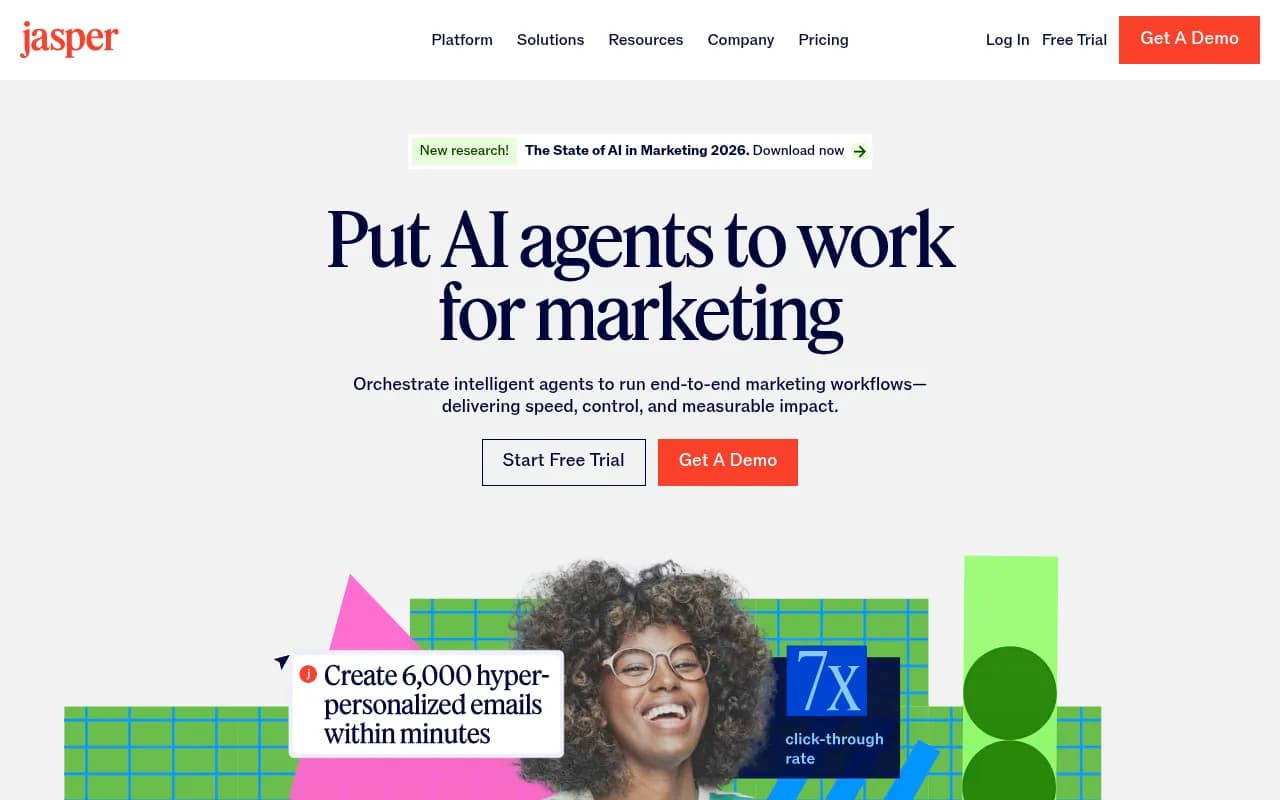
Jasper started as an AI writing assistant and has evolved into something much bigger: an enterprise marketing platform with 100+ AI agents, structured content pipelines, and a brand governance layer called Jasper IQ. The pitch is that marketing teams can automate entire workflows -- from brief to published content -- while keeping everything on-brand. It's used by mid-market and enterprise teams who need to produce a lot of content across a lot of channels without losing brand consistency.
The SEO/AEO/GEO solution is a real part of the product, not just a landing page. But Jasper's DNA is still content creation. It's very good at writing. The optimization and tracking side is thinner.
AirOps
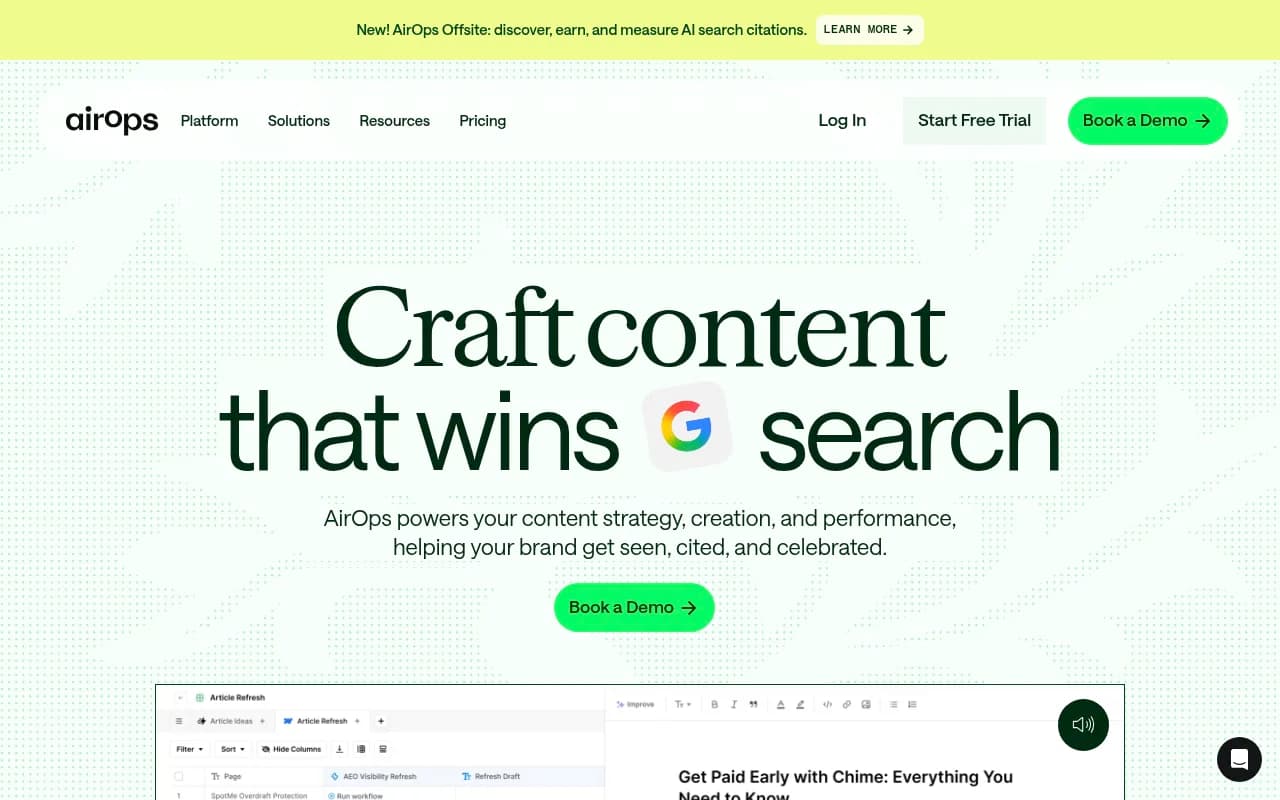
AirOps positions itself as the first "end-to-end content engineering platform" for AI search. The framing is deliberate: this isn't just about writing faster, it's about building content that gets cited by AI engines. Customers like Webflow, Chime, Ramp, and Carta use it to surface content gaps, understand what questions AI models are answering (and who they're citing), and then generate content designed to win those citations.
Chime reportedly went from being recommended in 24 to 68 priority questions after using AirOps. Webflow 5x'd its content refresh velocity. Those are real numbers, not vague claims.
Side-by-side comparison
| Feature | Jasper AI | AirOps |
|---|---|---|
| Primary use case | Content creation + brand governance | AI search visibility + content engineering |
| Free tier | Free trial only | Yes (1,000 tasks/month) |
| Starting price | ~$59/mo (Pro, annual) | $199/mo (Starter) |
| AI agents | 100+ purpose-built marketing agents | Workflow-based agents, less pre-built |
| Brand voice controls | Strong (Brand IQ, style guides, visual guidelines) | Basic brand customization |
| Content gap analysis | Limited | Core feature |
| AI search citation tracking | Basic (via SEO/AEO/GEO solution) | Core feature |
| Content pipelines | Yes (structured, repeatable workflows) | Yes (task-based workflows) |
| SEO/AEO/GEO solution | Yes (dedicated solution page) | Yes (primary focus) |
| Integrations | API, MCP, various marketing tools | API, Webflow, CMS integrations |
| Enterprise governance | Strong (Jasper IQ, governance layer) | Limited |
| Target audience | Mid-market + enterprise marketing teams | Growth/content teams at tech companies |
| Case studies | Enterprise brands (various) | Webflow, Chime, Ramp, Carta, Apollo |
Head-to-head feature deep-dive
Content creation quality
Jasper has a clear edge here. Its brand voice training, style guides, and visual guidelines mean that content comes out closer to publication-ready. Multiple independent reviews note that Jasper produces more polished first drafts than AirOps -- less generic AI phrasing, better adherence to tone.
AirOps content quality is more variable. The platform is workflow-first, so the output depends heavily on how well you've configured your prompts and templates. Teams with strong content ops skills get great results. Teams that want to just press a button and get a finished article will find Jasper more satisfying.
Verdict: Jasper wins on raw content quality and brand consistency.
AI search visibility and content gap analysis
This is where AirOps pulls ahead. Its core product is built around understanding what questions AI engines are answering, who they're citing, and where your content is missing. The content gap analysis surfaces specific topics and angles your site isn't covering -- the ones AI models want to answer but can't find on your domain.
Jasper has an SEO/AEO/GEO solution, but it's primarily a content creation layer. It can help you write content optimized for AI search, but it doesn't have the same depth of citation tracking or gap analysis that AirOps does.
Worth noting: if you want truly deep AI search monitoring -- crawler logs, prompt intelligence, citation tracking across 10+ AI models -- neither Jasper nor AirOps fully covers that. Platforms like Promptwatch are built specifically for that layer.

Verdict: AirOps wins on AI search strategy and gap analysis.
Brand governance and enterprise controls
Jasper's Jasper IQ system is genuinely impressive. Brand IQ, brand voice, visual guidelines, style guides, and a governance layer all work together to ensure that content produced by any team member (or agent) stays on-brand. For large marketing organizations with multiple contributors, this matters a lot.
AirOps has some brand customization but nothing close to Jasper's governance depth. It's not really designed for the "100 people writing content, all need to sound the same" problem.
Verdict: Jasper wins by a wide margin on enterprise brand governance.
Workflow automation and agents
Jasper's 100+ purpose-built marketing agents cover optimization, personalization, research, campaigns, and more. The content pipelines system adds structured, repeatable workflows on top. For teams that want to automate end-to-end marketing processes -- not just content writing -- Jasper has more pre-built infrastructure.
AirOps uses a task-based workflow system that's flexible but requires more configuration. It's powerful for teams with technical resources, but the setup overhead is real. One review noted that AirOps "requires engineering resources and enterprise budgets to get value" -- which is a fair criticism for smaller or less technical teams.
Verdict: Jasper wins on out-of-the-box workflow automation. AirOps wins on flexibility for technical teams.
Pricing and accessibility
AirOps has a genuine free tier -- 1,000 tasks per month, no credit card required. That's a real advantage for teams that want to test before committing. Jasper only offers a free trial, which means you're on a clock from day one.
On paid plans, Jasper is cheaper to start ($59/mo vs $199/mo), but the comparison gets complicated quickly. Jasper's Pro plan is limited in seats and features; enterprise pricing is custom. AirOps' $199/mo Starter plan includes 10,000 tasks, which is meaningful volume for a content team.
Verdict: AirOps wins on free access; Jasper wins on entry-level paid pricing.
Integrations and API
Both tools have APIs. Jasper also supports MCP (Model Context Protocol), which is increasingly important for connecting AI agents to external data sources. AirOps integrates well with Webflow and various CMS platforms, which makes sense given its content-engineering focus.
Neither tool has a dramatically better integration story -- it depends on your stack.
Verdict: Roughly even, with slight edge to Jasper for MCP support and AirOps for CMS-specific integrations.
Pricing comparison
| Plan | Jasper AI | AirOps |
|---|---|---|
| Free | Free trial only | Free (1,000 tasks/month) |
| Entry paid | ~$59/mo (Pro, annual) | $199/mo (Starter: 10,000 tasks/mo) |
| Mid-tier | Not publicly listed | Scale (custom pricing) |
| Enterprise | Custom pricing | Enterprise (custom pricing) |
A few things to keep in mind: Jasper's $59/mo Pro plan is billed annually, so the monthly commitment is real. AirOps' $199/mo Starter is a meaningful jump from free, but 10,000 tasks per month is enough for a serious content operation. Both tools have custom enterprise pricing that can vary significantly based on seats, usage, and features.
Pros and cons
Jasper AI
Pros:
- Best-in-class brand voice and style guide controls
- 100+ pre-built marketing agents covering a wide range of use cases
- Structured content pipelines for repeatable, scalable workflows
- Strong enterprise governance layer (Jasper IQ)
- More affordable entry-level paid plan
- Polished first drafts with less editing required
Cons:
- No permanent free tier -- only a time-limited trial
- AI search monitoring and citation tracking are shallow compared to dedicated tools
- Content gap analysis is limited
- Heavy feature set can be overwhelming for small teams
- Some features (agents, pipelines) require time to configure properly
AirOps
Pros:
- Free tier available (1,000 tasks/month)
- Purpose-built for AI search visibility and citation optimization
- Strong content gap analysis -- surfaces exactly what's missing
- Proven results with recognizable brands (Webflow, Chime, Ramp, Carta)
- Flexible workflow system for technical teams
- CMS integrations (especially Webflow)
Cons:
- Higher entry price on paid plans ($199/mo vs $59/mo)
- Content quality is more variable -- depends on workflow configuration
- Requires more technical setup to get full value
- Brand governance features are thin compared to Jasper
- Fewer pre-built agents and templates
Who should pick which tool
Choose Jasper AI if:
- You run a mid-market or enterprise marketing team that produces high volumes of content across multiple channels
- Brand consistency is a top priority -- you need style guides, visual guidelines, and governance enforced at scale
- You want pre-built agents and pipelines that work without heavy configuration
- Your budget allows for the Pro or Enterprise tier and you want a polished writing experience from day one
- You're automating broad marketing workflows beyond just content (campaigns, personalization, research)
Choose AirOps if:
- Your primary goal is increasing visibility and citations in AI search engines like ChatGPT, Perplexity, and Google AI Overviews
- You want to understand exactly which content gaps are costing you AI citations
- Your team has technical resources to configure and optimize workflows
- You want to start free and scale up based on results
- You're at a growth-stage tech company where AI search visibility is a direct revenue lever
Final verdict
These two tools are less direct competitors than they appear at first glance. Jasper is a content creation and brand governance platform that happens to have an AI search solution. AirOps is an AI search visibility platform that happens to generate content. The overlap is real, but the core strengths don't cancel each other out.
If you're a large marketing team that needs to produce a lot of on-brand content across many channels, Jasper is the stronger choice. If your specific problem is "we're invisible in ChatGPT and Perplexity and we need to fix that," AirOps is more directly built for that job. For teams that need both -- polished content creation AND deep AI search monitoring -- the honest answer is that you might need both tools, or you might need to supplement either one with a dedicated AI visibility platform.