Key takeaways
- Jasper AI and GWI Spark are not really direct competitors -- Jasper creates content, GWI Spark informs what content to create. If you're choosing between them, you're probably solving two different problems.
- Jasper AI is the better pick if your team needs to produce content at scale: blog posts, campaigns, ad copy, landing pages, all governed by brand rules.
- GWI Spark wins if you need verified consumer data -- audience profiles, behavioral trends, purchase intent -- to back up strategic decisions.
- Jasper AI has transparent pricing starting at ~$59/month. GWI Spark requires a sales conversation; expect enterprise-level costs.
- Teams with serious content operations often use both: GWI Spark for the "who are we talking to and what do they care about?" question, Jasper for the "now write 50 pieces of content for them" execution.
- Neither tool is a replacement for the other. The real question is which gap you're trying to close first.
Overview
Jasper AI
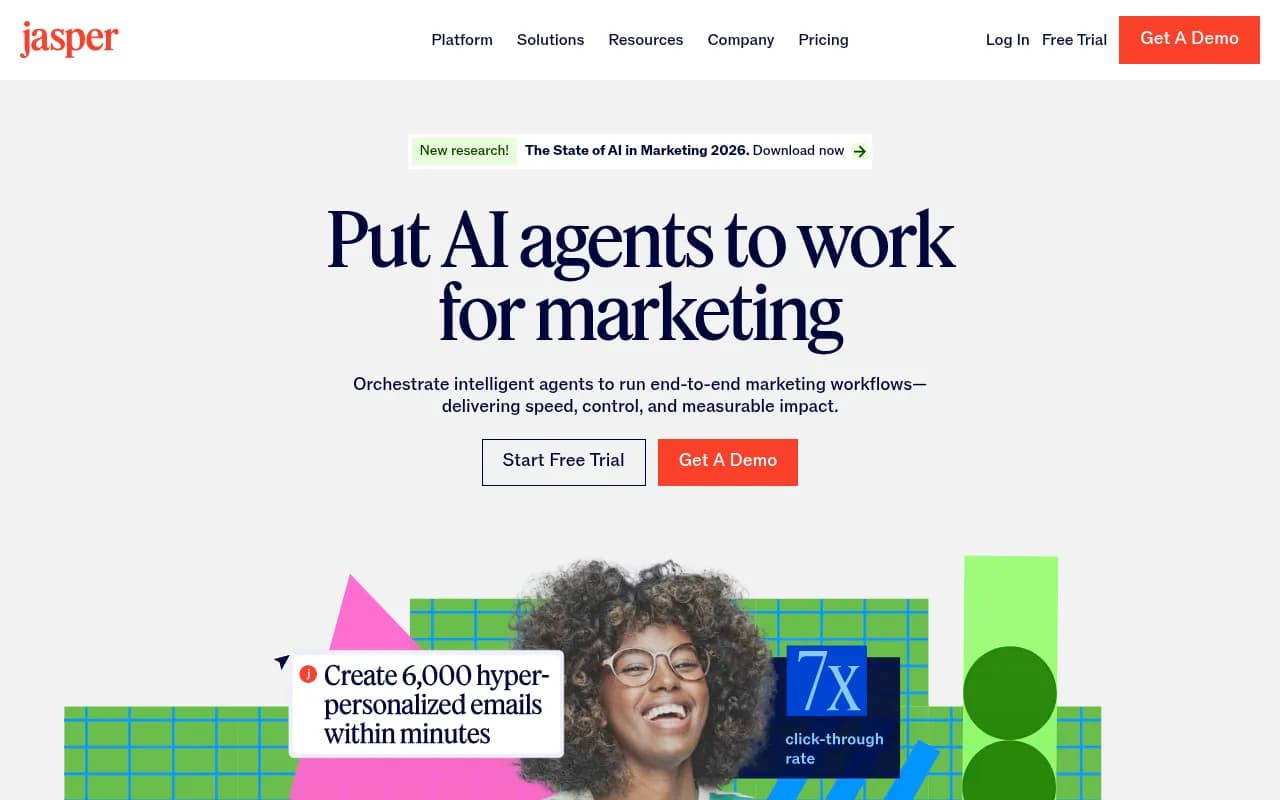
Jasper AI started as a GPT-powered writing assistant and has since grown into something considerably more ambitious: an enterprise marketing platform built around AI agents that can run entire workflows. The pitch is that marketing teams shouldn't just use AI to write faster -- they should use it to automate repeatable processes end-to-end. Jasper's current product centers on 100+ purpose-built agents (for optimization, personalization, research, and more), a content pipeline system for structured repeatability, and a brand governance layer called Jasper IQ that keeps everything on-brand across teams.
It targets mid-market and enterprise marketing teams who are producing a lot of content and want to systematize that production without losing brand consistency.
GWI Spark
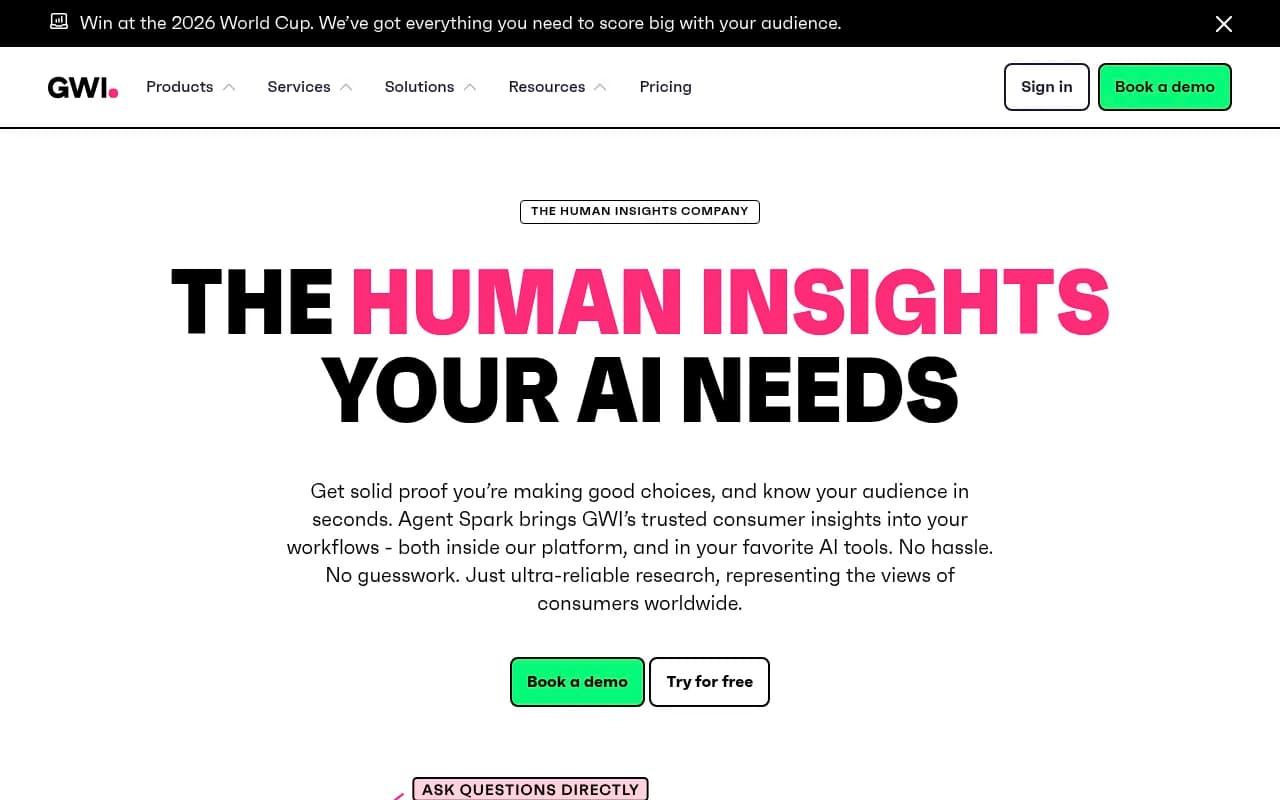
GWI (Global Web Index) has been running consumer surveys across 50+ markets for over 15 years. GWI Spark is their AI layer on top of that data -- a way to query 35 billion data points through natural language, get analyst-quality audience insights in seconds, and bring those insights into tools like ChatGPT, Claude, and Copilot via an agent integration.
The core value proposition is trust. AI tools hallucinate. GWI Spark grounds your AI workflows in verified survey data from 2 million+ annual interviews, not scraped web content. If you need to know what 25-34 year old urban consumers in Germany actually think about sustainability, GWI Spark can tell you with statistical confidence.
Side-by-side comparison
| Feature | Jasper AI | GWI Spark |
|---|---|---|
| Primary function | AI content creation & marketing automation | Consumer insights & audience research |
| Content generation | Yes -- full writing platform | No |
| AI agents | 100+ purpose-built marketing agents | Agent Spark (insights-focused) |
| Brand governance | Yes (Brand IQ, Brand Voice, Style Guide) | No |
| Consumer data | No | 35B+ data points, 50+ markets |
| Survey data coverage | No | 2M+ interviews/year, 15+ years of trends |
| SEO/AEO/GEO features | Yes (dedicated solution) | No |
| Integrations | API, MCP, browser extension, CMS tools | ChatGPT, Claude, Copilot, internal platform |
| Free tier | Free trial | Free sign-up (limited) |
| Pricing model | Transparent tiers from ~$59/mo | Custom enterprise pricing |
| Target user | Marketing teams, content teams, agencies | Market researchers, strategists, media planners |
| Ease of getting started | Moderate (feature-rich, some learning curve) | Low (natural language queries) |
| API access | Yes | Yes |
Head-to-head feature deep-dive
Content creation
Jasper AI is built for this. The Canvas is a full document editor with AI assistance baked in. The Grid handles bulk content production -- think generating 200 product descriptions or ad variants in one run. Content Pipelines let you define repeatable workflows so your team isn't reinventing the process every time. And Brand IQ means the output stays on-brand even when different team members are running different agents.
GWI Spark does not generate content. Full stop. It tells you what your audience cares about, what they're buying, what media they consume, and what messages resonate with them. That's genuinely useful input for content strategy, but it won't write a single word for you.
Verdict: Jasper AI wins this category by default. It's the entire point of the product.
Audience and market research
Jasper has a Research agent that can pull together information to support content briefs -- competitive analysis, topic research, that kind of thing. It's useful but it's content-oriented research, not consumer research.
GWI Spark is in a different league here. The underlying GWI dataset covers 50+ markets, tracks 4 waves of data per year, and goes back 15+ years. You can build detailed audience profiles, compare consumer segments across countries, pressure-test a campaign hypothesis against real survey data, and surface trends before they become obvious. The Agent Spark integration means you can do this directly inside ChatGPT or Claude without switching tabs.
For a media planner trying to understand whether Gen Z in Brazil and Gen Z in the UK have meaningfully different attitudes toward a product category, GWI Spark is the tool. Jasper can't touch it here.
Verdict: GWI Spark wins clearly. This is its core competency.
AI agent capabilities
Both products use the word "agent" but mean quite different things.
Jasper's agents are workflow executors. They take a brief, apply brand rules, pull from your knowledge base, and produce content outputs -- blog posts, email sequences, ad copy, landing pages. The 100+ agents cover specific marketing tasks: there are agents for SEO optimization, for personalization, for campaign creation, for research. You can chain them into pipelines.
GWI's Agent Spark is an insights retrieval agent. It connects to GWI's data and answers research questions in natural language. You can embed it in ChatGPT or Claude so that when you're working on a strategy document, you can ask "what percentage of our target audience uses Instagram for product discovery?" and get a verified answer without leaving your workflow.
These are complementary, not competing. One executes content production; the other injects verified data into your thinking process.
Verdict: Depends what you need. Jasper for production automation, GWI Spark for research augmentation.
Brand governance and consistency
This is a Jasper AI strength that GWI Spark doesn't address at all.
Jasper IQ is the governance layer: Brand Voice captures your tone and style, Visual Guidelines store your design rules, Style Guide enforces writing standards, and Knowledge lets you upload proprietary information (product specs, messaging frameworks, personas) that agents reference when generating content. Governance controls let admins set permissions and approval workflows.
For enterprise teams where 20 people are generating content simultaneously, this matters a lot. Without governance, AI-generated content drifts. Jasper's architecture is specifically designed to prevent that.
GWI Spark has no equivalent. It's a research tool, not a production tool.
Verdict: Jasper AI wins. GWI Spark doesn't compete here.
Integrations and workflow fit
Jasper connects via API and MCP (Model Context Protocol), has a browser extension, and integrates with common CMS and marketing platforms. The AI Studio lets you build custom workflows. It's designed to sit inside a marketing team's existing tech stack.
GWI Spark's most interesting integration is the Agent Spark connector for ChatGPT, Claude, and Copilot. This is genuinely clever -- instead of forcing researchers to live inside GWI's platform, it brings GWI's data into the AI tools people are already using. For teams that have adopted AI assistants as part of their daily workflow, this reduces friction significantly.
Verdict: Different integration philosophies. Jasper plugs into content production stacks; GWI Spark plugs into AI assistant workflows.
SEO, AEO, and GEO
Jasper has a dedicated SEO/AEO/GEO solution. It's designed to help teams create content that ranks in traditional search, appears in AI-generated answers (Answer Engine Optimization), and shows up in AI search results (Generative Engine Optimization). The agents can optimize existing content, generate new content targeting specific queries, and scale production across large content programs.
GWI Spark doesn't have SEO features. You could use GWI data to understand what topics your audience searches for, which is useful for keyword strategy, but the tool itself doesn't help you rank anywhere.
Worth noting: if you're serious about tracking how your brand actually appears in AI search results -- not just creating content for it -- Promptwatch is built specifically for that. It monitors your visibility across ChatGPT, Perplexity, Claude, Gemini, and others, and has content gap analysis to show you exactly which prompts competitors are winning that you're not.

Verdict: Jasper AI wins for content production targeting AI search. For tracking and measuring AI search visibility, a dedicated tool is worth adding to the stack.
Pricing comparison
| Plan | Jasper AI | GWI Spark |
|---|---|---|
| Free tier | Free trial (limited) | Free sign-up (limited access) |
| Entry-level paid | ~$59/mo (Pro, billed annually) | Custom quote required |
| Mid-tier | ~$99/mo (Teams, estimated) | Custom quote required |
| Enterprise | Custom pricing | Custom pricing |
| Billing options | Monthly or annual (annual saves ~20%) | Annual plans save 15% |
| Currencies | USD | USD, GBP, EUR |
Jasper AI is the more accessible option for smaller teams. The Pro plan at ~$59/month is a real entry point with meaningful features. GWI Spark's pricing is opaque -- you have to book a demo, which signals that the product is positioned for larger organizations with research budgets. Based on the market positioning and the depth of the data product, GWI Spark likely runs into four figures per month for most enterprise contracts.
Pros and cons
Jasper AI
Pros:
- Full content production platform -- from brief to published piece
- 100+ agents covering a wide range of marketing tasks
- Strong brand governance tools (Brand IQ, Brand Voice, Style Guide)
- Transparent pricing with an accessible entry point
- Explicit SEO/AEO/GEO solution for AI search content
- API and MCP for custom integrations
Cons:
- Feature-rich means a real learning curve for new users
- No consumer survey data -- you bring your own audience insights
- Quality of AI output still depends heavily on the quality of your prompts and knowledge base setup
- Enterprise features require custom pricing conversations
GWI Spark
Pros:
- 35 billion data points from verified consumer surveys -- not scraped web data
- 50+ markets, 15+ years of trend data, 4 data waves per year
- Agent Spark integrates directly into ChatGPT, Claude, and Copilot
- Natural language interface -- no training required to query the data
- Genuinely useful for media planning, campaign strategy, and audience segmentation
Cons:
- Does not generate content -- purely an insights and research tool
- Pricing is opaque; likely expensive for smaller teams
- The value is only realized if your team actually uses research to inform decisions (not all do)
- Less useful if your market isn't well-covered in GWI's survey panels
Who should pick which tool
Pick Jasper AI if:
- Your team needs to produce a high volume of content (blogs, emails, ads, landing pages) and wants to systematize that production
- Brand consistency across a large team is a real problem you're trying to solve
- You want AI agents that execute tasks, not just assist with them
- You're building out an SEO or AI search content program and need scale
- You want transparent pricing and a self-serve starting point
Pick GWI Spark if:
- Your work is strategy-first -- you need to understand audiences before you create anything
- You operate across multiple markets and need reliable cross-country consumer data
- You're a media planner, brand strategist, or market researcher who needs verified data, not AI-generated guesses
- You want to bring real consumer insights into your existing AI assistant workflows
- Your organization already has content production handled and the gap is insight quality
Use both if:
- You're a larger marketing organization where strategy and execution are separate functions
- You want GWI Spark to inform briefs and Jasper AI to execute against them
- You're running campaigns across multiple markets and need both audience intelligence and content at scale
Final verdict
Jasper AI and GWI Spark are tools for different jobs, and comparing them directly is a bit like comparing a kitchen knife to a recipe book -- both matter, but they're not substitutes for each other.
If you need to write more content, faster, with brand consistency: Jasper AI. If you need to know who you're writing for and what they actually care about: GWI Spark. The teams that get the most out of both are the ones who've figured out that insight without execution is just a slide deck, and execution without insight is just noise.