GWI Spark Review 2026
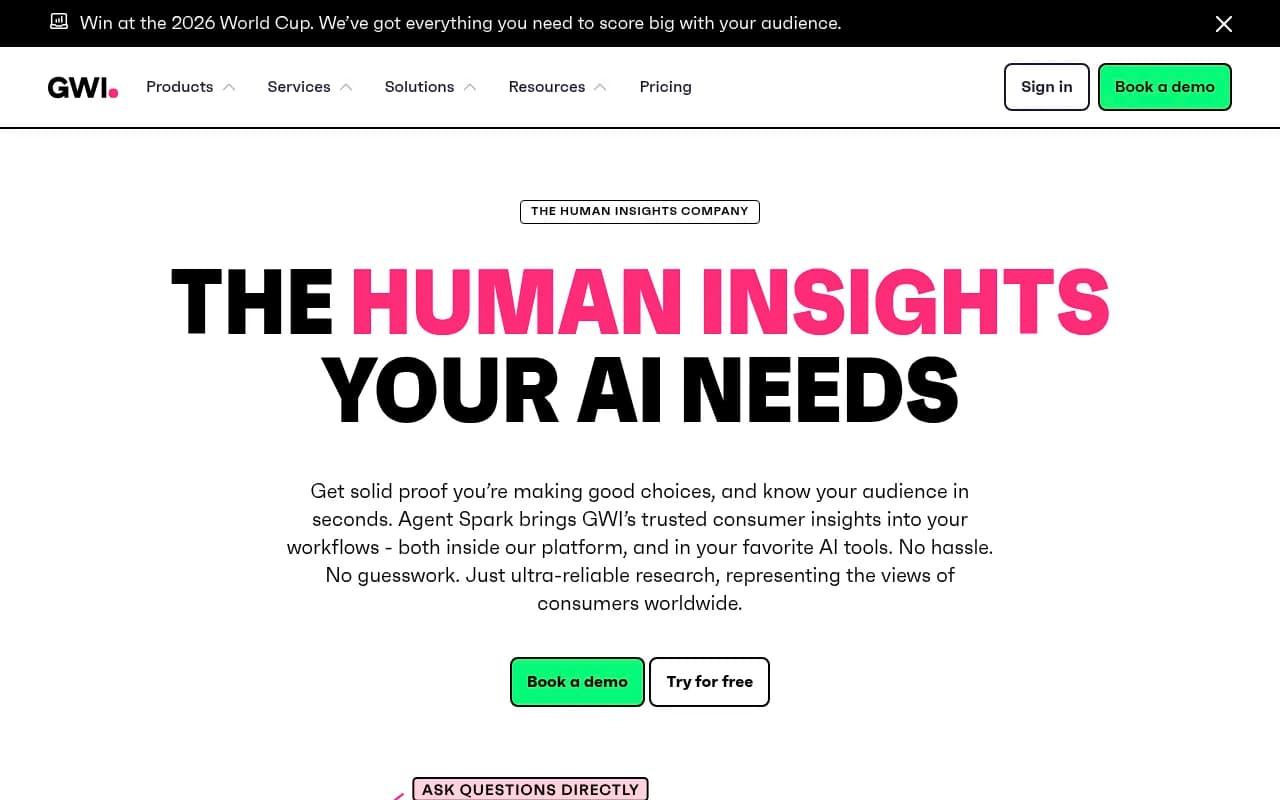
AI tool that provides consumer insights to inform content strategy. Helps marketers create data-backed content that resonates with target audiences.
Summary: Key Takeaways
• What it does: GWI Spark (Agent Spark) brings verified consumer insights from GWI's massive research database directly into AI tools like ChatGPT and Claude, replacing unreliable web-scraped data with real human responses from 2M+ annual interviews across 50+ markets • Best for: Marketing teams, agencies, and strategists at mid-to-large brands who need reliable audience data to inform campaigns, content strategy, and business decisions—especially those already using AI tools in their workflow • Standout strength: Unlike generic AI responses based on scraped web content, Agent Spark pulls from 35 billion verified data points collected through structured surveys, giving you actual consumer opinions and behaviors, not internet speculation • Main limitation: Pricing is enterprise-focused with no public rates listed—likely out of reach for freelancers, startups, or small agencies. Also requires understanding how to prompt effectively to get the most value from the integration. • Bottom line: If you're making strategic decisions based on audience insights and can afford enterprise research tools, GWI Spark eliminates the guesswork from AI-generated recommendations by grounding them in real consumer data.
GWI Spark (marketed as Agent Spark) is GWI's AI-powered interface that brings verified consumer insights directly into your existing AI workflows. GWI—formerly GlobalWebIndex—has been collecting consumer data for over 15 years, conducting 2 million interviews annually across 50+ global markets. Agent Spark takes that massive dataset (35 billion data points and counting) and makes it accessible through natural language queries in tools like ChatGPT, Claude, and Microsoft Copilot, as well as within GWI's own platform. The company positions this as "analyst-quality answers at the speed of AI"—essentially giving marketers and strategists a research analyst that never sleeps and doesn't rely on scraped web content.
The target audience is marketing teams, agencies, media companies, and strategists at mid-to-large organizations who need reliable audience intelligence to inform campaigns, content strategy, product positioning, and business decisions. GWI's client roster includes major brands like Nextdoor, One Championship, and Passion Digital, plus agencies managing multiple client accounts. This isn't a tool for solopreneurs or bootstrapped startups—it's built for teams with real budgets who are tired of making strategic bets based on gut feel or unreliable AI hallucinations.
Key Features
Agent Spark AI Integration: The headline feature is the ability to query GWI's consumer database directly through AI tools you already use. Instead of asking ChatGPT a question and getting an answer synthesized from random blog posts and Reddit threads, Agent Spark pulls verified responses from GWI's structured survey data. You can ask questions like "What streaming services do Gen Z gamers in the UK prefer?" or "How do millennial parents in the US feel about sustainability in fashion?" and get answers grounded in actual consumer responses, complete with percentages, demographic breakdowns, and trend data. This works both inside GWI's platform and as an integration with external AI tools—though the exact mechanics of the external integration aren't fully detailed on the site. The value here is eliminating the "is this even true?" question that plagues most AI-generated insights.
35 Billion Data Points from Real Humans: GWI conducts 2 million interviews per year across 50+ countries, with four waves of data collection annually. This isn't passive tracking or web scraping—it's structured survey research asking consumers about their behaviors, preferences, media consumption, purchasing habits, and attitudes. The dataset includes 15+ years of trended data, so you can see how consumer sentiment has shifted over time, not just a snapshot of today. For example, you could compare how attitudes toward remote work have evolved from 2019 to 2026, or track the rise of specific social platforms among different age groups. The depth here is what separates GWI from generic AI tools—you're getting longitudinal, structured data, not just whatever's trending on Twitter this week.
Audience Profiling and Segmentation: You can build detailed audience profiles based on demographics, psychographics, media consumption, brand affinities, and behaviors. Want to understand "women aged 25-34 in Germany who shop online weekly and follow fitness influencers"? GWI lets you slice the data that specifically, then see what else defines that segment—what devices they use, what content they consume, what brands they trust, how they feel about privacy, etc. This is particularly valuable for agencies managing multiple clients or brands targeting niche audiences. The platform shows you not just who your audience is, but how they differ from the general population or from competitors' audiences—critical for positioning and messaging.
Trend Discovery and Validation: Agent Spark helps you spot emerging trends and validate whether they're real or just hype. You can ask questions like "Is the interest in AI-generated art growing among creative professionals?" and get data-backed answers showing whether that's a genuine shift or just loud voices on social media. GWI tracks consumer attitudes, behaviors, and interests over time, so you can see if something is a flash in the pan or a sustained movement. This is especially useful for content strategists and product teams trying to decide where to invest resources—do you build a feature around a trend, or is it already peaking?
Competitive Intelligence: You can compare your brand's audience against competitors' audiences to find gaps and opportunities. See where your audience overlaps with rivals, where you're uniquely positioned, and what segments competitors are capturing that you're missing. For example, if you're a streaming service, you can see what percentage of Netflix subscribers also use your platform, what differentiates your exclusive users, and what content genres drive loyalty. This goes beyond basic market share—it's about understanding the why behind consumer choices, which is where strategic advantage lives.
Multi-Market and Multi-Language Coverage: GWI covers 50+ markets globally, with data collected in local languages and adjusted for cultural context. This is a huge advantage for global brands or agencies with international clients. You're not just getting US-centric data extrapolated to other markets—you're getting actual responses from consumers in Japan, Brazil, Germany, India, etc. The platform lets you compare markets side-by-side, so you can see how consumer behaviors differ by region and tailor strategies accordingly. For example, social media usage patterns in Southeast Asia look very different from Europe, and GWI captures those nuances.
GWI Canvas (Automated Reporting): While Agent Spark is the AI interface, GWI Canvas is the platform's automated reporting and data visualization tool. It generates presentation-ready reports and charts from your queries, which is a lifesaver for agencies and teams that need to package insights for clients or executives. You can export reports with or without watermarks depending on your plan tier. This isn't just raw data dumps—it's polished, shareable deliverables that look like they came from a research firm, because they basically did.
Integration with Existing Workflows: Beyond the AI tool integrations, GWI is designed to fit into how marketing teams already work. The platform is web-based, no installation required, and the Agent Spark interface is conversational—you don't need to be a data analyst to use it. For teams already using ChatGPT or Claude for brainstorming and research, adding Agent Spark means those tools suddenly have access to verified consumer data instead of just making educated guesses. The learning curve is minimal if you're already comfortable with AI chat interfaces.
Who Is It For
GWI Spark is built for marketing and strategy teams at mid-to-large companies, agencies, and media organizations who need reliable consumer insights to inform high-stakes decisions. The ideal user is someone who's currently using a mix of AI tools, Google searches, and maybe some basic survey data, but knows they're missing the depth and reliability that real research provides. Think: a brand manager at a consumer goods company planning a product launch, a creative director at an agency pitching a campaign, a content strategist at a media company deciding what topics to cover, or a market researcher at a tech company validating a new feature idea.
Team size matters here. This isn't a tool for solo freelancers or early-stage startups—the pricing and feature set are aimed at teams with dedicated marketing budgets. If you're a 5-person startup, you probably can't justify the cost. If you're a 50-person marketing team at a Series B SaaS company or a mid-sized agency with 10+ clients, GWI Spark makes a lot more sense. The value scales with the number of decisions you're making and the cost of getting those decisions wrong.
Industries where GWI particularly shines: consumer brands (fashion, beauty, food & beverage), media and entertainment (streaming services, publishers, gaming companies), advertising and marketing agencies, tech companies with consumer-facing products, and any business where understanding audience behavior and preferences is a competitive advantage. If your success depends on knowing what consumers think, want, and do—not just what they search for—GWI is relevant.
Who should NOT use this tool: Freelancers, solopreneurs, and small businesses with limited budgets. If you're just looking for basic keyword research or content ideas, there are cheaper (or free) alternatives. GWI is overkill if you're not making strategic decisions that justify the investment. Also, if your business is purely B2B and you're targeting a narrow set of enterprise buyers, consumer insights from a broad survey panel may not be as relevant as account-based research or intent data from tools like 6sense or Demandbase.
Integrations & Ecosystem
GWI Spark integrates with major AI tools including ChatGPT, Claude, and Microsoft Copilot, allowing you to query GWI's consumer database directly from those interfaces. The exact technical implementation isn't fully detailed on the website, but it appears to function as a plugin or API connection that lets the AI models access GWI's data when responding to your prompts. This means you can be working in ChatGPT for brainstorming and seamlessly pull in verified consumer insights without switching tools.
Within GWI's own platform, Agent Spark is the conversational interface for querying the database. You type natural language questions and get structured answers with data visualizations. The platform also includes GWI Canvas for automated reporting and export, which generates presentation-ready charts and reports.
GWI doesn't appear to offer a public API for custom integrations, and there's no mention of browser extensions or mobile apps. The focus is on web-based access and integration with existing AI tools that teams are already using. For teams that live in Slack, Notion, or other collaboration tools, you'd likely need to copy insights from GWI into those platforms manually—there's no native integration mentioned.
Data export is available, with the ability to remove watermarks on higher-tier plans. This is important for agencies that need to white-label insights for client deliverables.
Pricing & Value
GWI does not publish specific pricing on their website. The site mentions "flexible pricing plans" with monthly and annual options (annual saves 15%), and pricing in USD, GBP, and EUR, but you have to book a demo to get a quote. This is typical for enterprise research tools—pricing is customized based on team size, number of users, markets covered, and feature access.
Based on the positioning and target audience, expect pricing to be in the range of several hundred to several thousand dollars per month, likely starting around $500-$1,000/month for smaller teams and scaling up for agencies or enterprise accounts with multiple users and global market access. There is a free trial available (the site has a "Try for free" CTA), which suggests you can test the platform before committing, but the trial likely has limitations on data access or features.
GWI Canvas is included in all plans, but higher tiers (Plus and Pro) offer additional features like watermark-free exports, which is critical for agencies presenting to clients.
How does this compare to competitors? Traditional market research from firms like Nielsen, Kantar, or Ipsos can cost tens of thousands of dollars for a single custom study. GWI offers on-demand access to a massive dataset for a fraction of that cost, making it more accessible for teams that need ongoing insights rather than one-off reports. Compared to AI-native tools or basic survey platforms like SurveyMonkey or Typeform, GWI is significantly more expensive, but you're paying for the quality, scale, and verification of the data—not just a tool to collect your own responses.
For the target audience—marketing teams at mid-to-large companies or agencies—the value proposition is strong if the insights inform decisions that drive revenue or prevent costly mistakes. If GWI data helps you avoid a failed product launch or identify a high-value audience segment, it pays for itself quickly. For smaller teams or businesses where consumer insights are nice-to-have rather than mission-critical, the cost may be hard to justify.
Strengths & Limitations
Strengths:
Verified, Structured Data: Unlike AI tools that scrape the web or synthesize answers from random sources, GWI's data comes from structured surveys of real consumers. This eliminates the "is this even true?" problem that plagues most AI-generated insights. You're getting percentages, demographic breakdowns, and trended data—not educated guesses.
Massive Scale and Depth: 35 billion data points, 2 million interviews per year, 50+ markets, 15+ years of trended data. The breadth and depth here are hard to match. You can slice audiences incredibly specifically and still have statistically significant sample sizes.
AI Integration: Bringing verified consumer data directly into ChatGPT, Claude, and Copilot is a genuinely innovative approach. It makes high-quality research accessible in the tools teams are already using, without forcing them to learn a new platform or switch contexts.
Longitudinal Trends: The ability to see how consumer attitudes and behaviors have shifted over 15+ years is invaluable for understanding whether something is a new trend or a return to an old pattern. Most tools only give you a snapshot of today.
Global Coverage: 50+ markets with local-language data collection means you're not just getting US-centric insights extrapolated globally. This is critical for international brands or agencies with global clients.
Limitations:
Pricing Transparency: No public pricing is a barrier for smaller teams trying to evaluate whether GWI fits their budget. The enterprise sales model (book a demo, get a quote) adds friction and suggests this is not a tool for budget-conscious buyers.
Learning Curve for Effective Prompting: While the AI interface is conversational, getting the most value requires knowing what questions to ask and how to interpret the data. Teams without research experience may struggle to frame queries effectively or may take answers at face value without understanding the nuances.
Limited Integration Ecosystem: Beyond the AI tool integrations, there's no mention of native connections to marketing platforms like HubSpot, Salesforce, Google Analytics, or collaboration tools like Slack or Notion. You're largely working within GWI's platform or the AI tools it integrates with, then manually moving insights elsewhere.
Survey-Based Limitations: All data comes from surveys, which means it's self-reported and subject to the usual biases (social desirability bias, recall bias, etc.). It's not behavioral tracking or transactional data—it's what people say they do, which doesn't always match what they actually do. For example, consumers might overreport healthy eating habits or underreport time spent on social media.
Bottom Line
GWI Spark is the right choice for marketing teams, agencies, and strategists at mid-to-large organizations who need reliable, verified consumer insights to inform high-stakes decisions and are tired of making bets based on AI hallucinations or gut feel. It's particularly valuable if you're already using AI tools like ChatGPT or Claude in your workflow and want to ground those tools in real consumer data instead of web-scraped speculation. The combination of 35 billion data points, global market coverage, and longitudinal trends makes it a powerful alternative to expensive custom research or unreliable free tools.
Best use case in one sentence: Marketing teams at brands or agencies who need to validate strategies, build audience profiles, and uncover trends with verified consumer data—and want that data accessible through AI tools they already use, not locked in a separate research platform.
Tags:
Similar and alternative tools to GWI Spark