Key takeaways
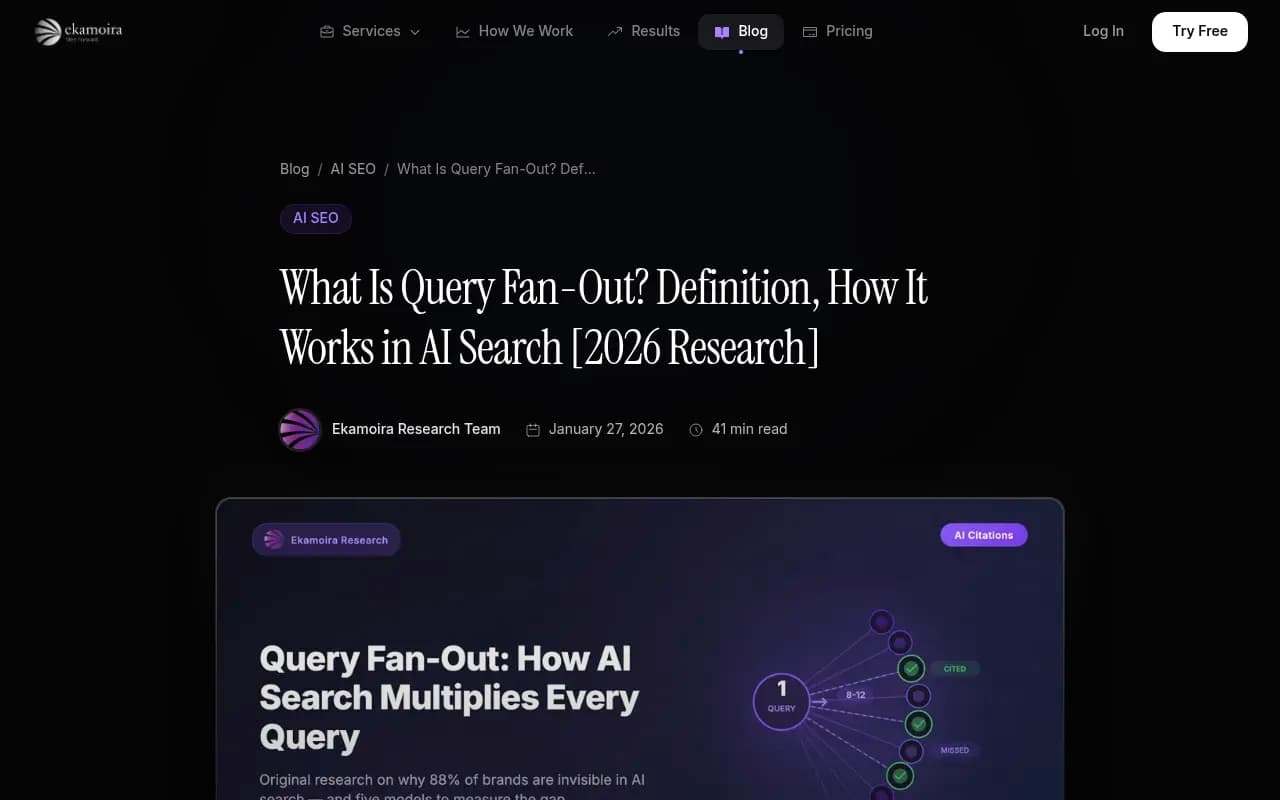
- Query fan-out means one health question in ChatGPT silently becomes 8-12 parallel sub-queries -- and most healthcare brands are only optimized for the surface-level prompt
- ChatGPT Health launched in January 2026, connecting patient records and wellness apps directly to ChatGPT; over 230 million people already ask ChatGPT health questions every week
- Medical and wellness queries fan out more aggressively than most other categories because they involve symptoms, treatments, providers, medications, lifestyle factors, and safety considerations simultaneously
- A December 2025 Surfer SEO study of 173,902 URLs found that 68% of pages cited in AI Overviews were not in the top 10 organic results -- traditional SEO rankings are a poor predictor of AI citation
- Healthcare brands need to map the full fan-out tree for their core topics, not just optimize for the obvious query
- Platforms like Promptwatch track query fan-outs and show exactly which sub-queries competitors are winning that you're missing
What query fan-out actually means for health searches
When a patient types "best treatment for type 2 diabetes" into ChatGPT, they think they're asking one question. They're not. Behind the scenes, the AI decomposes that query into something closer to a dozen parallel retrieval tasks:
- What are the current first-line medications for type 2 diabetes?
- Lifestyle interventions for type 2 diabetes management
- Type 2 diabetes diet recommendations 2026
- Metformin vs GLP-1 agonists comparison
- Type 2 diabetes complications to monitor
- When to see an endocrinologist for diabetes
- Blood sugar monitoring guidelines for type 2 diabetics
- Weight loss and type 2 diabetes reversal evidence
Each sub-query pulls from different sources. ChatGPT synthesizes them into one answer. The brand that appears in the final response isn't necessarily the one that ranked #1 for "best treatment for type 2 diabetes" -- it's the one whose content answered the most sub-queries comprehensively.
This is query fan-out. And it's why a December 2025 Surfer SEO analysis of 173,902 URLs found that 68% of pages cited in AI Overviews weren't in the top 10 organic results. Traditional SEO rankings are a genuinely poor predictor of AI citation. The content that wins in AI search is the content that covers the full topic tree, not just the headline query.
Why healthcare queries fan out harder than most
Health and wellness is one of the highest fan-out categories in AI search, and there's a structural reason for it. Medical questions almost always involve multiple intersecting dimensions:
- The condition itself (symptoms, diagnosis, staging)
- Treatment options (medications, procedures, lifestyle)
- Safety and contraindications
- Provider types and when to seek care
- Cost and insurance considerations
- Patient experience and quality of life
- Prevention and risk factors
A query like "is melatonin safe for kids" fans out into sleep science, pediatric dosing guidelines, drug interaction data, alternative sleep hygiene approaches, and when to consult a pediatrician. A query like "best protein powder for women over 50" fans out into protein requirements by age, muscle loss research, specific ingredient comparisons, hormonal considerations, and product safety.
The AI isn't being thorough for its own sake. It's trying to give a complete, safe answer to a health question -- which means it needs to pull from many angles simultaneously. Brands that only address the surface query get cited once, maybe. Brands that address the full fan-out tree get cited repeatedly across the synthesized response.
ChatGPT Health changes the stakes entirely
In January 2026, OpenAI launched ChatGPT Health -- a feature that lets users in the US connect their medical records, lab results, and data from wellness apps and wearables directly to ChatGPT. According to OpenAI, more than 230 million people globally already ask ChatGPT health and wellness questions every week. ChatGPT Health was developed in collaboration with physicians and is designed to help users understand test results, prepare for appointments, and manage their health more actively.
This matters for healthcare brands because it changes the nature of health queries in ChatGPT. Users are no longer asking generic questions -- they're asking personalized questions grounded in their actual health data. "What does my A1C of 6.4 mean and what should I do about it?" is a very different query from "what is prediabetes." The fan-out from a personalized health query is even more complex, pulling in condition-specific content, medication information, lifestyle guidance, and provider recommendations simultaneously.
OpenAI also announced ChatGPT for Healthcare, bringing the tool into hospitals and health systems. The combination of consumer health AI and institutional adoption means the volume of health queries flowing through ChatGPT is going to grow substantially through 2026. Brands that aren't visible in AI health responses now will face an increasingly crowded field later.
How fan-out works differently across AI platforms
Not all AI search engines fan out the same way. Understanding the differences matters for healthcare brands trying to prioritize their optimization efforts.
| Platform | Fan-out behavior | Health query behavior | Citation style |
|---|---|---|---|
| ChatGPT | 8-12 sub-queries, synthesized response | Pulls from medical sources, patient forums, clinical guidelines | Inline citations, source list |
| Google AI Mode | Aggressive fan-out, integrates Search index | Favors authoritative medical domains (Mayo, WebMD, NIH) | Carousel-style with links |
| Perplexity | Explicit source display, 4-8 sub-queries | Strong preference for recent, citable sources | Numbered citations, visible |
| Google AI Overviews | Moderate fan-out, tied to organic rankings | YMYL (Your Money Your Life) filtering is strict | Featured snippet style |
| Gemini | Similar to Google AI Mode | Integrates Google Search health panels | Summarized with links |
For healthcare brands, Perplexity's citation transparency is actually useful -- you can see exactly which sources it's pulling and why. ChatGPT's behavior is harder to reverse-engineer but has the largest user base. Google AI Mode's preference for established medical domains creates a higher barrier to entry for newer health brands.
Mapping the fan-out tree for your health topic
The practical starting point for any healthcare brand is building a fan-out map for their core topics. This isn't keyword research -- it's topic architecture. The goal is to identify every sub-query the AI might generate when a user asks your primary question.
Step 1: Start with your core query
Pick a query your target patient or customer would actually type. Be specific. "Back pain treatment" is too broad. "Lower back pain treatment without surgery" is closer to how real users prompt.
Step 2: Identify the fan-out dimensions
For any health query, the fan-out typically covers:
- Symptom and diagnosis angle ("what causes lower back pain")
- Treatment options angle ("non-surgical lower back pain treatment")
- Medication angle ("NSAIDs for back pain")
- Lifestyle angle ("exercises for lower back pain relief")
- Provider angle ("when to see a doctor for back pain")
- Prevention angle ("how to prevent lower back pain")
- Condition-specific variants ("lower back pain in pregnancy", "lower back pain after 50")
Step 3: Audit your content against each dimension
For each sub-query, ask: does your site have content that directly answers this? Not content that mentions it in passing -- content that is the best available answer to that specific question.
Most healthcare brands have good content for two or three dimensions and nothing for the rest. That's where AI visibility gaps come from.
Step 4: Prioritize by volume and competition
Not all sub-queries are equal. Some have high prompt volume and low competition -- these are the winnable gaps. Others are dominated by Mayo Clinic or WebMD and will be very hard to crack without significant authority.
Tools like Promptwatch show prompt volume and difficulty scores for specific sub-queries, which makes prioritization much more concrete than guessing.

The content types that win in health fan-out
AI models don't cite all content equally. In the health space, certain content formats consistently appear in AI responses because they match what the AI is trying to synthesize.
Structured comparison content
When the AI is answering a treatment comparison sub-query, it looks for content that directly compares options. A page titled "Metformin vs Ozempic: what the research says" is more likely to be cited for that sub-query than a general diabetes management guide that mentions both medications in passing.
Symptom-to-action content
Health queries frequently fan out into "when should I be concerned about X" sub-queries. Content that clearly maps symptoms to recommended actions -- including when to seek care -- is highly citable because it answers a complete decision-making question.
Evidence-grounded explainers
AI models in the health space are cautious about citing content that makes unsupported claims. Content that references clinical guidelines, names specific studies, or cites established medical organizations tends to perform better. This isn't about keyword stuffing -- it's about demonstrating that your content is grounded in evidence the AI can trust.
FAQ and Q&A formats
Structured Q&A content maps cleanly to fan-out sub-queries because each question-answer pair is essentially a self-contained retrieval unit. A page with 15 specific questions about a condition gives the AI 15 separate opportunities to cite you.
What healthcare brands are getting wrong
Most health brands optimize for the query they think patients are asking. They miss the queries the AI generates behind the scenes.
A supplement brand might have excellent content about "the benefits of magnesium" but nothing about "magnesium dosage by age," "magnesium and sleep quality research," "magnesium interactions with blood pressure medication," or "magnesium forms compared (glycinate vs citrate vs oxide)." When a user asks ChatGPT "should I take magnesium for sleep," the AI fans out into all of those sub-queries. The supplement brand gets cited for the benefits angle and missed for everything else.
A telehealth platform might have strong content about their service but weak content about the conditions they treat. When a user asks "can I get anxiety medication online," the AI fans out into how online prescribing works, which medications are available via telehealth, state-by-state regulations, and safety considerations. If the platform's content only covers the first sub-query, they appear once in a response that cites six different sources.
The fix isn't writing more content -- it's writing the right content for the right sub-queries. That requires knowing what the fan-out looks like for your specific topics.
Tracking fan-out performance over time
Identifying fan-out gaps is a one-time exercise. Tracking whether your content is actually getting cited across those sub-queries is ongoing work.
A few things to monitor:
- Which specific sub-queries is your brand appearing in, and which are you missing?
- Are competitors gaining ground on sub-queries you're not covering?
- When you publish new content targeting a specific sub-query, how long before AI crawlers index it and start citing it?
- Which AI models are citing you, and for which sub-queries?
This is where purpose-built AI visibility tools become genuinely useful. Platforms like Promptwatch track query fan-outs and show the gap between where competitors appear and where you don't -- which is the most actionable form of this data. Rather than guessing which sub-queries matter, you can see the exact prompts where a competitor is getting cited and you're invisible.
For broader AI visibility monitoring across platforms, tools like Profound and AthenaHQ also track brand mentions across multiple AI engines, though they focus more on monitoring than on the content gap analysis that actually drives improvement.
Profound


Practical priorities for healthcare brands in 2026
Given the launch of ChatGPT Health and the growing volume of AI health queries, here's where to focus:
Build topic depth, not just topic breadth
One comprehensive page that covers a condition from symptoms through treatment through prevention is more citable than five thin pages that each cover one angle. AI models prefer sources that can answer multiple sub-queries from a single authoritative source.
Target the "when to seek care" sub-queries
These are consistently underserved in AI health responses. Most health content tells people what a condition is. Far less content clearly answers "when does this require a doctor visit vs. home management." That gap is a citation opportunity.
Optimize for the personalization wave
With ChatGPT Health connecting personal health data, queries are becoming more specific. Content that addresses condition variants ("type 2 diabetes in people over 65," "back pain during pregnancy," "anxiety in teenagers") will be more citable than generic condition overviews as personalized queries increase.
Don't ignore Reddit and YouTube
AI models -- especially ChatGPT and Perplexity -- frequently cite Reddit discussions and YouTube videos in health responses, particularly for patient experience sub-queries. A Reddit thread where real patients discuss their experience with a medication can appear in an AI response alongside clinical sources. Healthcare brands that participate in or create content for these channels have an additional citation surface that most brands ignore entirely.
Monitor competitor citations, not just your own
The most useful signal isn't "am I being cited" -- it's "where is my competitor being cited that I'm not." That gap is the fan-out coverage you're missing. Closing it is the fastest path to improving AI visibility in health queries.
The regulatory reality
One thing worth stating plainly: health content in AI search operates under stricter scrutiny than most other categories. Google's YMYL (Your Money Your Life) framework has always applied extra skepticism to health content, and AI models have internalized similar caution. Content that makes unsupported claims, overstates efficacy, or lacks clear sourcing is less likely to be cited -- and in some cases may be actively filtered.
For healthcare brands, this means the quality bar for AI-citable content is genuinely higher than for other industries. The upside is that brands willing to invest in evidence-grounded, clinically accurate content have a real advantage over competitors who are publishing thin, SEO-optimized health content that AI models won't trust.
The fan-out opportunity in healthcare is real. But it rewards brands that take the content quality seriously, not just the content volume.
Putting it together
Query fan-out is the structural reason why healthcare brands with strong traditional SEO rankings are often invisible in AI search. One patient question becomes twelve retrieval events. Most brands are only optimized for one of them.
The path forward is straightforward in principle, even if it takes real work in practice: map the fan-out tree for your core health topics, audit your content against every sub-query dimension, prioritize the gaps where you can realistically compete, and track your citation performance as you publish new content.
With ChatGPT Health now connecting personal health data to AI responses, the volume and specificity of health queries in AI search will only grow through 2026. The brands that build comprehensive topic coverage now will have a significant head start on the ones that wait until AI health search is fully mainstream.