Key Takeaways
- Completely different tools: Airtop is a no-code web automation platform for building browser agents; Promptmonitor tracks brand mentions in AI search engines like ChatGPT and Claude. They don't compete -- they solve different problems.
- Airtop is for workflow automation: If you need to scrape websites, monitor competitors, extract leads from LinkedIn, or automate any browser-based task, Airtop is the tool. Promptmonitor can't do any of this.
- Promptmonitor is for AI visibility tracking: If you want to know how often ChatGPT, Perplexity, or Gemini mention your brand and which sources they cite, Promptmonitor handles that. Airtop doesn't track AI search at all.
- Pricing is similar but serves different budgets: Airtop starts at $26/mo, Promptmonitor at $29/mo. Both scale up to $80-$129/mo for pro tiers. You're not choosing based on price -- you're choosing based on what you need to accomplish.
- Integration ecosystems differ: Airtop plugs into Zapier, n8n, Make, Slack, Sheets, and CRMs to automate workflows. Promptmonitor is a standalone monitoring dashboard without heavy workflow integration.
- Consider Promptwatch for comprehensive AI visibility: If AI search tracking is your goal, Promptwatch offers more depth than Promptmonitor -- crawler logs, content gap analysis, AI content generation, and Reddit/YouTube tracking that Promptmonitor lacks.
Overview: Two tools, two completely different jobs
Airtop: No-code web automation platform
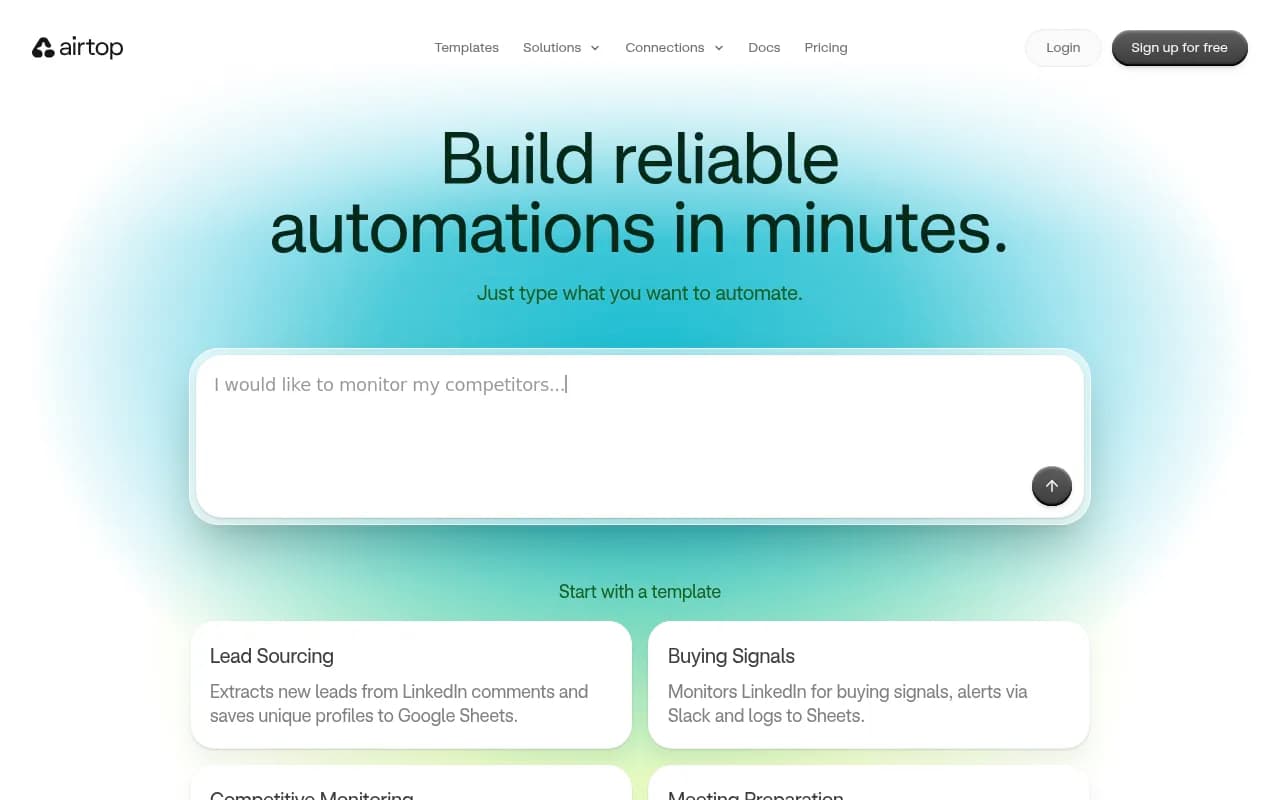
Airtop is a no-code platform for building web automation agents. You describe a task in plain English -- "monitor my competitors' LinkedIn posts weekly" or "extract new leads from LinkedIn comments and save to Google Sheets" -- and Airtop generates a browser agent that runs the automation for you. It works on any website, even behind logins or without APIs. The platform integrates with Slack, Gmail, Google Sheets, Airtable, HubSpot, Zapier, n8n, and Make, so your agents can push data and send updates wherever you need them. Pricing starts at $26/mo (Starter), $80/mo (Professional), with custom Enterprise plans.
Airtop is used by companies like Huel, Finn, Signalist, and Cared.io to automate tasks like invoice reconciliation, lead sourcing, competitive monitoring, and meeting prep research. The core value: automate browser-based workflows that APIs can't handle, without writing code.
Promptmonitor: AI visibility tracker
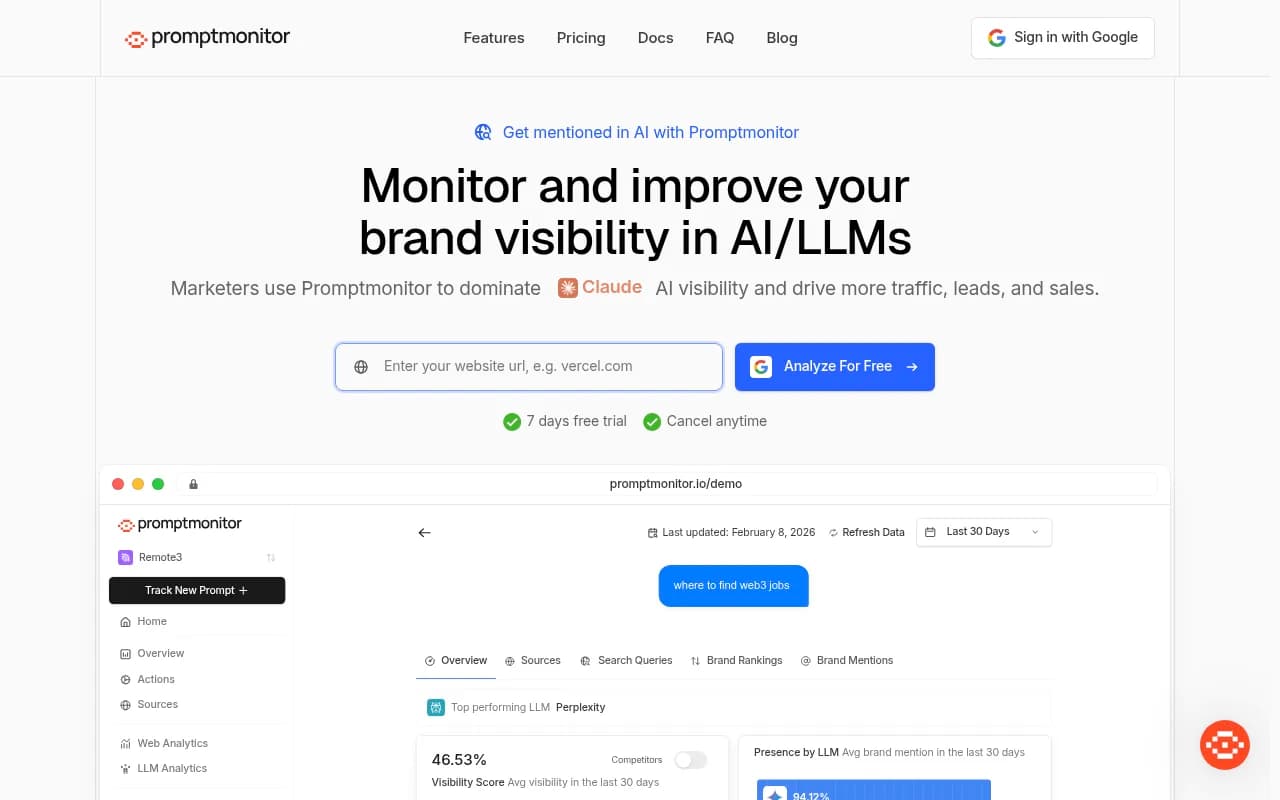
Promptmonitor is an AI visibility tracking tool that monitors how often ChatGPT, Claude, Gemini, and Perplexity mention your brand. You set up prompts (questions your customers might ask AI), and Promptmonitor tracks whether your brand appears in the responses, which sources get cited, and how your visibility changes over time. It offers dashboards showing presence by LLM, visibility scores, and competitor comparisons.
Pricing: 7-day free trial, then $29/mo (Starter), $39/mo (Growth), $129/mo (Pro), with custom Agency pricing. The tool is straightforward -- it's a monitoring dashboard, not an optimization platform. It shows you the data but doesn't help you fix gaps or generate content to improve visibility. If you need deeper AI search optimization (crawler logs, content gap analysis, AI content generation), tools like Promptwatch offer more comprehensive capabilities.

Side-by-Side Comparison
| Feature | Airtop | Promptmonitor |
|---|---|---|
| Primary purpose | Web automation / browser agents | AI visibility tracking |
| No-code agent builder | ✓ (plain English prompts) | ✗ |
| AI search tracking | ✗ | ✓ (ChatGPT, Claude, Gemini, Perplexity) |
| Web scraping / data extraction | ✓ | ✗ |
| Competitor monitoring | ✓ (LinkedIn, websites, any browser task) | ✓ (AI mentions only) |
| Workflow integrations | Slack, Gmail, Sheets, Airtable, HubSpot, Zapier, n8n, Make | Limited |
| Works behind logins | ✓ | N/A |
| AI crawler logs | ✗ | ✗ |
| Content gap analysis | ✗ | ✗ |
| AI content generation | ✗ | ✗ |
| Starting price | $26/mo | $29/mo (after 7-day trial) |
| Free trial | Not specified | 7 days |
| Target user | Operations teams, growth teams, anyone automating browser tasks | Marketing teams, SEO teams, brand managers |
Head-to-head feature breakdown
Core functionality: Automation vs monitoring
Airtop builds and runs browser automation agents. You describe a task -- "track competitors' top LinkedIn posts weekly and report engagement to Slack" -- and Airtop generates the agent, runs it on a schedule, and pushes results to your tools. It's deterministic code running in the cloud, so the agent behaves the same way every time. This is workflow automation.
Promptmonitor tracks AI search visibility. You define prompts ("best project management tools for remote teams"), and Promptmonitor checks whether ChatGPT, Claude, Gemini, and Perplexity mention your brand when answering those prompts. It shows you visibility scores, which LLMs mention you most, and which sources they cite. This is monitoring, not automation.
These are fundamentally different capabilities. Airtop can't tell you if ChatGPT recommends your brand. Promptmonitor can't automate lead extraction from LinkedIn.
Verdict: No winner here -- they do different things. Pick based on your actual need.
Use case fit
Airtop excels at:
- Lead sourcing (extract LinkedIn profiles, save to CRM)
- Competitive intelligence (monitor competitors' content, pricing, product changes)
- Data extraction from websites without APIs
- Automating repetitive browser tasks (invoice reconciliation, form filling, report generation)
- Extending Zapier/n8n/Make workflows with full browser automation
Promptmonitor excels at:
- Tracking brand mentions in AI search engines
- Monitoring how often ChatGPT, Claude, Gemini, Perplexity recommend your brand
- Seeing which sources AI models cite when mentioning you
- Comparing your AI visibility vs competitors
If you're a growth team trying to automate lead gen or competitive research, Airtop is the tool. If you're a marketing team trying to understand your brand's presence in AI search, Promptmonitor (or a more comprehensive platform like Promptwatch) is what you need.
Integrations and workflow automation
Airtop is built to integrate. It connects with Slack (send alerts), Gmail (send emails), Google Sheets (write data), Airtable (update records), HubSpot (sync CRM), Zapier, n8n, and Make (trigger workflows). The entire point is to plug browser automation into your existing stack.
Promptmonitor is a standalone monitoring dashboard. It doesn't emphasize third-party integrations because its job is to show you data, not automate workflows. You log in, check your visibility scores, see which prompts you're winning or losing, and export reports.
Verdict: Airtop wins on integrations. If you need automation that feeds into other tools, Airtop is designed for that.
Ease of use
Airtop's no-code builder is genuinely impressive. You type a task in plain English, and it generates the agent. The interface shows you what the agent is doing step-by-step, so you can debug or refine. Templates (Lead Sourcing, Buying Signals, Competitive Monitoring, Meeting Preparation) give you starting points. The learning curve is low if you can describe what you want to automate.
Promptmonitor is straightforward -- you set up prompts, the tool runs them daily, and you check dashboards. The UI shows visibility scores, presence by LLM, and source citations. It's easy to understand but also limited -- there's no content optimization guidance, no suggestions for what to fix, no AI content generation. You see the problem but you're on your own to solve it.
Verdict: Both are easy to use for their respective purposes. Airtop requires more setup (defining agents, connecting integrations) but the no-code builder makes it accessible. Promptmonitor is simpler but also less actionable.
AI visibility tracking depth
Airtop doesn't do AI visibility tracking at all. It's not in scope.
Promptmonitor covers the basics: tracks mentions across ChatGPT, Claude, Gemini, Perplexity; shows visibility scores and presence by LLM; identifies which sources get cited. But it's missing critical optimization features:
- No AI crawler logs (you can't see when ChatGPT or Claude crawl your site)
- No content gap analysis (no guidance on what content you're missing)
- No prompt intelligence (no volume estimates or difficulty scores)
- No AI content generation (you're on your own to create content that ranks)
- No Reddit or YouTube tracking (sources that heavily influence AI recommendations)
If you need deeper AI search optimization, Promptwatch offers all of these capabilities plus traffic attribution, competitor heatmaps, and multi-language/multi-region tracking. Promptmonitor is a monitoring-only tool; Promptwatch is an optimization platform.
Verdict: Promptmonitor handles basic AI visibility tracking. For comprehensive optimization, look at Promptwatch.
Pricing and value
| Plan | Airtop | Promptmonitor |
|---|---|---|
| Free tier | Not specified | 7-day free trial |
| Starter | $26/mo | $29/mo |
| Mid-tier | $80/mo (Professional) | $39/mo (Growth), $129/mo (Pro) |
| Enterprise | Custom pricing | Custom (Agency plan) |
Airtop is slightly cheaper at entry level ($26 vs $29). Both scale up to $80-$129/mo for pro tiers. Pricing is comparable but you're not choosing based on cost -- you're choosing based on what you need to accomplish.
Airtop's value is in time saved on manual browser tasks. If you're spending hours each week on lead research, competitor monitoring, or data extraction, $26-$80/mo pays for itself quickly.
Promptmonitor's value is in understanding your AI search presence. If you're investing in content to rank in AI search, $29-$129/mo is reasonable for visibility tracking. But if you need optimization tools (content gap analysis, AI content generation), you'll hit Promptmonitor's limits fast.
Verdict: Both are reasonably priced for their respective use cases. Airtop offers more value if you're automating workflows. Promptmonitor is fine for basic tracking but limited for optimization.
Pros and cons
Airtop
Pros:
- No-code agent builder -- describe tasks in plain English
- Works on any website, even behind logins or without APIs
- Deterministic code (agents run the same way every time)
- Strong integration ecosystem (Slack, Sheets, CRMs, Zapier, n8n, Make)
- Templates for common use cases (lead sourcing, competitive monitoring)
- Trusted by real companies (Huel, Finn, Cared.io)
Cons:
- Doesn't track AI search visibility (not its purpose)
- Requires setup and iteration to get agents working perfectly
- Pricing scales up for heavy usage (Enterprise custom pricing)
- Learning curve if you're new to automation concepts
Promptmonitor
Pros:
- Tracks AI visibility across ChatGPT, Claude, Gemini, Perplexity
- Simple dashboards showing visibility scores and presence by LLM
- Identifies which sources AI models cite
- 7-day free trial to test before committing
- Affordable entry point ($29/mo)
Cons:
- Monitoring only -- no optimization tools (no content gap analysis, no AI content generation)
- Missing AI crawler logs (can't see when AI models crawl your site)
- No prompt intelligence (no volume estimates or difficulty scores)
- No Reddit or YouTube tracking (sources that influence AI recommendations)
- Limited integrations compared to comprehensive platforms like Promptwatch
- Doesn't help you fix visibility gaps -- just shows you the data
Who should pick which tool?
Pick Airtop if you:
- Need to automate browser-based workflows (lead sourcing, competitor monitoring, data extraction)
- Want to scrape websites that don't have APIs or require logins
- Are building workflows in Zapier, n8n, or Make and need full browser automation
- Have repetitive manual tasks that involve clicking through websites
- Want to integrate automation with Slack, Sheets, CRMs, or other tools
- Don't care about AI search visibility tracking
Pick Promptmonitor if you:
- Need basic AI visibility tracking (how often ChatGPT, Claude, Gemini mention your brand)
- Want to see which sources AI models cite when recommending you
- Are comparing your AI presence vs competitors
- Have a small budget ($29-$129/mo) and just need monitoring dashboards
- Don't need optimization tools (content gap analysis, AI content generation)
Pick Promptwatch if you:
- Need comprehensive AI search optimization, not just monitoring
- Want AI crawler logs, content gap analysis, prompt intelligence, and AI content generation
- Are serious about improving your AI visibility and need actionable tools
- Want Reddit and YouTube tracking (sources that influence AI recommendations)
- Need traffic attribution to connect AI visibility to actual revenue
Pick both Airtop and Promptmonitor (or Promptwatch) if you:
- Are automating workflows AND tracking AI visibility (two separate needs)
- Want Airtop to handle competitor research automation and Promptmonitor/Promptwatch to track AI search presence
- Have budget for both tools and they serve different teams (ops/growth vs marketing/SEO)
Final verdict
Airtop and Promptmonitor aren't competitors -- they're tools for completely different jobs. Airtop automates browser-based workflows; Promptmonitor tracks AI search visibility. You're not choosing one over the other unless you've misunderstood what one of them does.
If you need web automation (lead sourcing, competitor monitoring, data extraction), Airtop is a strong no-code option with solid integrations and real customer traction. If you need AI visibility tracking, Promptmonitor covers the basics but lacks the optimization depth of platforms like Promptwatch. Most companies serious about AI search will outgrow Promptmonitor's monitoring-only approach and need tools that help them fix gaps, not just see them.
The real decision: Do you need automation, AI visibility tracking, or both? Answer that, and the tool choice is obvious.