Key Takeaways
- Completely different tools: Airtop is a web automation platform for building browser-based workflows; Gauge is an AI visibility tracker for monitoring brand mentions in ChatGPT, Claude, and other LLMs
- Airtop wins for automation: If you need to automate repetitive browser tasks like lead sourcing, data extraction, or competitive monitoring on traditional websites, Airtop is the clear choice
- Gauge wins for AI search: If your goal is tracking and improving how your brand appears in AI-generated answers, Gauge is purpose-built for that with citation analysis and content gap identification
- Pricing reflects specialization: Airtop starts cheaper ($26/mo vs $95/mo) but Gauge's higher price includes specialized AI tracking infrastructure across 7+ models
- No direct overlap: These platforms don't compete -- one automates web tasks, the other monitors AI visibility. You might use both for different parts of your marketing stack
- Integration potential: Airtop could theoretically automate data collection tasks that feed into your broader visibility strategy, while Gauge focuses specifically on the AI search channel
Overview
This comparison addresses a common point of confusion: Airtop and Gauge sound like they might overlap, but they're fundamentally different tools solving unrelated problems.
Airtop: Web automation platform
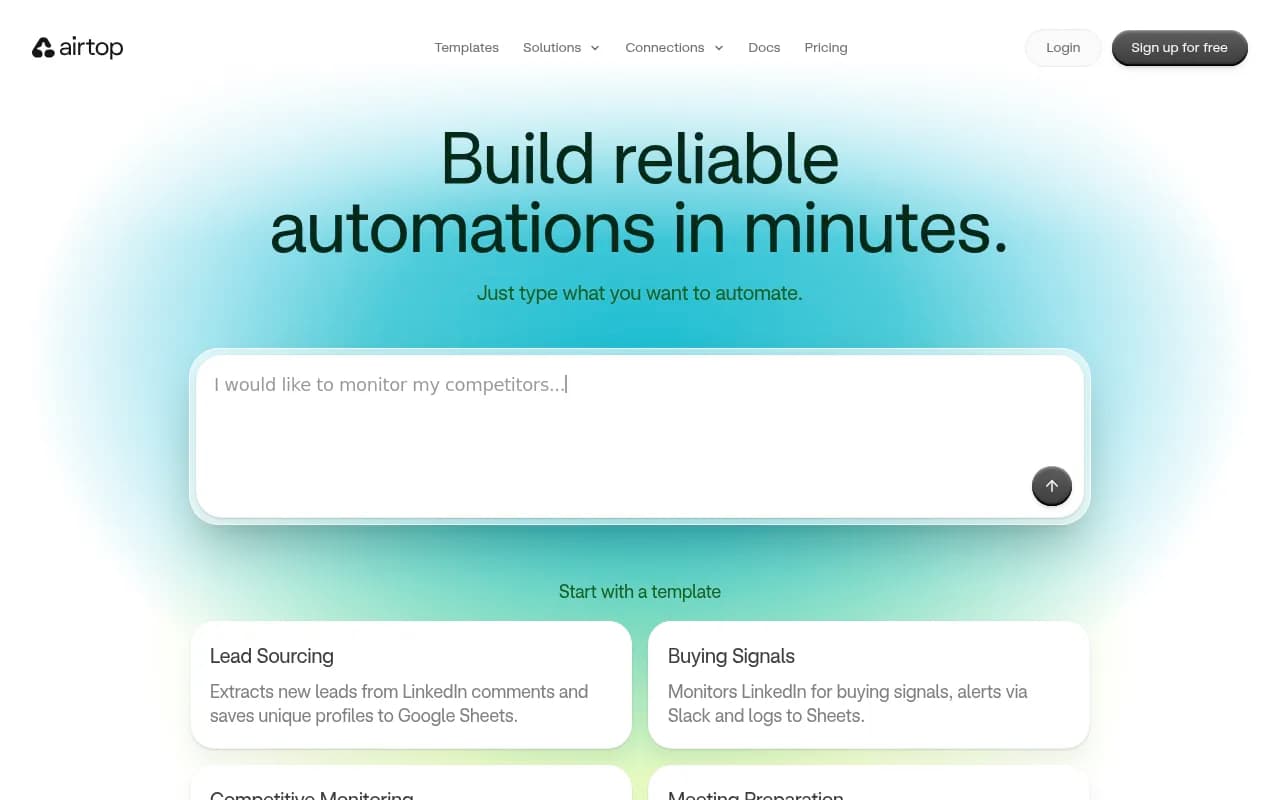
Airtop is a code-free web agent builder that automates browser-based tasks using natural language. You describe what you want to automate in plain English -- "monitor competitor LinkedIn posts weekly" or "extract new leads from LinkedIn comments" -- and Airtop generates the workflow. It works across any website, even behind logins or sites without APIs, and integrates with tools like Slack, Gmail, Google Sheets, Airtable, and HubSpot. The platform runs deterministic code in the cloud so automations execute consistently. Pricing starts at $26/mo for the Starter plan and $80/mo for Professional.
Gauge: AI visibility tracking platform
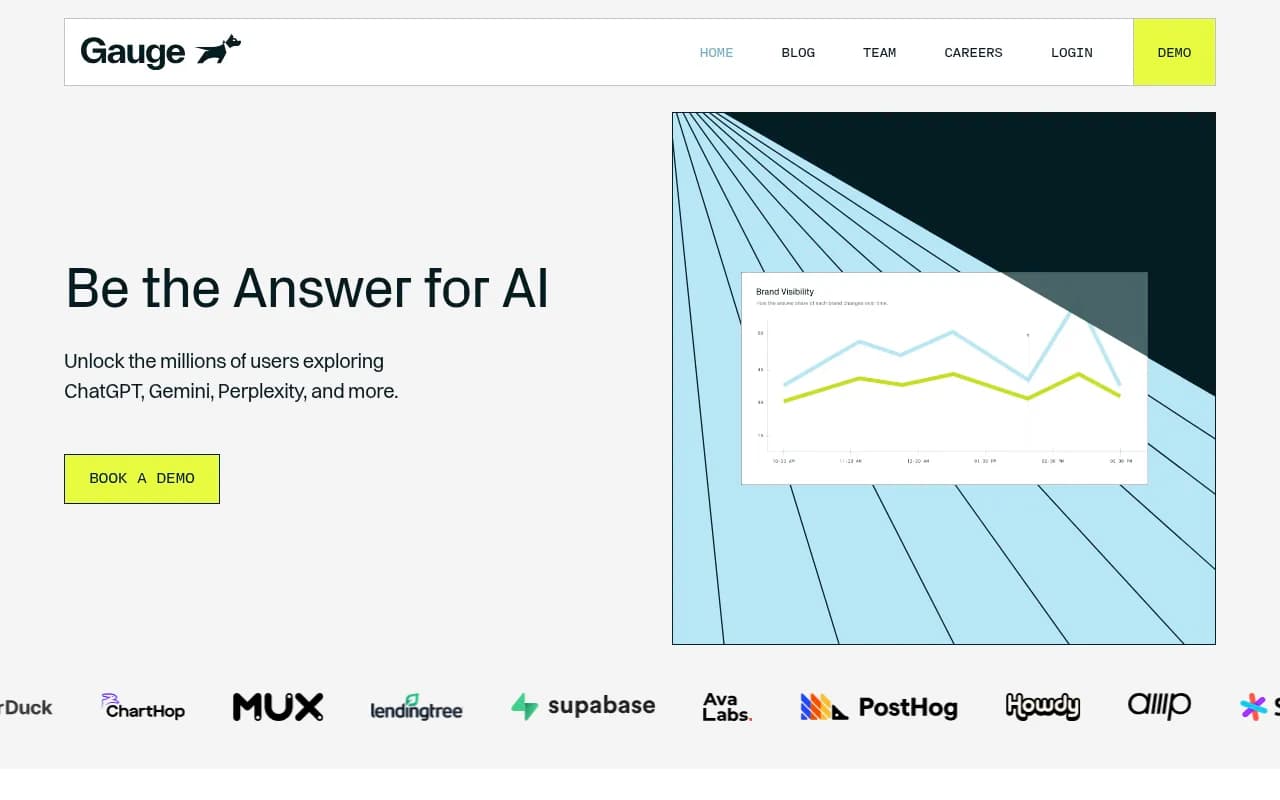
Gauge monitors how brands appear in AI-generated search results across ChatGPT, Claude, Gemini, Perplexity, Copilot, AI Mode, and AI Overviews. It tracks brand mentions, analyzes which content gets cited, identifies gaps where competitors are visible but you're not, and provides recommendations for improving AI search presence. The platform is designed for marketing teams managing brand visibility in the emerging AI search channel. Pricing starts at $95/mo with annual billing, with a Growth plan at $399/mo and custom Enterprise pricing.
Side-by-Side Comparison
| Feature | Airtop | Gauge |
|---|---|---|
| Primary purpose | Web automation and workflow building | AI visibility tracking and brand monitoring |
| AI search tracking | ❌ No | ✅ Yes (7+ AI engines) |
| Browser automation | ✅ Yes (core feature) | ❌ No |
| Starting price | $26/mo | $95/mo (annual billing) |
| Free tier | No | No |
| Code required | No (natural language) | No (dashboard interface) |
| Integrations | Slack, Gmail, Sheets, Airtable, HubSpot, Zapier, n8n, Make | Not specified |
| Citation analysis | ❌ No | ✅ Yes |
| Content gap identification | ❌ No | ✅ Yes |
| Competitive monitoring | ✅ Yes (traditional web) | ✅ Yes (AI search results) |
| Template library | ✅ Yes | Not specified |
| Target users | Operations teams, sales teams, marketers automating repetitive tasks | Marketing teams, SEO teams, brand managers |
Head-to-head feature analysis
Core functionality
Airtop and Gauge operate in completely separate domains. Airtop automates browser interactions -- clicking buttons, filling forms, extracting data from websites, monitoring pages for changes. It's a replacement for manual repetitive work. Gauge doesn't automate anything; it monitors and analyzes how AI models like ChatGPT respond to queries about your brand or category.
If you're trying to automate lead generation from LinkedIn or reconcile invoices across web portals, Airtop is the tool. If you're trying to understand why competitors get cited in AI search results but you don't, Gauge is the tool.
Verdict: No overlap. Choose based on whether you need automation (Airtop) or AI visibility tracking (Gauge).
AI search visibility
Gauge is purpose-built for this. It monitors ChatGPT, Claude, Gemini, Perplexity, Copilot, Google AI Mode, and AI Overviews. You can see which queries mention your brand, what content gets cited, how often competitors appear instead of you, and where your content is missing. The platform identifies specific gaps -- prompts where you should be visible but aren't -- and provides recommendations for closing them.
Airtop doesn't track AI search results at all. It could theoretically automate data collection from AI chatbots if you built a custom workflow, but it has no built-in AI visibility features, no citation analysis, no competitive tracking in LLMs.
Verdict: Gauge wins decisively. This is its entire reason for existing.
Web automation capabilities
Airtop excels here. The natural language interface lets you describe workflows in plain English: "Every Monday, check our top 3 competitors' LinkedIn pages, extract their most engaged posts from the past week, and send a summary to Slack." Airtop generates the automation, runs it in the cloud, and handles sites behind logins or without APIs. Templates cover lead sourcing, buying signal monitoring, meeting prep, and competitive research.
Gauge doesn't automate web tasks. It's a monitoring dashboard, not a workflow builder.
Verdict: Airtop wins. Gauge isn't competing in this category.
Competitive intelligence
Both platforms offer competitive monitoring, but for different channels:
- Airtop: Tracks competitors on traditional web properties (LinkedIn posts, website changes, pricing pages). Automates data extraction and alerts. Good for monitoring what competitors publish and how audiences engage.
- Gauge: Tracks competitors in AI search results. Shows which prompts they dominate, what content gets cited, how their visibility compares to yours across different AI models. Good for understanding the AI search landscape.
If you're monitoring competitor activity on LinkedIn or their website, use Airtop. If you're monitoring how often Claude recommends them vs you, use Gauge.
Verdict: Tie. Different competitive intelligence needs.
Integration ecosystem
Airtop integrates with Slack, Gmail, Google Sheets, Airtable, HubSpot, and workflow platforms like Zapier, n8n, and Make. Automations can push data to these tools or trigger based on events in them. This makes Airtop a connective layer in your marketing stack.
Gauge's integration details aren't specified in available materials. The platform appears focused on its own dashboard for tracking and analysis rather than pushing data to external tools.
Verdict: Airtop wins on integrations. More connectors and explicit support for workflow platforms.
Ease of use
Airtop's natural language interface is remarkably accessible. You type what you want, and it builds the automation. No coding, no flowchart builders. The trade-off: you're trusting the AI to interpret your intent correctly, and complex workflows might require iteration.
Gauge provides a dashboard interface for tracking AI visibility. You set up monitoring for your brand and queries, then review reports on mentions, citations, and gaps. Straightforward for anyone familiar with analytics dashboards.
Verdict: Both are accessible to non-technical users. Airtop's natural language feels more magical; Gauge's dashboard is more conventional.
Pricing structure
| Plan | Airtop | Gauge |
|---|---|---|
| Entry tier | $26/mo (Starter) | $95/mo (annual billing) |
| Mid tier | $80/mo (Professional) | $399/mo (Growth) |
| Enterprise | Custom pricing | Custom pricing |
| Free trial | Not specified | Not specified |
Airtop is cheaper at entry and mid tiers. Gauge's higher pricing reflects the specialized infrastructure required to monitor multiple AI models continuously and analyze citation patterns.
Verdict: Airtop is more affordable, but you're paying for different capabilities.
Use case fit
Airtop is better for:
- Automating lead generation from LinkedIn or other platforms
- Monitoring competitor activity on traditional websites
- Extracting data from sites without APIs
- Automating invoice reconciliation or data entry tasks
- Building workflows that connect multiple web tools
- Sales and operations teams reducing manual browser work
Gauge is better for:
- Tracking brand mentions in ChatGPT, Claude, Gemini, Perplexity
- Understanding why competitors rank in AI search but you don't
- Identifying content gaps that hurt AI visibility
- Monitoring citation patterns across AI models
- Optimizing content strategy for AI search
- Marketing and SEO teams focused on emerging AI channels
Pricing comparison
| Plan | Airtop | Gauge |
|---|---|---|
| Starter/Entry | $26/mo | $95/mo (annual) |
| Professional/Growth | $80/mo | $399/mo |
| Enterprise | Custom | Custom |
| Billing | Monthly | Annual (entry tier) |
| Free tier | No | No |
Airtop's lower price point makes sense for a web automation tool competing with platforms like Zapier or Phantombuster. Gauge's pricing reflects the specialized nature of AI visibility tracking -- a newer, more niche category with higher infrastructure costs (continuously querying multiple LLMs, analyzing citations, tracking changes over time).
Neither platform offers a free tier, though both may offer trials (not confirmed in available materials).
Pros and cons
Airtop pros
- Natural language interface makes automation accessible to non-coders
- Works on any website, even behind logins or without APIs
- Template library covers common use cases (lead sourcing, competitive monitoring)
- Integrates with popular tools (Slack, Sheets, HubSpot, Zapier)
- Lower starting price ($26/mo)
- Runs in the cloud with deterministic execution
Airtop cons
- Doesn't track AI search visibility at all
- No citation analysis or content gap identification
- Relies on AI interpretation of natural language instructions (potential for misunderstanding)
- Limited information on error handling or workflow debugging
- Not designed for AI-specific marketing tasks
Gauge pros
- Purpose-built for AI visibility tracking across 7+ models
- Citation analysis shows exactly what content gets referenced
- Content gap identification reveals where competitors win
- Provides actionable recommendations for improving AI presence
- Covers the full AI search landscape (ChatGPT, Claude, Gemini, Perplexity, etc.)
Gauge cons
- Higher starting price ($95/mo vs $26/mo)
- Doesn't automate web tasks or workflows
- Limited integration details available
- Focused on a single use case (AI visibility)
- Newer category means less established best practices
Who should pick which tool
Choose Airtop if:
- You need to automate repetitive browser-based tasks
- Your team spends hours manually extracting data from websites
- You want to monitor competitor activity on LinkedIn, pricing pages, or other traditional web properties
- You're building workflows that connect web tools without APIs
- Your primary goal is operational efficiency, not AI search visibility
- You want a lower-cost automation solution
Choose Gauge if:
- Your brand needs to be visible in AI-generated search results
- You're seeing competitors mentioned in ChatGPT or Claude but not your brand
- You want to understand what content AI models cite and why
- Your marketing strategy includes optimizing for AI search engines
- You need to track brand mentions across multiple LLMs
- You're willing to invest in a specialized AI visibility platform
Use both if:
- You need web automation AND AI visibility tracking
- Your marketing stack includes both operational efficiency (Airtop) and emerging channel monitoring (Gauge)
- You're automating competitive research on traditional web (Airtop) while tracking AI search presence (Gauge)
For teams specifically focused on AI search optimization, it's worth noting that Promptwatch offers a more comprehensive approach to AI visibility -- combining tracking with content gap analysis, AI-powered content generation, and crawler log monitoring to close the loop from insight to action. [tool:promptwatch]
Final verdict
Airtop and Gauge aren't competitors. They solve unrelated problems for different parts of your marketing and operations stack.
Pick Airtop if you're automating browser-based workflows -- lead generation, data extraction, competitive monitoring on traditional websites. It's a powerful, accessible automation platform with a natural language interface and broad integration support.
Pick Gauge if you're tracking and optimizing brand visibility in AI search results. It's a specialized monitoring platform for the emerging AI search channel, with citation analysis and content gap identification.
The comparison only makes sense if you're deciding where to allocate budget across different marketing needs. Most teams will find these tools complementary rather than competing -- one handles operational automation, the other handles AI visibility strategy.