Key Takeaways
- Airtop and Ceyo solve completely different problems: Airtop is a web automation platform that builds browser agents to scrape data, monitor competitors, and automate workflows. Ceyo is an AI visibility tracker that monitors how your brand appears in ChatGPT, Gemini, Claude, and Perplexity responses.
- Airtop is cheaper upfront ($26/mo vs $49/mo), but pricing models are incomparable -- Airtop charges per automation run, Ceyo charges per brand and prompt volume.
- Ceyo is the only tool here that tracks AI search visibility. Despite Airtop's tagline mentioning "SEO visibility", the platform doesn't monitor LLM responses or brand mentions in AI search.
- Airtop is code-free and built for non-technical users to automate browser tasks. Ceyo is analytics-focused, built for marketers and SEO teams tracking brand performance in AI engines.
- If you need both capabilities -- AI visibility tracking and web automation -- you'd use them together, not choose one over the other.
- For AI search optimization specifically, Ceyo gives you the data but doesn't help you act on it. Tools like Promptwatch go further by showing content gaps and generating optimized articles to improve your AI visibility.
Overview: Two tools, two completely different jobs
Airtop: Web automation with browser agents
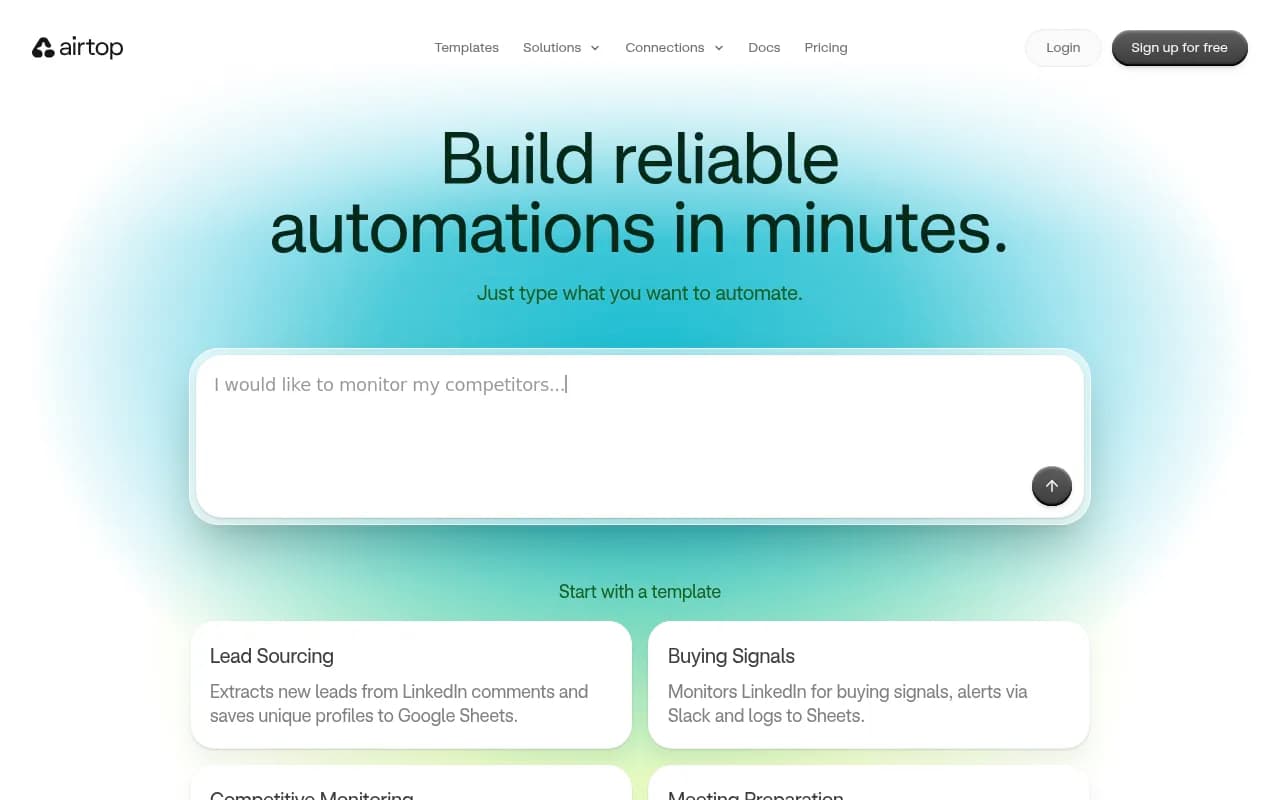
Airtop is a no-code platform for building web automations. You describe a task in plain English -- "monitor competitor LinkedIn posts weekly" or "extract new leads from comments and save to Google Sheets" -- and Airtop generates a browser agent that executes it. The platform runs these agents in the cloud, handling logins, CAPTCHAs, and dynamic content. It integrates with Slack, Gmail, Google Sheets, Airtable, HubSpot, and other tools to push data or trigger actions. Airtop is built for operations teams, agencies, and anyone automating repetitive browser tasks that don't have APIs.
Ceyo: AI search visibility monitoring
Ceyo
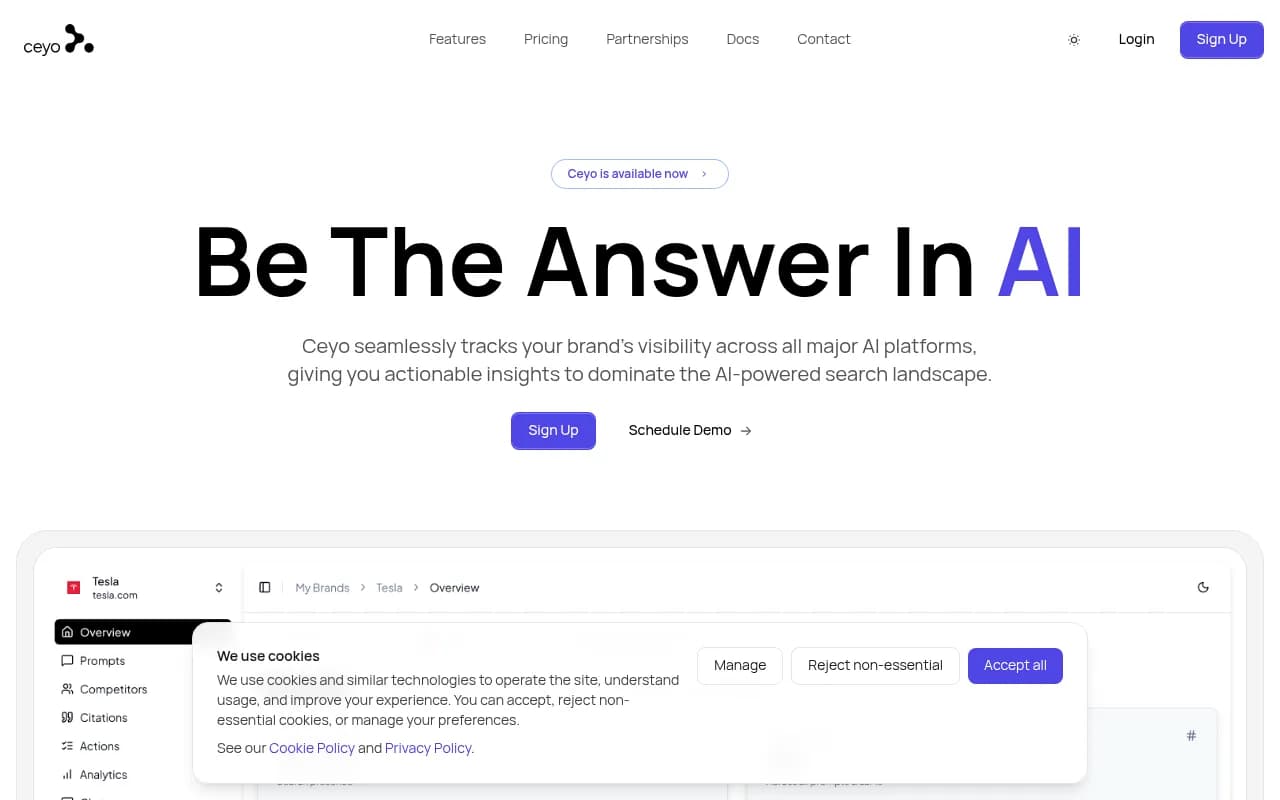
Ceyo tracks how your brand shows up in responses from ChatGPT, Gemini, Claude, and Perplexity. It monitors thousands of prompts daily, measuring visibility percentage, sentiment, average position, and competitive context. You see which queries mention your brand, which competitors appear instead, and how sentiment shifts over time. Ceyo is built for SEO teams, agencies, and brand managers who need to understand and improve their presence in AI-powered search. It doesn't automate workflows or generate content -- it's purely monitoring and analytics.
Side-by-Side Comparison
| Feature | Airtop | Ceyo |
|---|---|---|
| Primary use case | Web automation, browser agents | AI search visibility tracking |
| Starting price | $26/mo (Starter) | $49/mo (Core, 1 brand) |
| Code required | No -- plain English prompts | No -- analytics dashboard |
| AI models tracked | None | ChatGPT, Gemini, Claude, Perplexity |
| Web scraping | Yes -- any website, even behind logins | No |
| Brand mention tracking | No | Yes -- sentiment, position, context |
| Integrations | Slack, Gmail, Sheets, Airtable, HubSpot, Zapier, n8n, Make | Not applicable (monitoring only) |
| Competitor analysis | Manual setup via agents | Built-in -- see who appears in your prompts |
| Content gap analysis | No | No |
| Automation workflows | Core feature | Not available |
| Daily updates | On-demand or scheduled runs | Yes -- prompt monitoring |
| Multi-language support | Depends on target website | Yes -- track prompts in any language |
| API access | Yes | Not mentioned |
| Free trial | Not specified | Not specified |
| Target audience | Operations teams, agencies, non-technical users | SEO teams, agencies, brand managers |
Head-to-head feature breakdown
Core functionality: Automation vs monitoring
Airtop builds browser agents that perform actions -- clicking buttons, filling forms, extracting data, navigating multi-step workflows. You describe the task ("scrape product prices from competitor sites daily"), and Airtop generates deterministic code that runs in a cloud browser. The agents handle logins, CAPTCHAs, and dynamic content. They can trigger on schedules or via webhooks, push results to Slack or Sheets, and chain together with Zapier or n8n workflows.
Ceyo doesn't automate anything. It monitors AI search engines by running thousands of prompts daily and analyzing the responses. You see visibility scores (what percentage of prompts mention your brand), sentiment (positive/neutral/negative), average position (where you rank when mentioned), and competitive context (which other brands appear). The platform surfaces trends over time and flags prompts where competitors dominate.
Verdict: These tools don't compete. Airtop is for doing things automatically. Ceyo is for understanding what AI engines say about you.
Pricing structure
| Plan | Airtop | Ceyo |
|---|---|---|
| Entry tier | $26/mo (Starter) | $49/mo (Core, 1 brand) |
| Mid tier | $80/mo (Professional) | $89-199/mo (Pro plans) |
| Enterprise | Custom pricing | Custom pricing |
| What you get | Browser sessions, automation runs, integrations | Brands tracked, prompt volume, LLM coverage |
Airtop charges based on usage -- how many browser sessions you run, how long they last, and how many automations you execute. The Starter plan includes limited runs and sessions. Professional adds more capacity and advanced features. Enterprise is custom.
Ceyo charges per brand tracked and prompt volume. The Core plan ($49/mo) covers one brand with a set number of prompts monitored daily. Pro plans ($89-199/mo) add more brands, higher prompt volumes, and deeper analytics. Enterprise pricing is custom for agencies managing multiple clients.
Verdict: Airtop is cheaper to start, but costs scale with automation usage. Ceyo's pricing is predictable if you know how many brands you're tracking. Neither is expensive for what it does.
AI search visibility tracking
Airtop's tagline mentions "SEO visibility and AI search tracking", but the platform doesn't actually monitor LLM responses. The website focuses entirely on web automation -- building agents, scraping data, integrating with tools. There's no mention of tracking ChatGPT, Claude, or Perplexity. The tagline is misleading.
Ceyo is purpose-built for this. It tracks ChatGPT, Gemini, Claude, and Perplexity, running thousands of prompts daily across categories relevant to your brand. You see:
- Visibility percentage (how often you're mentioned)
- Sentiment analysis (positive/neutral/negative tone)
- Average position (where you rank when mentioned)
- Competitive context (which brands appear alongside or instead of you)
- Prompt-level detail (exact queries, full LLM responses, citation sources)
Ceyo updates daily and surfaces trends over time. You can filter by geography, category, and LLM model.
Verdict: Ceyo wins by default. Airtop doesn't do AI search tracking despite the tagline. If you need to monitor brand visibility in LLM responses, Ceyo is built for it. For a more action-oriented approach that goes beyond monitoring to help you fix visibility gaps, Promptwatch combines tracking with content gap analysis and AI-powered content generation.

Web automation and scraping
Airtop excels here. You can automate:
- Lead sourcing (scrape LinkedIn profiles, save to Sheets)
- Competitive monitoring (track competitor posts, log engagement metrics)
- Buying signal detection (monitor LinkedIn for intent signals, alert via Slack)
- Meeting prep (research attendees, email personalized notes)
- Invoice reconciliation (extract data from portals without APIs)
- Any repetitive browser task
The platform handles authentication, CAPTCHAs, and dynamic content. Agents run in the cloud, so you're not tying up your local machine. Integrations with Slack, Gmail, Sheets, Airtable, and HubSpot mean data flows directly into your existing tools. You can extend Zapier, n8n, or Make workflows with full browser automation.
Ceyo doesn't scrape or automate. It's a read-only monitoring platform.
Verdict: Airtop is the only option if you need web automation. Ceyo doesn't compete here.
Competitor analysis
Airtop can monitor competitors manually -- you'd build an agent to scrape their LinkedIn posts, track their website changes, or extract their pricing. But you're building the logic yourself. There's no built-in competitor benchmarking or analysis.
Ceyo includes competitor context automatically. When it runs prompts, it shows which other brands appear in the same responses. You see:
- Which competitors dominate prompts where you're missing
- How your visibility compares to theirs over time
- Sentiment differences (are they mentioned more positively?)
- Position differences (do they rank higher when both appear?)
This is passive analysis -- Ceyo doesn't tell you why competitors win or how to beat them. It just shows the data.
Verdict: Ceyo gives you competitor context out of the box for AI search. Airtop requires manual setup for any competitor tracking.
Integrations and workflow automation
Airtop integrates deeply with:
- Slack (send alerts, post updates)
- Gmail (send emails with extracted data)
- Google Sheets (write rows, read data)
- Airtable (sync records)
- HubSpot (update contacts, log activities)
- Zapier, n8n, Make (trigger automations, pass data)
You can chain Airtop agents into multi-step workflows. For example: scrape competitor pricing → compare to your pricing in Sheets → send Slack alert if they undercut you → update HubSpot deal notes.
Ceyo doesn't integrate with external tools. It's a standalone dashboard. You can export data manually, but there's no API mentioned and no workflow automation.
Verdict: Airtop is built for integration. Ceyo is a closed analytics platform.
Ease of use
Airtop is no-code. You type what you want in plain English: "Monitor my competitors' top LinkedIn posts weekly and report engagement metrics to Slack." Airtop generates the agent, you review the steps, and you run it. The interface shows templates for common tasks (lead sourcing, buying signals, meeting prep). Non-technical users can build automations without writing code.
Ceyo is a dashboard. You add brands to track, select prompt categories, and view analytics. There's no setup complexity -- you're just reading data. The interface shows tables of prompts with visibility scores, sentiment, and competitive context. Filtering by LLM, geography, or category is straightforward.
Verdict: Both are easy to use. Airtop requires more upfront thinking (what do you want to automate?), but the builder is intuitive. Ceyo is simpler -- just monitor and analyze.
Reporting and analytics
Airtop doesn't have built-in analytics. It executes tasks and pushes results to your tools (Sheets, Slack, etc.). You'd build your own reporting by aggregating data in Sheets or a BI tool.
Ceyo is analytics-first. The dashboard shows:
- Visibility trends over time (line charts)
- Sentiment distribution (positive/neutral/negative percentages)
- Prompt-level detail (tables with visibility, position, brands mentioned)
- Competitive heatmaps (who appears most often across prompts)
- Geographic and category breakdowns
You can export data, but there's no API mentioned for custom reporting.
Verdict: Ceyo has richer analytics for its specific use case (AI search visibility). Airtop leaves reporting to you.
Support and documentation
Airtop's website shows customer testimonials and case studies (Cared.io using it for invoice reconciliation). Documentation isn't linked publicly, but the platform includes templates and examples. Support details aren't specified.
Ceyo's website mentions partnerships with agencies (BrandFirm, Zigt, Enreach). No public documentation or support details are visible.
Verdict: Both lack transparency on support. Airtop has more public case studies.
Pricing comparison
| Plan | Airtop | Ceyo |
|---|---|---|
| Starter/Core | $26/mo | $49/mo (1 brand) |
| Professional/Pro | $80/mo | $89-199/mo (multiple brands) |
| Enterprise | Custom | Custom |
| Free trial | Not specified | Not specified |
| Annual discount | Not mentioned | Not mentioned |
Airtop's pricing is usage-based. You pay for browser sessions and automation runs. Light users (a few automations per week) stay cheap. Heavy users (hundreds of runs daily) hit higher tiers or custom pricing.
Ceyo's pricing is brand-based. One brand at $49/mo is affordable for small businesses. Agencies tracking 5-10 client brands would pay $89-199/mo or move to Enterprise.
Neither tool offers a free tier. Both have custom Enterprise pricing for larger deployments.
Pros and cons
Airtop pros
- No-code automation builder -- type in plain English
- Works on any website, even behind logins or without APIs
- Integrates with Slack, Gmail, Sheets, Airtable, HubSpot, Zapier, n8n, Make
- Deterministic cloud execution -- agents run the same way every time
- Templates for common tasks (lead sourcing, competitive monitoring, meeting prep)
- Extends existing automation tools with full browser capabilities
Airtop cons
- Doesn't actually track AI search visibility despite the tagline
- No built-in analytics or reporting -- you export to other tools
- Pricing scales with usage, which can get expensive for heavy automation
- No competitor analysis features -- you build everything manually
- Limited public documentation or support details
Ceyo pros
- Purpose-built for AI search visibility tracking across ChatGPT, Gemini, Claude, Perplexity
- Daily updates with thousands of prompts monitored
- Competitive context built-in -- see who else appears in your prompts
- Sentiment analysis and position tracking
- Multi-language and multi-geography support
- Predictable pricing based on brands tracked
Ceyo cons
- Monitoring only -- no content generation or optimization features
- No integrations with external tools (Slack, Sheets, etc.)
- No API mentioned for custom reporting
- Doesn't help you act on the data -- just shows you the gaps
- Limited public information on support or documentation
Who should pick which tool
Pick Airtop if you:
- Need to automate repetitive browser tasks (scraping, monitoring, data entry)
- Work with websites that don't have APIs or require logins
- Want to integrate browser automation into Zapier, n8n, or Make workflows
- Manage operations or workflows that involve manual clicking and copying
- Need to extract data from multiple sources and sync it to Sheets, Airtable, or a CRM
- Are comfortable describing tasks in plain English but don't want to write code
Pick Ceyo if you:
- Need to track how your brand appears in ChatGPT, Gemini, Claude, or Perplexity responses
- Manage SEO or content strategy and want to understand AI search visibility
- Track multiple brands (agency use case) and need competitive benchmarking
- Want daily updates on prompt performance, sentiment, and position
- Care about geographic or category-specific AI search trends
- Need a dashboard to report AI visibility metrics to stakeholders
Use both if you:
- Track AI search visibility with Ceyo and automate competitor research or content workflows with Airtop
- Run an agency managing both AI visibility and operational automation for clients
- Need to scrape data (Airtop) to feed into AI visibility analysis (Ceyo)
Consider alternatives if you:
- Want AI visibility tracking plus content optimization and generation -- Promptwatch goes beyond monitoring to show content gaps and help you create articles that rank in AI search
- Need traditional SEO tools with some AI search features -- Semrush or Ahrefs have limited AI tracking but stronger traditional SEO capabilities
- Want pure web scraping without automation -- tools like Apify or Bright Data focus on data extraction at scale
Final verdict
Airtop and Ceyo don't compete. Airtop automates browser tasks. Ceyo monitors AI search visibility. The comparison only makes sense if you're deciding which problem to solve first -- or if you're evaluating both for different parts of your workflow.
If you need web automation, Airtop is a strong no-code option. If you need to track brand visibility in LLM responses, Ceyo does that job. If you need both, you'd use them together.
One note: Ceyo shows you the data but doesn't help you act on it. You see where you're missing, but you're on your own to fix it. For a more complete solution that combines tracking with content gap analysis and AI-powered content generation, Promptwatch is worth a look -- it closes the loop from visibility monitoring to optimization.
Bottom line: Pick Airtop for automation, Ceyo for AI search monitoring, or use both if your workflow needs both capabilities.