Key Takeaways
- Completely different tools: Airtop builds browser automation agents for repetitive web tasks (lead sourcing, data extraction, form filling). Bear AI tracks brand visibility in AI search engines like ChatGPT and Claude, then converts that traffic into leads.
- Pricing gap: Airtop starts at $26/mo, Bear AI at $199/mo -- but they solve unrelated problems. Airtop's pricing reflects automation usage; Bear AI's reflects prompt tracking volume and AI model coverage.
- Use case split: Pick Airtop if you need to automate workflows across websites (scraping, monitoring, syncing data). Pick Bear AI if you want to understand and optimize how AI models recommend your brand.
- No overlap: Airtop doesn't track AI search visibility. Bear AI doesn't automate browser tasks. You could use both if you need workflow automation AND AI search tracking.
- Integration approach: Airtop connects with Zapier, n8n, Make, Slack, Gmail, Sheets. Bear AI integrates with Google Search Console and offers lead identification for AI-driven traffic.
Overview
Airtop: Web automation with AI agents
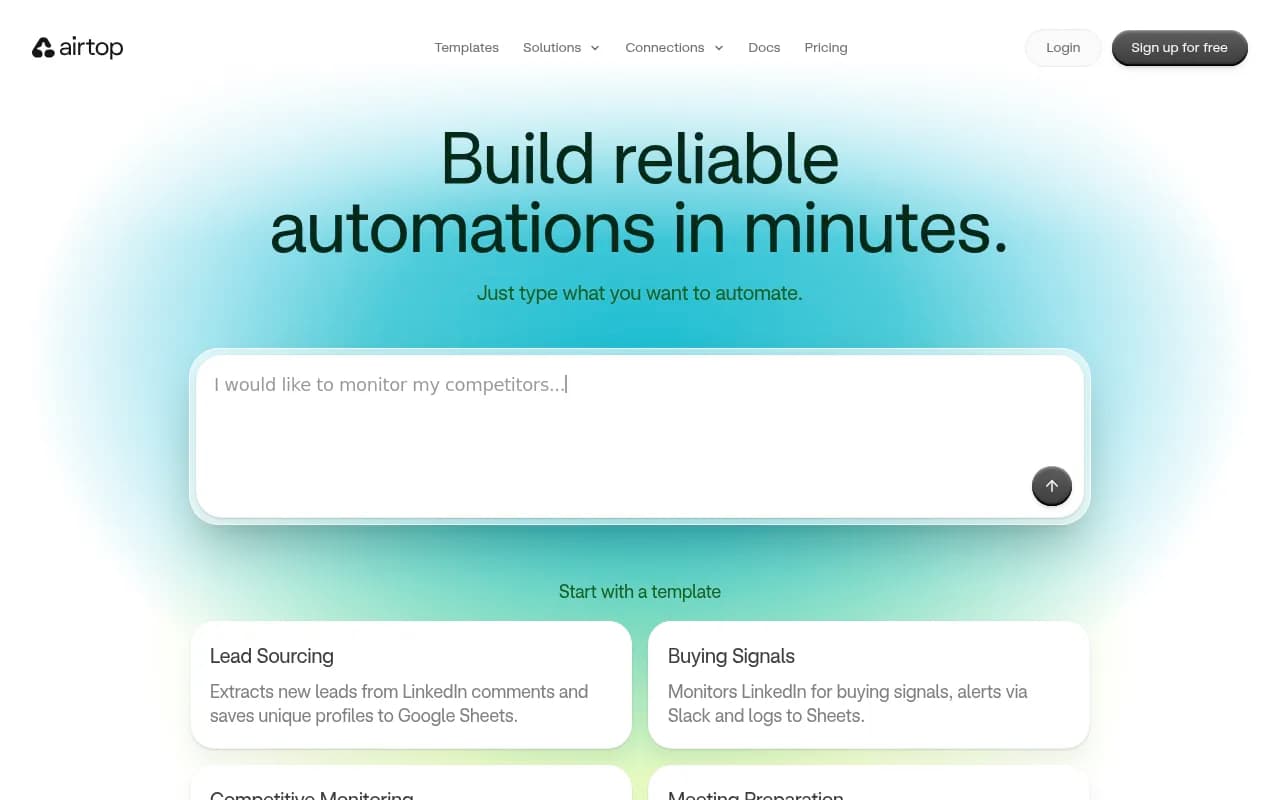
Airtop is a code-free web automation platform that lets you build browser agents using plain English. You describe a task -- "monitor competitor LinkedIn posts weekly" or "extract new leads from LinkedIn comments" -- and Airtop generates a deterministic automation that runs in the cloud. It works across any website, even behind logins or without APIs. The platform integrates with tools like Slack, Gmail, Google Sheets, Airtable, and HubSpot, and extends workflow automation platforms like Zapier and n8n. Pricing starts at $26/mo for the Starter plan, with Professional at $80/mo and custom Enterprise pricing.
Airtop is built for teams that need reliable, repeatable browser automations: sales teams sourcing leads, ops teams reconciling invoices, marketing teams monitoring competitors. It's not an AI search visibility tool -- it's a workflow automation engine.
Bear AI: AI search visibility and lead conversion
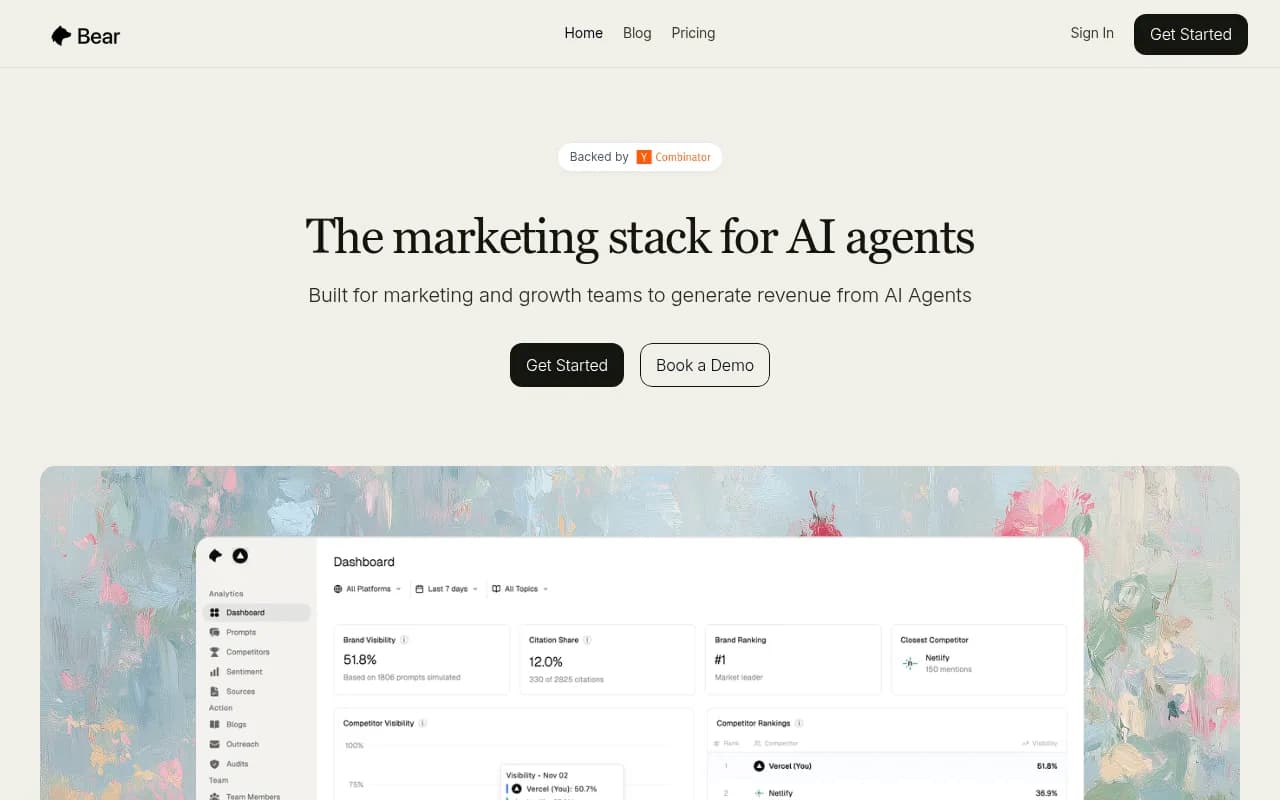
Bear AI is a marketing platform designed to generate revenue from AI agents like ChatGPT, Claude, Google AI Overviews, and Perplexity. It tracks how AI models discover and recommend your brand, identifies trending prompts, monitors competitor visibility, and surfaces high-intent visitors arriving from AI sources. The platform also generates content optimized for AI search and provides lead identification tools to convert AI-driven traffic. Pricing starts at $199/mo (Basic: 75 prompts, 2 blogs, 2 AI models) with custom Enterprise pricing for unlimited prompts and full model coverage.
Bear AI is built for marketing and growth teams that want to capitalize on the emerging AI search channel. It doesn't automate workflows or scrape websites -- it tracks and optimizes brand visibility in AI model responses.
Side-by-Side Comparison
| Feature | Airtop | Bear AI |
|---|---|---|
| Primary use case | Web automation, browser agents | AI search visibility tracking |
| Starting price | $26/mo (Starter) | $199/mo (Basic) |
| Free tier | No | No |
| Core capability | Automate tasks across any website | Track brand mentions in AI models |
| AI models tracked | N/A (not a tracking tool) | ChatGPT, Claude, Gemini, Perplexity, Google AI Overviews |
| Content generation | No | Yes (AI-optimized blogs) |
| Lead identification | No | Yes (high-intent AI visitors) |
| Workflow integrations | Zapier, n8n, Make, Slack, Gmail, Sheets, Airtable, HubSpot | Google Search Console |
| Browser automation | Yes (core feature) | No |
| Prompt tracking | No | Yes (75-unlimited depending on plan) |
| Competitor monitoring | Yes (via custom automations) | Yes (AI visibility comparison) |
| API access | Yes | Not specified |
| Target audience | Sales, ops, marketing teams needing automation | Marketing, growth teams optimizing AI search |
Head-to-head feature deep-dive
Core functionality
Airtop and Bear AI operate in entirely different domains. Airtop is a browser automation platform. You build agents that perform repetitive web tasks: scraping data from LinkedIn, filling out forms, monitoring competitor websites, syncing information to spreadsheets. The agents run deterministic code in the cloud, so they execute the same way every time. You describe what you want in plain English, and Airtop generates the automation.
Bear AI is an AI search visibility platform. It tracks how AI models like ChatGPT and Claude discover and recommend your brand. You see which prompts trigger mentions of your company, how your visibility compares to competitors, and which pages AI models cite. The platform identifies high-intent visitors arriving from AI sources and generates content optimized to improve your AI search rankings.
There's zero functional overlap. Airtop doesn't track AI search visibility. Bear AI doesn't automate browser tasks.
Verdict: Not comparable -- they solve unrelated problems. Pick based on whether you need workflow automation (Airtop) or AI search optimization (Bear AI).
Pricing structure
| Plan | Airtop | Bear AI |
|---|---|---|
| Entry tier | $26/mo (Starter) | $199/mo (Basic: 75 prompts, 2 blogs, 2 AI models) |
| Mid tier | $80/mo (Professional) | Not specified (likely custom) |
| Enterprise | Custom pricing | Custom (unlimited prompts, 6+ models, lead gen) |
Airtop's pricing reflects automation usage -- how many agents you run, how much compute time they consume. Bear AI's pricing reflects tracking volume: number of prompts monitored, number of AI models covered, content generation limits. The $26 vs $199 starting price difference is meaningless because the tools do completely different things.
Airtop is cheaper at entry level, but if you need AI search visibility tracking, Airtop can't do it at any price. If you need browser automation, Bear AI can't help.
Verdict: Pricing isn't comparable. Airtop is cheaper for automation; Bear AI is the only option for AI search tracking.
Integrations and workflow connections
Airtop integrates deeply with workflow automation platforms: Zapier, n8n, Make. It also connects directly to Slack, Gmail, Google Sheets, Airtable, and HubSpot. You can build an automation that scrapes LinkedIn, pushes data to Sheets, and sends a Slack notification -- all without code. The integrations are designed to fit into existing ops and marketing workflows.
Bear AI integrates with Google Search Console to correlate traditional SEO performance with AI search visibility. It doesn't offer the same breadth of workflow integrations because it's not a workflow tool. The focus is on tracking AI model behavior and converting AI-driven traffic, not automating tasks across multiple apps.
Verdict: Airtop wins for workflow integrations. Bear AI's integrations are narrower because its purpose is different.
Content generation
Airtop doesn't generate content. It automates browser tasks. If you want to scrape content from websites and push it somewhere, Airtop can do that. But it's not creating blog posts or optimizing text for search engines.
Bear AI includes AI-optimized content generation. The Basic plan includes 2 blogs per month; higher tiers offer more. The content is designed to improve visibility in AI search results -- targeting prompts where your brand is underrepresented, using language and structure that AI models favor when generating responses.
Verdict: Bear AI is the only option if you need content generation for AI search optimization.
Lead identification and conversion
Airtop can automate lead sourcing -- extracting contact info from LinkedIn, monitoring competitor activity, syncing leads to your CRM. But it doesn't identify which visitors came from AI sources or provide intent signals based on AI search behavior.
Bear AI's Enterprise plan includes lead identification: it surfaces high-intent visitors who arrived via AI agents, showing you which prompts they used and what they're looking for. This is designed to help sales and marketing teams prioritize outreach based on AI-driven buying signals.
Verdict: Bear AI offers AI-specific lead intelligence. Airtop offers lead sourcing automation. Different capabilities.
Monitoring and tracking
Airtop monitors websites and automates responses. You can build an agent that checks a competitor's LinkedIn page weekly and reports engagement metrics to Slack. Or one that monitors invoice systems and flags discrepancies. The monitoring is task-specific and action-oriented -- you're automating a workflow, not analyzing aggregate data.
Bear AI monitors AI model behavior across ChatGPT, Claude, Gemini, Perplexity, and Google AI Overviews. You see trending prompts, citation frequency, competitor visibility, and how your brand's AI search presence changes over time. The monitoring is analytical -- you're tracking visibility trends to inform content and SEO strategy.
Verdict: Airtop monitors websites for automation triggers. Bear AI monitors AI models for visibility insights. Not comparable.
Ease of use and setup
Airtop's "build with words, not code" approach makes it accessible to non-technical users. You type what you want to automate in plain English, and the platform generates the agent. There's still a learning curve -- you need to understand how to structure tasks and handle edge cases -- but it's far simpler than writing Selenium scripts or Puppeteer code.
Bear AI's setup involves connecting your website, defining prompts to track, and configuring which AI models to monitor. The interface is dashboard-based, showing visibility metrics, trending prompts, and competitor comparisons. It's straightforward for marketing teams familiar with SEO or analytics tools.
Both tools are designed for non-developers, but they require different mental models. Airtop: think in terms of workflows and automations. Bear AI: think in terms of prompts and visibility.
Verdict: Both are accessible to non-technical users. Ease of use depends on whether you're more comfortable with automation logic (Airtop) or analytics dashboards (Bear AI).
API and developer access
Airtop offers API access, allowing developers to trigger automations programmatically, retrieve results, and integrate Airtop agents into custom applications. This is useful for teams that want to embed browser automation into their own products or workflows.
Bear AI's API access isn't prominently documented on their site. The platform is more focused on providing a dashboard experience for marketing teams than serving as a developer platform.
Verdict: Airtop is more developer-friendly with clear API access. Bear AI is built for marketing teams, not developers.
Pricing comparison
| Plan | Airtop | Bear AI |
|---|---|---|
| Starter / Basic | $26/mo | $199/mo (75 prompts, 2 blogs, 2 AI models) |
| Professional / Mid | $80/mo | Not specified |
| Enterprise | Custom | Custom (unlimited prompts, 6+ models, lead gen) |
| Free tier | No | No |
| Annual discount | Not specified | Not specified |
The pricing structures reflect fundamentally different value propositions. Airtop charges based on automation usage. Bear AI charges based on tracking volume and AI model coverage. You can't directly compare them because they don't compete.
Pros and cons
Airtop pros
- Code-free browser automation using plain English
- Works across any website, even behind logins or without APIs
- Integrates with Zapier, n8n, Make, Slack, Gmail, Sheets, HubSpot
- Deterministic execution -- agents run the same way every time
- Lower entry price ($26/mo)
- API access for developers
Airtop cons
- Doesn't track AI search visibility or brand mentions in AI models
- No content generation for SEO or AI optimization
- No lead identification based on AI search behavior
- Learning curve for structuring complex automations
- Pricing scales with usage, which can get expensive for heavy automation
Bear AI pros
- Tracks brand visibility across ChatGPT, Claude, Gemini, Perplexity, Google AI Overviews
- Identifies trending prompts and competitor visibility
- Generates AI-optimized content to improve search rankings
- Lead identification for high-intent AI-driven visitors (Enterprise)
- Built specifically for the emerging AI search channel
- Dashboard designed for marketing and growth teams
Bear AI cons
- Higher entry price ($199/mo)
- Doesn't automate workflows or browser tasks
- Limited workflow integrations compared to automation platforms
- Prompt tracking limits on lower tiers (75 prompts on Basic)
- No API access for developers (not documented)
- Relatively new platform -- less established than traditional SEO tools
Who should pick which tool
Pick Airtop if you:
- Need to automate repetitive browser tasks (lead sourcing, data extraction, form filling)
- Want to monitor competitor websites and sync data to your CRM or Sheets
- Use Zapier, n8n, or Make and need to extend them with full browser automation
- Have workflows that involve logging into websites, clicking through interfaces, or scraping data
- Need deterministic, reliable automations that run in the cloud without manual intervention
- Want API access to trigger automations programmatically
Pick Bear AI if you:
- Want to understand how AI models like ChatGPT and Claude discover and recommend your brand
- Need to track competitor visibility in AI search results
- Want to identify trending prompts and optimize content for AI search
- Need lead identification for high-intent visitors arriving from AI sources
- Run marketing or growth teams focused on emerging search channels
- Want AI-optimized content generation to improve visibility in LLM responses
Use both if you:
- Need workflow automation (Airtop) AND AI search visibility tracking (Bear AI)
- Want to automate lead sourcing with Airtop while tracking how AI models recommend your brand with Bear AI
- Run a marketing operation that spans traditional automation tasks and AI search optimization
If you're also looking to track how your brand shows up in AI search results with deeper optimization capabilities, Promptwatch offers content gap analysis, AI content generation grounded in citation data, and page-level tracking across 10 AI models -- complementing either tool here.

Final verdict
Airtop and Bear AI aren't competitors. Airtop automates browser tasks; Bear AI tracks AI search visibility. The comparison only makes sense if you're trying to decide which problem to solve first.
If your bottleneck is repetitive manual work -- scraping leads, monitoring competitors, syncing data across tools -- Airtop is the answer. It's cheaper, more flexible, and designed for workflow automation.
If your bottleneck is understanding how AI models discover your brand and converting that traffic into revenue, Bear AI is the answer. It's purpose-built for AI search optimization and lead identification.
You could use both. They don't overlap. One automates workflows; the other optimizes AI visibility. Pick based on which problem you need to solve today.