Key Takeaways
- Completely different tools: Airtop automates browser-based workflows (lead sourcing, data extraction, monitoring), while Nightwatch tracks SEO rankings and AI search visibility. They don't compete -- they solve different problems.
- Airtop is for automation: If you need to scrape LinkedIn, monitor competitor activity, reconcile invoices, or automate repetitive browser tasks, Airtop builds agents that do it. No code required.
- Nightwatch is for visibility tracking: If you need to know where you rank in Google, Bing, ChatGPT, Perplexity, or other search engines, Nightwatch gives you daily updates, keyword research, and AI overview monitoring.
- Pricing is similar but scales differently: Both start around $24-26/mo. Airtop pricing grows with automation complexity and execution volume. Nightwatch pricing scales with keyword count and tracking frequency.
- Marketing teams might need both: Use Airtop to automate data collection and competitive research, then use Nightwatch to track how your SEO efforts translate to rankings and AI visibility.
- Integration potential: Airtop can feed data into tools like Google Sheets or Slack, which Nightwatch can then analyze for SEO insights. They complement each other in a broader marketing stack.
Overview
Airtop: Browser automation with AI agents
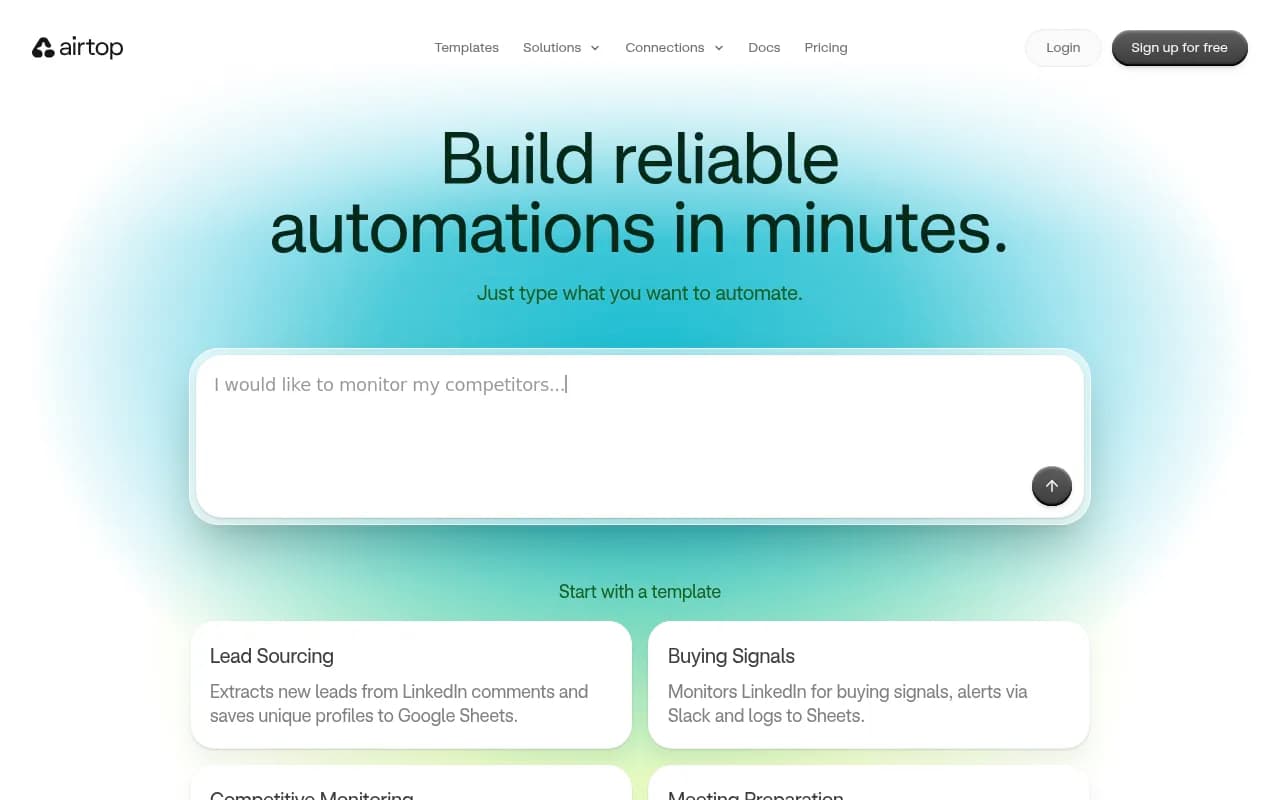
Airtop is a no-code browser automation platform that lets you build web agents using plain English. You describe what you want to automate -- "monitor competitor LinkedIn posts weekly" or "extract new leads from comments and save to Google Sheets" -- and Airtop generates the automation. It runs in the cloud, works across any website (even behind logins or without APIs), and integrates with tools like Slack, Gmail, HubSpot, and Airtable.
The platform is built for reliability. Instead of unpredictable AI agents that might do something different each time, Airtop converts your natural language instructions into deterministic code that executes consistently. Companies like Cared.io use it to automate invoice reconciliation, saving hours of manual work each week.
Nightwatch: SEO and AI search visibility tracker
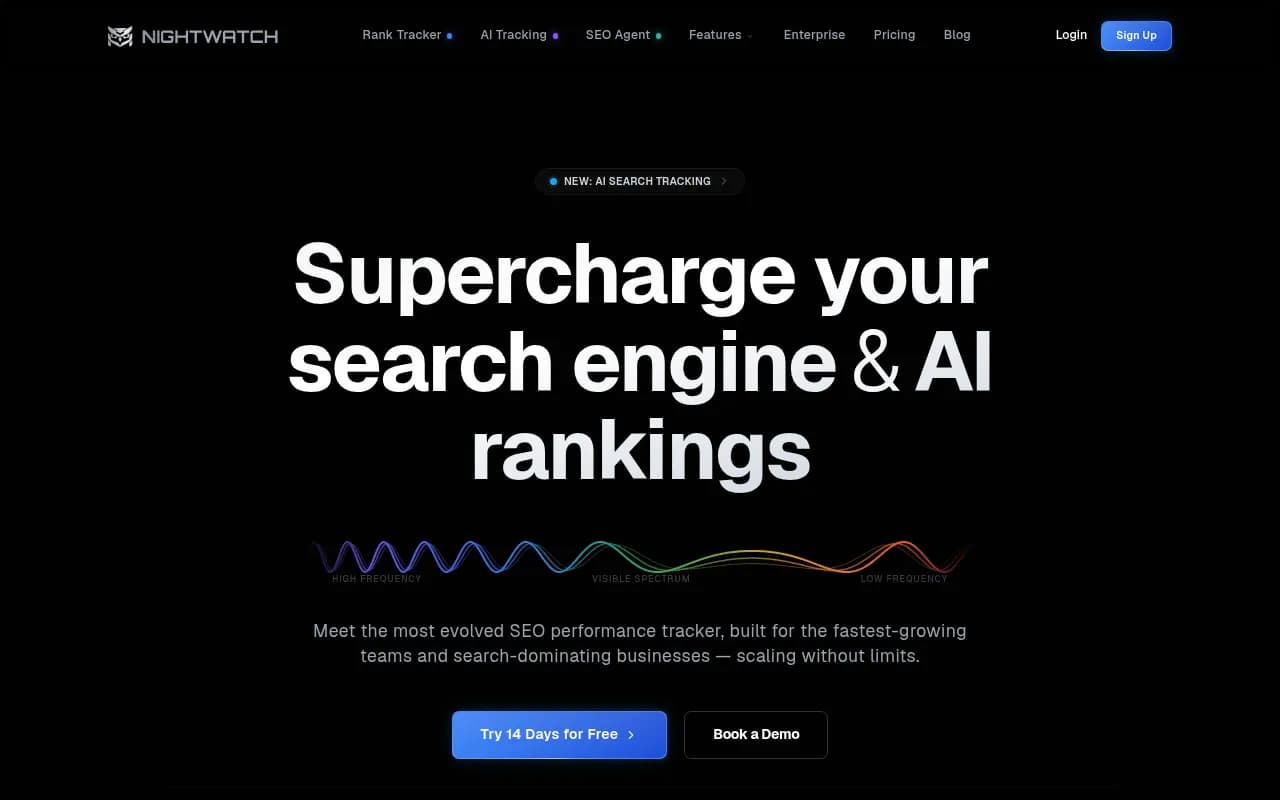
Nightwatch is an SEO performance monitoring platform that tracks keyword rankings across traditional search engines (Google, Bing, Yahoo, DuckDuckGo) and AI search engines (ChatGPT, Gemini, Claude, Perplexity). It provides daily ranking updates, keyword research, AI overview visibility tracking, site audits, and customizable reporting.
The platform is designed for precision. While many rank trackers approximate data to cut costs, Nightwatch accesses more data points more frequently, with real-time updates for critical keywords and localization down to 107,000+ zip codes. It's built for SEO teams, agencies, and businesses that need accurate visibility data to guide their content and optimization strategies.
Side-by-Side Comparison
| Feature | Airtop | Nightwatch |
|---|---|---|
| Primary Purpose | Browser automation and web agents | SEO rank tracking and AI search monitoring |
| Core Capability | Automate tasks across any website | Track keyword rankings and visibility |
| AI Search Tracking | Not applicable | ChatGPT, Gemini, Claude, Perplexity |
| Traditional Search | Not applicable | Google, Bing, Yahoo, DuckDuckGo |
| Automation | Full browser automation with agents | Not applicable |
| No-Code Builder | Yes, natural language to automation | No |
| Keyword Research | Not applicable | Yes, with prompt research |
| Site Audit | Not applicable | Yes |
| Integrations | Slack, Gmail, Sheets, Airtable, HubSpot, Zapier, n8n, Make | Looker Studio, reporting tools |
| Pricing Start | $26/mo (Starter) | $24/mo (Starter) |
| Mid-Tier Pricing | $80/mo (Professional) | $59/mo (Optimize) |
| Free Trial | Available | 14-day free trial |
| Target User | Marketing ops, sales ops, automation teams | SEO teams, agencies, content marketers |
Use case breakdown
What Airtop does (and Nightwatch doesn't)
Airtop is built for automating repetitive browser-based tasks. Here's what it handles:
Lead sourcing and prospecting: Extract new leads from LinkedIn comments, posts, or profiles and save them to Google Sheets or your CRM. Airtop can navigate LinkedIn's interface, identify relevant profiles, and push data to your sales stack.
Competitive monitoring: Track competitors' top LinkedIn posts weekly, scrape their website changes, or monitor their pricing pages. Airtop logs the data and sends alerts via Slack.
Meeting preparation: Research tomorrow's meeting attendees on LinkedIn and email you personalized notes. Airtop pulls profile data, recent activity, and company info automatically.
Invoice reconciliation: Cared.io uses Airtop to automate invoice matching between Cliniko and Xero, eliminating hours of manual work. Airtop handles the browser interactions where APIs don't exist or are too rigid.
Data extraction: Pull data from any website, even behind logins or paywalls. Airtop can log in, navigate multi-step workflows, and extract structured data.
Nightwatch doesn't do any of this. It's not an automation tool.
What Nightwatch does (and Airtop doesn't)
Nightwatch is built for tracking search performance. Here's what it handles:
Keyword rank tracking: Monitor where your pages rank for thousands of keywords across Google, Bing, Yahoo, and DuckDuckGo. Daily updates, real-time refresh on demand, localization down to zip codes.
AI search visibility: Track how often your brand appears in AI-generated responses from ChatGPT, Gemini, Claude, and Perplexity. See which prompts trigger your content and which don't.
Prompt research: Discover what prompts people are using in AI search engines and which ones you're visible for. Nightwatch provides volume estimates and difficulty scores.
Competitor analysis: Compare your rankings and AI visibility against competitors. See where they're winning and where you have opportunities.
Site audits: Identify technical SEO issues, broken links, and optimization opportunities across your website.
Reporting: Generate white-label reports for clients or internal stakeholders, with Looker Studio integration for custom dashboards.
Airtop doesn't do any of this. It's not a rank tracker or SEO tool.
Pricing comparison
| Plan | Airtop | Nightwatch |
|---|---|---|
| Starter | $26/mo | $24/mo (Starter) |
| Mid-Tier | $80/mo (Professional) | $59/mo (Optimize) |
| Enterprise | Custom pricing | Custom pricing |
| Free Trial | Yes | 14-day free trial |
| What Scales Price | Automation complexity, execution volume | Keyword count, tracking frequency |
Airtop's pricing is based on how many automations you run and how complex they are. More browser sessions, more integrations, and more frequent executions cost more.
Nightwatch's pricing scales with how many keywords you track and how often you want updates. More keywords and more frequent checks (hourly vs daily) push you into higher tiers.
Both offer custom enterprise pricing for large teams or agencies.
Integration and workflow fit
Airtop's integration story
Airtop connects with your existing tools to push data and send updates. It integrates with:
- Google Sheets and Airtable: Store extracted data, leads, or monitoring results
- Slack: Send alerts when automations complete or when specific conditions are met
- Gmail: Send emails with research summaries or extracted data
- HubSpot and CRMs: Push leads directly into your sales pipeline
- Zapier, n8n, Make: Extend Airtop into broader automation workflows
Airtop is designed to fit into automation stacks. You build an agent, it runs on a schedule or trigger, and it pushes results to wherever you need them.
Nightwatch's integration story
Nightwatch connects with reporting and analytics tools:
- Looker Studio: Build custom dashboards with your ranking data
- White-label reporting: Generate client reports with your branding
- API access: Pull ranking data into your own tools or workflows
Nightwatch is designed to fit into SEO and marketing analytics stacks. You track rankings, analyze trends, and report results to stakeholders.
When you'd use both
Here's a scenario where both tools make sense:
You're running an SEO campaign for a SaaS product. You use Nightwatch to track your keyword rankings and AI search visibility. You see that competitors are ranking for certain prompts you're not.
You use Airtop to automate competitive research -- scraping competitor blog posts, extracting their LinkedIn content strategy, and monitoring their product updates. Airtop saves this data to Google Sheets.
You analyze the competitive data, create new content targeting the gaps, and publish. Nightwatch tracks how your new content performs in search rankings and AI overviews.
Airtop handles the automation and data collection. Nightwatch handles the visibility tracking. They complement each other.
If you're also looking to track how your brand shows up in AI search results beyond just rankings, Promptwatch covers that angle with citation tracking, prompt intelligence, and content gap analysis.

Pros and cons
Airtop pros
- No-code automation builder using plain English
- Works across any website, even behind logins or without APIs
- Deterministic execution -- agents run consistently, not unpredictably
- Integrates with Slack, Gmail, Sheets, CRMs, and automation platforms
- Extends Zapier, n8n, and Make with full browser automation
- Trusted by companies like Cared.io for mission-critical workflows
Airtop cons
- Not an SEO or visibility tracking tool
- Pricing can scale quickly with complex automations or high execution volume
- Requires clear task definition -- vague instructions produce vague results
- Limited to browser-based tasks -- can't automate desktop apps or mobile workflows
Nightwatch pros
- Comprehensive rank tracking across traditional and AI search engines
- Real-time keyword updates on demand
- Precise localization (107,000+ locations down to zip code)
- AI overview visibility tracking for ChatGPT, Gemini, Claude, Perplexity
- Keyword and prompt research with volume and difficulty scores
- Site audit and technical SEO analysis
- Looker Studio integration and white-label reporting
Nightwatch cons
- Not an automation tool -- can't scrape data or execute workflows
- Pricing scales with keyword count, which can get expensive for large sites
- Focused on search visibility, not broader marketing automation
- No built-in content creation or optimization features
Who should pick which tool
Pick Airtop if you need to:
- Automate lead sourcing from LinkedIn or other platforms
- Monitor competitor activity and scrape their content or pricing
- Extract data from websites without APIs
- Automate invoice reconciliation or other repetitive browser tasks
- Build workflows that span multiple websites and tools
- Extend Zapier or Make with full browser automation
Pick Nightwatch if you need to:
- Track keyword rankings across Google, Bing, and other search engines
- Monitor AI search visibility in ChatGPT, Perplexity, Gemini, Claude
- Research keywords and prompts with volume and difficulty data
- Run site audits and identify technical SEO issues
- Compare your search performance against competitors
- Generate client reports or dashboards for SEO campaigns
Pick both if you:
- Run SEO campaigns and need both competitive research automation (Airtop) and visibility tracking (Nightwatch)
- Want to automate data collection and then analyze how it impacts search performance
- Need to scrape competitor content (Airtop) and track how your response content ranks (Nightwatch)
Final verdict
Airtop and Nightwatch don't compete. They solve different problems for different parts of your marketing stack.
If you're spending hours manually scraping LinkedIn, monitoring competitors, or extracting data from websites, Airtop automates it. If you're trying to understand where you rank in search engines or how visible you are in AI-generated responses, Nightwatch tracks it.
Most teams won't choose between them -- they'll use one or the other based on the specific problem they're solving. Some teams will use both, with Airtop feeding competitive data into their strategy and Nightwatch measuring the results.
The real question isn't "which is better" but "which problem are you trying to solve right now?"