Key Takeaways
- Airtop is a browser automation platform that builds web agents to automate tasks like lead sourcing, competitive monitoring, and data extraction. Orchly is an AI search visibility tracker that monitors brand mentions across ChatGPT, Claude, Perplexity, and Google.
- They solve different problems: Airtop replaces manual browser work with automated agents. Orchly tells you how visible your brand is in AI search results and helps optimize content for AI engines.
- Pricing: Orchly starts at $49/mo (Essential) after a 14-day free trial. Airtop starts at $26/mo (Starter). Both offer custom enterprise pricing.
- Orchly tracks 6+ AI platforms (ChatGPT, Claude, Perplexity, Gemini, Grok, Google AI Overviews) plus organic search rankings. Airtop doesn't track visibility at all -- it automates workflows.
- Airtop integrates with Slack, Gmail, Google Sheets, Airtable, HubSpot and other tools to push data from automated tasks. Orchly integrates with Shopify, WooCommerce, BigCommerce for e-commerce tracking.
- Use case overlap is minimal: If you need to automate browser tasks, pick Airtop. If you need to track AI search visibility and optimize content for AI engines, pick Orchly. Many teams use both.
Overview
Airtop: Browser automation with AI agents
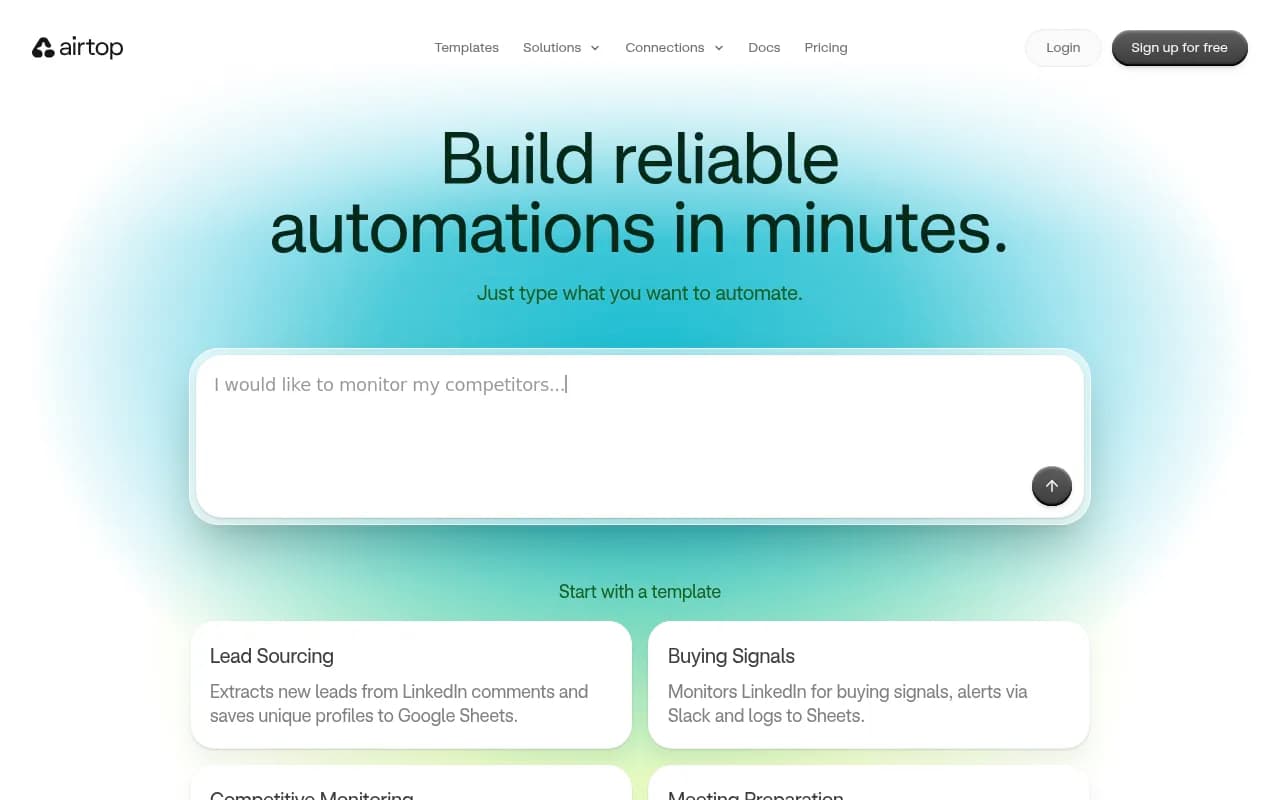
Airtop is a code-free browser automation platform that lets you build web agents by typing instructions in plain English. It automates repetitive browser tasks -- lead sourcing from LinkedIn, competitive monitoring, invoice reconciliation, meeting prep research -- and integrates with tools like Slack, Gmail, Google Sheets, Airtable, and HubSpot. The platform runs deterministic code in the cloud so agents behave consistently every time. Airtop works on any website, even behind logins or without APIs. It's designed for teams that want to eliminate manual browser work without writing code.
Orchly: AI search visibility and SEO tracking
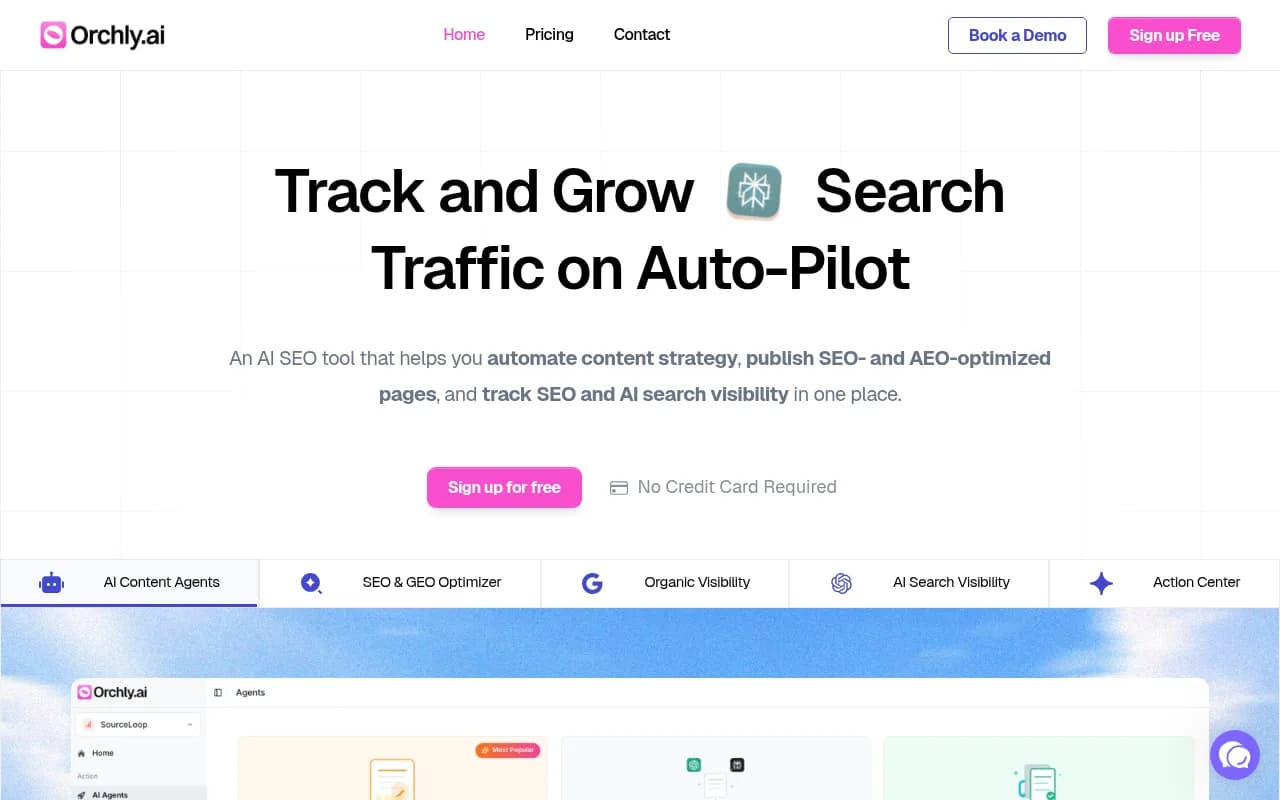
Orchly is an AI search visibility tracker that monitors how your brand appears across ChatGPT, Claude, Perplexity, Gemini, Grok, and Google AI Overviews. It tracks brand mentions, sentiment (positive/neutral/negative), competitor visibility, and organic search rankings. The platform includes an SEO content writer, website audit tools, and optimization recommendations. Orchly helps SEO teams understand where they rank in AI search results, identify gaps, and create content that gets cited by AI models. It's built for marketers who want to measure and improve their AI search presence.
Side-by-Side Comparison
| Feature | Airtop | Orchly |
|---|---|---|
| Core purpose | Browser automation | AI search visibility tracking |
| AI platform tracking | None | ChatGPT, Claude, Perplexity, Gemini, Grok, Google AI |
| Organic search tracking | No | Yes (Google rankings) |
| Browser automation | Yes (web agents) | No |
| Content creation | No | Yes (SEO content writer) |
| Integrations | Slack, Gmail, Sheets, Airtable, HubSpot, Zapier, n8n, Make | Shopify, WooCommerce, BigCommerce |
| Competitor tracking | Via custom agents | Built-in AI visibility comparison |
| Sentiment analysis | No | Yes (positive/neutral/negative) |
| Free trial | Not specified | 14 days |
| Starting price | $26/mo (Starter) | $49/mo (Essential) |
| Mid-tier price | $80/mo (Professional) | $125/mo (Pro) |
| Enterprise pricing | Custom | Custom |
| Annual discount | Not specified | 25% off |
| Target audience | Operations, sales, automation teams | SEO teams, marketers, content strategists |
Head-to-head feature comparison
Core functionality
Airtop and Orchly operate in completely different domains. Airtop automates browser tasks -- you describe what you want in plain English ("monitor my competitors' LinkedIn posts weekly") and it builds an agent that executes that task. The agent runs in the cloud, interacts with websites like a human would, and pushes data to your tools (Slack, Sheets, CRM). It's designed to replace manual browser work.
Orchly tracks visibility. It monitors how often your brand gets mentioned in AI search results, what sentiment those mentions carry, and how you compare to competitors. It also tracks organic Google rankings and includes tools to optimize content for AI engines. You're not automating tasks -- you're measuring presence.
Verdict: No overlap. Pick based on your need: automation (Airtop) or visibility tracking (Orchly).
AI search visibility tracking
Orchly is purpose-built for this. It tracks your brand across ChatGPT, Claude, Perplexity, Gemini, Grok, and Google AI Overviews. You see exactly where you rank, what prompts trigger mentions, and how competitors compare. The platform breaks down sentiment (positive/neutral/negative) and shows trends over time. It monitors multiple locations and gives you a visibility score for each AI platform.
Airtop doesn't track AI search visibility at all. You could theoretically build an agent to scrape AI search results, but that's a workaround -- not a core feature. Airtop is about automating workflows, not monitoring visibility.
Verdict: Orchly wins decisively. If AI search visibility matters to you, Airtop isn't even in the conversation.
Browser automation and workflow building
Airtop excels here. You type what you want to automate ("extract new leads from LinkedIn comments and save to Google Sheets") and Airtop generates the agent. It works on any website -- even behind logins or without APIs. The platform integrates with Slack, Gmail, Sheets, Airtable, HubSpot, and extends Zapier, n8n, and Make with full browser automation capabilities. Agents run deterministically in the cloud, so they behave the same way every time.
Orchly has no automation features. It's a monitoring and optimization platform. You can't build agents or automate browser tasks.
Verdict: Airtop is the only option if you need browser automation. Orchly doesn't compete here.
Content creation and optimization
Orchly includes an SEO content writer that generates optimized pages for both traditional search and AI search. It trains on your brand voice, integrates with your style guide, and can auto-publish content. The platform also provides content optimization recommendations based on what's missing from your site compared to competitors.
Airtop doesn't create content. It automates tasks. You could build an agent to scrape content ideas or research topics, but Airtop itself isn't a content tool.
Verdict: Orchly is the clear winner for content teams. Airtop isn't designed for this.
Competitor tracking
Orchly has built-in competitor tracking for AI visibility. You add competitor domains and see how they rank across ChatGPT, Claude, Perplexity, and other platforms. The comparison is side-by-side with visibility scores for each AI engine.
Airtop can monitor competitors through custom agents. For example, you could build an agent that tracks competitors' LinkedIn posts weekly and reports engagement metrics to Slack. But you have to define and build the agent yourself -- it's not a pre-built feature.
Verdict: Orchly for AI visibility comparison. Airtop for custom competitive monitoring workflows.
Integrations and data flow
Airtop integrates with Slack, Gmail, Google Sheets, Airtable, HubSpot, and extends Zapier, n8n, and Make. Agents push data to these tools automatically. For example, an agent can scrape leads from LinkedIn and add them to your CRM, or monitor a website and send Slack alerts when something changes.
Orchly integrates with Shopify, WooCommerce, and BigCommerce for e-commerce tracking. It also offers white-label reports and API access. The focus is on pulling visibility data into your reporting stack, not pushing data to external tools.
Verdict: Airtop has broader integration options for workflow automation. Orchly is more focused on e-commerce and reporting.
Ease of use
Airtop is code-free. You describe tasks in plain English and the platform builds the agent. The interface shows templates for common use cases (lead sourcing, buying signals, competitive monitoring, meeting prep). You can test agents before deploying them.
Orchly has a dashboard-style interface with visibility scores, trend charts, and competitor comparisons. It's straightforward for SEO teams familiar with rank tracking tools. The content writer and optimization recommendations are accessible from an "Action Center."
Verdict: Both are designed for non-technical users. Airtop feels more conversational ("just type what you want"). Orchly feels more analytical (dashboards and charts).
Pricing structure
Airtop starts at $26/mo (Starter), $80/mo (Professional), and custom enterprise pricing. The website doesn't specify what's included at each tier.
Orchly offers a 14-day free trial, then $49/mo (Essential) or $125/mo (Pro). Annual plans save 25%. Enterprise pricing is custom. The Essential plan likely covers basic visibility tracking, while Pro adds more platforms, competitor slots, and content features.
Verdict: Airtop is cheaper at the entry level ($26 vs $49), but you're comparing automation to visibility tracking. The pricing reflects different value propositions.
Pricing comparison
| Plan | Airtop | Orchly |
|---|---|---|
| Free trial | Not specified | 14 days |
| Entry tier | $26/mo (Starter) | $49/mo (Essential) |
| Mid tier | $80/mo (Professional) | $125/mo (Pro) |
| Enterprise | Custom | Custom |
| Annual discount | Not specified | 25% off |
Note: Airtop's website doesn't detail what's included at each tier. Orchly's Essential plan likely covers basic AI visibility tracking, while Pro adds more platforms and features.
Pros and cons
Airtop pros
- Code-free agent building with plain English instructions
- Works on any website, even behind logins or without APIs
- Integrates with Slack, Gmail, Sheets, Airtable, HubSpot, Zapier, n8n, Make
- Deterministic execution -- agents behave consistently
- Templates for common use cases (lead sourcing, competitive monitoring)
- Lower entry price ($26/mo)
Airtop cons
- No AI search visibility tracking
- No content creation or optimization features
- Pricing tiers not fully detailed on website
- Requires defining and building agents for each task
Orchly pros
- Tracks 6+ AI platforms (ChatGPT, Claude, Perplexity, Gemini, Grok, Google AI)
- Built-in competitor visibility comparison
- Sentiment analysis (positive/neutral/negative)
- SEO content writer with brand voice training
- Organic search ranking tracking
- 14-day free trial
- 25% discount on annual plans
Orchly cons
- No browser automation capabilities
- Higher entry price ($49/mo)
- Integrations focused on e-commerce (Shopify, WooCommerce, BigCommerce)
- Not designed for workflow automation
Who should pick which tool
Pick Airtop if you:
- Need to automate repetitive browser tasks (lead sourcing, data extraction, competitive monitoring)
- Want to eliminate manual work without writing code
- Work with tools like Slack, Gmail, Sheets, Airtable, HubSpot and want to push data automatically
- Need agents that work on websites without APIs or behind logins
- Are an operations, sales, or automation-focused team
Pick Orchly if you:
- Need to track how your brand appears in AI search results (ChatGPT, Claude, Perplexity, etc.)
- Want to monitor competitor AI visibility and identify gaps
- Are an SEO team or content strategist optimizing for AI engines
- Need sentiment analysis and brand mention tracking
- Want tools to create and optimize content for AI search
- Run an e-commerce site on Shopify, WooCommerce, or BigCommerce
Use both if you:
- Want to automate competitive research (Airtop) and track AI visibility (Orchly)
- Need workflow automation for operations and AI search optimization for marketing
- Have separate teams handling automation and SEO/content
If you're specifically focused on tracking AI search visibility and optimizing content to rank in AI engines, tools like Promptwatch offer a more comprehensive approach. Promptwatch goes beyond monitoring to help you identify content gaps, generate AI-optimized articles, and track results across 10+ AI models -- including crawler logs that show exactly how AI engines discover your content.

Final verdict
Airtop and Orchly don't compete. Airtop automates browser tasks. Orchly tracks AI search visibility. If you need to eliminate manual browser work, Airtop is the tool. If you need to understand and improve how your brand shows up in AI search results, Orchly is the tool. Many teams will benefit from both -- use Airtop to automate competitive research and data extraction, then use Orchly to monitor the AI visibility outcomes of your content strategy. The decision comes down to which