Key Takeaways
- Completely different tools: Airtop automates web workflows with no-code browser agents. Otterly.AI monitors brand mentions across AI search engines. They don't compete -- they solve unrelated problems.
- Airtop wins for automation: If you need to scrape data, monitor competitors, extract leads, or automate repetitive browser tasks across any website (even without APIs), Airtop is the tool. Otterly.AI doesn't do automation.
- Otterly.AI wins for AI search tracking: If you want to see where your brand appears in ChatGPT, Perplexity, or Google AI Overviews, Otterly.AI is built for that. Airtop has zero AI search monitoring capabilities.
- Pricing is similar but serves different budgets: Airtop starts at $26/mo, Otterly.AI at $29/mo. Both scale up quickly -- Airtop Professional is $80/mo, Otterly.AI Standard is $189/mo. You're paying for fundamentally different value.
- Otterly.AI is monitoring-only: It shows you data but doesn't help you optimize content or fix gaps. For teams wanting to act on AI visibility insights (not just track them), platforms like Promptwatch combine monitoring with content gap analysis, AI content generation, and crawler logs.
- Airtop integrates with your stack: It connects with Slack, Gmail, Google Sheets, Airtable, HubSpot, Zapier, n8n, and Make. Otterly.AI focuses on reporting and doesn't offer workflow integrations.
Overview: Two tools, two completely different jobs
Airtop: No-code web automation builder
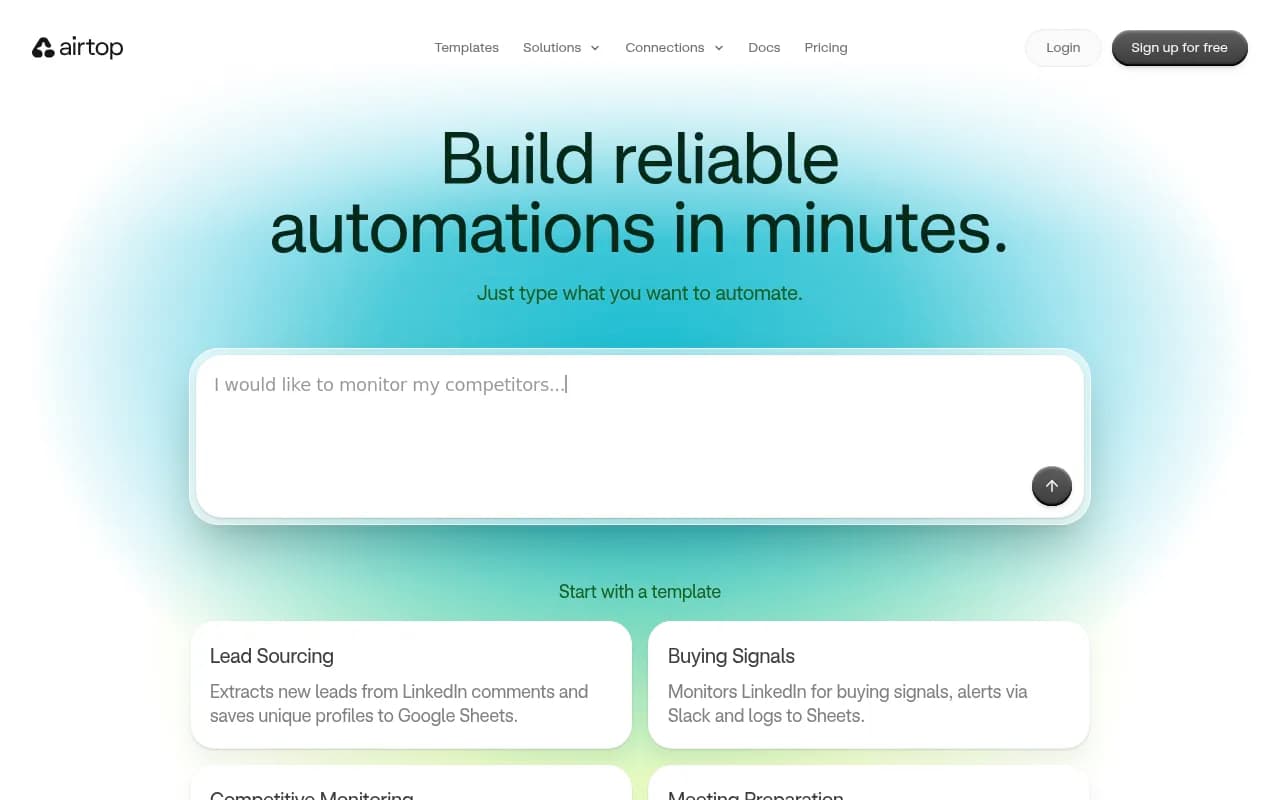
Airtop is a browser automation platform that lets you build workflows by typing instructions in plain English. It automates tasks across any website -- even behind logins or without APIs -- by running deterministic code in the cloud. Marketing teams use it for lead sourcing, competitive monitoring, data extraction, and meeting prep. It integrates with tools like Slack, Google Sheets, HubSpot, and Zapier to push data and trigger actions.
The pitch: automate repetitive browser work without writing code. Type "monitor my competitor's LinkedIn posts weekly and report to Slack" and Airtop builds the agent.
Otterly.AI: AI search monitoring platform
Otterly.AI

Otterly.AI tracks where your brand appears in AI search engines -- ChatGPT, Perplexity, Google AI Overviews, AI Mode, Gemini, and Copilot. You define search prompts (queries your audience asks), and Otterly.AI monitors which brands get mentioned, which websites get cited, and where you rank. It's designed for marketing teams wanting to understand their AI search visibility and benchmark against competitors.
The pitch: see how often AI engines recommend your brand, track share of voice, and spot opportunities before competitors do.
Side-by-Side Comparison
| Feature | Airtop | Otterly.AI |
|---|---|---|
| Primary use case | Web automation, workflow building | AI search monitoring, brand tracking |
| AI search tracking | None | 6 engines (ChatGPT, Perplexity, Google AI Overviews, AI Mode, Gemini, Copilot) |
| Browser automation | Full automation across any website | None |
| No-code builder | Yes (plain English commands) | No |
| Content optimization | No | No (monitoring only) |
| Integrations | Slack, Gmail, Sheets, Airtable, HubSpot, Zapier, n8n, Make | Reporting only, no workflow integrations |
| Starting price | $26/mo (Starter) | $29/mo (Lite: 15 prompts) |
| Mid-tier price | $80/mo (Professional) | $189/mo (Standard: 100 prompts) |
| Free trial | Available | 14 days, no credit card |
| Target audience | Marketing ops, sales ops, automation teams | SEO teams, brand managers, content marketers |
| API access | Yes | Not mentioned |
| Crawler logs | No | No |
| Prompt intelligence | No | Basic keyword research |
Head-to-head feature breakdown
Core functionality: Automation vs monitoring
Airtop builds automations. You describe a task in plain English ("extract new leads from LinkedIn comments and save to Google Sheets") and it generates a browser agent that runs the workflow. It handles logins, clicks, form fills, data extraction -- anything a human can do in a browser. The agents run in the cloud on a schedule or via trigger.
Otterly.AI monitors AI search results. You define prompts ("best project management software", "top CRM for small business") and it tracks which brands and websites appear in responses from ChatGPT, Perplexity, and other AI engines. It measures share of voice, citation frequency, and competitive positioning.
Verdict: These tools don't overlap. Airtop is for doing work. Otterly.AI is for watching results.
AI search visibility
Airtop has zero AI search capabilities. It doesn't track ChatGPT, Perplexity, or any AI engine. It's not built for that.
Otterly.AI monitors six AI search platforms: ChatGPT, Perplexity, Google AI Overviews, Google AI Mode, Gemini, and Microsoft Copilot. It shows brand mentions, website citations, and share of voice. The GEO Audit tool analyzes 25+ on-page factors to identify why you're not getting cited.
But here's the gap: Otterly.AI is monitoring-only. It shows you the data but doesn't help you fix it. You see that competitors are getting cited more often, but you're on your own to figure out what content to create or how to optimize. If you want to close that loop -- find gaps, generate content, track results -- platforms like Promptwatch combine monitoring with content gap analysis, AI content generation grounded in citation data, and crawler logs that show how AI engines interact with your site.

Verdict: Otterly.AI wins for basic AI search monitoring. For teams wanting to act on the insights (not just collect them), more comprehensive platforms offer optimization tools alongside tracking.
Automation and workflow capabilities
Airtop's entire value is automation. It connects with Slack, Gmail, Google Sheets, Airtable, HubSpot, and workflow tools like Zapier, n8n, and Make. You can build agents that:
- Monitor competitor activity and send Slack alerts
- Extract leads from LinkedIn and push to your CRM
- Research meeting attendees and email personalized notes
- Reconcile invoices by pulling data from multiple sites
- Track buying signals and log them to Google Sheets
The agents run deterministically -- same inputs produce same outputs every time. They handle complex multi-step workflows across sites that don't have APIs.
Otterly.AI doesn't automate anything. It's a reporting dashboard. You log in, check your visibility scores, and export data. No integrations with your stack, no workflow triggers, no actions.
Verdict: Airtop is the only option if you need automation. Otterly.AI is purely passive monitoring.
Ease of use and setup
Airtop's no-code builder is its main selling point. You type instructions in plain English and it generates the automation. The interface shows templates for common tasks (lead sourcing, competitive monitoring, meeting prep) that you can customize. There's a learning curve for complex workflows, but simple automations take minutes.
Otterly.AI is straightforward: add your brand, define search prompts, and it starts tracking. The dashboard shows visibility scores, citation counts, and competitor benchmarks. The GEO Audit tool scans your site and highlights issues. It's easier to get started than Airtop because there's less to configure.
Verdict: Otterly.AI is simpler for its use case (just add prompts and watch). Airtop requires more setup but delivers more power.
Data and insights
Airtop extracts whatever data you tell it to extract. It's a blank canvas -- you define the workflow, and it pulls the data. The value is in what you build, not in pre-packaged insights.
Otterly.AI provides:
- Brand mention frequency across six AI engines
- Website citation tracking (which pages get cited)
- Share of voice vs competitors
- Keyword research for conversational prompts
- GEO Audit with 25+ on-page factors
The insights are useful for understanding where you stand, but they're descriptive, not prescriptive. You see the problem but not the solution.
Verdict: Otterly.AI delivers packaged insights for AI search. Airtop delivers raw data you define yourself.
Integrations and extensibility
Airtop integrates with:
- Communication: Slack, Gmail
- Data: Google Sheets, Airtable
- CRM: HubSpot
- Workflow tools: Zapier, n8n, Make
You can chain Airtop agents into larger workflows, trigger them from other tools, and push extracted data anywhere.
Otterly.AI doesn't mention integrations. It's a standalone dashboard. You export reports manually.
Verdict: Airtop is built for integration. Otterly.AI is a silo.
Content optimization and action
Neither tool directly optimizes content.
Airtop doesn't touch content at all. It automates tasks.
Otterly.AI's GEO Audit identifies on-page issues (missing schema, weak authority signals, poor content structure) but doesn't fix them or suggest what to write. It's diagnostic, not prescriptive.
If you want to go from "I'm not getting cited" to "here's the content I need to create", you need a platform that does content gap analysis and generation. That's where tools like Promptwatch come in -- they show you which prompts competitors rank for but you don't, then help you generate content engineered to get cited by AI models.
Verdict: Both tools leave you to figure out the content strategy yourself. Otterly.AI at least points out problems. Airtop isn't in this game at all.
Pricing comparison
| Plan | Airtop | Otterly.AI |
|---|---|---|
| Entry tier | $26/mo (Starter) | $29/mo (Lite: 15 prompts) |
| Mid tier | $80/mo (Professional) | $189/mo (Standard: 100 prompts) |
| High tier | Custom (Enterprise) | Custom (Premium) |
| Free trial | Yes | 14 days, no credit card |
| Annual discount | Not specified | Not specified |
Airtop's pricing is based on usage (number of automations, execution time). Otterly.AI's pricing is based on prompt count (how many queries you track). The Standard plan at $189/mo is steep if you're just starting out, but 100 prompts covers a lot of ground for most brands.
Airtop's $80/mo Professional plan is reasonable for teams running multiple automations. The Starter plan at $26/mo is cheap but likely limited in execution capacity.
Verdict: Airtop is cheaper at the mid tier. Otterly.AI's Standard plan is expensive for what you get (monitoring only, no optimization).
Pros and cons
Airtop pros
- No-code automation builder using plain English
- Works on any website, even without APIs or behind logins
- Integrates with Slack, Sheets, HubSpot, Zapier, n8n, Make
- Deterministic execution (reliable, repeatable results)
- Templates for common use cases (lead sourcing, competitive monitoring)
- Affordable entry pricing ($26/mo)
Airtop cons
- Zero AI search monitoring capabilities
- Learning curve for complex workflows
- Pricing details for higher tiers not transparent
- No content optimization or SEO features
Otterly.AI pros
- Monitors six AI search engines (ChatGPT, Perplexity, Google AI Overviews, AI Mode, Gemini, Copilot)
- Tracks brand mentions and website citations
- Competitive benchmarking and share of voice
- GEO Audit tool identifies on-page issues
- 14-day free trial, no credit card required
- Simple setup and dashboard
Otterly.AI cons
- Monitoring-only -- no content optimization or generation
- No workflow integrations or automation
- Expensive mid-tier pricing ($189/mo for 100 prompts)
- No crawler logs or prompt intelligence
- Doesn't help you act on the insights it provides
Who should pick which tool
Choose Airtop if you:
- Need to automate repetitive browser tasks (data extraction, lead sourcing, competitive monitoring)
- Work with websites that don't have APIs or require login
- Want to integrate automations with Slack, Sheets, HubSpot, or your CRM
- Prefer no-code tools over writing scripts
- Need deterministic, reliable workflows that run on a schedule
Choose Otterly.AI if you:
- Want to track brand mentions in ChatGPT, Perplexity, and Google AI Overviews
- Need to benchmark your AI search visibility against competitors
- Are a marketing or SEO team focused on AI search performance
- Want a simple dashboard to monitor share of voice
- Don't need automation or workflow integrations
Choose neither (or both) if:
- You need both automation AND AI search monitoring -- they're complementary, not competing tools. Many teams use Airtop for workflow automation and a separate platform for AI visibility.
- You want end-to-end AI search optimization (not just monitoring) -- in that case, look at platforms like Promptwatch that combine tracking with content gap analysis, AI content generation, and crawler logs to help you actually improve your rankings.
Final verdict
This isn't a real comparison. Airtop and Otterly.AI solve completely different problems.
Airtop is a no-code automation platform for teams that need to scrape data, monitor competitors, extract leads, or automate repetitive browser work across any website. It's powerful, flexible, and integrates with your stack. If you need automation, Airtop is a strong choice.
Otterly.AI is an AI search monitoring dashboard for teams that want to track brand mentions and citations in ChatGPT, Perplexity, and other AI engines. It's simple, affordable at entry level, and gives you visibility into a channel most brands ignore. But it's monitoring-only -- it won't help you optimize content or fix gaps.
If you're choosing between them, you're asking the wrong question. Pick the tool that matches your job to be done: automation (Airtop) or AI search tracking (Otterly.AI). Many teams need both.
And if you want to go beyond monitoring to actually improve your AI search rankings -- with content gap analysis, AI content generation, and crawler logs that show how AI engines interact with your site -- platforms like Promptwatch offer the optimization layer that monitoring-only tools like Otterly.AI don't provide.