Key Takeaways
- Amionai targets agencies and mid-market brands with transparent pricing starting at $375/mo for 5 clients, while Bluefish AI serves Fortune 500 enterprises with custom pricing estimated at $4,000+/month
- Bluefish AI offers deeper enterprise features like custom audiences and tailored prompts, but lacks content generation and crawler logs that some competitors provide
- Amionai includes weekly action plans and white-label solutions for agencies managing multiple clients -- Bluefish AI focuses on single large enterprise deployments
- Neither platform offers a free trial, making them harder to evaluate before committing compared to alternatives
- Both are monitoring-focused platforms that show you where you appear in AI search but don't help you create optimized content to improve visibility
- If you're an agency managing 5-10 clients, Amionai's pricing structure makes more sense. If you're a Fortune 500 brand with a large marketing team and budget, Bluefish AI's enterprise depth might justify the cost.
Overview: Two different takes on AI visibility tracking
Amionai
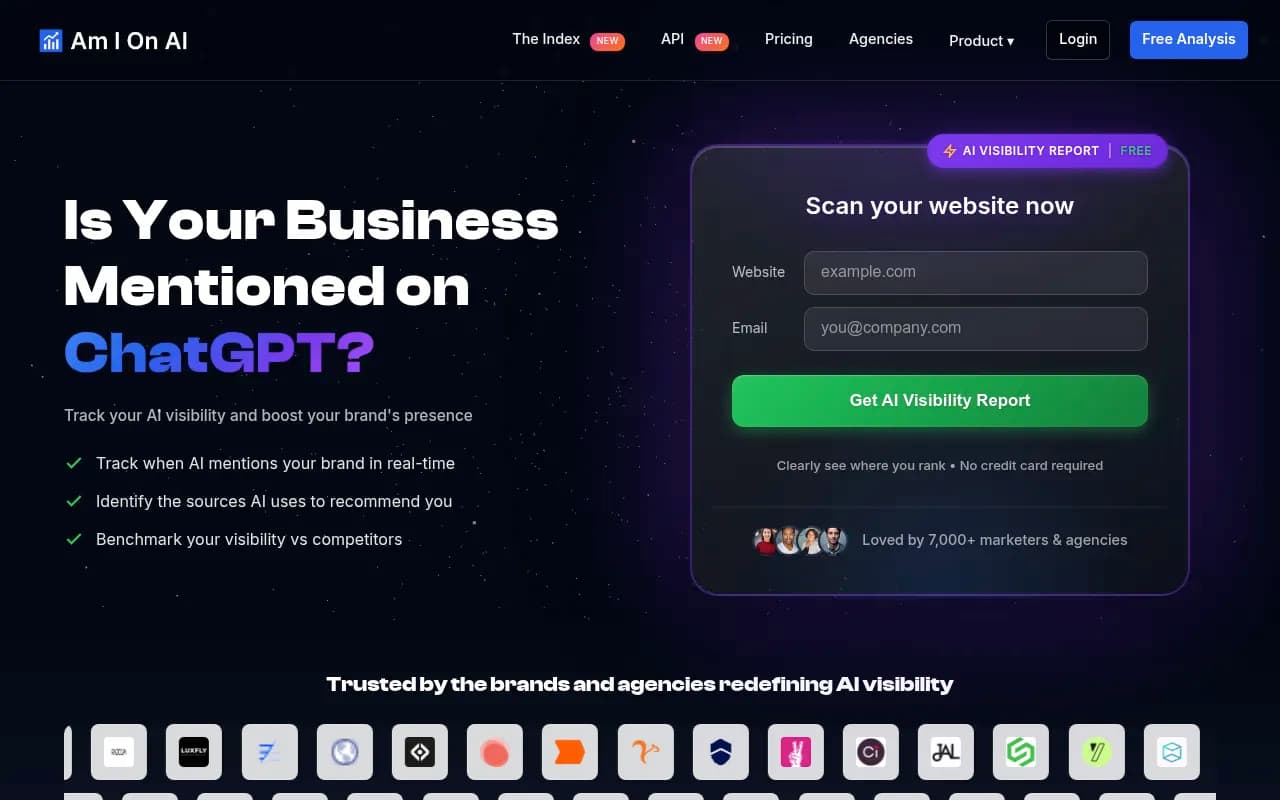
Amionai positions itself as an AI visibility monitoring platform built for agencies and brands that want to track how they show up in ChatGPT, Perplexity, Claude, and other LLMs. The platform emphasizes weekly action plans, competitor benchmarking, and white-label solutions that let agencies resell the service to clients. With 7,000+ marketers and agencies using it, Amionai has carved out a niche in the mid-market and agency space.
The core promise: real-time tracking of when AI mentions your brand, identification of sources AI uses to recommend you, and competitive visibility benchmarking. They offer a free AI visibility report to get started, though there's no ongoing free tier or trial.
Bluefish AI
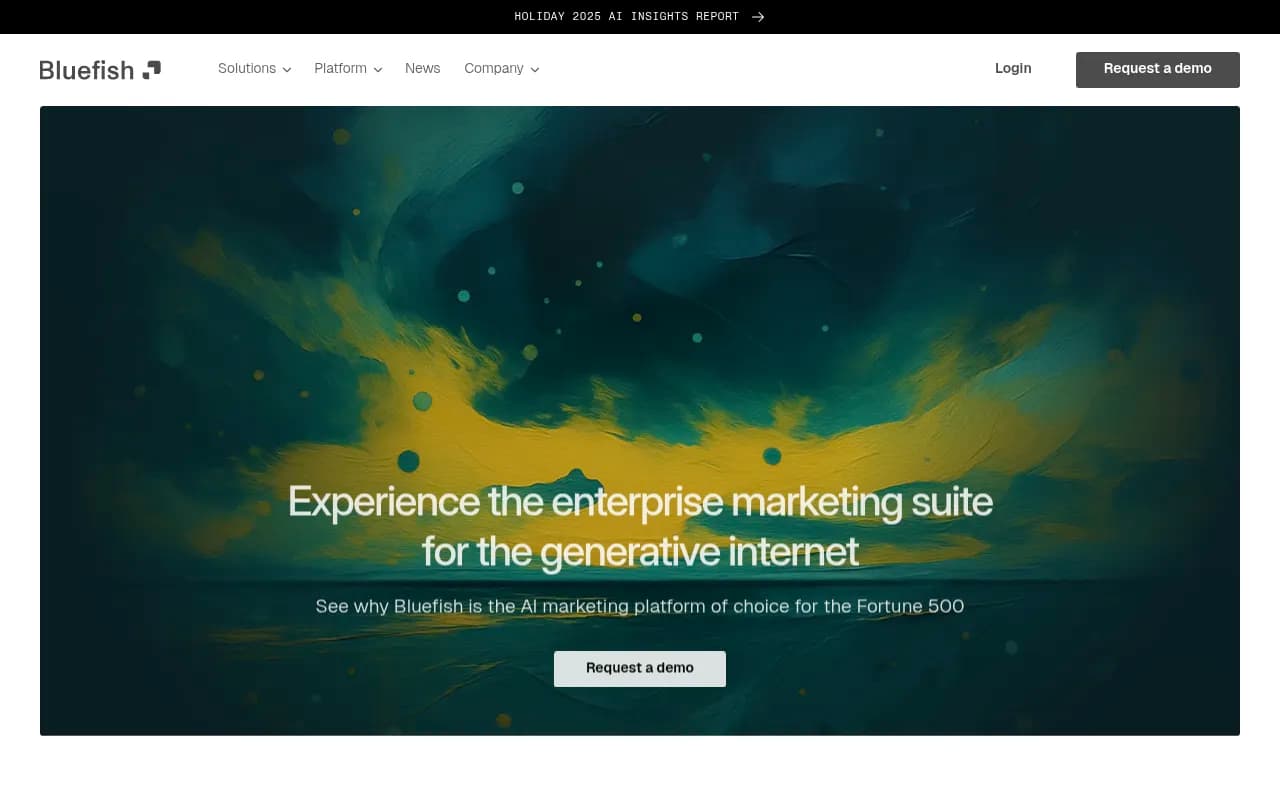
Bluefish AI takes an enterprise-first approach, marketing itself as "the AI marketing platform of choice for the Fortune 500." The platform goes beyond basic visibility tracking to offer custom audiences, tailored prompts, and what they call "deep performance analytics" that help marketers understand how AI "thinks."
Bluefish AI covers AI search monitoring, AI commerce tracking, and what they call GEO (Generative Engine Optimization) measurement. The platform is built for large marketing teams that need to pass infosec reviews and want custom segmentation options. No transparent pricing -- everything is quote-based.
Side-by-side comparison
| Feature | Amionai | Bluefish AI |
|---|---|---|
| Starting price | $375/mo (5 clients) | Custom quote (~$4,000+/mo) |
| Free trial | No (free report only) | No |
| Target audience | Agencies, mid-market brands | Fortune 500 enterprises |
| AI models tracked | ChatGPT, Perplexity, Claude, others | ChatGPT, Perplexity, major LLMs |
| White-label/reseller | Yes | No |
| Multi-client management | Yes (5-10 clients per plan) | No (single enterprise focus) |
| Custom audiences | Not mentioned | Yes |
| Tailored prompts | Not mentioned | Yes |
| Content generation | No | No |
| Crawler logs | No | No |
| Weekly action plans | Yes | Not mentioned |
| Competitor analysis | Yes | Yes |
| AI commerce tracking | Not mentioned | Yes |
| Self-service signup | Yes | No (sales-led only) |
Pricing: Agency tiers vs enterprise quotes
Amionai uses transparent tiered pricing designed for agencies managing multiple clients:
| Plan | Price | Clients included |
|---|---|---|
| Agency Starter | $375/mo | 5 clients |
| Agency Growth | ~$500-600/mo (estimated) | 7-8 clients |
| Agency Pro | $670/mo | 10 clients |
No free trial, but they offer a free AI visibility report to test the waters. Annual billing likely available but not prominently advertised.
Bluefish AI doesn't publish pricing. Based on their enterprise positioning and feature set, expect custom quotes starting around $4,000/month and scaling up from there. The sales process involves demos, infosec reviews, and custom scoping -- not a quick signup.
The pricing gap here is massive. Amionai is accessible to agencies and mid-market brands. Bluefish AI is priced for companies with serious marketing budgets.
Feature depth: Monitoring vs enterprise control
AI model coverage
Both platforms track the major LLMs -- ChatGPT, Perplexity, Claude, and others. Amionai mentions "AI-powered search results" broadly. Bluefish AI explicitly covers "AI native experiences" and agentic commerce channels.
Neither platform specifies exactly how many models they monitor or whether they cover Google AI Overviews, Gemini, Meta AI, DeepSeek, Grok, or Mistral individually. This lack of transparency makes it hard to know if you're getting comprehensive coverage.
Competitor analysis
Amionai includes competitor benchmarking as a core feature -- you can see how your visibility stacks up against competitors in AI search results.
Bluefish AI also offers competitive analysis but frames it as part of their "deep performance analytics" and custom audience capabilities. The enterprise angle suggests more granular segmentation and comparison options.
Both platforms show you where competitors are winning, but neither helps you close the gap with content creation tools.
Action plans and optimization
Amionai provides weekly action plans -- specific recommendations on what to do to improve your AI visibility. This is valuable for teams that want guidance, not just data.
Bluefish AI talks about "optimization workflows" and "measurement frameworks" but doesn't mention automated action plans. The focus is on giving you the data and tools to build your own optimization strategy.
Here's the catch with both platforms: they're monitoring-focused. They show you the problem but don't help you fix it. No content gap analysis. No AI writing tools. No crawler log analysis to see what AI models are actually reading on your site.
If you want a platform that goes beyond monitoring to actually help you create content that ranks in AI search, tools like Promptwatch fill that gap with content generation, answer gap analysis, and crawler logs.

White-label and agency features
Amionai is built for agencies. The white-label solution lets you rebrand the platform and resell it to clients. Multi-client management is baked into the pricing structure.
Bluefish AI doesn't offer white-label or multi-client features. It's designed for a single large enterprise with a dedicated marketing team.
If you're an agency, Amionai is the obvious choice here.
Enterprise capabilities
Bluefish AI emphasizes enterprise-grade features:
- Custom audiences (segment by persona, geography, use case)
- Tailored prompts (test specific queries relevant to your business)
- Infosec-ready (passes enterprise security reviews)
- Data customization and segmentation
Amionai doesn't highlight these enterprise features. The platform is more plug-and-play.
For Fortune 500 brands with complex needs and compliance requirements, Bluefish AI's enterprise focus is a selling point. For everyone else, it's overkill.
What's missing from both platforms
Neither Amionai nor Bluefish AI offers:
- Content generation: No AI writing tools to create articles optimized for AI search
- Crawler logs: No visibility into which pages AI models are actually reading on your site
- Prompt intelligence: No data on prompt volumes, difficulty scores, or query fan-outs
- Reddit/YouTube tracking: No monitoring of discussions that influence AI recommendations
- Traffic attribution: No way to connect AI visibility to actual website traffic or revenue
These are table-stakes features in comprehensive GEO platforms. Both Amionai and Bluefish AI are monitoring dashboards, not optimization platforms.
User experience and onboarding
Amionai offers a free AI visibility report -- you enter your website and email, and they scan your presence across AI platforms. It's a low-friction way to see what the platform does before committing.
Once you sign up, the interface appears straightforward. Weekly action plans guide you on what to improve. The agency dashboard lets you switch between client accounts.
Bluefish AI requires a sales demo. No self-service signup. The onboarding process involves scoping calls, custom setup, and likely a multi-week implementation. This is standard for enterprise software but a barrier for teams that want to move fast.
Pros and cons
Amionai pros
- Transparent pricing designed for agencies
- White-label solution for reselling to clients
- Weekly action plans provide clear next steps
- Free visibility report to test before buying
- Multi-client management built in
Amionai cons
- No free trial (just a one-time report)
- Monitoring-only -- no content creation or optimization tools
- Lacks crawler logs and prompt intelligence
- Limited enterprise features for large brands
- No visibility into AI model coverage specifics
Bluefish AI pros
- Deep enterprise features (custom audiences, tailored prompts)
- Built for Fortune 500 scale and compliance
- AI commerce tracking for agentic shopping
- Strong focus on data segmentation and customization
- Passes infosec reviews easily
Bluefish AI cons
- No transparent pricing (custom quotes only)
- Estimated $4,000+/month puts it out of reach for most brands
- No free trial or self-service option
- Sales-led process slows down evaluation
- Monitoring-focused, lacks content generation and crawler logs
- Not designed for agencies managing multiple clients
Who should choose which platform
Choose Amionai if:
- You're an agency managing 5-10 clients and want to resell AI visibility monitoring
- You need transparent pricing and don't want to go through a sales process
- Weekly action plans and guided optimization appeal to you
- Your budget is in the $375-670/month range
- You want a free visibility report to test the platform first
Choose Bluefish AI if:
- You're a Fortune 500 brand with a large marketing budget
- You need custom audiences, tailored prompts, and deep segmentation
- Passing infosec reviews and enterprise compliance are requirements
- You're tracking AI commerce and agentic shopping channels
- You have $4,000+/month to spend and a dedicated team to manage the platform
Consider alternatives if:
- You want content generation and optimization tools, not just monitoring
- You need crawler logs to see what AI models are reading on your site
- You want prompt intelligence (volumes, difficulty, query fan-outs)
- You're looking for a free trial or freemium tier to test before committing
- You want Reddit and YouTube tracking to understand what influences AI recommendations
Final verdict
Amionai and Bluefish AI serve completely different markets. Amionai is the agency play -- transparent pricing, white-label options, multi-client management. Bluefish AI is the enterprise play -- custom audiences, deep analytics, Fortune 500 positioning.
Both platforms are monitoring dashboards that show you where you appear in AI search but don't help you create content to improve visibility. If you just want to track and benchmark, they'll do the job. If you want to optimize and improve, you'll need to supplement with content creation tools or choose a more comprehensive GEO platform.
The pricing gap is the real differentiator. Amionai at $375-670/month is accessible. Bluefish AI at $4,000+/month is enterprise-only. Pick based on your budget and whether you're managing multiple clients or optimizing a single large brand.