Key Takeaways
- Cognizo costs $300/mo for 350 prompts and includes content creation tools; Amionai starts at $375/mo for 5 clients (agency-focused) with no content generation
- Cognizo offers a free trial and targets individual marketing teams; Amionai has no free trial and is built exclusively for agencies managing multiple clients
- Cognizo includes AI-driven traffic measurement and content optimization features that Amionai lacks entirely
- Amionai provides white-label solutions for agencies; Cognizo focuses on direct brand monitoring without white-label options
- Both platforms track similar AI engines (ChatGPT, Perplexity, Claude, Gemini) but Cognizo adds query volume insights and buyer question discovery
- If you need content creation and optimization alongside monitoring, Cognizo is the clear choice; if you're an agency reselling AI visibility reports, Amionai's white-label approach fits better
Overview
Amionai
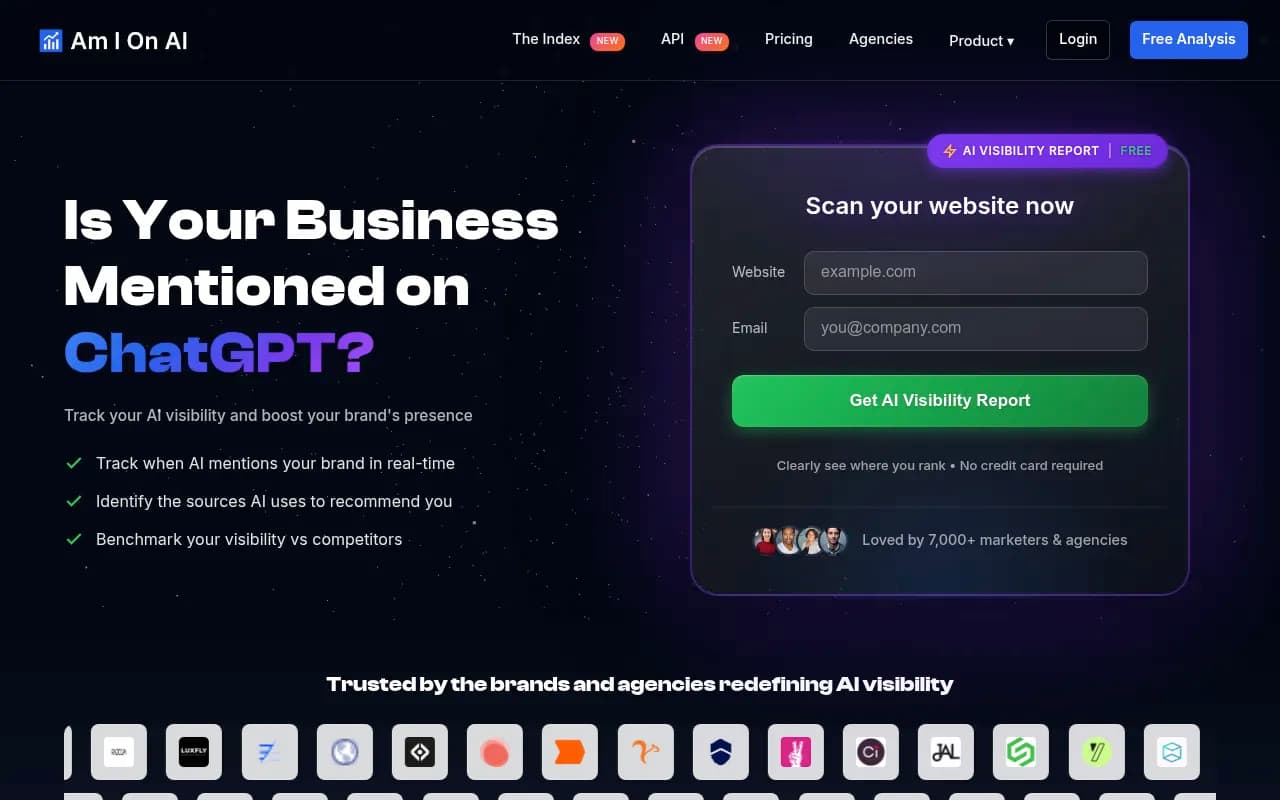
Amionai positions itself as an AI visibility monitoring platform designed specifically for agencies. The platform tracks how brands appear in AI-powered search results from ChatGPT, Perplexity, Claude, and other LLMs, then packages that data into weekly action plans and white-label reports. The core value proposition: agencies can monitor multiple clients under one roof and deliver branded visibility reports without building their own tracking infrastructure.
The platform serves 7,000+ marketers and agencies according to their website, with clients including Ceragon, Vultr, Bookaway, and SysAid. Pricing starts at $375/mo for 5 clients and scales to $670/mo for 10 clients. There's no free trial, and the platform doesn't offer plans for individual brands -- it's agencies or nothing.
Cognizo
Cognizo
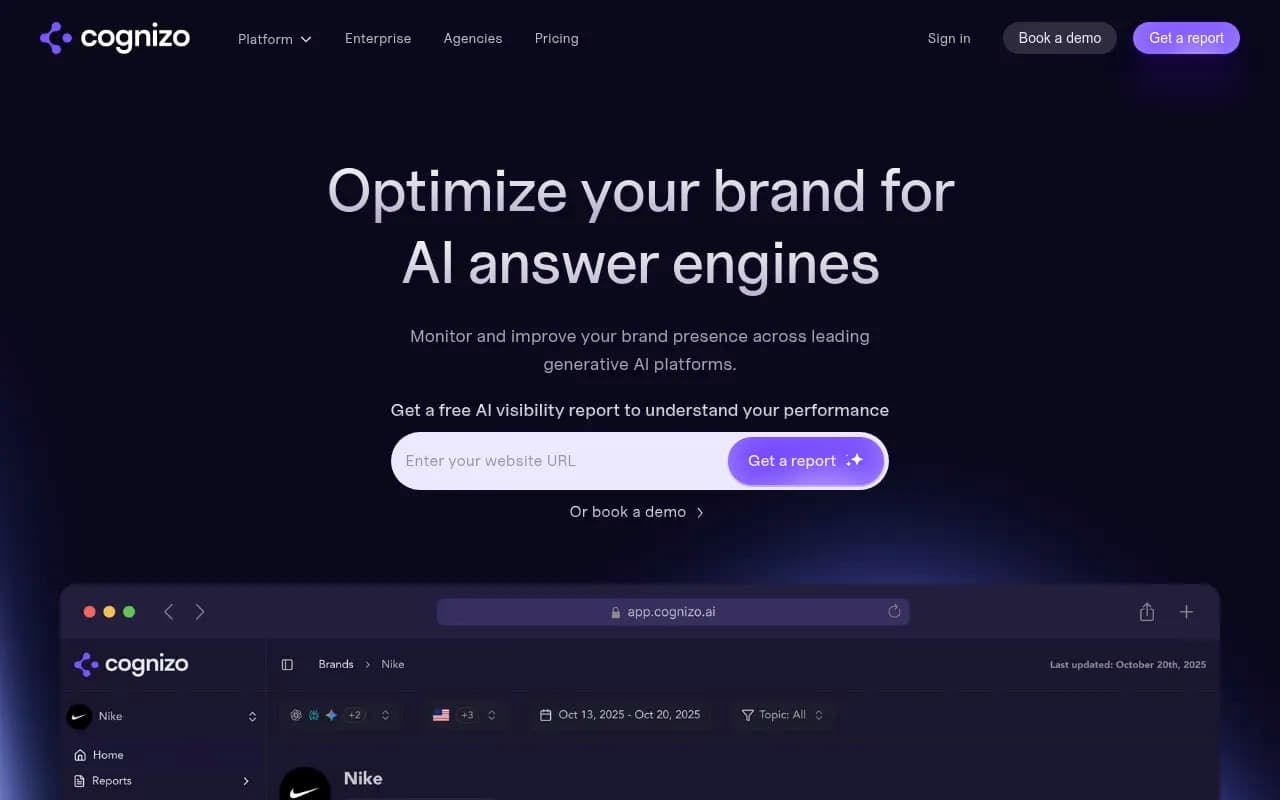
Cognizo takes a broader approach to Answer Engine Optimization (AEO). Beyond monitoring brand mentions across AI platforms, it helps marketing teams create AI-optimized content, measure AI-driven traffic, and discover what questions billions of customers are asking AI engines. The platform analyzes millions of data points daily and turns visibility insights into actionable content recommendations.
Cognizo targets marketing teams directly, not just agencies. Pricing starts at $300/mo for the Starter plan with 350 prompts and basic monitoring. A free trial is available. The platform emphasizes the full optimization loop: monitor visibility, identify gaps, create content, measure traffic -- not just tracking.
If you're also looking to understand how your brand shows up across AI search results and want tools that help you actually improve that visibility, Promptwatch covers similar ground with content gap analysis, AI content generation, and crawler log tracking.

Side-by-side comparison
| Feature | Amionai | Cognizo |
|---|---|---|
| Starting price | $375/mo (5 clients) | $300/mo (350 prompts) |
| Free trial | No | Yes |
| Target audience | Agencies only | Marketing teams, brands |
| AI engines monitored | ChatGPT, Perplexity, Claude, others | ChatGPT, Perplexity, Gemini, Google AI Overviews |
| Content creation tools | No | Yes (AI-optimized content generation) |
| White-label reports | Yes | No |
| Traffic measurement | Not mentioned | Yes (AI-driven traffic tracking) |
| Competitor analysis | Yes | Yes |
| Query volume insights | Not mentioned | Yes (buyer question discovery) |
| Sentiment tracking | Not mentioned | Yes |
| Citation tracking | Yes (sources AI uses) | Yes |
| Multi-client management | Yes (agency plans) | Not emphasized |
Monitoring capabilities
AI engine coverage
Both platforms track the major AI search engines -- ChatGPT, Perplexity, Claude -- but with different emphases. Amionai mentions tracking "AI-powered search results from ChatGPT, Perplexity, Claude, and other LLMs" without specifying the full list. Cognizo explicitly lists ChatGPT, Perplexity, Gemini, and Google AI Overviews.
Cognizo's inclusion of Google AI Overviews is notable. That's where traditional search and AI search overlap, and it's a channel most brands already care about because it sits directly in Google search results. Amionai doesn't mention Google AI Overviews at all.
Neither platform appears to track as many AI engines as some competitors. For context, platforms like Promptwatch monitor 10+ AI models including Meta AI, DeepSeek, Grok, Mistral, and Copilot. If comprehensive coverage matters, both Amionai and Cognizo leave gaps.
Verdict: Cognizo has a slight edge with explicit Google AI Overviews support, but both platforms cover the core engines most brands care about.
Real-time tracking and alerts
Amionai emphasizes "real-time" brand mention tracking and weekly action plans. The weekly cadence suggests the platform batches insights rather than pushing instant alerts when your brand appears in a new AI response.
Cognizo also mentions "real-time mentions, citations and sentiment" tracking. The platform's focus on "millions of data points daily" suggests continuous monitoring, but it's unclear whether alerts are instant or batched.
Neither platform provides specifics about alert mechanisms, notification options, or how quickly you'll know when your visibility changes. This is a gap in both products' messaging.
Verdict: Tie. Both claim real-time tracking but don't explain what that means in practice.
Competitor benchmarking
Amionai includes competitor analysis as a core feature, letting you "benchmark your visibility vs competitors." The platform shows where competitors rank and how your brand stacks up.
Cognizo offers similar competitor tracking, with the ability to "see how you stack up against competitors" and identify where you're missing. The platform's emphasis on "identifying gaps and opportunities" suggests it goes beyond simple ranking comparisons to show what competitors are doing that you're not.
Both platforms treat competitor analysis as table stakes. The real question is depth -- do you get just a ranking comparison, or do you see the specific content and citations that make competitors visible? Neither platform's website makes this clear.
Verdict: Tie. Both offer competitor analysis; neither explains how deep it goes.
Content optimization and creation
Content generation tools
This is where the platforms diverge sharply. Cognizo includes "AI-optimized content creation" as a core feature. The platform's website shows a content optimization interface with sections, key advantages, SEO overview, word count, and content scores. It promises to "automate AI-optimized content creation that moves the needle" and turn insights into action.
Amionai has no content creation features. The platform delivers "weekly action plans" that presumably tell you what to do, but you're on your own to actually create the content. For agencies, this might be fine -- you're billing clients for content creation anyway. For in-house teams, it's a missing piece.
Cognizo's content tools appear to be integrated with the monitoring data. You see where you're not visible, then generate content designed to fill those gaps. That's the optimization loop most brands need.
Verdict: Cognizo wins decisively. If you want a platform that helps you fix visibility problems, not just report them, Cognizo is the only option here.
Query and buyer intent insights
Cognizo emphasizes "identifying buyer questions" and discovering "what billions of customers are asking AI." This suggests the platform surfaces popular queries and helps you understand search intent at scale. That's valuable for content planning -- you're not guessing what to write about, you're responding to actual demand.
Amionai doesn't mention query insights or buyer intent discovery. The platform tracks whether your brand appears in AI responses, but it doesn't appear to tell you what questions people are asking that you should be answering.
This is a significant gap. Knowing you're invisible for a certain topic is useful. Knowing the specific questions people ask about that topic -- and how often they ask them -- is actionable.
Verdict: Cognizo wins. Query volume and buyer intent insights are critical for content strategy, and Amionai doesn't offer them.
Traffic and attribution
AI-driven traffic measurement
Cognizo includes "AI-driven traffic" measurement as a core feature. The platform promises to "see how AI interacts with your site and drives human traffic." This suggests some form of attribution -- connecting AI visibility to actual website visits and conversions.
Amionai doesn't mention traffic measurement or attribution at all. You can see whether AI engines mention your brand, but you can't connect that visibility to business outcomes.
For marketing teams that need to justify AI visibility investments to leadership, attribution is critical. "We're mentioned in 50 ChatGPT responses" is interesting. "Those mentions drove 500 website visits and 20 demo requests" is a budget conversation.
Verdict: Cognizo wins. Traffic measurement is a must-have for proving ROI, and Amionai doesn't offer it.
Citation and source analysis
Amionai tracks "the sources AI uses to recommend you," which means you can see which pages, articles, or third-party sites AI engines cite when mentioning your brand. This is useful for understanding what content is working and where you might need to build more presence.
Cognizo offers similar citation tracking, monitoring "mentions, citations and sentiment in real time." The platform's focus on "turning insights into action" suggests it goes beyond showing citations to recommending what to do about them.
Both platforms treat citation tracking as a core feature. The difference is what happens next -- Amionai shows you the data, Cognizo helps you act on it.
Verdict: Tie on citation tracking itself, but Cognizo's integration with content creation gives it an edge in the broader workflow.
Agency and white-label features
Multi-client management
Amionai is built for agencies from the ground up. Pricing is structured around client count -- $375/mo for 5 clients, $670/mo for 10 clients. The platform assumes you're managing multiple brands and need to keep their data separate.
Cognizo doesn't emphasize multi-client management. The platform is priced per account ($300/mo for Starter), not per client. Agencies could use Cognizo, but they'd need separate accounts for each client or manage everything under one login.
For agencies with 5+ clients, Amionai's pricing model makes more sense. For agencies with 1-2 clients or in-house teams, Cognizo's per-account pricing is simpler.
Verdict: Amionai wins for agencies managing multiple clients. Cognizo is better for individual brands.
White-label reporting
Amionai offers "white-label solutions for agencies," meaning you can rebrand reports and dashboards with your agency's logo and deliver them to clients as your own product. This is valuable if you're selling AI visibility monitoring as a service.
Cognizo doesn't mention white-label capabilities. The platform is designed for direct use by marketing teams, not for agencies reselling reports.
If you're an agency that wants to offer AI visibility monitoring under your own brand, Amionai is the only option here. If you're an in-house team or an agency comfortable using third-party tools directly with clients, white-label doesn't matter.
Verdict: Amionai wins for agencies that need white-label. Irrelevant for everyone else.
Pricing comparison
| Plan | Amionai | Cognizo |
|---|---|---|
| Entry price | $375/mo (5 clients) | $300/mo (350 prompts) |
| Mid-tier | $670/mo (10 clients) | Not specified |
| Free trial | No | Yes |
| Pricing model | Per client count | Per prompt volume |
| Target buyer | Agencies | Marketing teams |
Amionai's pricing is straightforward but inflexible. You're paying for client slots, not features. If you have 3 clients, you're still paying for 5. If you have 6 clients, you jump to the 10-client tier at $670/mo.
Cognizo's $300/mo Starter plan includes 350 prompts and basic monitoring. The platform doesn't publish higher-tier pricing on the website, which suggests custom pricing for larger teams. The free trial lowers the barrier to entry.
For a single brand, Cognizo is cheaper and includes more features (content creation, traffic measurement). For an agency with 5+ clients, Amionai's per-client pricing might be more economical than buying 5 separate Cognizo accounts.
Neither platform offers a free tier. If you're looking for free AI visibility monitoring, you'll need to look elsewhere.
Verdict: Cognizo offers better value for individual brands. Amionai's pricing makes sense only for agencies managing multiple clients.
Pros and cons
Amionai pros
- White-label reporting for agencies
- Multi-client management built in
- Weekly action plans provide clear next steps
- Trusted by 7,000+ marketers and agencies
- Competitor benchmarking included
Amionai cons
- No free trial
- No content creation or optimization tools
- No traffic measurement or attribution
- Agency-only pricing excludes individual brands
- Limited AI engine coverage (no Google AI Overviews mentioned)
- No query volume or buyer intent insights
Cognizo pros
- AI-optimized content creation included
- Traffic measurement and attribution
- Query volume and buyer intent insights
- Free trial available
- Lower entry price ($300/mo vs $375/mo)
- Tracks Google AI Overviews
- Sentiment tracking included
Cognizo cons
- No white-label options for agencies
- Multi-client management not emphasized
- Higher-tier pricing not transparent
- Smaller customer base (newer platform)
Who should pick which tool
Pick Amionai if:
- You're an agency managing 5+ clients and need white-label reports
- Your clients want AI visibility monitoring but you're handling content creation separately
- You need a simple way to track multiple brands under one roof
- Weekly action plans are sufficient -- you don't need real-time content recommendations
Pick Cognizo if:
- You're an in-house marketing team that needs to monitor and improve AI visibility
- You want content creation tools integrated with monitoring data
- Traffic attribution matters -- you need to connect AI visibility to business outcomes
- You want to understand what questions buyers are asking AI engines
- You prefer a free trial before committing
- You're managing 1-3 brands and don't need white-label reporting
Consider alternatives if:
- You need comprehensive AI engine coverage (10+ models) -- look at platforms like Promptwatch that track Meta AI, DeepSeek, Grok, Mistral, and others
- You want free AI visibility monitoring -- neither platform offers a free tier
- You need deep content gap analysis and AI content generation grounded in citation data -- Cognizo has content tools, but specialized platforms go deeper
Final verdict
Cognizo is the better platform for most teams. It costs less, includes content creation and optimization tools, measures AI-driven traffic, and offers a free trial. The platform is built around the full optimization loop -- monitor, identify gaps, create content, measure results -- not just reporting.
Amionai makes sense only if you're an agency that needs white-label reporting and multi-client management. The platform's lack of content tools, traffic measurement, and query insights makes it feel incomplete for in-house teams.
If you're choosing between these two, ask yourself: do I need to resell AI visibility reports under my own brand, or do I need to actually improve my AI visibility? The first question points to Amionai. The second points to Cognizo.
For teams that want both monitoring and optimization -- with deeper coverage of AI engines, content gap analysis, and tools that help you take action -- platforms like Promptwatch offer a more complete solution. But between these two specific options, Cognizo delivers more value for the money.