Key Takeaways
- Pricing difference is massive: LLMrefs costs $79/mo with unlimited projects and team seats, while AthenaHQ starts at $295/mo ($95 first month) with a credit-based model that can get expensive fast
- Keyword vs prompt approach: LLMrefs organizes tracking around keywords with automated prompt generation, while AthenaHQ uses a traditional prompt-by-prompt tracking model (1 credit = 1 query)
- Team access: LLMrefs includes unlimited team seats at every tier; AthenaHQ's team collaboration features are gated behind enterprise pricing
- Enterprise vs lean teams: AthenaHQ targets enterprise marketing teams with executive dashboards and ROI tracking, while LLMrefs is built for SEO teams and agencies that need simple, scalable tracking
- Both cover the same AI engines: 8-11 LLMs including ChatGPT, Perplexity, Claude, Gemini, Google AI Overviews -- the core tracking capability is comparable
- Content optimization: AthenaHQ emphasizes automated content recommendations and citation source analysis; LLMrefs focuses on competitor benchmarking and keyword gap analysis
Overview
AthenaHQ: Enterprise GEO platform

AthenaHQ positions itself as an end-to-end Generative Engine Optimization platform for enterprise marketing teams. Used by brands like Coinbase, ZoomInfo, and SoFi, it's built around executive-level visibility dashboards, ROI tracking, and cross-functional workflows. The platform monitors 8+ AI engines and emphasizes citation source analysis and automated content optimization recommendations. AthenaHQ came out of Y Combinator and has been featured in Forbes and the Wall Street Journal for its approach to AI search optimization.
The platform uses a credit-based pricing model where each AI query costs one credit. Self-serve plans start at $295/mo, with enterprise custom pricing for larger teams.
LLMrefs: Keyword-first AI search analytics
LLMrefs
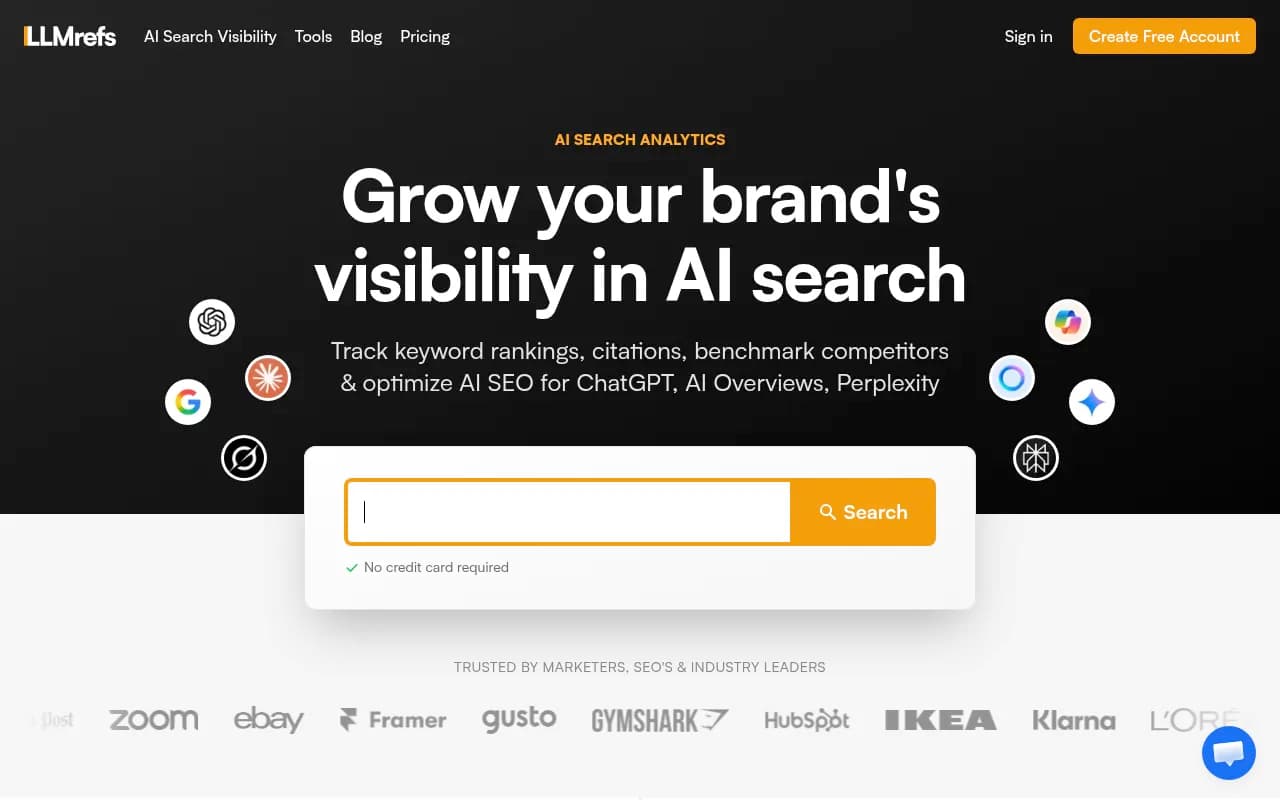
LLMrefs takes a different approach by organizing AI search tracking around keywords instead of individual prompts. It tracks visibility across 11 generative AI engines (ChatGPT, Google AI Overviews, Perplexity, Claude, Gemini, and more) with automated prompt generation -- you add keywords, it generates relevant prompts and tracks them across all engines. Built for SEO teams and agencies, it includes unlimited projects, domains, and team seats at a flat $79/mo price point.
The platform emphasizes simplicity and scalability. Instead of managing hundreds of individual prompts, you manage keywords and let the system handle prompt variations. Competitor benchmarking and source citation analysis are built in, with support for 50+ countries.
Side-by-side comparison
| Feature | AthenaHQ | LLMrefs |
|---|---|---|
| Starting price | $295/mo ($95 first month) | $79/mo |
| Pricing model | Credit-based (1 credit = 1 query) | Flat rate (500 prompts included) |
| Free trial | Not specified | 7 days, no credit card |
| AI engines tracked | 8+ (ChatGPT, Perplexity, Claude, Gemini, AI Overviews, etc.) | 11 (ChatGPT, Perplexity, Claude, Gemini, AI Overviews, Grok, Copilot, Meta AI, etc.) |
| Team seats | Enterprise tier only | Unlimited at all tiers |
| Projects/domains | Limited by plan | Unlimited |
| Tracking approach | Prompt-by-prompt | Keyword-based with auto-generated prompts |
| Competitor analysis | ✓ Citation source analysis | ✓ Benchmarking & gap analysis |
| Content optimization | ✓ Automated recommendations | Basic (via competitor insights) |
| Geographic coverage | Multiple regions | 50+ countries |
| Executive dashboards | ✓ ROI tracking, strategic insights | Standard analytics |
| Target audience | Enterprise marketing teams | SEO teams, agencies, lean operations |
| Annual discount | 17% | Not specified |
Pricing breakdown
| Plan | AthenaHQ | LLMrefs |
|---|---|---|
| Entry tier | $295/mo ($95 first month) | $79/mo |
| What's included | Credit-based queries, self-serve features | 500 prompts, unlimited projects/domains/seats |
| Mid-tier | Not specified (custom enterprise) | Same tier (flat pricing) |
| Enterprise | Custom pricing | Not offered (single tier serves all) |
| Free trial | Not specified | 7 days, no credit card required |
| Annual discount | 17% off | Not specified |
The pricing difference is stark. AthenaHQ's credit model means costs scale with usage -- if you're tracking 500 prompts across 8 engines monthly, you're burning through 4,000 credits. LLMrefs charges a flat $79/mo regardless of how many engines you query or how many team members need access.
For agencies managing multiple clients or lean teams tracking dozens of keywords, LLMrefs' unlimited model is a huge cost advantage. AthenaHQ makes sense if you need enterprise features like ROI dashboards and can justify the higher spend.
Tracking methodology: Keywords vs prompts
This is the biggest philosophical difference between the two platforms.
AthenaHQ uses prompt-level tracking. You manually define each prompt you want to monitor (e.g. "best CRM software for small business"), and the platform queries AI engines with that exact prompt. Each query costs one credit. If you want to track variations ("top CRM tools for startups", "affordable CRM for small teams"), you add them as separate prompts and pay for each one.
This gives you precise control over what gets tracked, but it's labor-intensive. You're responsible for thinking through all the prompt variations that matter to your business. For enterprise teams with dedicated GEO specialists, this level of control is valuable. For everyone else, it's a lot of manual work.
LLMrefs uses keyword-based tracking with automated prompt generation. You add a keyword (e.g. "CRM software"), and the platform automatically generates relevant prompts and variations, then tracks them across all 11 AI engines. You're not managing individual prompts -- you're managing keywords, and the system handles the rest.
This approach scales much better. Adding 50 keywords doesn't mean manually crafting 200 prompts. The trade-off is less granular control over exact phrasing, but for most SEO use cases, tracking keyword visibility across AI engines is what matters, not obsessing over specific prompt wording.
Feature depth: Enterprise workflows vs lean operations
Executive dashboards and ROI tracking
AthenaHQ emphasizes executive-level visibility. The platform includes ROI tracking for AI optimization efforts, strategic oversight dashboards, and cross-functional workflow management. If you need to justify GEO spend to a CMO or board, AthenaHQ's reporting is built for that conversation.
LLMrefs doesn't have executive dashboard features. It's analytics-focused -- you get visibility scores, competitor benchmarks, and citation data, but not the strategic overlay that AthenaHQ provides. For lean teams or agencies, this isn't a loss. You're tracking performance, not building board decks.
Content optimization
AthenaHQ includes automated content optimization recommendations and citation source analysis. The platform analyzes which sources AI engines cite and suggests content improvements to increase your citation rate. This is useful if you have a content team that can act on the recommendations.
LLMrefs provides competitor benchmarking and keyword gap analysis, which indirectly guides content strategy (you see where competitors rank and you don't), but it's not as prescriptive as AthenaHQ's approach. You get the data, you decide what to do with it.
Worth noting that tools like Promptwatch take content optimization further by not just showing gaps but actually generating AI-optimized content based on citation data and prompt analysis. If content creation is a bottleneck, that's worth exploring alongside either tracking platform.

Team collaboration
LLMrefs includes unlimited team seats at every price point. Add your entire SEO team, your agency clients, your content writers -- no extra cost.
AthenaHQ gates team collaboration behind enterprise pricing. For the self-serve $295/mo tier, you're likely limited to a single user or a small team. If you need multi-user access, you're looking at custom enterprise pricing, which pushes the cost even higher.
For agencies or distributed teams, this is a dealbreaker. LLMrefs' unlimited seats mean you can onboard clients or collaborators without worrying about per-seat fees.
AI engine coverage
Both platforms cover the major AI search engines:
AthenaHQ: ChatGPT, Perplexity, Google AI Overviews, Claude, Gemini, and 3+ others (8+ total)
LLMrefs: ChatGPT, Perplexity, Google AI Overviews, Google AI Mode, Claude, Gemini, Grok, Microsoft Copilot, Meta AI, and 2+ others (11 total)
LLMrefs has slightly broader coverage, including Grok and Meta AI, which AthenaHQ doesn't explicitly list. In practice, both platforms cover the engines that matter most for brand visibility. The difference is marginal.
Both support multi-country tracking, though LLMrefs explicitly mentions 50+ countries while AthenaHQ's geographic scope isn't detailed on their site.
Competitor analysis and benchmarking
AthenaHQ provides citation source analysis -- you see which domains and pages AI engines cite when answering prompts in your space. This helps identify link building targets and content gaps. The platform also includes competitor visibility tracking, though the specifics aren't detailed on their public site.
LLMrefs emphasizes competitor benchmarking as a core feature. You add competitor domains, and the platform shows you where they rank vs where you rank across keywords and AI engines. The keyword gap analysis highlights terms where competitors are visible but you're not, which directly informs content strategy.
Both approaches are valuable. AthenaHQ's citation source analysis is more granular (useful for link building), while LLMrefs' keyword gap analysis is more actionable for SEO teams (tells you exactly what to write about).
Ease of use and setup
LLMrefs wins on simplicity. The keyword-based model means you can get started in minutes -- add your domain, add keywords, start tracking. The 7-day free trial with no credit card required lowers the barrier to testing.
AthenaHQ's prompt-based approach requires more upfront work. You need to define your prompt list, which means thinking through all the queries that matter to your business. For enterprise teams with GEO specialists, this is fine. For everyone else, it's friction.
AthenaHQ's interface emphasizes workflows and executive dashboards, which adds complexity but also power. If you need cross-functional collaboration and strategic reporting, that complexity pays off. If you just need to track visibility and benchmark competitors, it's overkill.
Pros and cons
AthenaHQ pros
- Executive-level dashboards and ROI tracking for justifying GEO spend
- Automated content optimization recommendations
- Citation source analysis for link building and content strategy
- Enterprise workflow management for cross-functional teams
- Strong brand credibility (YC-backed, used by Coinbase, ZoomInfo, SoFi)
AthenaHQ cons
- Expensive: $295/mo starting price, credit-based model scales costs quickly
- Team collaboration gated behind enterprise pricing
- Prompt-by-prompt tracking requires manual setup and ongoing management
- Less transparent pricing (enterprise tier is custom only)
- Overkill for lean teams or agencies that just need visibility tracking
LLMrefs pros
- Affordable: $79/mo flat rate with no usage-based fees
- Unlimited team seats, projects, and domains at every tier
- Keyword-based tracking with automated prompt generation (less manual work)
- 7-day free trial, no credit card required
- Simple, focused interface built for SEO teams
- Slightly broader AI engine coverage (11 vs 8+)
LLMrefs cons
- No executive dashboards or ROI tracking features
- Less prescriptive content optimization (you get data, not recommendations)
- Single pricing tier means no enterprise-specific features
- Less brand recognition compared to AthenaHQ's enterprise client list
Who should pick which tool
Pick AthenaHQ if:
- You're an enterprise marketing team with budget for GEO and need to justify spend to executives
- You need ROI tracking, strategic dashboards, and cross-functional workflow management
- You have a dedicated GEO specialist who can manage prompt-level tracking
- Content optimization recommendations and citation source analysis are critical to your strategy
- You're already working with enterprise tools and need a platform that integrates into that ecosystem
Pick LLMrefs if:
- You're an SEO team, agency, or lean operation that needs cost-effective AI search tracking
- You want unlimited team seats and the ability to track multiple clients or projects without per-seat fees
- You prefer keyword-based tracking over managing hundreds of individual prompts
- You need competitor benchmarking and keyword gap analysis to guide content strategy
- You want a simple, focused tool that does one thing well without enterprise complexity
Pick neither if:
- You need end-to-end GEO including content creation, not just tracking. In that case, look at platforms like Promptwatch that combine visibility tracking with AI content generation and optimization tools.
Final verdict
LLMrefs is the better choice for most teams. The $79/mo flat rate with unlimited seats and keyword-based tracking makes it accessible and scalable for SEO teams, agencies, and lean operations. You get the core visibility tracking and competitor analysis you need without enterprise overhead or credit-based pricing that spirals as you scale.
AthenaHQ makes sense for enterprise marketing teams with dedicated GEO budgets and a need for executive reporting, ROI tracking, and prescriptive content recommendations. If you're justifying a six-figure GEO program to a CMO, AthenaHQ's dashboards and strategic features are worth the premium. For everyone else, it's expensive and complex relative to what you actually need.
The keyword vs prompt debate comes down to how you work. If you're an SEO team used to thinking in keywords, LLMrefs' approach is intuitive and saves hours of manual prompt management. If you're a GEO specialist who needs precise control over every query variation, AthenaHQ's prompt-level tracking gives you that control -- at a cost.
For agencies managing multiple clients, LLMrefs' unlimited everything model is a no-brainer. For enterprise teams with deep pockets and complex workflows, AthenaHQ's feature set justifies the spend. Most teams fall into the first category.