Summary
- AI content detection tools like Ahrefs Site Explorer and specialized detectors can reveal when competitors are publishing machine-generated content at scale
- AI visibility tracking platforms show which brands are winning citations in ChatGPT, Perplexity, and other AI search engines -- a new competitive battleground most teams ignore
- Traffic pattern analysis and sudden content volume spikes are early warning signs that a competitor has deployed AI content tools
- Crawler log monitoring reveals when AI models (ChatGPT, Claude, Perplexity) are actively reading competitor sites, signaling their content is being indexed for AI search
- The best defense is offense: use AI visibility platforms like Promptwatch to track competitor strategies and optimize your own content for AI search before they do

The new competitive threat: AI content at scale
Your competitor just published 47 blog posts in two weeks. Last month they averaged three. Either they hired a small army of writers or they're using AI content tools to flood the zone.
This isn't paranoia. AI writing tools like Jasper, Copy.ai, and ChatGPT have made it trivially easy to generate hundreds of articles in the time it used to take to write one. The cost of content creation has collapsed. A competitor with a $200/month AI writing subscription can now outpublish your entire content team.
But volume isn't the only threat. The real danger is that AI-generated content is getting good enough to rank in Google and get cited by AI search engines like ChatGPT and Perplexity. If your competitors figure out how to use AI content tools effectively before you do, they'll steal visibility in both traditional search and the emerging AI search landscape.
You need to know when this is happening. Here's how to detect it.
Method 1: Use Ahrefs to spot AI content on competitor sites
The fastest way to check if a competitor is using AI content tools is through Ahrefs Site Explorer. As of 2026, Ahrefs has added an "AI Content Level" column to their Top Pages report.
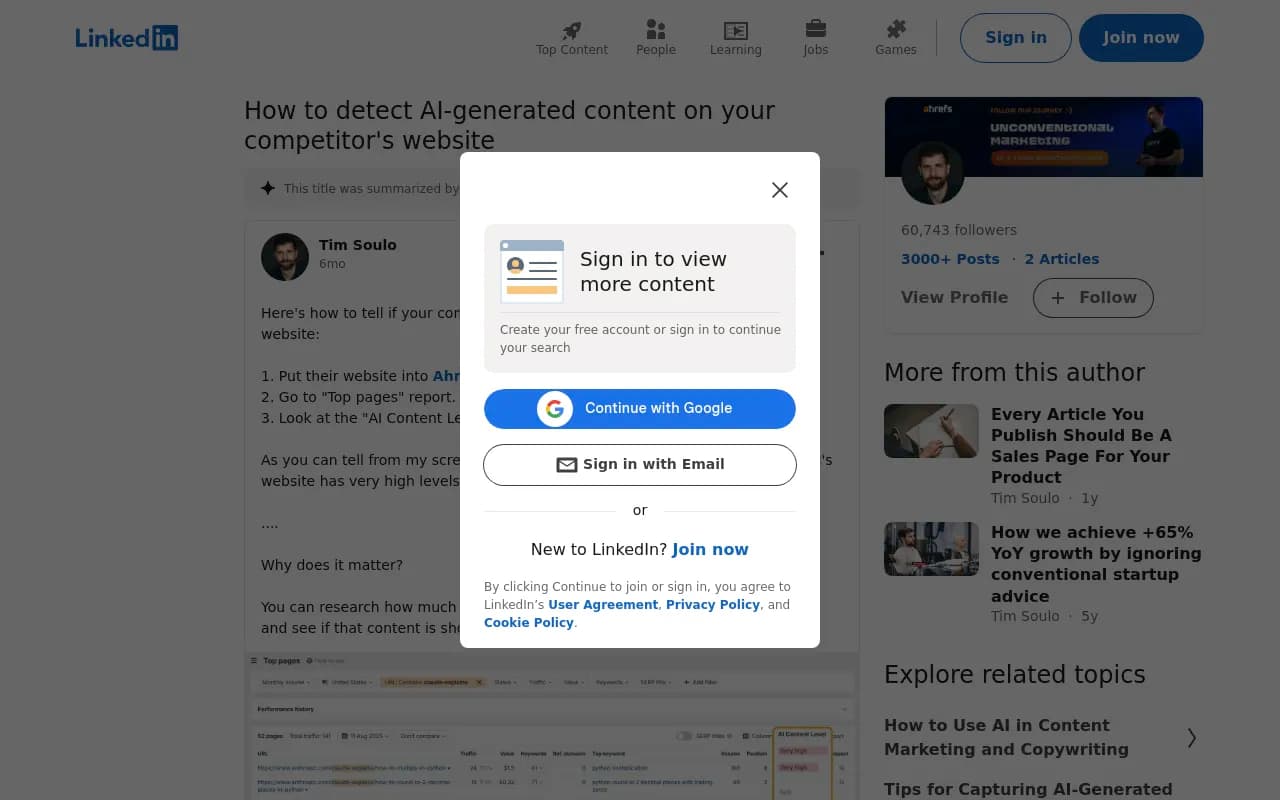
Here's the process:
- Open Ahrefs Site Explorer and enter your competitor's domain
- Navigate to the "Top pages" report in the left sidebar
- Look at the "AI Content Level" column -- this shows Ahrefs' assessment of how much AI was likely used to generate each page
- Sort by this column to see which pages have the highest AI content scores
- Cross-reference with the "Traffic" column to see if their AI content is actually ranking and driving visitors

What you're looking for: a sudden cluster of high-traffic pages with elevated AI content scores. If a competitor has 20+ pages published in the last 60 days with AI content levels above 70%, they're almost certainly using AI writing tools at scale.
The limitation: Ahrefs' AI detection isn't perfect. It can flag human-written content as AI-generated (false positives) or miss heavily edited AI content (false negatives). Use this as a starting point, not a definitive answer.
Method 2: Run competitor content through dedicated AI detectors
When you want more certainty, copy a competitor's article and run it through a specialized AI detection tool. These tools analyze writing patterns, sentence structure, and vocabulary to estimate the probability that text was machine-generated.
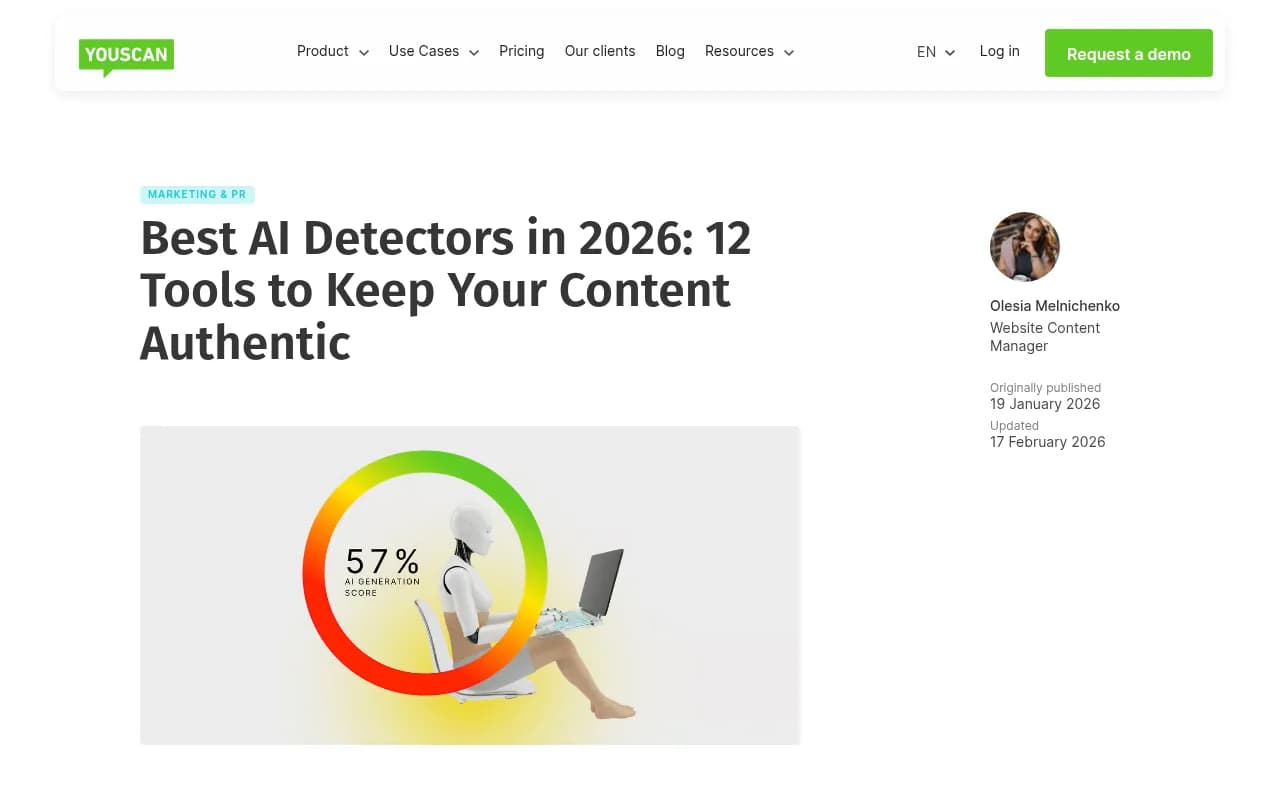
The most reliable AI detectors in 2026:
| Tool | Free tier | Accuracy | Best for |
|---|---|---|---|
| GPTZero | Yes (5,000 words/month) | High | Academic content, long-form articles |
| Originality.AI | No ($0.01/100 words) | Very high | Marketing content, blog posts |
| Copyleaks | Yes (10 pages/month) | High | Multi-language content |
| Winston AI | No ($12/month) | High | Bulk scanning competitor sites |
How to use them:
- Pick 5-10 recent articles from your competitor's site -- prioritize high-traffic pages or topics where you compete directly
- Copy the full text of each article (or use a browser extension to scrape it)
- Paste into an AI detector and run the analysis
- Look for patterns: if 8 out of 10 articles score above 80% AI probability, you've found your answer
Important caveat: as one Reddit user noted in 2026, "there's still no fully accurate AI detection tool as most of them misfire, flagging human writing as AI or missing edited AI content." These tools are directional, not definitive. A high AI score means "probably AI-generated," not "definitely AI-generated."
If you're checking multiple competitors regularly, a paid tool like Originality.AI or Winston AI makes sense. They offer bulk scanning and API access for automated monitoring.
Method 3: Track competitor visibility in AI search engines
Here's what most teams miss: your competitors aren't just using AI to create content for Google. They're optimizing for AI search engines -- ChatGPT, Perplexity, Claude, Gemini, and Google AI Overviews.
When someone asks ChatGPT "What's the best project management software?" or "How do I fix a leaky faucet?", which brands get mentioned? If your competitors are showing up in AI-generated answers and you're not, they're winning a visibility war you didn't know you were fighting.
This is called Generative Engine Optimization (GEO), and it's the next frontier after SEO. AI visibility tools let you track which brands are being cited by AI models and for which prompts.
Promptwatch is the leading platform here. It tracks your brand mentions across ChatGPT, Perplexity, Claude, Gemini, and 6+ other AI models, then shows you exactly where competitors are outranking you.
What you can see:
- Competitor heatmaps: Compare your AI visibility vs competitors across every AI model. See who's winning for each prompt and why.
- Citation analysis: Which specific pages, Reddit threads, or YouTube videos are AI models citing when they mention your competitor? This reveals their content strategy.
- Prompt intelligence: Volume estimates and difficulty scores for each prompt. See which queries your competitors are targeting and whether you can compete.
- Answer gap analysis: The prompts your competitors are visible for but you're not. This is your roadmap for closing the gap.
Other tools in this category:
Otterly.AI



Comparison of AI visibility platforms:
| Platform | AI models tracked | Content gap analysis | Crawler logs | Pricing |
|---|---|---|---|---|
| Promptwatch | 10 (ChatGPT, Perplexity, Claude, Gemini, etc.) | Yes | Yes | From $99/mo |
| Otterly.AI | 3 (ChatGPT, Perplexity, Google AI) | No | No | From $49/mo |
| Rankshift | 2 (ChatGPT, Perplexity) | No | No | From $29/mo |
| Peec AI | 3 (ChatGPT, Perplexity, Claude) | No | No | From $79/mo |
Why this matters: if your competitor's brand is being cited 3x more often than yours in ChatGPT responses, they're not just ranking in Google -- they're becoming the default recommendation in AI search. That's a compounding advantage. Every citation trains the model to recommend them more often.
Promptwatch goes beyond monitoring. It shows you the content gaps (the prompts competitors rank for but you don't), then helps you create content that actually gets cited using its built-in AI writing agent. Most competitors stop at tracking. Promptwatch helps you fix the problem.
Method 4: Monitor AI crawler activity on competitor sites
AI search engines don't magically know about your competitor's content. They send crawlers -- GPTBot (OpenAI), ClaudeBot (Anthropic), PerplexityBot, Google-Extended -- to read and index websites.
If AI crawlers are hitting your competitor's site frequently, it means their content is being actively ingested into AI training data and citation databases. This is a leading indicator that they'll start appearing in AI-generated answers.
How to check this:
Option 1: Use Promptwatch's AI Crawler Logs feature
Promptwatch tracks real-time logs of AI crawlers hitting your site (and competitor sites if you have access to their server logs). You can see:
- Which AI crawlers are visiting (ChatGPT, Claude, Perplexity, etc.)
- Which pages they're reading
- How often they return
- Errors they encounter (404s, blocked pages, etc.)
This is the most direct way to know if AI models are actively indexing a competitor's content.
Option 2: Check robots.txt and server headers
Visit competitor.com/robots.txt and look for AI crawler directives:
User-agent: GPTBot
Disallow:

User-agent: ClaudeBot
Disallow:

User-agent: PerplexityBot
Disallow:
If they're explicitly allowing these bots (or not blocking them), they're optimizing for AI search. If they're blocking them, they're either unaware of AI search or deliberately staying out of it.
Option 3: Use SEO crawler tools with bot detection
Tools like Screaming Frog and Semrush can analyze a site's robots.txt and identify which bots are allowed or blocked. This won't show you real-time crawler activity, but it reveals intent.
Method 5: Analyze content velocity and publishing patterns
AI content tools leave fingerprints in publishing behavior. Human writing teams have natural limits -- you can't suddenly triple output without hiring more people. AI tools remove those limits.
Red flags that suggest AI content deployment:
Sudden volume spike: A competitor goes from 4 articles/month to 40 articles/month with no announced hiring. This is the clearest signal.
Uniform publishing schedule: Articles published at exactly 9:00 AM every Monday, Wednesday, and Friday. Humans are messier. AI workflows are clockwork.
Topic clustering: 15 articles on "best [X] software" published in two weeks, all following the same structure. This suggests a template-driven AI content strategy.
Thin, formulaic content: Articles that hit 1,500 words but feel padded with generic advice, repetitive phrasing, and surface-level analysis. AI tools often generate content that checks SEO boxes without adding real insight.
How to track this:
- Use Ahrefs or Semrush to pull a competitor's content publishing history
- Export to a spreadsheet and chart articles published per month over the last 12 months
- Look for inflection points -- the month where volume suddenly doubles or triples
- Cross-reference with traffic data: did the volume spike correlate with a traffic increase? If yes, their AI content is working
Method 6: Check for AI content patterns in the writing itself
Even when AI detection tools fail, you can often spot AI-generated content by reading it. AI writing in 2026 has improved dramatically, but it still has tells.
Common AI writing patterns:
Overuse of transition phrases: "Moreover," "Furthermore," "Additionally," "In conclusion" appear in nearly every paragraph. AI models love these connectors.
Hedging language: "It's important to note that," "It's worth mentioning," "One could argue that." AI is trained to be cautious and non-commitional.
Generic examples: AI-generated content often includes vague, hypothetical examples instead of specific case studies or real-world data. "For instance, a marketing team might use this tool to..." instead of "Airbnb used this tool to increase conversions by 23%."
Repetitive sentence structure: Every paragraph starts with a topic sentence, followed by 2-3 supporting sentences, followed by a transition. It's formulaic.
Lack of voice: AI content is smooth and readable but personality-free. No strong opinions, no humor, no idiosyncratic phrasing. It sounds like it was written by a committee.
If you read three competitor articles and they all feel like they were written by the same bland, overly polite robot, they probably were.
Method 7: Monitor traffic and ranking changes
The ultimate test: is their AI content actually working?
Use competitive intelligence tools to track:
Organic traffic trends: Is their traffic growing faster than yours? A sudden 50% traffic increase over 3 months suggests they've found a scalable content strategy (likely AI-powered).
Keyword rankings: Are they suddenly ranking for dozens of new keywords you both target? Check if those rankings correspond to recently published pages.
Featured snippet takeovers: If they're stealing featured snippets from you at scale, they're probably using AI to optimize for SERP features.
Tools for this:
Set up automated alerts in these tools to notify you when a competitor's traffic spikes or they start ranking for your target keywords. This gives you early warning that something has changed in their content strategy.
What to do when you detect AI content usage
Finding out your competitor is using AI content tools isn't the end of the story. It's the beginning. Here's how to respond:
1. Audit their AI content quality
Not all AI content is created equal. If their AI-generated articles are thin, generic, and unhelpful, they're playing a volume game that will eventually backfire. Google's algorithm updates increasingly penalize low-quality content, even if it's technically SEO-optimized.
If their AI content is actually good -- well-researched, specific, and useful -- you have a different problem. They've figured out how to use AI as a force multiplier for quality content creation. You need to match or beat their strategy.
2. Analyze their AI visibility strategy
Use an AI visibility platform like Promptwatch to see which prompts they're targeting and which AI models are citing them. This reveals their GEO strategy.
Key questions:
- Are they optimizing for broad, high-volume prompts ("best CRM software") or niche, long-tail prompts ("best CRM for real estate teams under 10 people")?
- Which AI models cite them most often? If they're dominating ChatGPT but invisible in Perplexity, you know where to focus your efforts.
- What content formats are working? Listicles? Comparison pages? How-to guides?
3. Close the content gaps
Promptwatch's Answer Gap Analysis shows you exactly which prompts competitors are visible for but you're not. This is your priority list.
Don't try to outpublish them with more AI-generated fluff. Instead:
- Create fewer, better pieces of content that actually answer the prompts AI models care about
- Use AI as a research and drafting tool, but add human expertise, specific examples, and original insights
- Optimize for AI citation: include clear definitions, structured data, and direct answers to common questions
Promptwatch's built-in AI writing agent can help here. It generates content grounded in real citation data (880M+ citations analyzed), so you're not guessing what AI models want to see.
4. Optimize your site for AI crawlers
If competitors are getting crawled by GPTBot, ClaudeBot, and PerplexityBot more frequently than you, fix your technical setup:
- Check your robots.txt -- make sure you're not accidentally blocking AI crawlers
- Improve your site speed and Core Web Vitals -- AI crawlers are more likely to index fast, accessible sites
- Use structured data (schema markup) to make your content easier for AI models to parse
- Fix crawl errors -- use Promptwatch's AI Crawler Logs to identify and resolve issues
5. Track your progress
Set up ongoing monitoring so you know if your response is working:
- Weekly AI visibility reports (Promptwatch, Otterly.AI, or similar)
- Monthly traffic and ranking audits (Ahrefs, Semrush)
- Quarterly competitive content analysis (are they still outpublishing you? Has their quality improved or declined?)
The goal isn't to match their volume. It's to win the visibility war in both traditional search and AI search.
The bigger picture: AI content is table stakes in 2026
Detecting when competitors use AI content tools is useful. But the real insight is this: if you're not using AI content tools yourself, you're already behind.
The question isn't "Should we use AI for content?" It's "How do we use AI to create content that's better than what competitors are publishing?"
The brands winning in 2026 aren't the ones publishing the most AI-generated articles. They're the ones using AI to:
- Research faster (AI summarizes competitor content, Reddit threads, and customer reviews in seconds)
- Draft faster (AI writes the first version so humans can focus on adding expertise and originality)
- Optimize smarter (AI visibility tools like Promptwatch show exactly which content gaps to fill and how to structure content for AI citations)
If you're still writing every article from scratch without AI assistance, you're spending 10x more time to produce the same output as competitors who've figured out the AI workflow.
The competitive advantage isn't in avoiding AI. It's in using it better than everyone else.
Final thoughts
Your competitors are using AI content tools. Some are doing it well. Most are doing it poorly. Either way, you need to know what they're doing so you can respond strategically.
The methods above -- Ahrefs analysis, AI detectors, visibility tracking, crawler monitoring, traffic analysis -- give you the intelligence you need. But intelligence without action is just anxiety.
The best defense is offense. Use Promptwatch to track competitor AI visibility, identify content gaps, and create content that actually gets cited by AI models. Don't just monitor the game. Win it.